




































































Decal Types: Milky, Clear, Mesh, Paper, Plastic — Which to Choose?
Oct
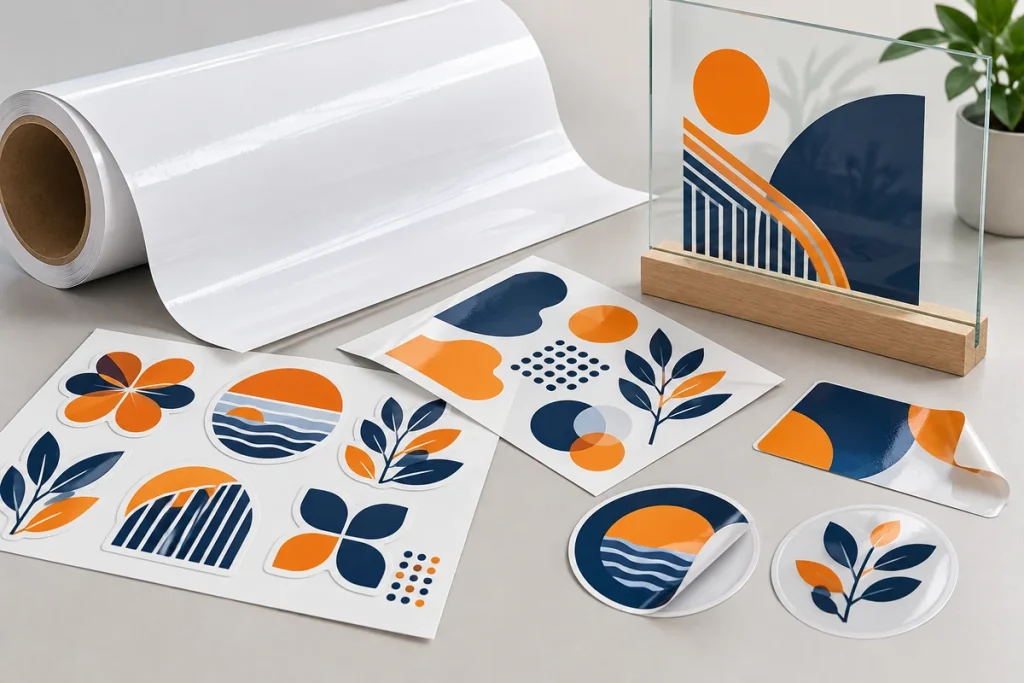
Types of decal differ mainly in the base layer: paper base, plastic base, opaque white base, transparent base or mesh base. Applying the wrong type means a faint image, peeling or blocking the view. This article sums up how to tell apart the decal types the In Quảng Cáo Q7 workshop prints every day, so you choose correctly from the start.
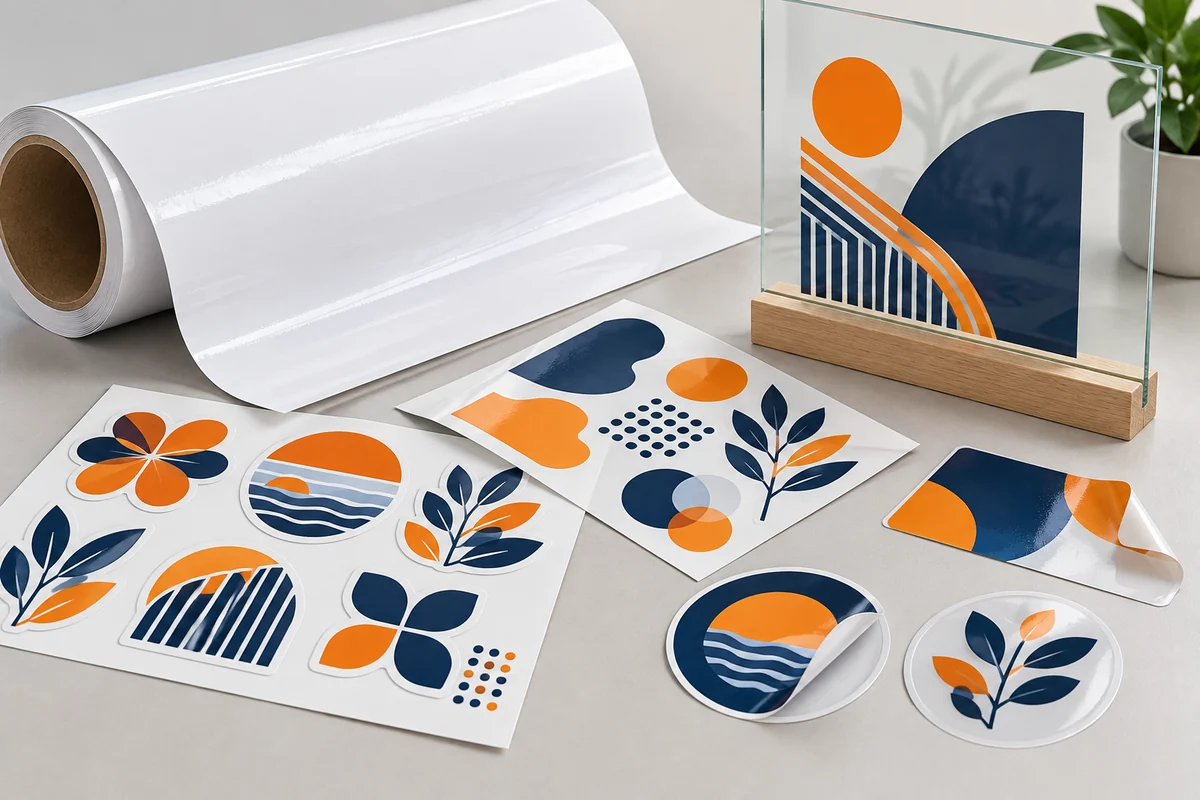
Types of decal by base material
- Paper decal — paper face, the most affordable, used indoors: product labels, seal stickers, box labels.
- Plastic (PVC) decal — water and sun resistant, used outdoors: vehicle wraps, signboards, exterior walls.
- Black-back decal — a black backing that blocks light, so when applied on a coloured background the image does not let the background show through.
How milky white, clear and mesh decals differ
| Type | Features | Suitable for applying to |
|---|---|---|
| Milky decal | Opaque white base, hides the background behind | Glass doors that should hide the inside, bottle and jar labels |
| Clear decal | Transparent base, only the inked parts are visible | Glass doors that keep the view, plastic cups, clear boxes |
| Mesh decal | Tiny holes: the image is seen from outside, while you can still see out from inside | Vehicle windows, building glass facades |
These are the 3 types most often confused among window decals. A quick rule: need to screen → milky white, need to keep the view → clear, need one-way vision → mesh. Details of each material are in the article Advertising decal .


Choosing decal by where it is applied
- Product labels and packaging labels: paper decal, or plastic decal if it gets wet — see labels.
- Decorating venue glass doors: milky white or clear decal; the workshop applies on site according to the premises.
- Vehicle decals and outdoor advertising signs: laminated plastic decal for lasting colour.
- Logos cut to shape: decal cutting die-cut tightly along the edge of each label.
Printing prices and lead times
Digital decal in small sizes printed from 4.000đ/sheet, collected fast within the day; large-format decal from 50.000đ/m²; decal cutting from 95.000đ/m². Prices follow quantity — the more you print, the better the unit price. For urgent orders, send files early via Zalo 0866.511.099 (Phone/Zalo) so we can schedule the machine.
Contact 0866.511.099 (Phone/Zalo) or visit the workshop at 49 Mai Van Vinh, Tan Hung Ward, Ho Chi Minh City. Production and delivery: Monday – Saturday, 8:00–12:00 and 13:00–18:00. Consultation & orders via Zalo/hotline: Monday – Saturday 8:00–12:00 and 13:00–20:00, Sunday 14:00–19:00.
View directions to the workshop on Google Maps
Frequently asked questions
Among the types of decal, which looks best on glass doors?
It depends on the purpose: if you want customers to see through, choose clear decal; to hide the interior, milky white decal; for large shopfront glass needing one-way vision, mesh decal.
Can decals be laminated?
Yes — gloss or matte lamination helps resist scratches and keeps colours longer, recommended for decals applied outdoors.
Do you print small quantities?
Yes. Digital decals print from a single A4 sheet; large-format decals are printed at exactly the area needed.
Some images on this page are illustrations.
Quick lookup table by surface and period of use
The table below gathers the types of decal the workshop prints in one place for quick lookup by the surface it will go on and the intended period of use. Those two pieces of information are enough to settle the material.
| Type | Applied to | Period of use | Visible characteristics |
|---|---|---|---|
| Milky decal | Glass, Alu, painted walls, coated wood | 2 to 3 years indoors | Opaque white base, blocks light |
| Clear decal | Glass | 2 to 3 years | Transparent base, see through the unprinted parts |
| Frosted one-way decal | Shopfront glass | 2 to 3 years | Can see out from inside, not in from outside |
| Mesh decal | Large glass, doors opened a lot | 1 to 2 years | Small holes, breathable, mesh visible up close |
| Paper decal | Boxes, packaging, indoor labels | Under 1 year | Paper surface, can be written on with a ballpoint |
| PVC plastic decal | Any flat surface | 2 to 3 years | Flexible, can bend to curved surfaces |
| Reflective decal | Direction signs, vehicle decals | 3 years or more | Catches vehicle headlights in the dark |
| Floor decal | Tile floors, stone floors | 1 to 3 months | Matte anti-slip coated surface |
| Easy-peel decal | Glass, painted walls | Under 6 months | Peels off without adhesive residue |
| Imitation metal decal | Name plates, machine labels | 3 years | Metallic finish, looks like stainless steel |
Among the types of decal in the table above, the three lines run most are milky white decal, clear decal and PVC plastic decal. The others are used for specific situations, such as mesh decal for glass doors opened constantly or floor decal for short promotions.
Related products

Decal application

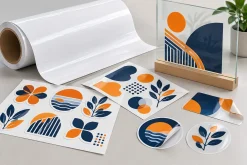
Decal

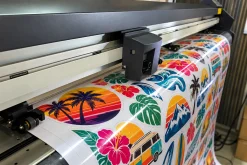
Decal cutting

Fast Printing
Adhesive layer and re-peelability
The adhesive layer is the part few people see, but it decides how long the applied panel holds and whether it leaves marks when peeled.
| Adhesive layer | Adhesion | When peeled | Used for |
|---|---|---|---|
| Strong adhesive | Very high | Leaves adhesive, needs remover | Signboards, machine labels, long-term decals |
| Standard adhesive | Height | Leaves a little adhesive | Most ordinary orders |
| Removable adhesive | Medium | Leaves no adhesive | Short campaigns, decals on rented premises |
| Air-release adhesive | Height | Like standard adhesive | Large areas; helps squeeze out all air bubbles |
| Clear adhesive | Height | Leaves a little adhesive | Clear decal on glass, without cloudy adhesive colour |
| Grey light-blocking adhesive | Height | Leaves adhesive | Applied over surfaces with an old image that needs covering |
Grey light-blocking adhesive is the solution when customers need to apply a new panel right over an old one without removing it. The grey layer in the middle stops the old image showing through the new panel, especially with light backgrounds.
Roll widths and how area is calculated
The chargeable area is the area of material actually used, and the roll width decides the waste. The list below shows the calculation applied to every material line.
- Common roll widths are 0.91 m, 1.07 m, 1.27 m and 1.52 m.
- Take the finished length and width, and match one side against the nearest roll width.
- The leftover roll width is still charged, so sizes that divide evenly are clearly cheaper.
- Panels wider than the largest roll width must be joined, with a 1 cm overlap at the seam.
- Decals cut to an outline are charged by the rectangle enclosing the shape, plus cutting labour.
- Small labels printed many to a sheet are charged by number of sheets, not label by label.
- Lamination is charged on the same area as printing.
When a panel size ends up with a lot of waste, the solution is to adjust the measurements slightly to divide evenly on the roll width, or combine several small panels into one print run. The workshop works out both options and replies with the figures so customers can compare for themselves.
Finishing after printing
After printing, the panel goes through a few finishing steps. Each step changes durability and how it is applied, so this part must be settled at the same time as choosing the material.
- Matte lamination: scratch-resistant, reduces glare, and the surface can still be written on with an oil-based marker.
- Gloss lamination: deeper, fresher colour and better water resistance, but glares under lights.
- Anti-slip lamination: mandatory for floor decals.
- Cutting to an outline with a plotter: cuts along the line drawn in the file.
- Kiss cutting: cuts only the face layer, keeping the backing, used for labels peeled one by one.
- Hole punching and corner rounding: for product labels.
- Mounting onto Formex or Alu: makes a rigid panel that can stand, with no need to apply to a wall.
- Edge wrapping: folding the panel edge so it cannot be peeled, used for panels applied long-term outdoors.
Cutting to an outline needs a cut line drawn in advance on a separate layer in the file. Without a cut line, the order waits an extra day for the workshop to redraw it to the shape, and the redrawn line may not match the design's intention completely.
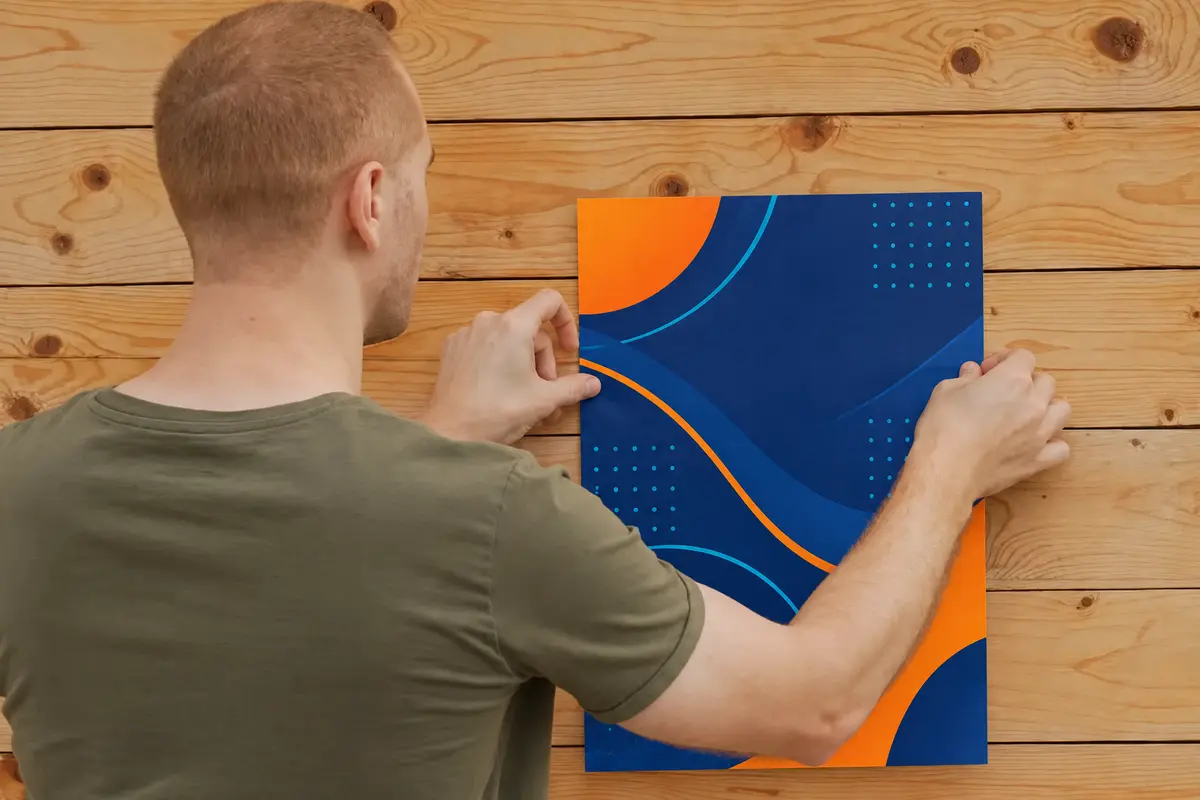
Basic applying and peeling technique
Applying is not difficult, but a few steps must not be skipped. The list below applies to medium-sized panels within reach.
- Clean the surface and wait until fully dry; fine dust left behind becomes bumps under the panel.
- Fix one edge with masking tape as a hinge, and align it straight before peeling the backing.
- Peel the backing gradually from the fixed edge, squeegeeing from the centre outwards with a plastic squeegee.
- Push air bubbles towards the nearest edge; for bubbles in the middle, prick a small hole with a needle and press down.
- Press the edges and four corners again with a roller after 30 minutes.
- Wait at least 24 hours before wiping water on the surface.
- When removing old panels, heat with a heat gun and peel at a 30-degree angle, pulling slowly and evenly.
For large panels over 2 square metres, there should be two people and a material line with air-release adhesive. This adhesive has micro-channels for air to escape, so large panels go on flat in one go without needle pricking.
Outdoor lifespan by conditions
Outdoor lifespan depends on sun direction and whether it is laminated. The table below shows the real-world levels the workshop has recorded in city conditions.
| Condition | No lamination | Matte lamination | Glossy lamination |
|---|---|---|---|
| Indoors, no direct sun | 3 years or more | 4 years or more | 4 years or more |
| Outdoors under cover | 1.5 to 2 years | 2.5 to 3 years | 3 years |
| Outdoors, facing east or west | 1 year | 1.5 to 2 years | 2 years |
| Outdoors, direct sun all day | 6 to 9 months | 1 to 1.5 years | 1.5 years |
| Floors with heavy foot traffic | 1 month | 2 to 3 months | Not used, slippery |
Red and purple are the two colours that fade first in the sun, whatever the material line. When a panel has a red background and must stand in the sun all day, the solution is to laminate and accept reprinting after about a year, or switch to Hiflex banner if it is large.
Common mistakes when choosing materials
The mistakes below recur when customers choose wrongly among the available types of decal, and most only show up after a few weeks.
| Mistake | Consequence | How to avoid it |
|---|---|---|
| Choosing paper decal for panels applied outdoors | Rots and smudges after the first rain | Use the PVC plastic line for every outdoor position |
| Choosing clear decal for light backgrounds | The surface behind shows clearly, the image looks faint | Use milky white decal when a light-blocking base is needed |
| Choosing strong adhesive for rented premises | Leaves adhesive when peeled and may peel off the paint | Use the removable adhesive line |
| Not laminating floor decals | Slippery and peels after a few days | Use a type with an anti-slip coating |
| Cut line missing from the file | The order is delayed a day to redraw it | Draw the cut line on a separate layer |
| Applying large areas alone | Crooked with many air bubbles | Two people, using the air-release adhesive line |
| Applying onto freshly painted walls | Corners peel within a few weeks | Wait 7 days for the paint to dry |
| Using a red background for panels in the sun all day | Fades within about a year | Laminate, or switch to Hiflex banner if large |
Quick Q&A before ordering
Below are the questions customers often message our workshop about, answered briefly according to what we actually do.
| Question | Answer |
|---|---|
| What is the minimum order? | There is no minimum; even one small panel is printed |
| What is the largest size printed in one piece? | 1.52 m wide; wider panels are joined with a 1 cm overlap |
| Can you print and apply it for me as well? | Yes, the workshop applies on site within the city |
| Can I apply it myself? | Yes for medium sizes; the workshop supplies a squeegee and instructions |
| Is there a type that peels off without leaving adhesive? | Yes, the removable adhesive line, suitable for campaigns under 6 months |
| How is the price calculated | By square metres of material actually used, with starting prices from the list price for each line, plus lamination and cutting |
| How long does it take? | Within the day for flat panels without outline cutting, a few hours extra for cutting |
| Do you print labels in large quantities? | Yes, many labels printed on one sheet and then die-cut or kiss cut |
Ordering decal printing at the workshop
The workshop prints all the types of decal in this article, accepting single panels and large-quantity orders, in the District 7 area and neighbouring districts.
- Tell us what surface it will be applied to and how long it is meant to stay, and the workshop names the corresponding material line.
- Send the file with the cut line if outline cutting is needed, via Zalo.
- Receive the chargeable area and delivery time.
- Pick up at the workshop at 49 Mai Van Vinh, Tan Hung Ward, Ho Chi Minh City or delivery within the city; if applying is needed, book an installation time.
Items in the same group are at decal application, large-format decals, decal cutting and the group advertising printing.
Lines often used by sector
Each sector uses a few fixed lines, because the application surface and period of use in that sector hardly change. The table below follows the sectors the workshop receives most.
| Industry | Lines often used | Where to apply them |
|---|---|---|
| Cafés and milk tea shops | Milky white decal, clear decal | Glass doors, bar counters, fridges |
| Restaurants and eateries | Milky white decal, floor decal | Shopfronts, partitions, entrance floors |
| Spas and salons | Frosted one-way decal | Shopfront glass needing privacy |
| Retail shops | Clear decal, floor decal | Display glass, promotion area floors |
| Clinics | Milky white decal, frosted one-way decal | Room doors, glass partitions, direction boards |
| Furniture showrooms | Clear decal, imitation metal decal | Large glass, product name plates |
| Factories | PVC plastic decal with strong adhesive | Machine labels, rules boards, safety instructions |
| Transport and delivery | PVC plastic decal, reflective decal | Vehicle bodies, truck boxes, auxiliary number plates |
| Company offices | Frosted one-way decal, clear decal | Meeting room glass partitions, entrance doors |
| Event organisers | Easy-peel decal, floor decal | Booth walls, aisle floors, temporary direction boards |
What the first group in the table has in common is that they apply to glass and last a few years, so the milky white and clear lines cover almost all needs. Factories and transport are the opposite, needing strong adhesive and resistance to grease and pressure washing.
Need printing or signage in Ho Chi Minh City?
In Quảng Cáo Q7 runs its own print workshop in Tân Hưng Ward (former District 7), Ho Chi Minh City, producing and installing signage, banners, window graphics, exhibition booths and event displays. Send us the size, material, quantity and a photo on WhatsApp and we will get back to you.

Phone: +84 866 511 099 · Also on WeChat
Workshop: 49 Mai Văn Vĩnh, Tân Hưng Ward, Ho Chi Minh City