









































































Our commitments
Printed directly in our workshop, no middlemen
Digital and offset presses right in our workshop. You deal directly with the people who make your order, so every request is understood and handled immediately.
Fast production, many orders ready the same day
Business cards, documents, decals, standees… printed and delivered the same day. See production times for each product group.
One point of contact, all-in-one from file to finished product
Quotes, orders, Zalo messages, delivery booking and invoicing run automatically on one system. Design – printing – finishing – installation all happen in-house, so you don't have to go anywhere else.
Full VAT invoices, issued fast
E-invoices issued right after delivery, with urgent support for businesses that need documents early for payment.
Folder
From 2.440.000 ₫
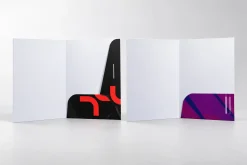
22x31x7cm presentation folder printing on C300 paper. Standard folders or box folders with a spine.
Presentation Folder Printing at Workshop Prices in Ho Chi Minh City
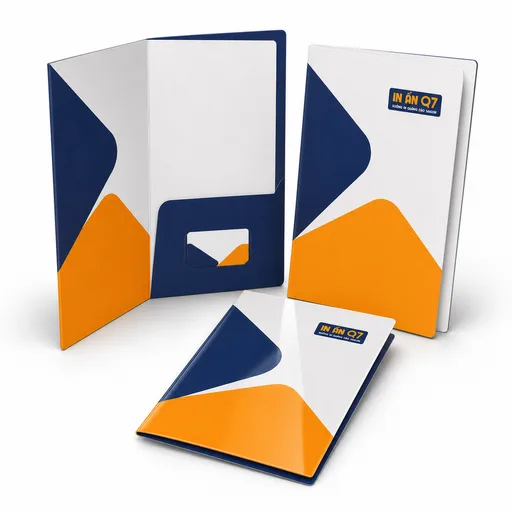
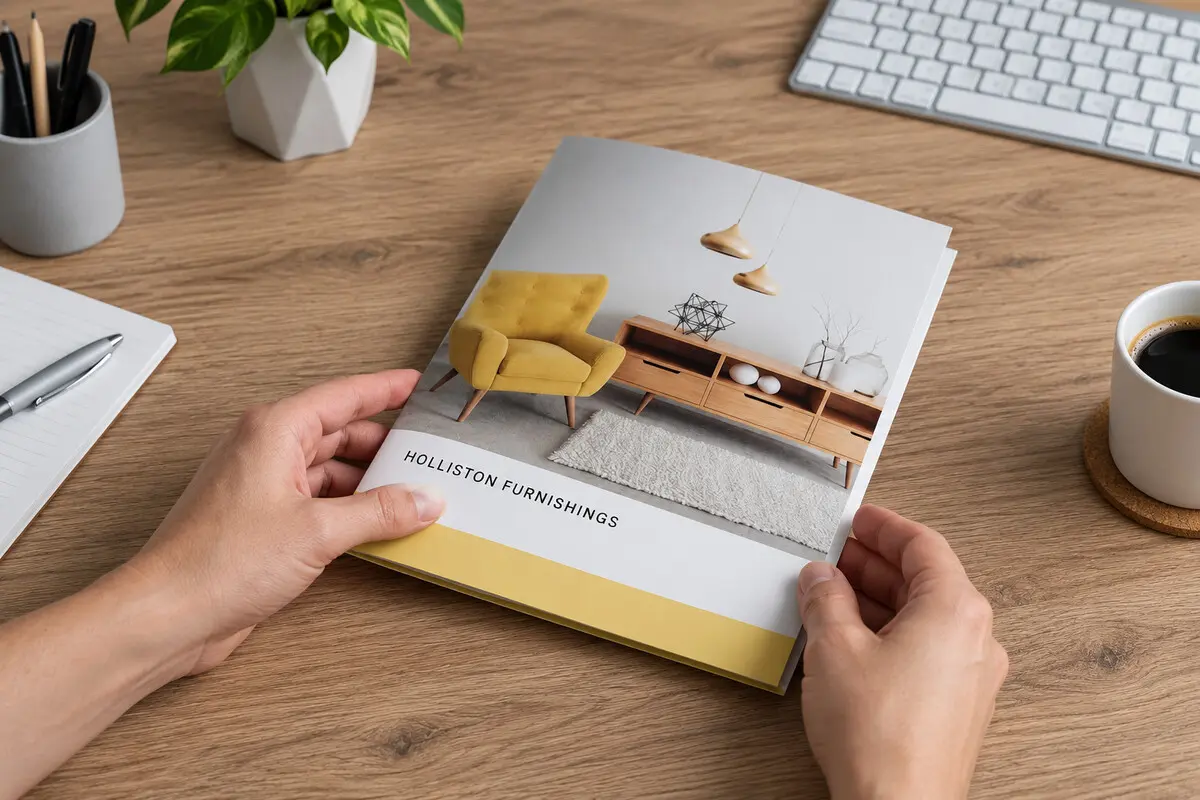
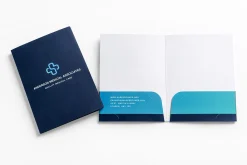
A folder – or presentation folder – is a hard cover folded in half, with pockets inside to hold quotes, contracts and company profiles. When handed to clients, a stack of loose papers becomes a neat document set printed with the company logo. At In Quảng Cáo Q7, presentation folders are printed on C300paper, sized 22 × 31 × 7 cm, with a choice of standard folders or box folders with a spine.
If you're ordering presentation folders for the first time, the section below explains each detail with real photos: pocket styles inside, business card slots, box spines, C300 paper and how matte and glossy lamination differ.
What are presentation folders used for?
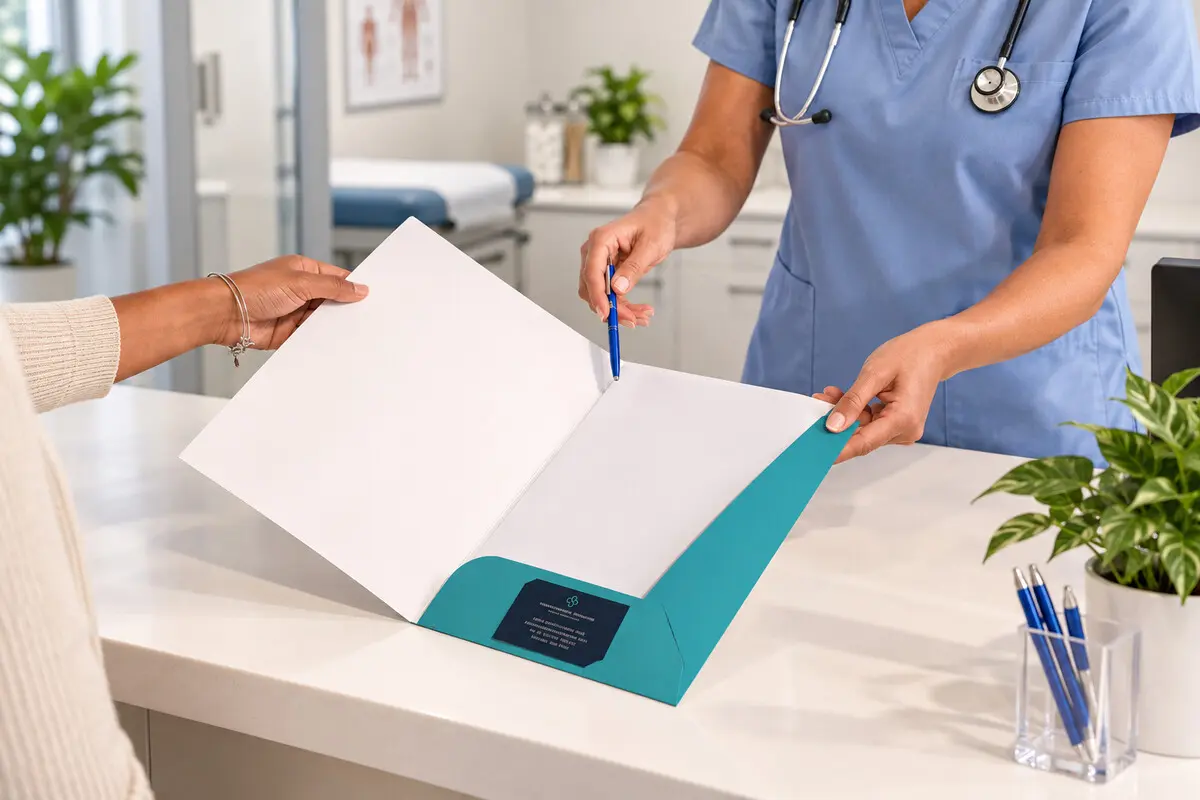
Folders are used whenever documents must “leave the office”: sending quotes to clients, presenting company profiles at a first meeting, handing out materials at seminars, or giving documents to patients, students or investors. The cover keeps paper flat without bent corners, and keeps the company logo in front of the recipient for as long as they keep the set.
That's why presentation folders are usually printed in the same run as business cards, catalogues and letterheads: all share one brand identity, so recipients instantly know which company they're from.
Pocket styles inside the folder
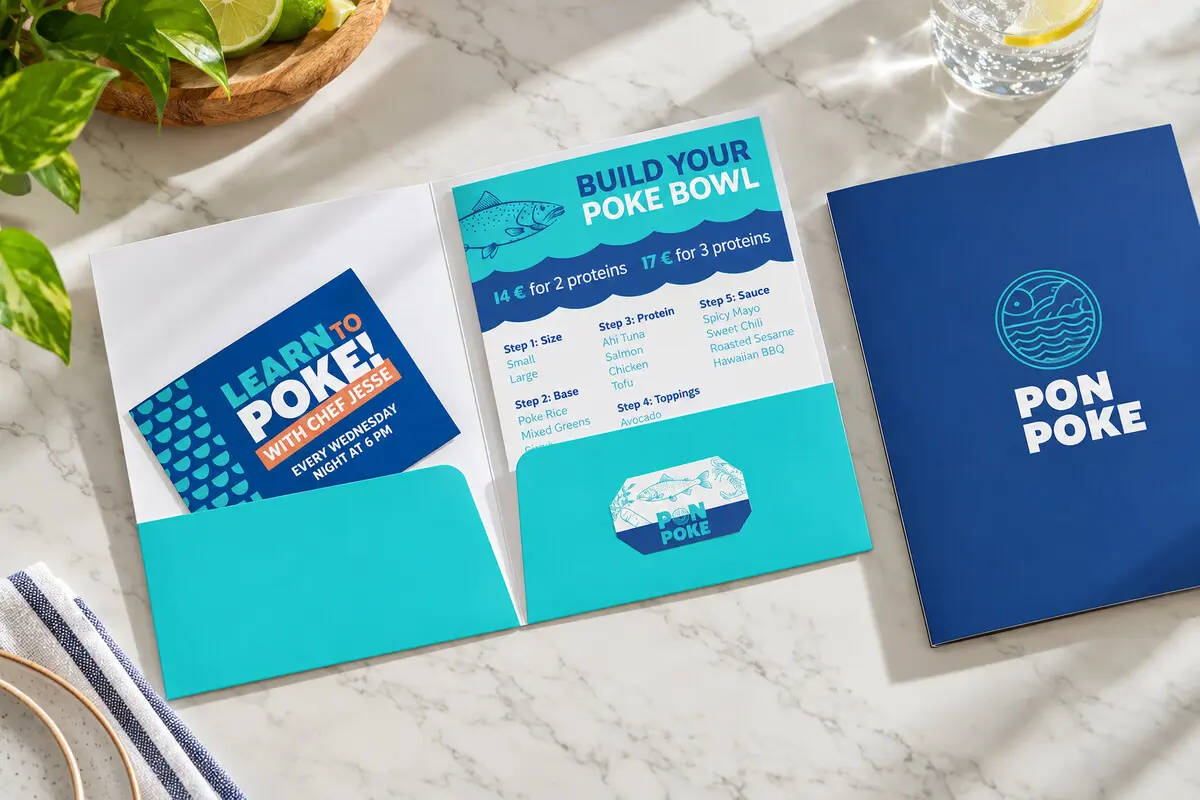
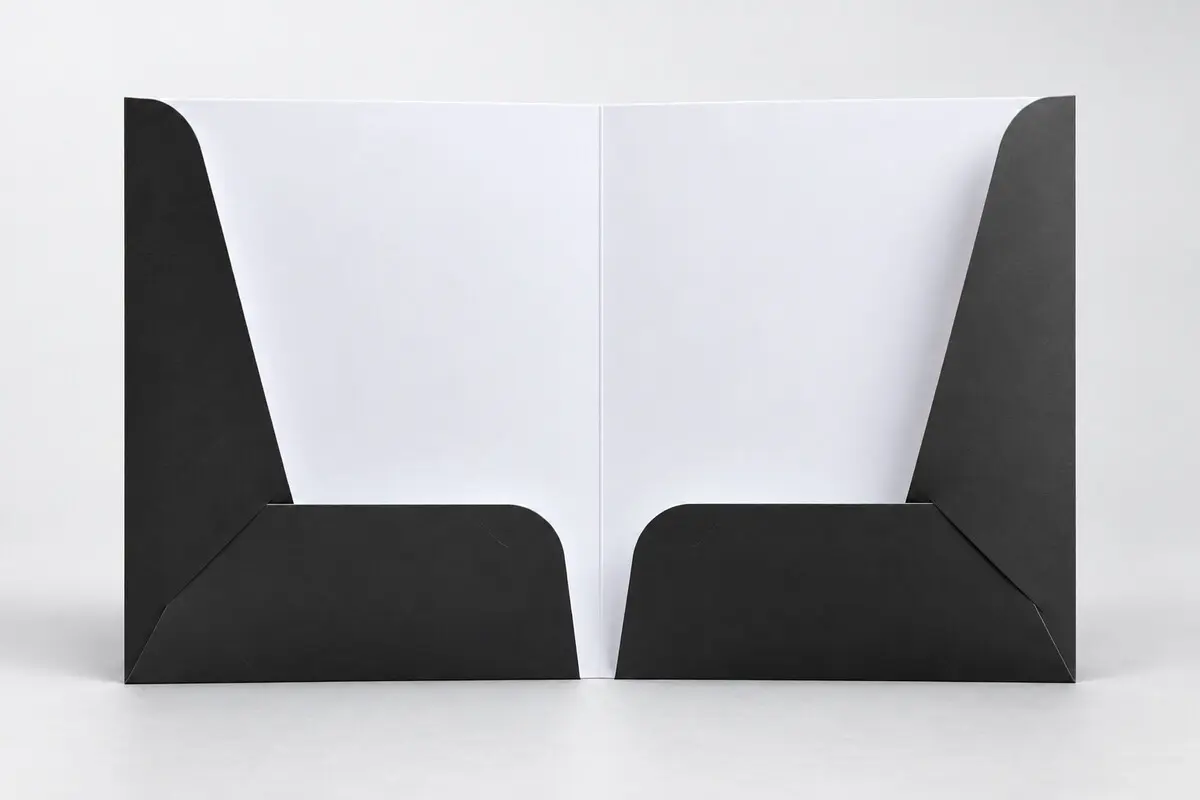
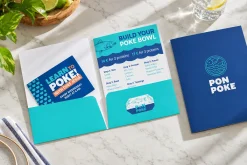
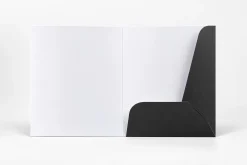
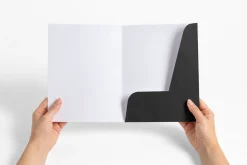
The part customers ask about most is the inside pocket. The pocket is paper folded up from the bottom or side edge to form a compartment holding documents. The pocket style decides how much paper the folder holds and how securely.
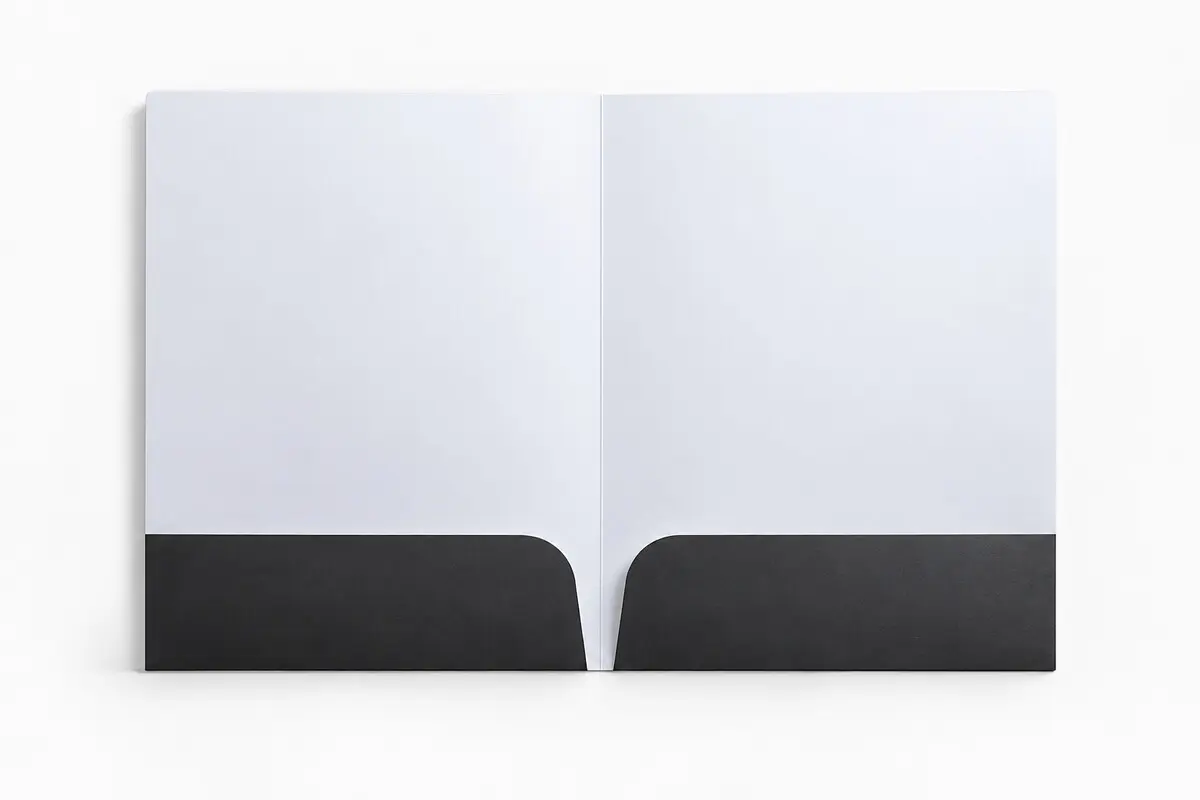
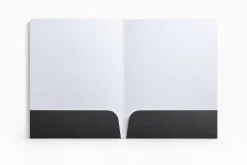
Glued pocket with a rounded edge
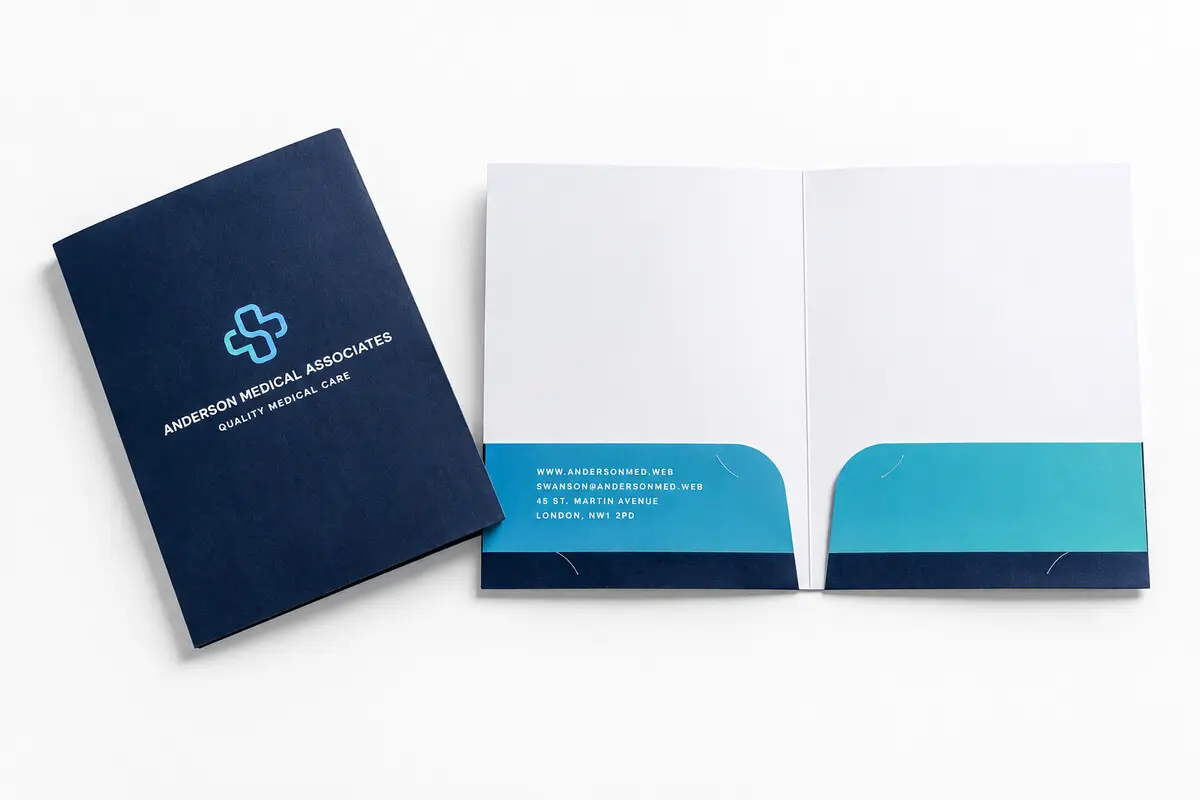
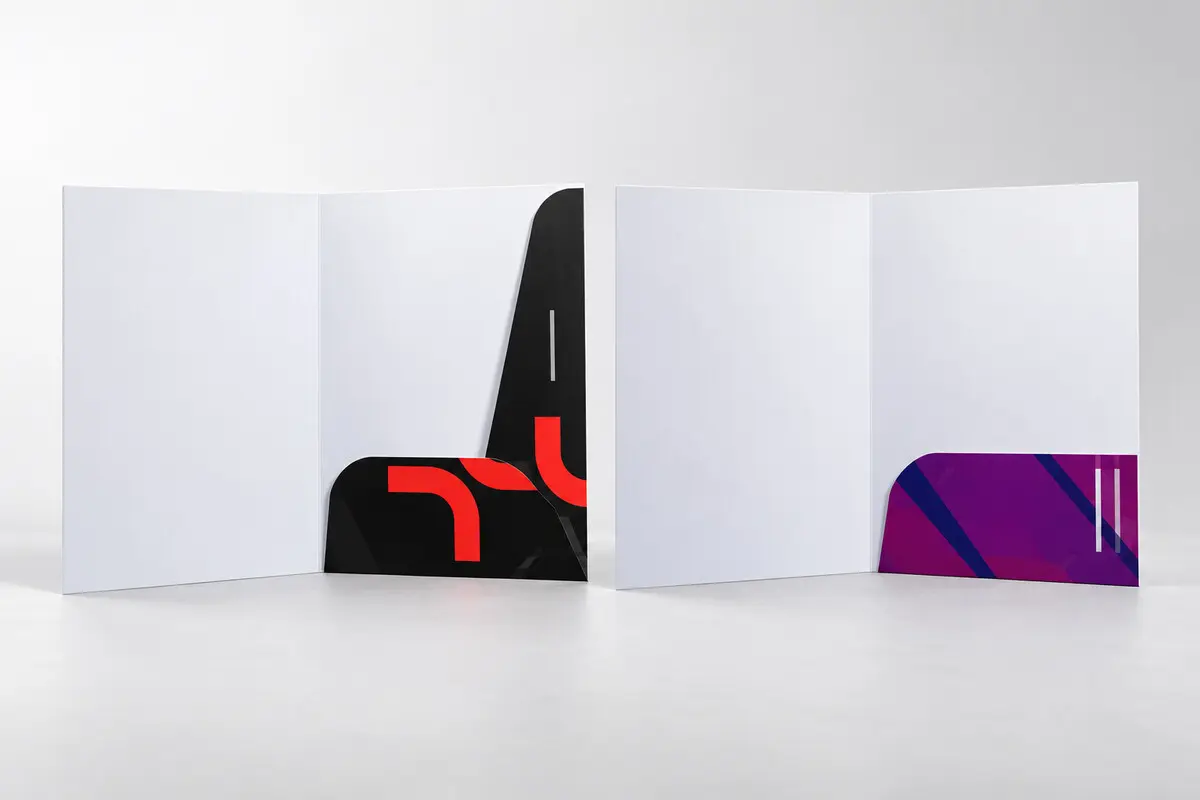
The pocket folds up from the bottom edge, with both ends glued to the cover and a curved pocket opening. This is the most common style because it's easy to produce, well priced and documents slide in and out quickly. Suited to thin sets of about 10–20 A4 sheets.
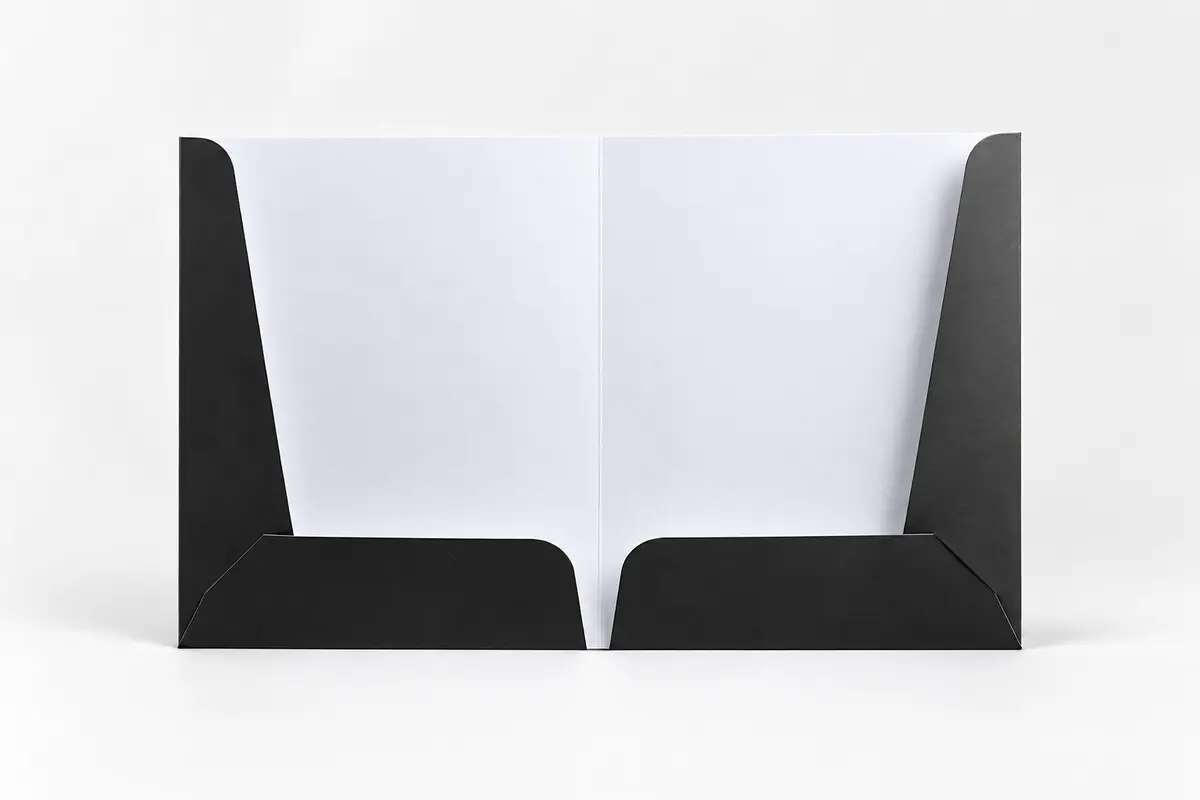
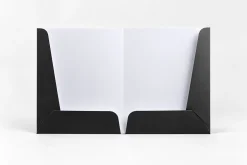
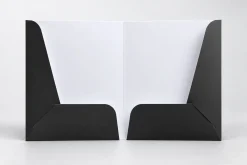
Tuck pocket with side flaps
A taller pocket, with a diagonal flap reaching nearly halfway up the page and side flaps wrapping the document edges. This holds paper far more securely – turn the folder upside down and papers still don't fall out – suited to thick sets and documents carried around a lot.
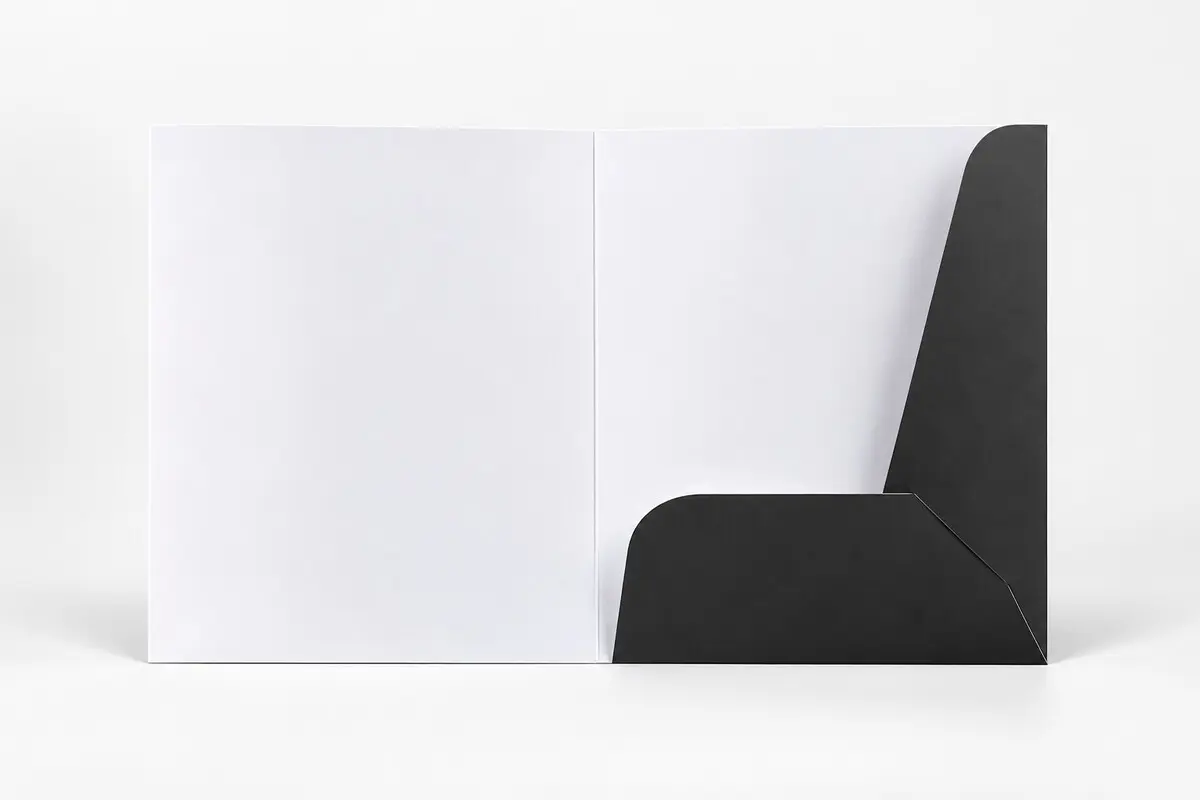
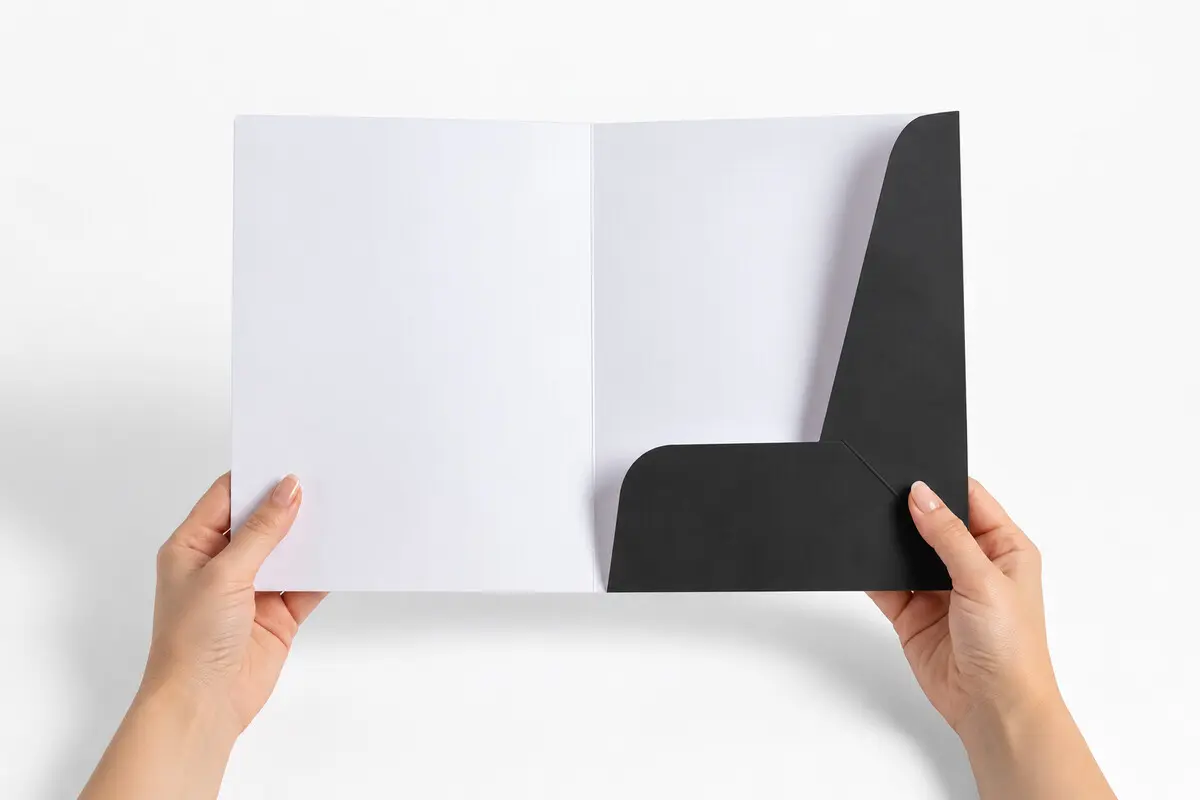
Single-pocket folder
Only one side has a pocket, the other is left plain. This saves paper and makes the folder thinner and lighter, and the plain side can carry an introduction or work process for clients to read as soon as they open it.
Business card slots
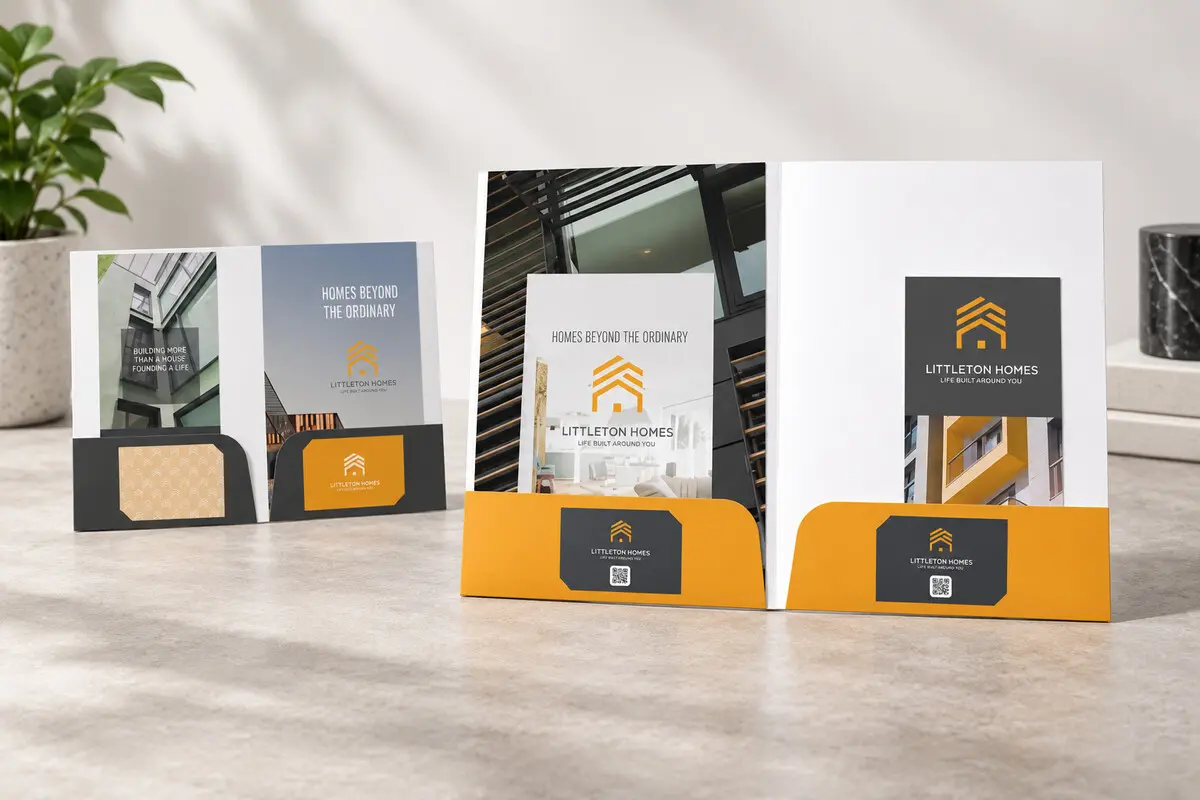
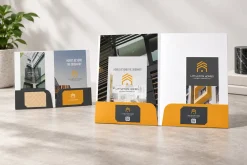
Two small slits can be die-cut on the pocket edge to hold a business card. A tiny but useful detail: the recipient always has the contact person's details without hunting for a loose card.
Standard folders and box folders with a spine
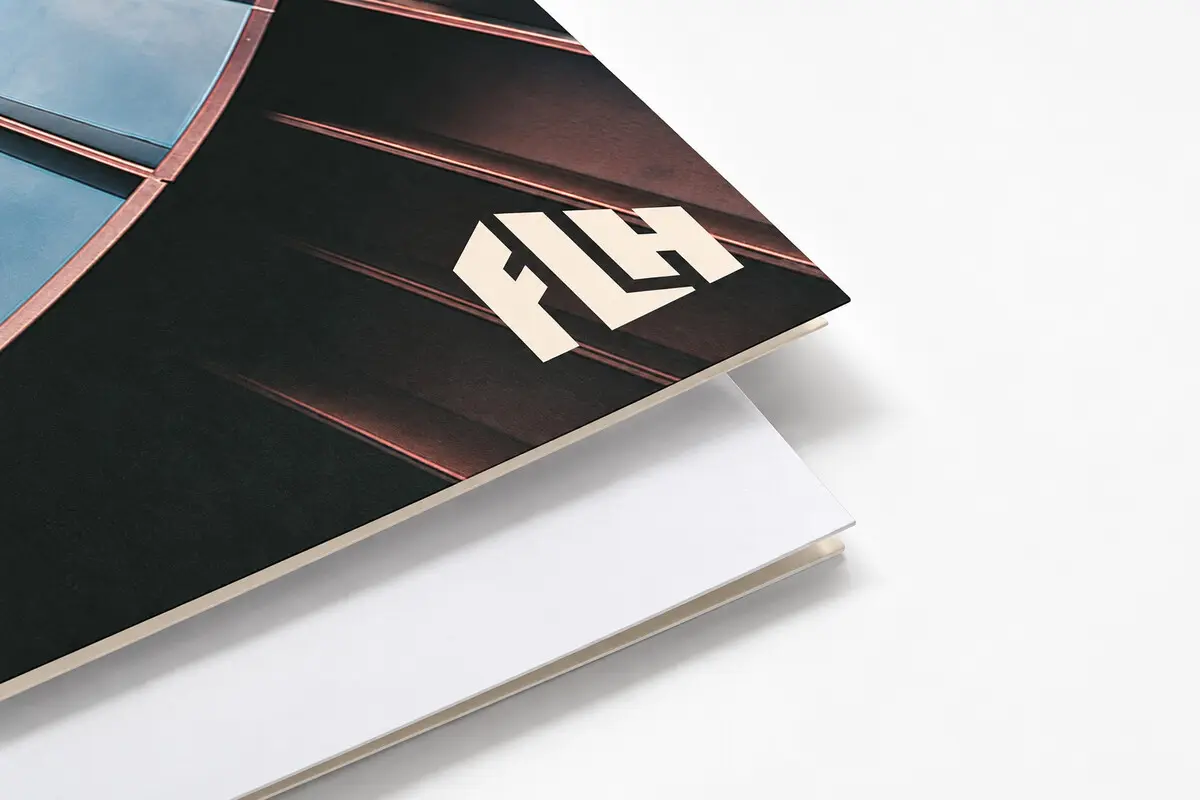
Standard folder simply fold in half, with no spine, lying flat when closed. box folders have extra scored lines forming a spine of about 0.5 cm at the fold and the pocket bottom, so the folder can “expand” and hold thicker document stacks without warping or popping its glued edges.
Choose a standard folder when the set is under 20 sheets. Choose a box folder when you need to hold multi-page contracts, drawings, or include a catalogue, USB stick or material samples.
C300 paper – why this weight?
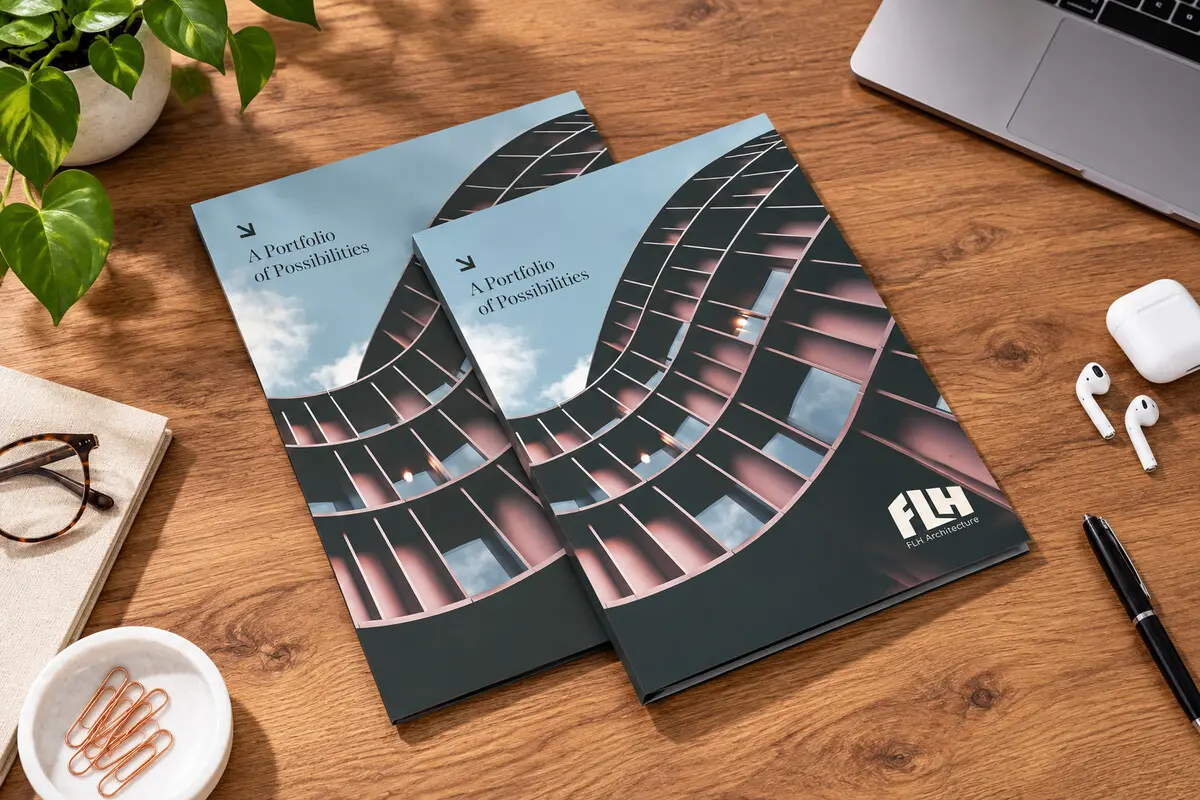
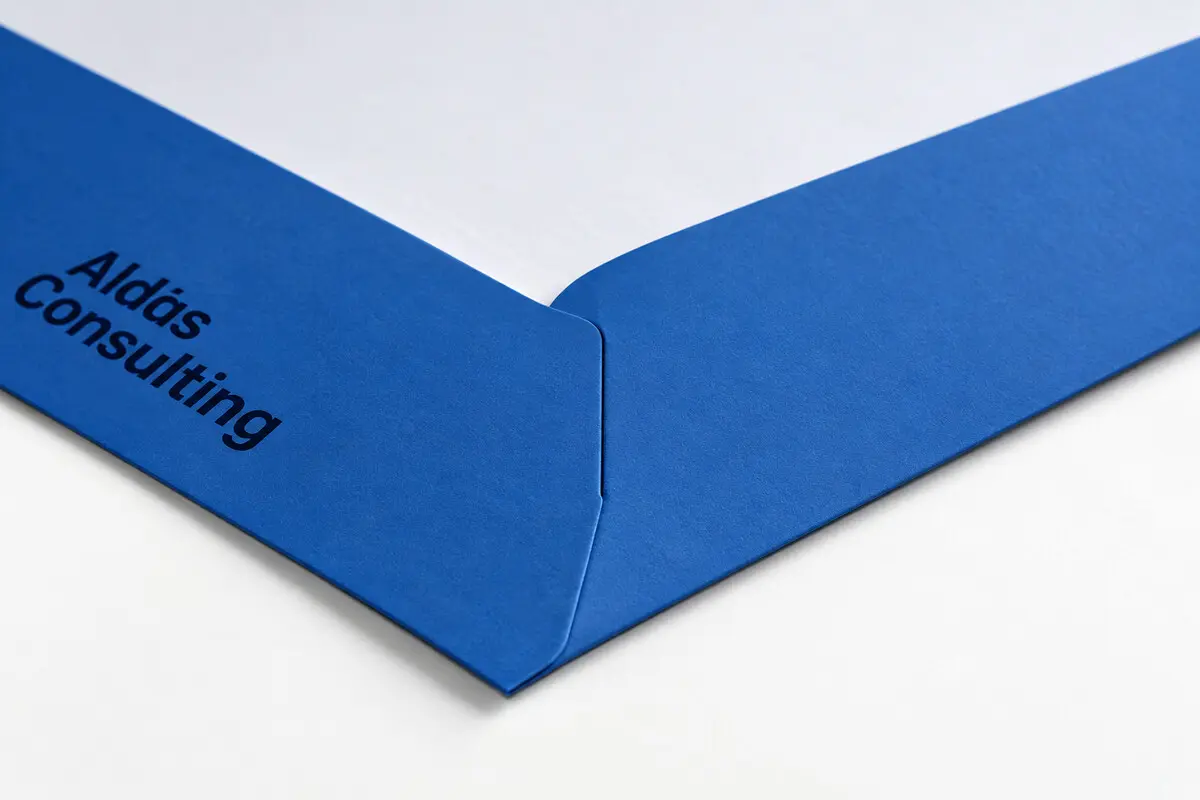
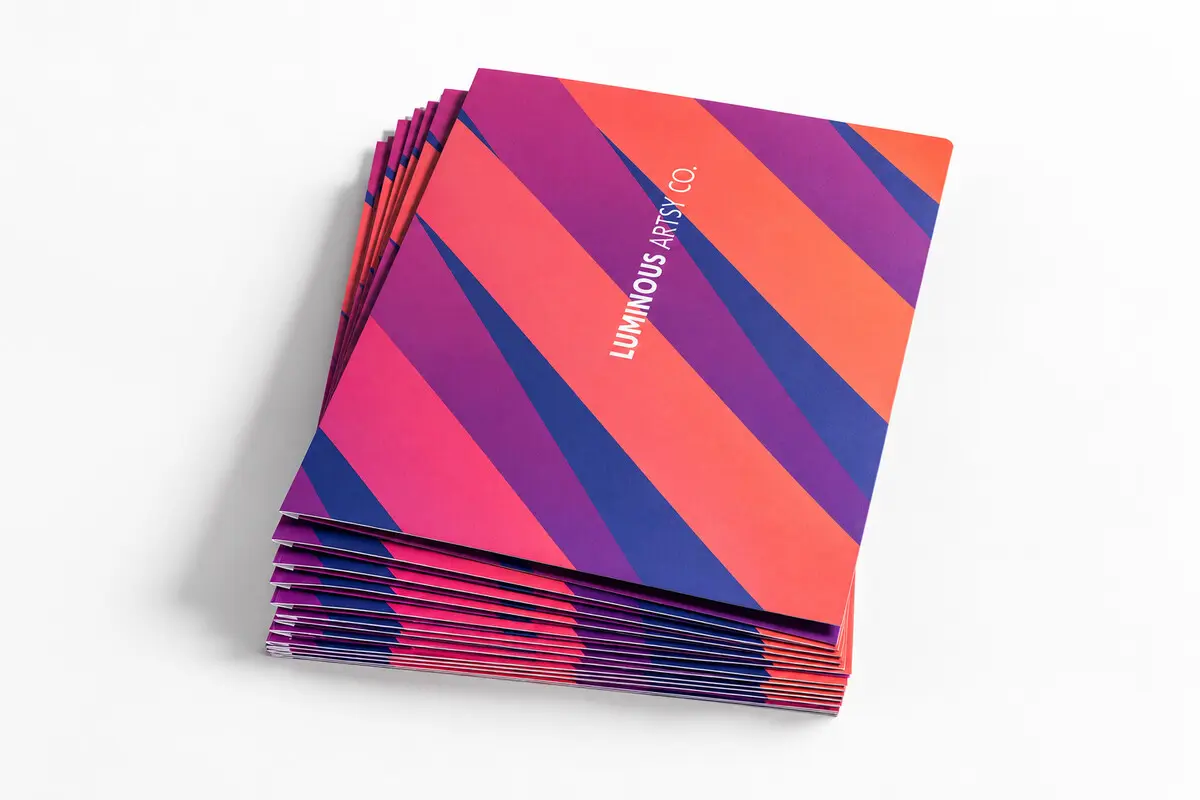
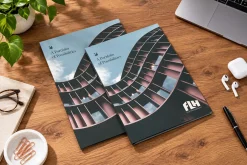
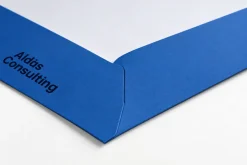
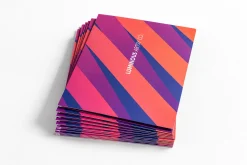
C300 is 300 gsm couche paper, with one smooth side for color printing. It's the thinnest weight at which the cover stays rigid: under 300 gsm the cover is floppy and pockets sag with paper inside; over 300 gsm the cover is stiffer but score lines crack easily and costs rise significantly. The couche surface prints sharp colors, especially for full-bleed designs like the sample below.
How do matte and glossy lamination differ?
Lamination is a thin plastic film pressed onto the paper surface after printing. For folders, this film is almost essential since covers are handled constantly – without lamination, ink scratches and paper stains easily with damp hands.
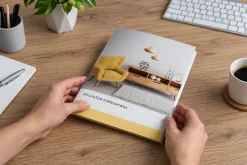
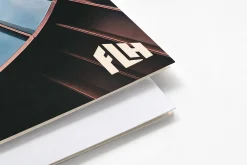
Matte lamination gives a non-glossy, non-reflective surface, velvety to the touch, with a muted, premium look. This is the choice for most company profiles and folders in architecture, law and healthcare. Glossy lamination gives a mirror-like surface with more vivid, deeper colors, suited to image-heavy designs, warm colors, and food and retail businesses. It can be applied to one side (outside only) or both sides.
Size and print quantity
The standard size at the workshop is 22 × 31 × 7 cm: slightly wider than A4 (21 × 29.7 cm) so paper fits inside without the edges sticking out, with 7 cm being the pocket height. Print quantities come in tiers of 200 – 500 – 1.000 – 2.000 – 5.000 sets; the more you order, the lower the price per set, since plate and cutting die costs are spread out.
Production time for presentation folders is 5–7 working days, since after printing they still need lamination, die-cutting, and hand folding and gluing for each set.
What company folders are used for
Company folders, company presentation folders and company A4 document folders are the same product: a hard cover folded in half, printed with the brand identity outside, with pockets inside holding loose A4 sheets. In practice, the stack of documents is no longer a few loose sheets but a document set with the company name on the cover.
- Presentation folders for quotes – multi-page quotes with specification sheets, handed to clients at meetings.
- Contract folders – contracts and appendices, kept flat when taken for signing.
- Company profile folders – when profiles are printed as loose sheets rather than bound, or to hold copies of certificates alongside the profile booklet.
- Seminar handout folders – one set per guest with the program, flyers and note paper, laid out on the tables.
A quote for presentation folders appears right on this page once you choose the folder type, lamination and quantity; from 2.440.000đ for the smallest tier.
Folder specifications: paper, lamination and quantity
The finished product is a 22x31x7cm presentation folder — 22cm wide, 31cm tall, with a 7cm-deep pocket — enough for A4 stacks without folding the edges. Everything runs on 300gsm couche paper, commonly called C300: stiff enough to form pockets while still folding to crisp creases.
Two body styles: standard folders without a spine are a flat folded cover, suited to thin document sets; 0.5cm box spine folders add a central spine strip so they open into a box, holding thicker stacks.
The inside pocket style is chosen when sending the file: single glued-pocket folders have a pocket on one side only, with the other side plain; two-tuck-pocket folders have side flaps supporting documents so paper doesn't fall out when tilted; rounded-pocket folders have curved pocket openings to avoid scratching hands; folders with business card slots have a small slit on the pocket edge to hold the contact person's card.
Lamination has four levels, and the lamination decides the smallest quantity tier available:
| Lamination | Surface | Quantity tier |
|---|---|---|
| 1-side matte laminated folders — C300 matte-laminated folders | Non-glossy outside, no fingerprints | From 200 pieces (standard folders only) |
| 2-side matte laminated folders | The inside is also non-glossy, resisting scratches when papers are pulled out | From 200 pieces (standard folders only) |
| 1-side glossy laminated folders — C300 glossy-laminated folders | Mirror-like outside, deep colors | From 500 pieces |
| 2-side glossy laminated folders | Glossy inside and out | From 500 pieces |
200 folders is the smallest tier on the page, available for matte-laminated standard folders. 500, 1,000 and 2,000 folders are open for all combinations, including 0.5cm box spine folders and glossy lamination. The 5,000-piece tier is the cheapest per piece.
Folder delivery areas
Our workshop is at 49 Mai Van Vinh, Tan Hung Ward, Ho Chi Minh City. Presentation folders for District 7 are delivered to your office as soon as the pockets are glued. Folders for District 8 and Trung Son go across the Nguyen Van Cu or Pham Hung bridges. Company folders for District 1 and District 4 go via Nguyen Huu Tho – Khanh Hoi. Glued folders are quite bulky — a box of 500 takes significant space — so tell us the floor and access in advance so we can arrange a vehicle.
Preparing design files
Folders must be designed on a flat cutting dieline, not on an A4 page. Message us on Zalo 0866.511.099 or email inquangcaoq7@gmail.com, and we'll send the die file matching your chosen pocket and spine style for your designer to build on. We check files for free before printing; if you have no file, In Quảng Cáo Q7 can help with design.
See more guidance at design file submission guide page, or drop by to see material samples in person at 49 Mai Van Vinh, Tan Hung Ward, Ho Chi Minh City.
Folding, die-cutting and gluing folders
After printing and lamination, the cover goes through three more steps to take shape. These steps decide whether the folder opens and closes smoothly with straight edges.
- Die-cutting: a cutting die cuts the outline and the inside pockets to the exact shape.
- Scoring: pressing a groove at the folds so C300 paper doesn't crack the lamination.
- Hand folding: folding along the score lines, smoothing flat, then stacking.
- Gluing pocket edges with PVA or hot-melt glue, leaving a 5mm glue margin.
- Checking each piece: opening and closing once to check whether the scores crack.
The most error-prone step is scoring. Too shallow and the fold goes off-line; too deep and the lamination cracks white along the fold. We run a few test sheets before scoring the whole order.
Common mistakes when ordering folder printing
Most orders that need redoing aren't due to wrong colors, but to files missing bleed or details placed too close to the die line.
- Text or logos placed less than 3mm from the cut line get partly cut off after die-cutting.
- Dark backgrounds without 3mm bleed leave white strips at the finished edges.
- Forgetting to put the die line on its own layer, so the workshop has to redraw it by estimate.
- Using RGB color, which prints paler and off-tone compared with the screen.
- Images pulled from the web, under 150dpi, print grainy.
- Odd quantities under 100 pieces raise the price per piece, since a cutting die is still needed.
Send your file with a PDF preview export, and we'll check the points above and get back to you before running. This adds half a day but avoids reprinting the whole order.
Storage and transport after delivery
Laminated C300 paper is quite stiff, but the folds are still the weak point. Stored the wrong way, they curl at the edges after a month in storage.
- Store flat in stacks, not upright for long periods.
- At most 200 pieces per stack, with carton board above and below.
- Keep somewhere dry, at least 10cm off the floor, away from damp walls.
- Don't place heavy objects or other boxes on top of the stacks.
- For provincial shipping: pack in five-ply carton boxes with foam at both ends.
- Take folders from the top down, not from the middle of the stack.
If you won't use them right away, keep them in the plastic bags we pack them in. Opening the bags early lets the paper absorb moisture, softening the folds and making them curl.
Production time and key milestones
A standard presentation folder order takes three to four working days from file approval. The timeline breaks down as follows.
- Quote: within two hours of receiving the specifications.
- File check and preview: half a day to one day.
- Printing and lamination: one day.
- New cutting die: one extra day; skipped if an existing die is available.
- Die-cutting, scoring, folding and gluing: one day for orders under 1,000 pieces.
- Delivery within the city: on the day of completion or the next morning.
Urgent orders can be shortened to two days if using an existing die and finalizing the file in the morning. Tell us your deadline in advance so we can schedule the machines.
Frequently asked questions
What is the minimum order?
One hundred pieces. Smaller quantities are possible but cost more per piece, since the cutting die and machine setup are spread over fewer items.
Can you make a custom cutting die for my shape?
Yes. A new die takes one extra day and a die-making fee; later orders reuse that die at no extra cost.
Is there a big difference between single- and double-sided printing?
Double-sided adds about twenty percent. The inside is usually printed light or in one color so handwriting on it stays readable.
Can each folder be printed with an individual name?
Yes, using variable data inkjet printing. This is charged separately by the number of names.
Can you use paper thicker than C300?
Yes, we have C350. Thicker paper feels stiffer but the folds need deeper scoring, so we run a few test sheets first.
Order presentation folder printing at In Quảng Cáo Q7
Choose the folder type, lamination and quantity right on this page, then click Ordering; or message us on Zalo / call 0866.511.099 for advice on pocket and spine styles and a quote within 30 minutes during working hours. Our workshop at 49 Mai Van Vinh, Tan Hung Ward, Ho Chi Minh City has real samples for you to try. Production & delivery: 8:00–12:00 & 13:00–18:00 Mon–Sat (closed Sun) · Consultation & orders: 8:00–12:00 & 13:00–20:00 Mon–Sat; 14:00–19:00 Sun.
| Folder type | Standard folder, Box folder (0.5cm spine) |
|---|---|
| Lamination | Matte laminated 1 side, Glossy laminated 1 side, Matte laminated 2 sides, Glossy laminated 2 sides |
| Quantity | 200 pieces, 500 pieces, 1,000 pieces, 2,000 pieces, 5,000 pieces |
| Made at | In Quảng Cáo Q7 workshop – 49 Mai Van Vinh, Tan Hung Ward, Ho Chi Minh City |
| Origin | Vietnam |
| Status | Made to order |
| Warranty | 24 hours from receipt: if you find a printing error or a difference from the approved file, let us know and we will reprint free of charge. |
| Price excl. VAT | 2.440.000 ₫ – 25.630.000 ₫ |
| Price incl. 8% VAT | 2.635.200 ₫ – 27.680.400 ₫ |
Ordering
Three ways to order: choose the specifications and quantity on the website and click Place order; message us on Zalo or call 0866.511.099; or visit the workshop to see material samples at 49 Mai Van Vinh, Tan Hung Ward, Ho Chi Minh City. During working hours, In Quảng Cáo Q7 replies within about 30 minutes. Most products have listed prices by size, material and quantity – prices exclude 8% VAT.
→ Online ordering guide · Quick quote
Sending design files
PDF or AI preferred, CMYK color mode, 300dpi for small formats, 3mm bleed. Send via Zalo, email inquangcaoq7@gmail.com, the form on our website, or a Google Drive link for large files. We check your file for free before printing; if you have no file yet, In Quảng Cáo Q7 can help with the design.
→ Design file submission guide
Payment
Bank transfer, QR code or cash at the workshop. Orders are confirmed and scheduled for production after payment; after transferring, send a photo of the receipt with your phone number via Zalo. Transfer note: Your name – Phone number – Product.
→ Payment guide
Timing & delivery
Completion time is shown on each product, counted from receipt of a print-ready file and payment confirmation. Pick up at the workshop Monday – Saturday, 8:00–12:00 and 13:00–18:00; urgent orders within Ho Chi Minh City delivered within 2 hours; other provinces via bus courier or express delivery. On receipt, please check quantity, size, material and condition of the products.
Order tracking
Enter the phone number used when ordering to see your orders from the last 90 days and their status: Unpaid → Printing → Printed → Delivering → Invoiced → Completed. For orders placed via Zalo, send your name and phone number to get progress updates.
→ Order tracking
E-invoice (VAT)
In Quảng Cáo Q7 issues 8% VAT e-invoices. Provide the company name, tax code, address and email within 24 hours of ordering; the invoice is issued within 24 working hours and sent by email, and cannot be changed once issued.
→ E-invoice (VAT) details
Misprints – reprints
Products that differ from the order or the approved proof are reprinted free of charge – report within 24 hours with photos. Spelling mistakes in a file you approved are not covered by free reprints.
→ Frequently asked questions (FAQs)
Reviews
There are no reviews yet.