




































































Folder Printing District 7 – 22x31x7cm C300, Matte Laminated From 200
Oct
Does your company need District 7 folder printing? This article sets out the 22x31x7cm size, two folder body styles, four lamination levels, inner pocket styles and quantity levels at the In Quảng Cáo Q7 workshop.
Document folder printing right in District 7
Folders are printed items that go through many finishing steps: printing, lamination, die-cutting, folding and then pocket gluing. Each step done at a different place means the goods have to move each time. In Quảng Cáo Q7 does all these steps at 49 Mai Van Vinh, Tan Hung Ward so it can give a specific pickup time.
Customers for District 7 folder printing include consulting firms, real estate companies, clinics and organisations that often hold seminars around Phu My Hung, Tan Hung, Tan Quy and Tan Phong. Folders are used to hold quotations, contracts, capability profiles or materials handed to attendees.
22x31x7cm size and C300 paper
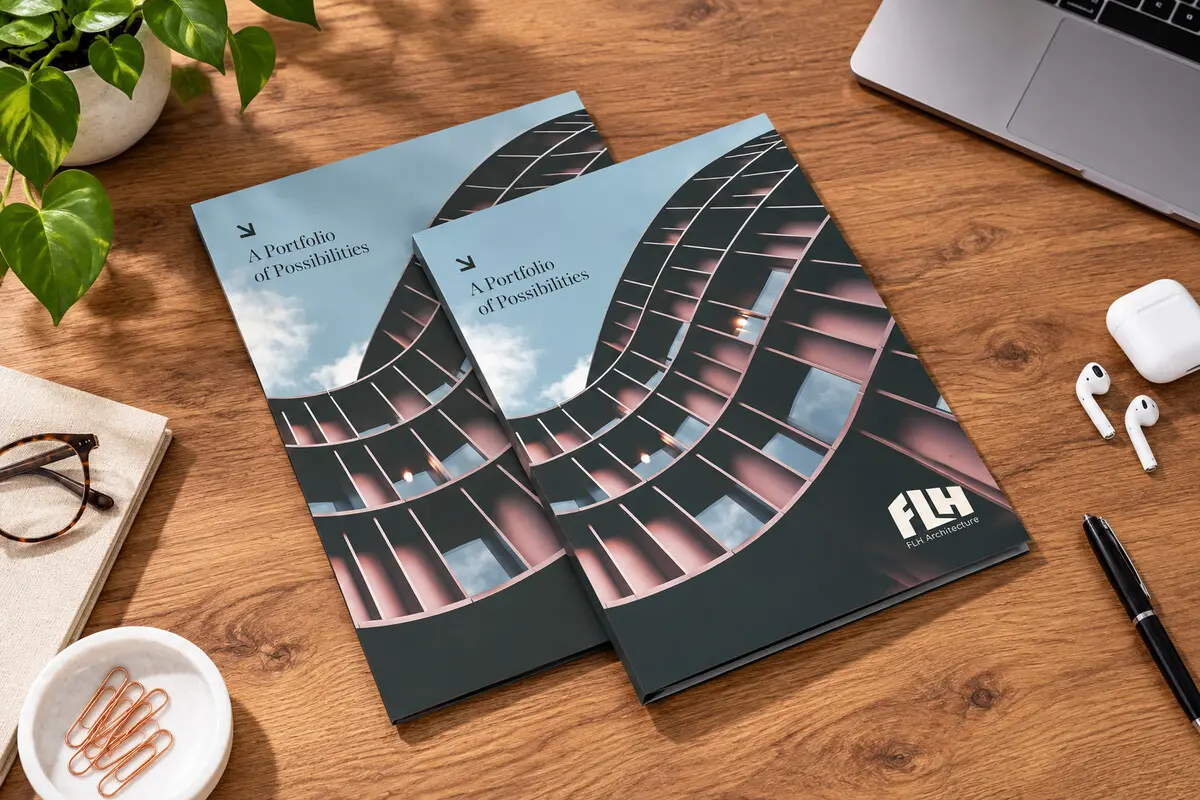
The finished size is 22cm wide, 31cm high, with a 7cm pocket depth – enough for an A4 stack to go in without bending the edges. Everything runs on Couche paper 300gsm, commonly called C300: stiff enough to form the pocket yet still folding into a sharp crease.
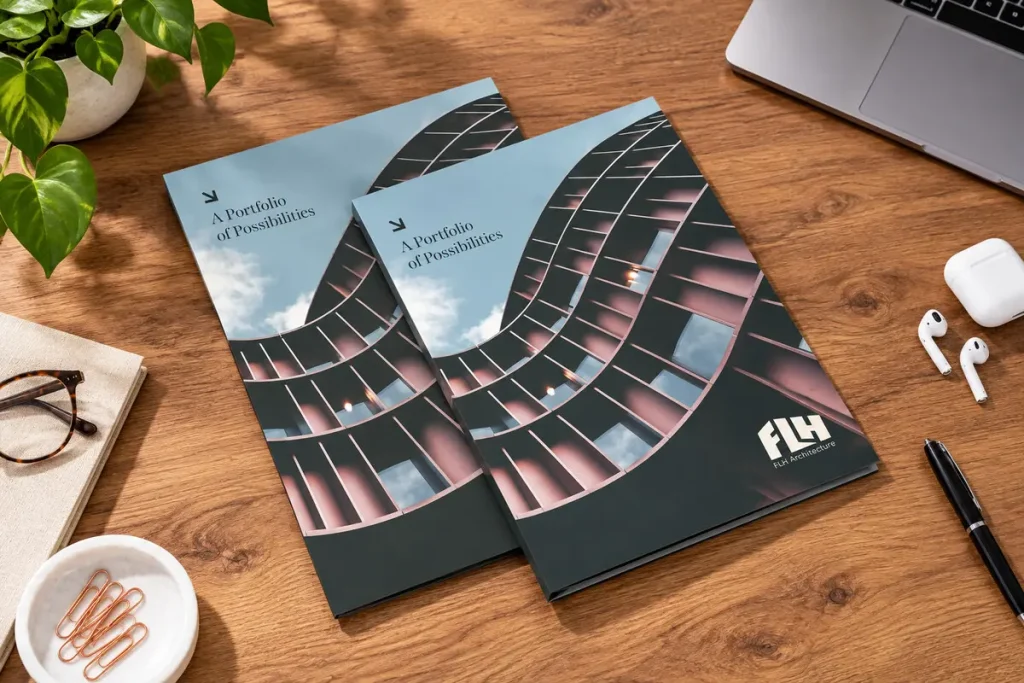
Two body styles: the standard folder is a flat sheet folded in half, suited to thin document sets of about 10–20 A4 sheets; the 0.5cm box-spine folder has an extra spine strip in the middle so it opens into a box, holding a thicker stack while still closing its opening.
Inner pocket styles
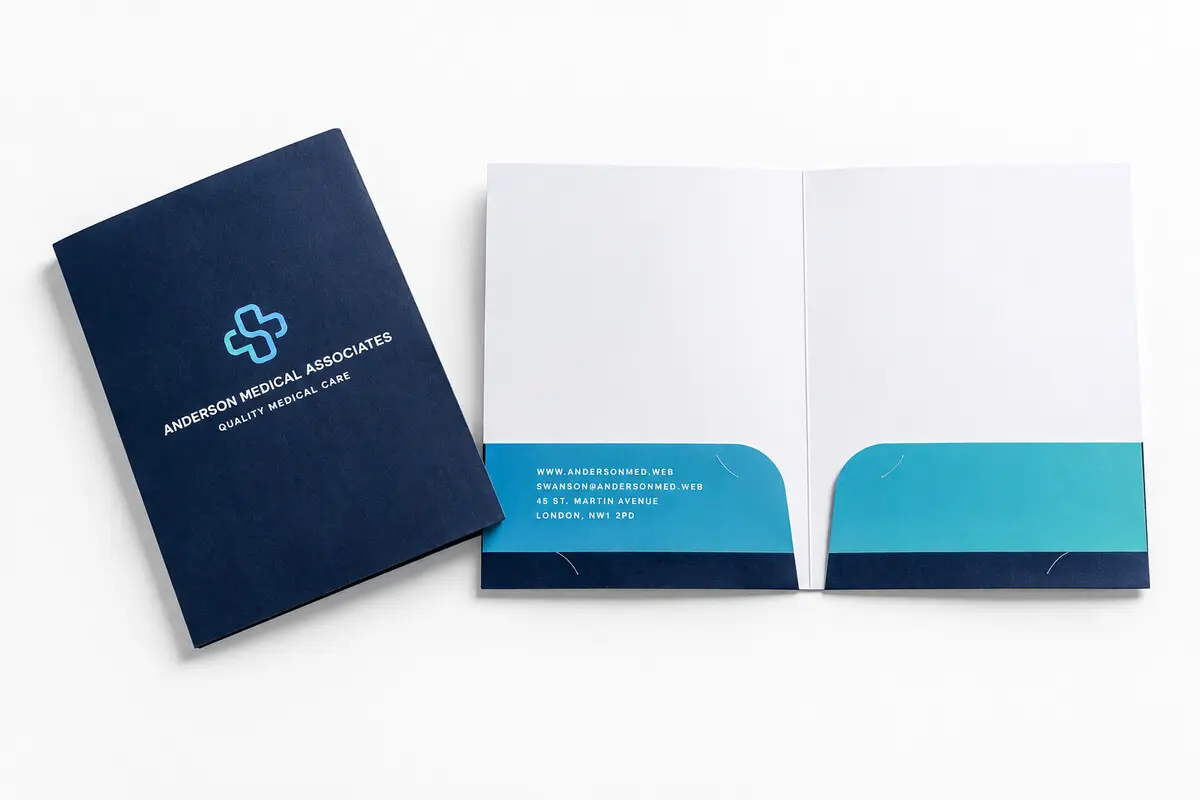
One-pocket folders have a pocket on only one side, with the other side left blank – this saves paper and is often used when the inside is printed with introduction content or a work process for clients to read as soon as they open the cover.
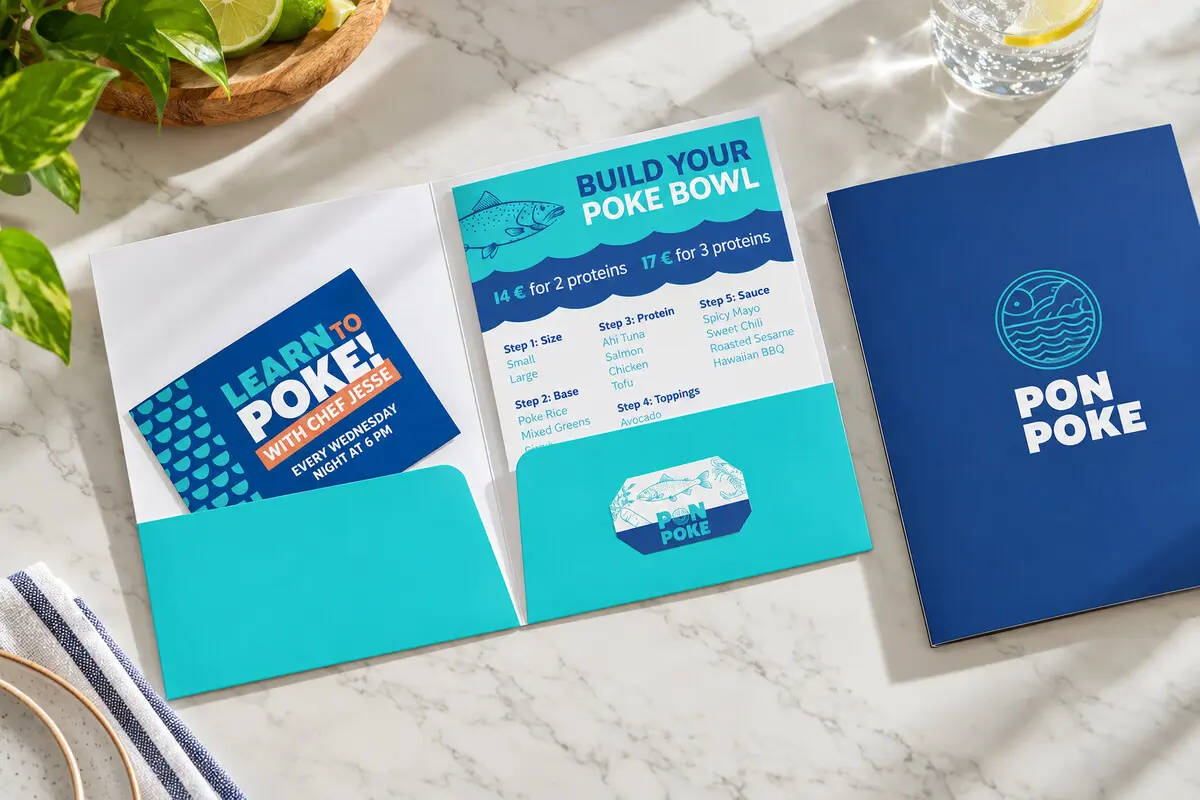
Two-pocket folders with tuck-in flaps have side flaps supporting the documents, with taller pockets cut diagonally upwards so paper does not fall out when tilted – suited to thick files carried back and forth a lot. Two-pocket folders with glued pockets have rounded-corner openings so documents go in and out quickly. The business card slot is a small groove on the pocket opening to hold the business card of the person in charge.
Lamination decides the quantity level
There are four lamination levels: matte 1 side and matte 2 sides give a smooth surface that does not pick up fingerprints; gloss 1 side and gloss 2 sides give deep colours and a mirror shine. The 2-sided version also covers the inside so it resists scratches when paper is pulled in and out many times.
The 200-piece level is the smallest on the page, only available for standard matte-laminated folders. The other combinations – including all gloss-laminated versions and all box-spine folders – start from 500 pieces, then go up to 1,000, 2,000 and 5,000 pieces. From 2.440.000đ for the smallest level.
Frequently asked questions about District 7 folder printing
How long does delivery within District 7 take?
Delivered to your office as soon as the pockets are glued, usually within the day. Folders with glued pockets are quite bulky, so tell us the floor and entrance beforehand so the workshop arranges the vehicle.
What if I need 100 pieces?
The smallest level on the page is 200 pieces for standard matte-laminated folders. If you need fewer, message us on Zalo so the workshop can quote a digital printing and hand die-cutting option.
What does a folder design file need?
The file must be built on the workshop's die-cut template, including the pockets and spine in flat-laid form. Message us on Zalo so the workshop can send the template file before you design, or send the content for the workshop to build it for you.
Order printing at In Quảng Cáo Q7
If your company in District 7 needs document folders printed, message us on Zalo to receive the die-cut template file and a quote by folder type, lamination style and quantity – printed, die-cut, pocket-glued and delivered right within the area.
In Quảng Cáo Q7 direct print workshop – 49 Mai Van Vinh, Tan Hung Ward, Ho Chi Minh City. Production and delivery hours: Monday – Saturday, 8:00–12:00 and 13:00–18:00 · Orders via Zalo/hotline: Monday – Saturday 8:00–12:00 and 13:00–20:00, Sunday 14:00–19:00. Quick message via Zalo or call 0866.511.099.
See more printing services on the In Quảng Cáo Q7 home page, see all corporate print products or contact us quickly via the contact page; you can also get directions to the workshop on Google Maps.
The structure of a folder
A folder is a sheet of thick paper die-cut and then folded into a cover for holding documents. It looks simple, but four details decide whether it is convenient to use: inner size, pocket, business card slot and spine fold.
The inner size must be about five millimetres wider than an A4 sheet in each dimension. Too close and documents inserted get bent at the edges, especially when the set has more than ten sheets or includes laminated sheets.
The pocket is the part folded up at the bottom edge to keep documents from slipping out. A pocket about five to seven centimetres high is the common level; lower pockets let documents fall out when the folder is tipped, higher pockets hide part of the content of the sheets inside.
The business card slot is a diagonal die line on the pocket, used to hold one card. This detail is small but used a lot because clients receiving the folder get the contact information right away.
| Detail | Common size | Role |
|---|---|---|
| Inner size | 225x315mm | Holds A4 without bending |
| 50 to 70mm high | Keeps documents from slipping out | |
| Business card slot | 55mm diagonal | Holds one card |
| Spine fold | 3 to 8mm wide | Holds thick sets |
| Pen slot | Small die line at the edge | Optional, rarely used |
The spine fold is the detail that decides whether the folder can hold thick sets. Without a spine fold it only holds about ten sheets; a spine fold eight millimetres wide holds up to thirty or forty sheets while the cover still closes fully.
Paper and weight for folders
The cover must hold its own shape so the paper needs to be stiff enough. Thin paper makes the cover sag when held in one hand, and the documents inside are not kept flat either.
The common level is Couche paper 300gsm. This weight is stiff enough for standard A4, takes colour well and is reasonably priced. For folders with a wide spine fold to hold thick sets, 350gsm holds its shape better.
Textured fine art paper is used for folders handed to partners, giving a distinctive feel to the touch. This type is ordered separately by paper source so it needs extra time and the smallest quantity level is also higher.
Lamination is an almost mandatory step for this item, because the cover is opened and closed many times and constantly handled. Covers without lamination peel at the corners very quickly, especially at the spine fold.
- Couche paper 300gsm: the common level for A4 folders.
- Couche paper 350gsm: used when there is a wide spine fold or a thick set to hold.
- Fine art paper: used for folders handed to partners, needs ordering in advance.
- Matte lamination: resists fingerprints, smooth to the touch, the popular choice.
- Gloss lamination: more vivid colours but shows fingerprints clearly.
For folders with dark backgrounds, matte lamination is almost the only choice. Dark backgrounds without lamination or with gloss lamination show fingerprints after a few handlings, and the folder handed to clients then looks very old.
Related products

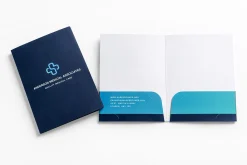
Folder

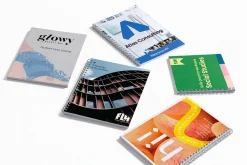
Catalogue – Company Profile

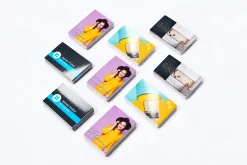
Business cards


Leaflet / Brochure
Sizes and variants
A4 is the standard size and also the cheapest because the cutting die already exists. Other sizes all need a separate cutting die, so the first round has an extra die cost, and this die is kept for later rounds.
A5 is used for folders holding small documents or slips, often seen at clinics and spas. Landscape A4 is less common, used when the documents inside are printed in landscape.
A commonly chosen variant is a folder with two pockets, one on each side, used to separate documents into two groups. This type is convenient when handing over a file with an introduction part and a quotation part, but uses more paper and needs a separate cutting die.
Another variant is a folder with a tuck-in flap, where the top edge folds down and tucks into a slot. This type holds documents most firmly, suited to folders carried around a lot, but is slower to open and close.
| Variant | Features | Needs a separate cutting die |
|---|---|---|
| A4 one pocket | Standard, cheapest | No |
| A4 two pockets | Separates documents into two groups | Yes |
| A4 with tuck-in flap | Holds most firmly | Yes |
| A5 one pocket | Holds slips, small documents | Yes |
| A4 landscape | Used for documents printed in landscape | Yes |
If you are not sure which variant you need, A4 one-pocket with a business card slot is the safe choice. This is also the most used type and has the lowest price in the folder group.
Designing the outside and inside
The outside is what clients see first when handed documents, so it usually only carries the logo and one positioning line. Cramming lots of text on the outside makes the cover look cluttered and ineffective.
The back is for contact information, address and QR code. This is a more sensible place than the front because clients look it up when needed, rather than seeing it every time they hold the cover.
The inside is often left blank in self-designed templates. This part works well for a service catalogue, a process diagram or a specification table, and printing the inside adds almost no cost because the sheet already goes through the machine.
The pocket can be printed too. Many businesses print a thank-you line or a short catalogue on the pocket face, making use of an area clients always see when pulling documents out.
When designing, remember that the spine fold sits between the front and back. Images or text running across this fold will be broken up, so important content needs to be placed away from the fold zone.
Quantity and price levels
This item has a cutting die cost so the price per piece drops very clearly with quantity. The first round with a non-standard size also has an extra die cost, so the quantity level needs to be weighed against whether the design will change during the year.
The smallest level usually ordered is thirty pieces, used by small businesses or for a specific round of client meetings. This level has the highest price per piece but is still accepted as normal because it runs on digital printing.
From two hundred pieces upwards, offset printing starts to pay off and the price per piece drops clearly. Above five hundred pieces the price reaches the lowest range, suited to businesses using folders for the whole year.
| Quantity | Technology | Time |
|---|---|---|
| 30 to 100 pieces | Digital printing | 2 days |
| 100 to 200 pieces | Calculate both ways | 2 to 3 days |
| 200 to 500 pieces | Offset printing | 3 to 4 days |
| Over 500 pieces | Offset printing | 4 to 5 days |
The time in the table includes die-cutting and folding-gluing, two steps done by hand so they cannot be shortened much. For urgent folders, the solution is to receive part first and the rest later.
Folders in the printed set handed to clients
File folders are rarely used alone. They are the outer shell of a set including a quotation, introduction sheet, business card and sometimes a slim brochure. The whole set should be printed in one round so the colours match.
When printed separately at different places or times, small differences in logo shade are still visible when clients open the cover and the sheets inside lie next to it. This is the most common mistake with printed sets made piecemeal.
The order inside should also be consistent: introduction sheet on top, quotation in the middle, appendices at the bottom, business card in the slot. Pre-collating in this order saves the presenter rearranging before the meeting.
- Folder: outer shell, carrying the logo and contact information.
- A4 introduction sheet: placed on top in the pocket.
- Quotation: printed on Fort paper so notes can be written with a pen.
- Business card: inserted into the slot on the pocket.
- Slim brochure: placed at the bottom if any.
Many businesses have the workshop pre-collate the sets and deliver them as complete sets. This adds one step but removes the need for staff to sit and collate documents before each meeting.
Common mistakes in a first folder order
The four mistakes below account for most cases where a round of folders has to be redone. All four show up right away on a die-cut fold mock-up, so the sample approval step should not be skipped.
The first mistake is an inner size too close to A4, so documents inserted get bent at the edges. The second is having no spine fold yet using it to hold a thick set, so the cover does not close fully and springs open.
The third mistake is important images or text running across the spine fold, broken up when folded. The fourth is choosing no lamination to save money, and then the folder peels at the corners after just one month of use.
| Mistake | Consequence | How to avoid it |
|---|---|---|
| Inner size too close to A4 | Documents bent at the edges | Inner size 5mm wider in each dimension |
| No spine fold | Cover does not close fully | Leave a spine fold of 3 to 8mm |
| Content running across the fold | Image broken up | Avoid the fold zone when laying out |
| No lamination | Corners peel after a month | Matte lamination on both sides |
A die-cut fold mock-up is delivered before running a large round, for testing with the real document set. Testing it the way it is actually used gives a much clearer answer than viewing the layout on screen.
Storage and annual usage
This item takes up more space than other paper items because it is already folded into shape, so storage space needs to be considered when ordering large quantities. A carton of five hundred pieces takes up about one cubic metre, not small for offices in high-rises.
What many businesses do is receive enough for a few months and leave the rest at the workshop, receiving in trips when needed. The part stored at the workshop is kept in a dry environment so the lamination does not curl and the corners do not wear.
If storing at the office, keep them upright in a carton rather than stacked flat in layers. Stacking in layers for a long time presses the spine fold flat, and then the cover no longer opens out to hold thick sets.
- Store upright in a sealed carton, in a dry place, away from sunlight.
- Do not stack too high on top of each other because it flattens the spine fold.
- Take out one or two weeks' worth of use, keeping the rest in the carton.
- Receive in trips if the office has no large storage space.
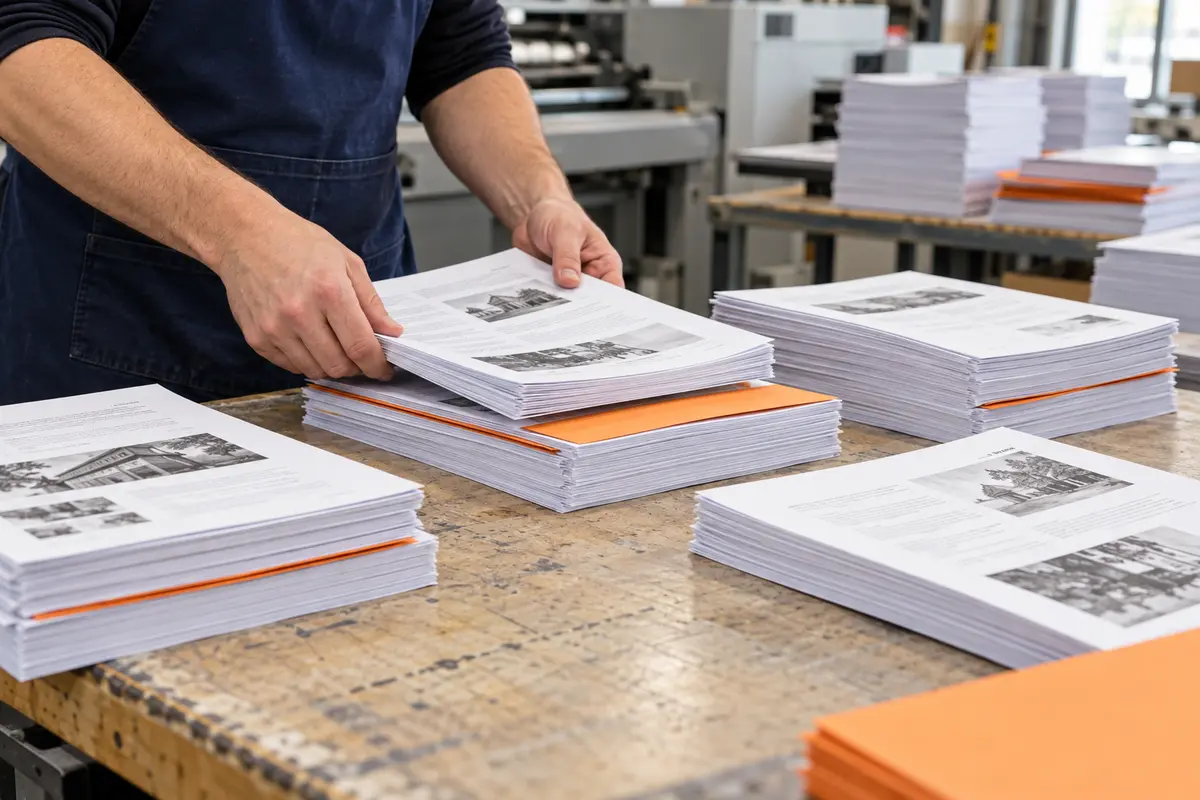
The quantity per round should be calculated by the actual rhythm of client meetings. A business handing over about five document sets a week needs about two hundred and sixty pieces for a year, and that level is also enough to bring the price into a reasonable range.
Delivery and ordering folder printing in District 7
The workshop is right in District 7 at 49 Mai Van Vinh, Tan Hung Ward, Ho Chi Minh City so customers in the district receive goods fast. Folders are packed in cartons by quantity, delivered by motorbike for a few dozen pieces and by small truck for many cartons.
- Information 1: size and variant, one pocket or two, with or without a tuck-in flap.
- Information 2: quantity and paper type, lamination level.
- Information 3: roughly how many sheets the document set will be.
- Information 4: the date you need it and the delivery address.
If you do not have a file, send the logo and content; the layout is done at the workshop and a preview is sent with a die-cut diagram. Send your request via Zalo to receive a quote split into printing, die-cutting and lamination.
Need printing or signage in Ho Chi Minh City?
In Quảng Cáo Q7 runs its own print workshop in Tân Hưng Ward (former District 7), Ho Chi Minh City, producing and installing signage, banners, window graphics, exhibition booths and event displays. Send us the size, material, quantity and a photo on WhatsApp and we will get back to you.

Phone: +84 866 511 099 · Also on WeChat
Workshop: 49 Mai Văn Vĩnh, Tân Hưng Ward, Ho Chi Minh City