




































































Presentation Folder Printing District 8 – Matte C300, 0.5cm Spine
Oct
Does your company need District 8 file folder printing? This article sets out the 22x31x7cm size, two folder body styles, four lamination levels, inner pocket styles and quantity levels at the In Quảng Cáo Q7 workshop.
File folder printing for District 8 businesses
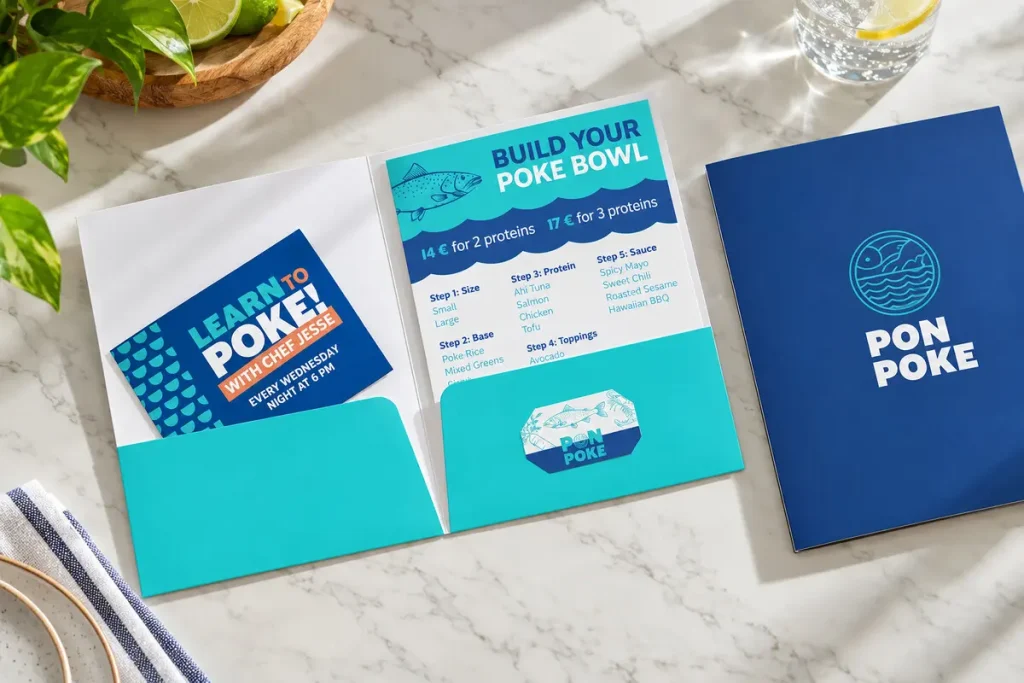
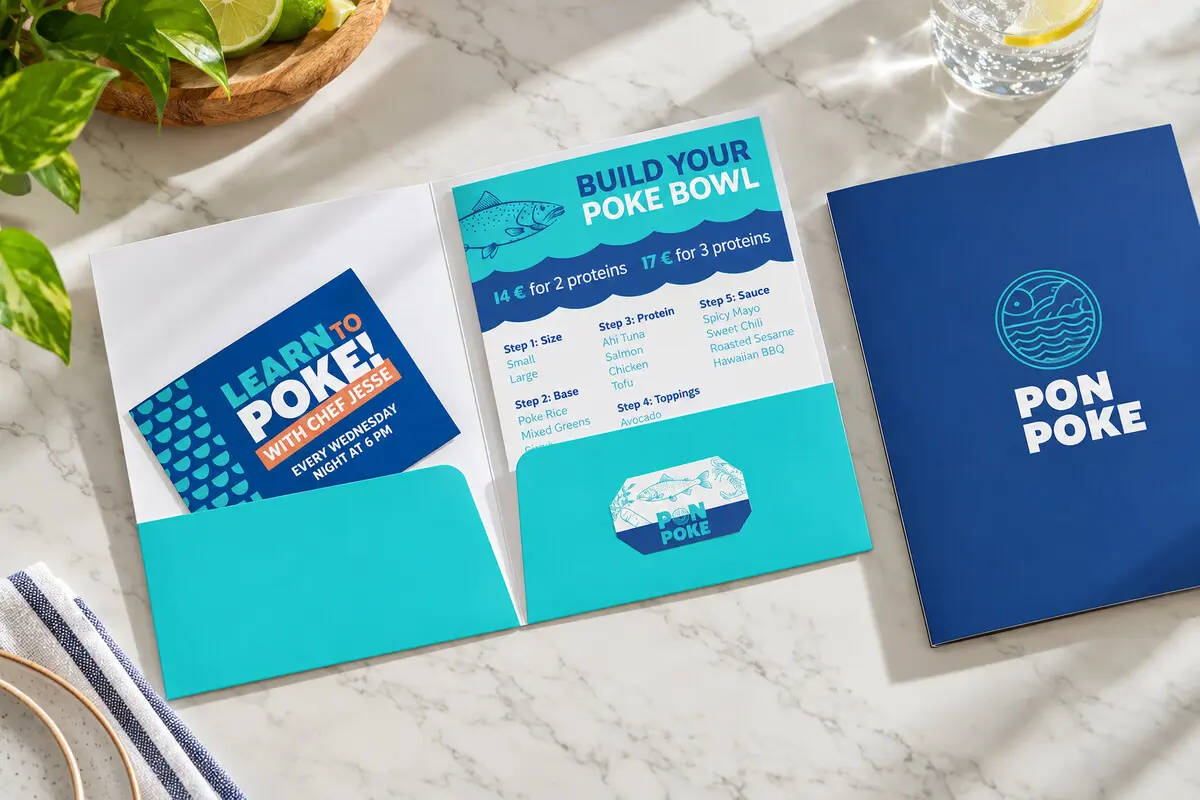
A file folder – many places call it a folder – is a rigid cover folded in half, with pockets inside for quotations, contracts and capability profiles. When handed to clients, the loose papers become a document set with the company name on the cover.
From Pham The Hien, Ta Quang Buu or Binh Dong, cross Nguyen Van Cu Bridge or Pham Hung Bridge and you reach the In Quảng Cáo Q7 workshop at 49 Mai Van Vinh, Tan Hung Ward. District 8 file folder printing orders are delivered within the day once ready, even though folder cartons are quite bulky.
Specifications and materials
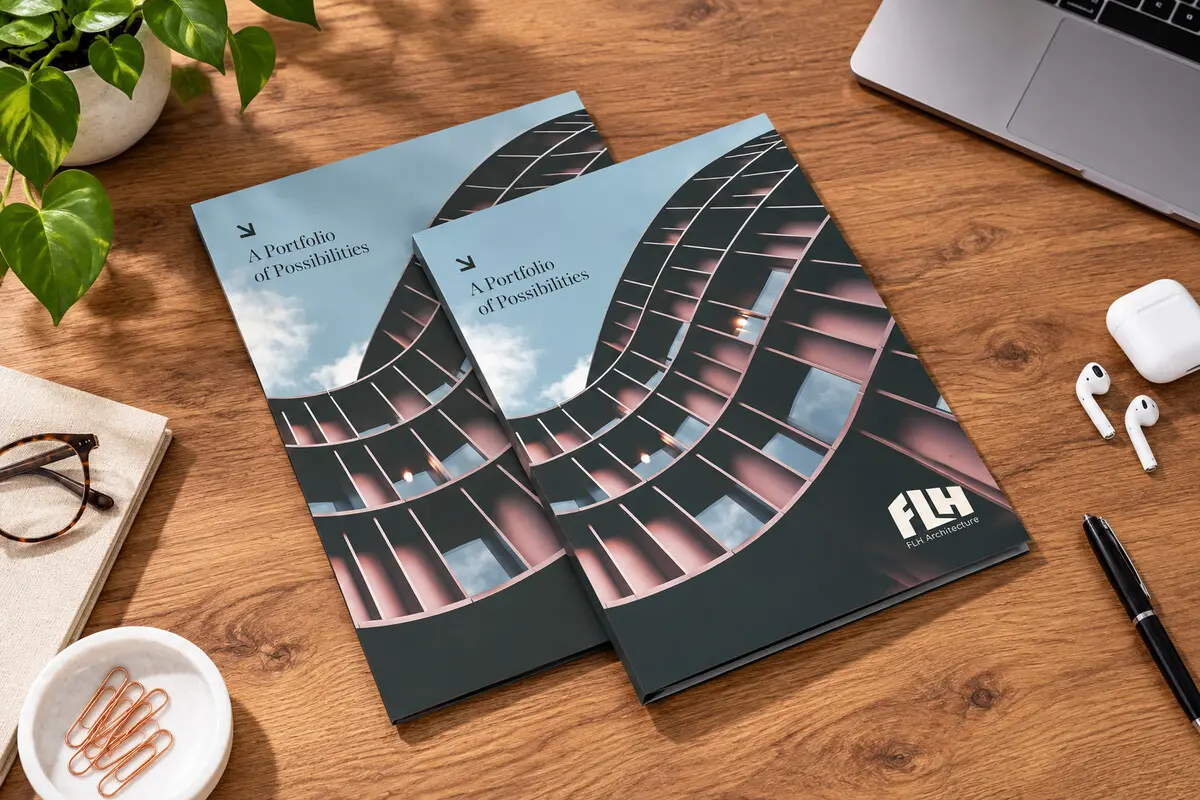
Finished size 22cm wide, 31cm high, 7cm pocket depth, run on Couche paper 300gsm. This is the most balanced weight for folders: stiff enough that the pocket does not collapse when documents are inserted, yet still folds into a sharp crease without the ink cracking along the fold.
The two body styles are the standard spineless folder – a flat sheet folded in half, suited to thin document sets; and the 0.5cm box-spine folder – with a spine strip in the middle so it opens into a box, holding a thick stack. Production facilities and warehouses often choose the box version because files come with many slips.
Four lamination levels and corresponding quantity levels
Matte 1 side and matte 2 sides give a smooth surface that does not pick up fingerprints when passed around. Gloss 1 side and gloss 2 sides give deep colours and a mirror shine, standing out when the cover is printed with product photos.
The 200-piece level is only available for standard matte-laminated folders; box-spine folders and all gloss-laminated versions start from 500 pieces, then go up to 1,000, 2,000 and 5,000 pieces. The unit price per piece drops clearly at higher levels because the die-making cost is spread over more products.
Pocket styles and business card slots
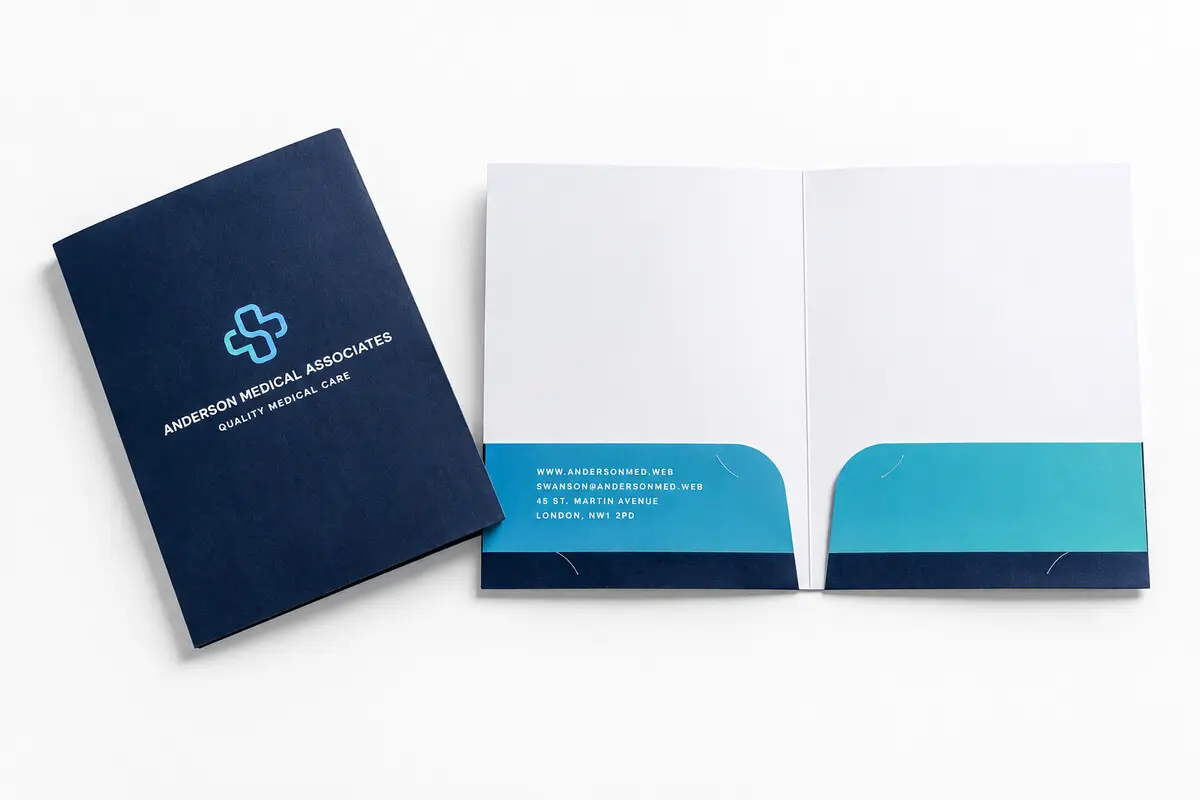
One glued pocket means only one side has a pocket; the other side is left blank or printed with introduction content. Two tuck-in pockets have side flaps supporting the documents so paper does not fall out when tilted. Two glued pockets with rounded-corner openings let documents in and out quickly.
The business card slot is a small groove on the pocket opening, holding the business card of the person in charge so clients can get in touch later. Many companies order folders in the same round as business cards so the logo on both items runs under the same colour command.
Frequently asked questions about District 8 file folder printing
How are folder cartons delivered to District 8?
Folders with glued pockets take up space, so a carton of 500 pieces is quite large. The workshop arranges a specific delivery time so you can have someone to receive it and a place for the goods.
What is the price difference between matte and gloss lamination?
The two levels differ in the smallest quantity level: matte lamination on standard folders starts from 200 pieces, gloss lamination starts from 500 pieces. The specific price shows on the page when you select all three options.
Is there a test print of one piece first?
The cutting die is a fixed-cost step so one piece is not run as a test. Instead, the workshop sends a flat-laid layout for you to approve the logo position, folds and die lines before going to the machine.
Order printing at In Quảng Cáo Q7
If you are in District 8 and need file folders printed, message us on Zalo to receive the die-cut template file and a quote by folder type, lamination style and quantity – delivered over the bridge within the day once ready.
In Quảng Cáo Q7 direct print workshop – 49 Mai Van Vinh, Tan Hung Ward, Ho Chi Minh City. Production and delivery hours: Monday – Saturday, 8:00–12:00 and 13:00–18:00 · Orders via Zalo/hotline: Monday – Saturday 8:00–12:00 and 13:00–20:00, Sunday 14:00–19:00. Quick message via Zalo or call 0866.511.099.
See more printing services on the In Quảng Cáo Q7 home page, see all corporate print products or contact us quickly via the contact page; you can also get directions to the workshop on Google Maps.
Where file folders are used in a business
File folders are an item rarely talked about but used heavily in businesses with warehouses and accounting departments. Unlike file folders handed to clients, this type is used for storage, so the requirements are durability and quick look-up.
In accounting departments, file folders store documents by month. In warehouses, they store issue and receipt slips by week. In HR, they store each person's file. All three cases need a label on the spine to look up without pulling them off the shelf.
Businesses in District 8 have many warehouses and production facilities, so this group orders in large quantities and reorders every year. A new set of file folders each year for the new accounting period is the common rhythm.
| Part | Using file folders to | What the spine label shows |
|---|---|---|
| Accounting | Store documents by month | Month and year |
| Warehouse | Store issue and receipt slips | Week or month |
| Crew | Store each person's file | Name and employee code |
| Sales | Store contracts by client | Client name |
| Administration | Store outgoing and incoming official letters | Document type and year |
Because the spine label is what decides look-ups, many businesses print this label directly onto the file folder instead of sticking on loose paper labels. Pre-printed labels do not peel or fade like handwritten labels.
Types of file folders
There are four commonly used types of file folders, differing in how they hold paper inside. Which type to choose depends on whether the file needs sheets added or removed later or is stored once and left as is.
The two-hole metal ring type is the most common for long-term storage. Paper is punched and fitted onto the rings, sheets can be added or removed at any time, and the stack lies flat without shifting.
The string-tie type is used for thin files, cheaper than metal rings but slower to add sheets. The spring clip type is used for files in progress, quick to take out and put away but cannot hold thick stacks.
The pocket type has no rings, just a cover folded into a pocket, used for files that should not be punched, such as signed originals or papers that must be kept intact.
| Style | Holds | Adding or removing sheets | Used for |
|---|---|---|---|
| Two-hole metal ring | Thick sets up to 5cm | Easy | Long-term storage |
| String tie | Thin sets | Slow | Files with few sheets |
| Spring clip | Up to 2cm | Very fast | Files in progress |
| Pocket without rings | Depending on pocket thickness | No punching | Originals, papers that must stay intact |
Many businesses use two types in parallel: spring clips for the current month's files and metal rings for closed files. At the end of the month, papers are moved from the spring clip into the ring file folder for storage.
Related products

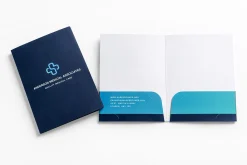
Folder

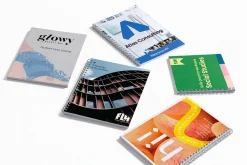
Catalogue – Company Profile

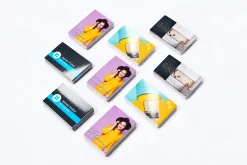
Business cards

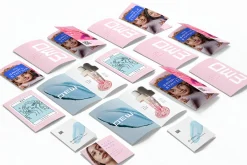
Leaflet / Brochure
Materials and durability when stored for many years
File folders sit on shelves for many years, so the material needs to withstand dust, humidity and constant pulling out and pushing in. Thin paper covers will sag and the spine tabs tear after a year or two.
The common level is rigid carton board covered with printed paper, about two millimetres thick. This type stands on the shelf, holds its shape when pulled out, and withstands a heavy stack of paper inside.
For warehouses with high humidity, the covering should be laminated to resist moisture and prevent mould on the printed surface. This is a point to watch for warehouses near canals or open warehouses in District 8.
A lighter level is folded Couche paper 350gsm, with no carton core. This type is clearly cheaper but only used for thin files stored in cabinets, as it cannot stand on open shelves.
- Rigid 2mm carton covered with printed paper: the common level for shelf storage.
- Rigid carton covered with laminated paper: used for warehouses with high humidity.
- Folded Couche paper 350gsm: cheaper, only for thin files in cabinets.
- Leatherette-covered folders: the most durable, used for important files stored long-term.
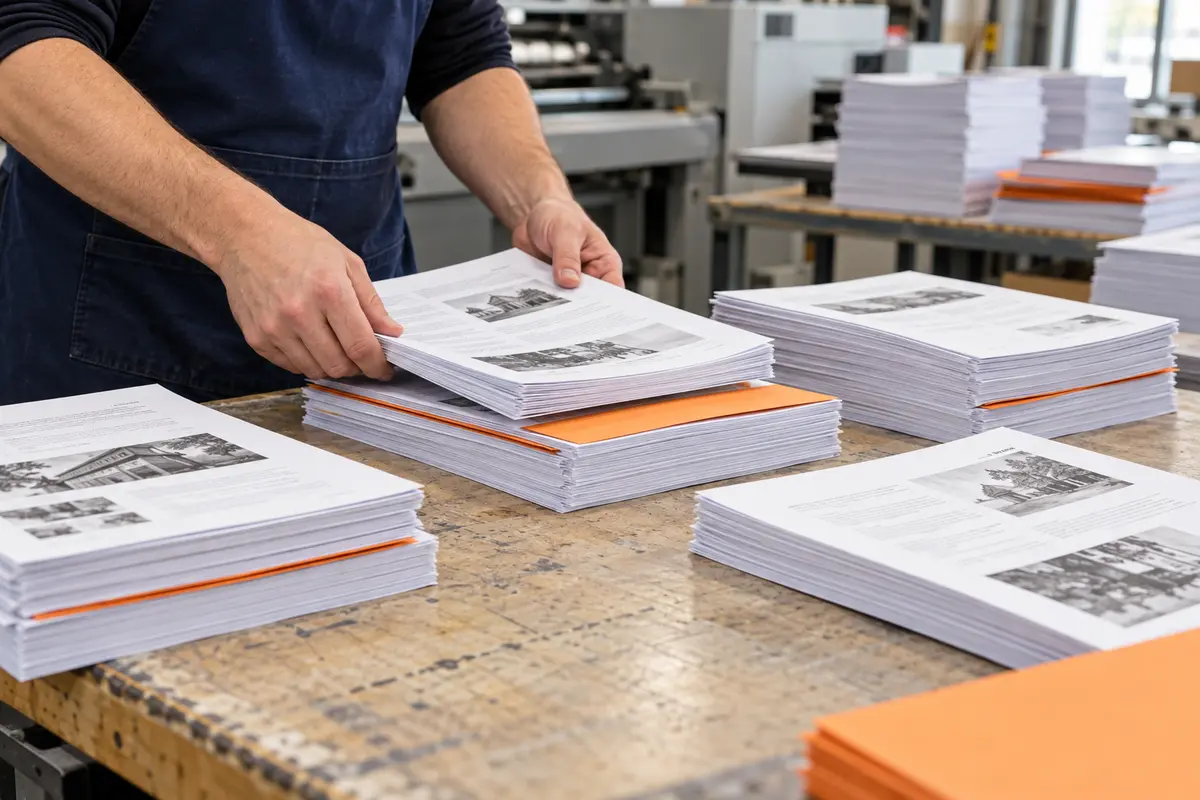
Leatherette-covered folders are the highest level, used for legal files or files that must be kept for decades. The price is significantly higher so usually only a few are ordered for the group of important files.
Spine labels and how to mark them
The spine label is the detail that decides whether look-ups are fast or slow. A shelf of thirty file folders without spine labels means pulling each one out to check, taking a few minutes for each look-up.
The neatest way is to pre-print the label frame on the spine and then fill in the content with an oil-based marker. The pre-printed frame keeps handwriting aligned and the same size across file folders on the same shelf.
For file sets whose content is known in advance, such as storage by twelve months, the spine label is printed with the content too. This makes the file shelf look even and does not depend on the handwriting of the person arranging it.
The third way is sticking decal labels printed from a list. Most flexible because they can be replaced when the content changes, but stuck labels may peel after a few years if the warehouse is humid.
| Approach | Advantages | Limited |
|---|---|---|
| Printed frame, filled in with a marker | Flexible, cheap | Uneven handwriting |
| Pre-printed content | Looks even, professional | Content cannot be changed |
| Stick decal labels | Replaceable when changed | May peel if humid |
| Use cover colours to group | Recognise groups from afar | Need to order several colours |
Using cover colours to group is very effective when the shelf holds many types of files. For example, blue file folders for accounting documents and orange for warehouse slips; from afar you know which one to take.
Size and spine thickness
Spine thickness decides how many sheets the file folder holds. Choosing a spine that is too thin means the stack cannot close; choosing one too thick wastes shelf space and the folder does not stand steadily with only a few sheets.
A three-centimetre spine holds about two hundred and fifty sheets, suited to storing one month of documents for a small business. A five-centimetre spine holds about four hundred and fifty sheets, used for storing by quarter or for warehouses with large volumes of slips.
The cover size is usually A4, but warehouses with A5 slips should order A5 separately to save shelf space. A5 slips stored in A4 file folders shift around and are hard to look up.
| Spine thickness | Sheets held | Used for |
|---|---|---|
| 2cm | About 150 sheets | Individual HR files |
| 3cm | About 250 sheets | One month of documents |
| 5cm | About 450 sheets | One quarter of documents |
| 7cm | About 650 sheets | Large volumes of warehouse slips |
Many businesses order two thicknesses in parallel: a three-centimetre spine for most files and a five-centimetre spine for a few large sets. Ordered in the same round, they share the same colour and label design, so the shelf still looks even.
Quantity and reorder cycle
File folders are ordered by accounting cycle, usually one round a year. The quantity is calculated by the number of file sets to store in the year, plus a spare for files that arise.
A small business storing documents by month needs about twelve to twenty folders a year. A business with a warehouse storing slips by week needs fifty to sixty folders. Adding HR files and contracts, the total rises to about one hundred.
The price per piece drops with quantity, and the clear price break is around one hundred pieces. So businesses ordering once for the whole year get a better price than ordering a few each month.
| Quantity per run | Price level | Lasts |
|---|---|---|
| Under 20 pieces | Highest | Small business, one year |
| 20 to 50 pieces | Slight reduction | Medium business, one year |
| 50 to 100 pieces | Clear reduction | With a warehouse, one year |
| Over 100 pieces | Lowest | Many departments, one to two years |
File folders have no adhesive layer so they keep for a long time without damage, unlike envelopes. So ordering two years' worth is fine, as long as the label design and cover colour do not change.
Common mistakes when ordering for the first time
The four mistakes below account for most cases where a round of file folders has to be redone. All four show up right away on a single sample, so the sample approval step is worth keeping.
The first mistake is choosing a spine too thin for the actual amount of paper, so the folder cannot close. The second is a cover size too close to the paper size, so sheets stick out past the edge and curl.
The third mistake is a spine label in the wrong orientation. The label must be readable when the folder stands on the shelf, so the text runs vertically along the spine; printed horizontally, it cannot be read when standing on the shelf.
The fourth mistake is no lamination in a humid warehouse, so the printed surface gets mouldy after one rainy season. This mistake only appears after many months so it is hard to fix, because by then the whole set is in use.
- Measure the actual thickness of the paper stack before choosing the spine, adding a spare.
- Cover size about 5mm wider than the paper size in each dimension.
- Print spine labels with vertical text so they can be read when the folder stands on the shelf.
- Laminate if the warehouse has no air conditioning or is near a source of moisture.
One sample is delivered before running a large round, for testing with the real stack of paper. Testing it the way it is actually used gives a clearer answer than calculating on paper.
Arranging file shelves for easy look-up
A set of file folders only works when the shelf is arranged by convention. This convention should be written on a note page and stuck right on the shelf, so newcomers can look things up without asking.
The common arrangement is by time from left to right, old on the left and new on the right. Within the same year, by month; client files in alphabetical order of client name.
Cover colours are used to group, not to divide time. One colour for accounting documents, one for warehouse slips, one for HR files; from afar you know which area is which.
- Write the arrangement convention on one page and stick it on the shelf.
- Arrange by time from left to right within the same group.
- Use cover colours to group, not to divide time.
- Leave empty space at the end of each group for files that arise.
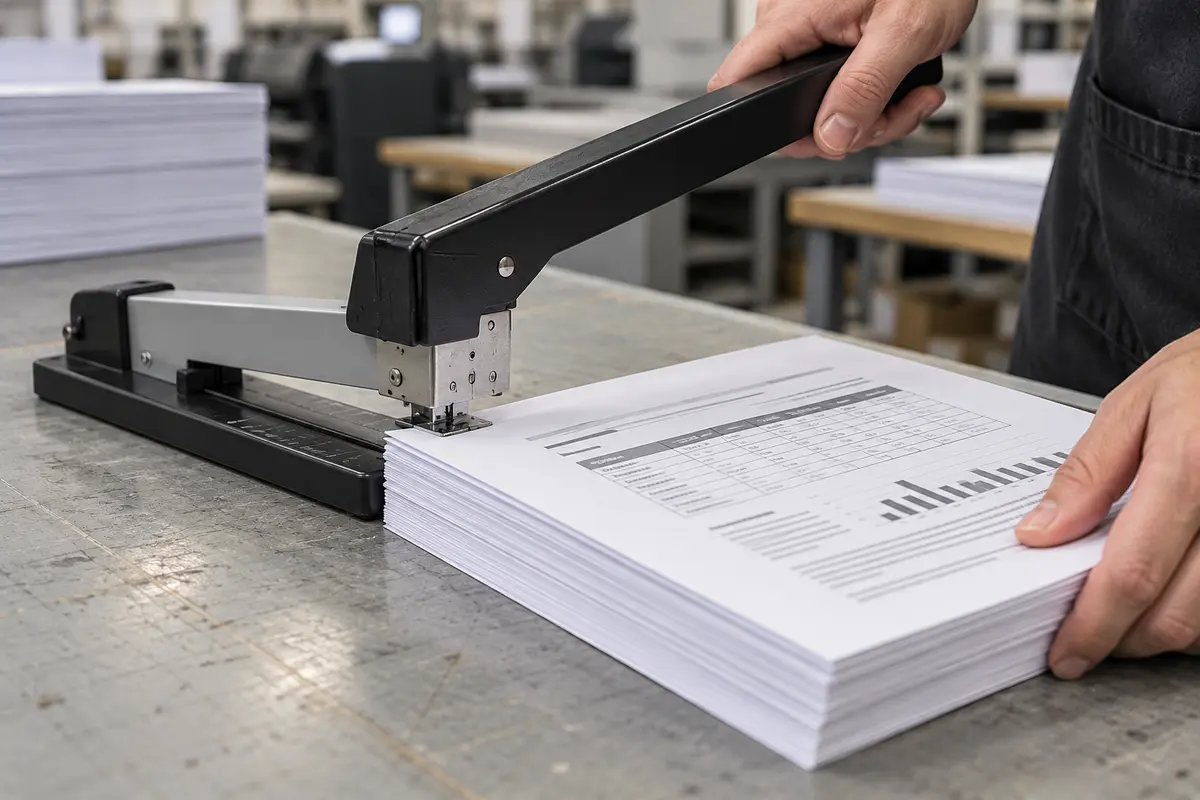
Leaving empty space at the end of each group is a detail often overlooked. A shelf filled tight from the start means shifting the whole shelf when new files arise, and that is when the order gets mixed up.
Delivery and ordering file folder printing in District 8
Workshop at 49 Mai Van Vinh, Tan Hung Ward, Ho Chi Minh City, to District 8 via Nguyen Van Cu Bridge or Chanh Hung Bridge. File folders take up volume so orders over fifty pieces are delivered by small truck, needing a gate-opening time arranged if delivering into a warehouse.
- Information 1: folder type, metal ring, spring clip or pocket.
- Information 2: the paper size stored inside and the desired spine thickness.
- Information 3: quantity, cover colour and how the spine label is made.
- Information 4: the date you need it, delivery address and gate opening hours.
Production time is usually three to five days because there are steps for making the carton core and fitting the rings, both done by hand. Send your request via Zalo to receive a quote split into the cover, the rings and the printing.
Need printing or signage in Ho Chi Minh City?
In Quảng Cáo Q7 runs its own print workshop in Tân Hưng Ward (former District 7), Ho Chi Minh City, producing and installing signage, banners, window graphics, exhibition booths and event displays. Send us the size, material, quantity and a photo on WhatsApp and we will get back to you.

Phone: +84 866 511 099 · Also on WeChat
Workshop: 49 Mai Văn Vĩnh, Tân Hưng Ward, Ho Chi Minh City