




































































Folder Printing Trung Son – 22x31x7cm C300, Two Pockets, From 200
Oct
Does your company need Trung Son folder printing? This article sets out the 22x31x7cm size, two folder body styles, four lamination levels, inner pocket styles and quantity levels at the In Quảng Cáo Q7 workshop.
Document folder printing for the Trung Son area
The Trung Son residential area sits right on the border of the former District 7; from Road 9A or the Nguyen Van Cu extension, cross the bridge and you reach the In Quảng Cáo Q7 workshop at 49 Mai Van Vinh, Tan Hung Ward. Being close, customers in this area often drop by to see real samples before settling the pocket style.
Demand for Trung Son folder printing comes from clinics, training centres, consulting firms and representative offices. Each group uses folders differently: clinics hold medical records and result slips, training centres hand out course materials, consulting firms hold quotations and contracts.
See real samples before settling the pocket style
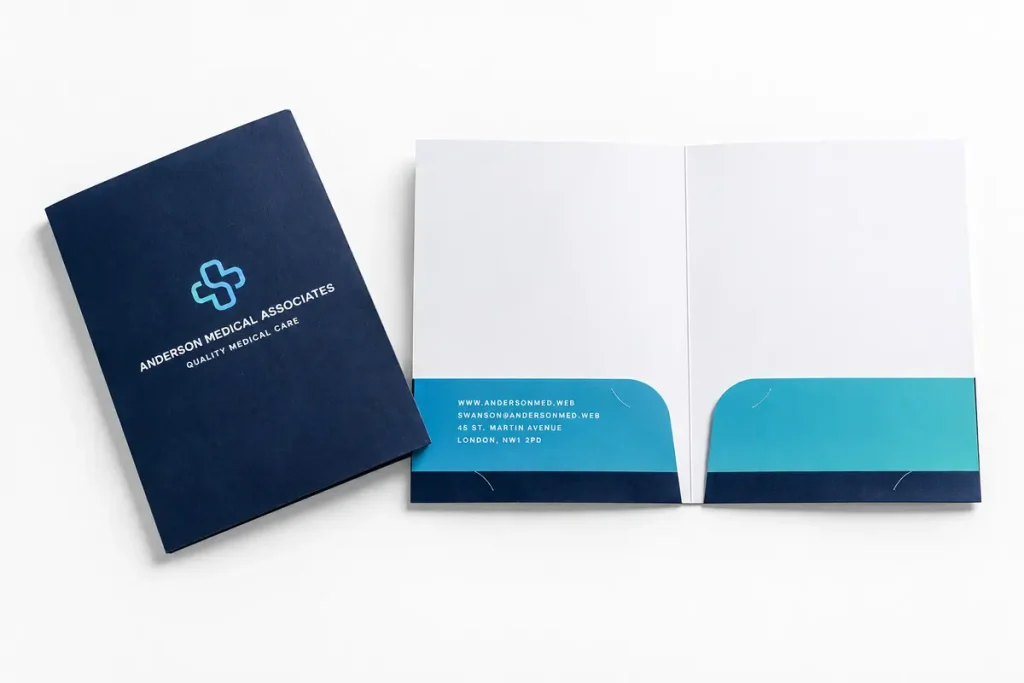
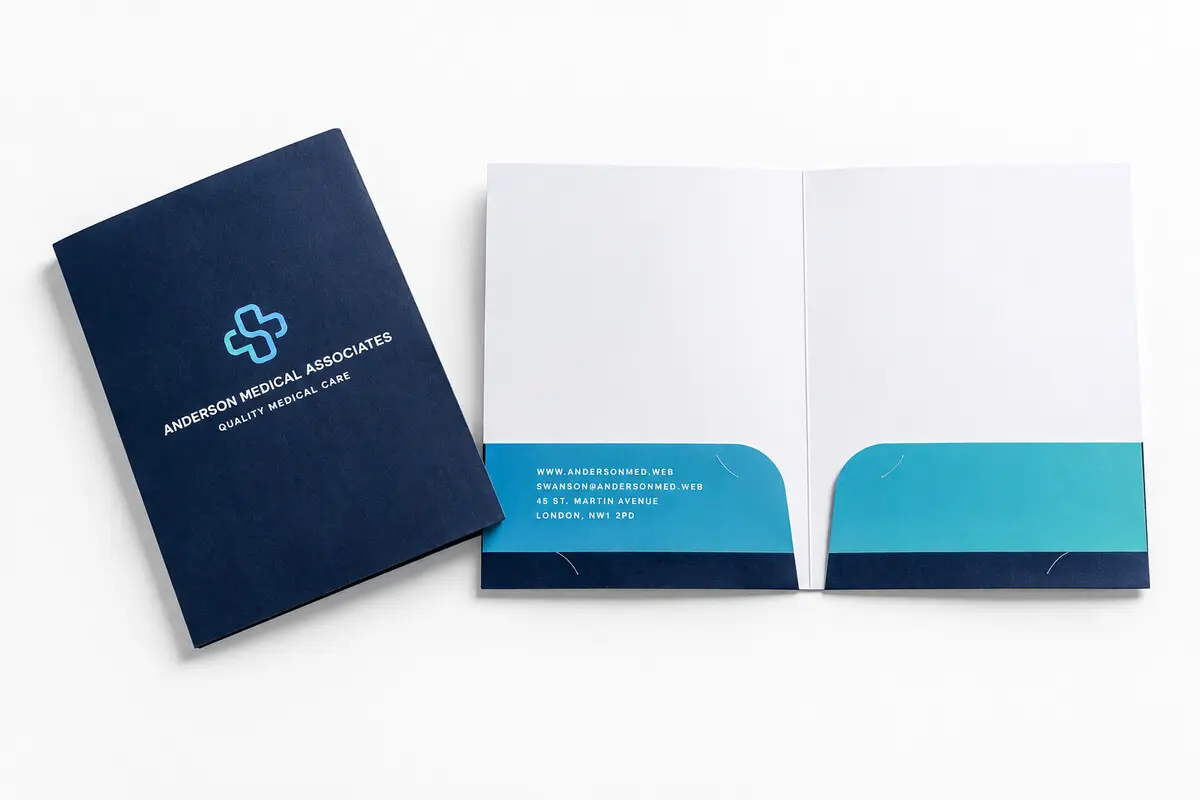
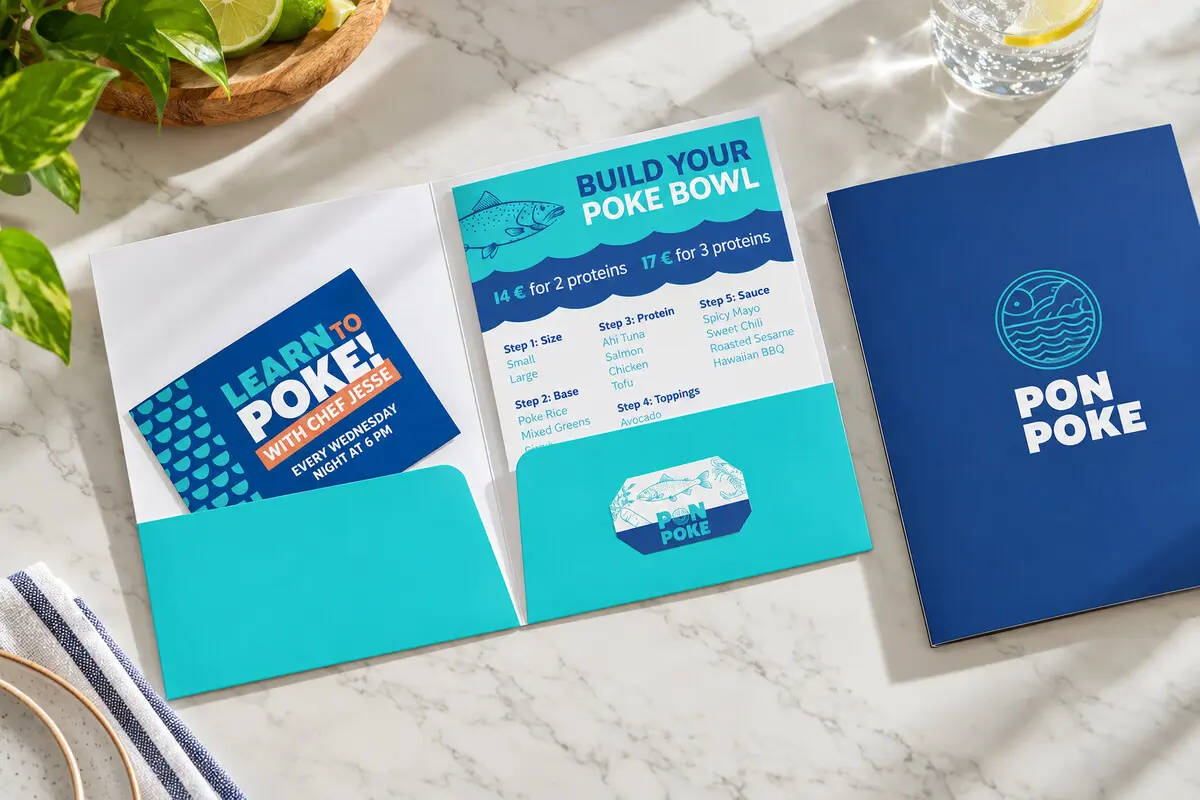
Pocket style is the hardest thing to picture from a drawing. One-pocket, glued two-pocket and tuck-in two-pocket folders differ clearly in hand: tuck-in pockets have side flaps supporting the documents so paper does not fall out when tilted, while glued pockets let documents in and out faster but hold less firmly.
The workshop has real samples of all pocket styles, both matte and gloss laminated, standard and 0.5cm box-spine versions. Customers in the Trung Son area often drop by to hold them and settle right away, avoiding changes after the die has been cut.
General specifications
Finished size 22cm wide, 31cm high, 7cm pocket depth, run on Couche paper 300gsm. The standard folder is a flat sheet folded in half for thin document sets; the 0.5cm box-spine folder has a spine strip in the middle and opens into a box, so it holds a thicker stack.
The business card slot is a small groove on the pocket opening to hold the business card of the person in charge – a small detail but very suited to clinics and training centres, where clients often need to contact the right person again.
Lamination and quantity levels
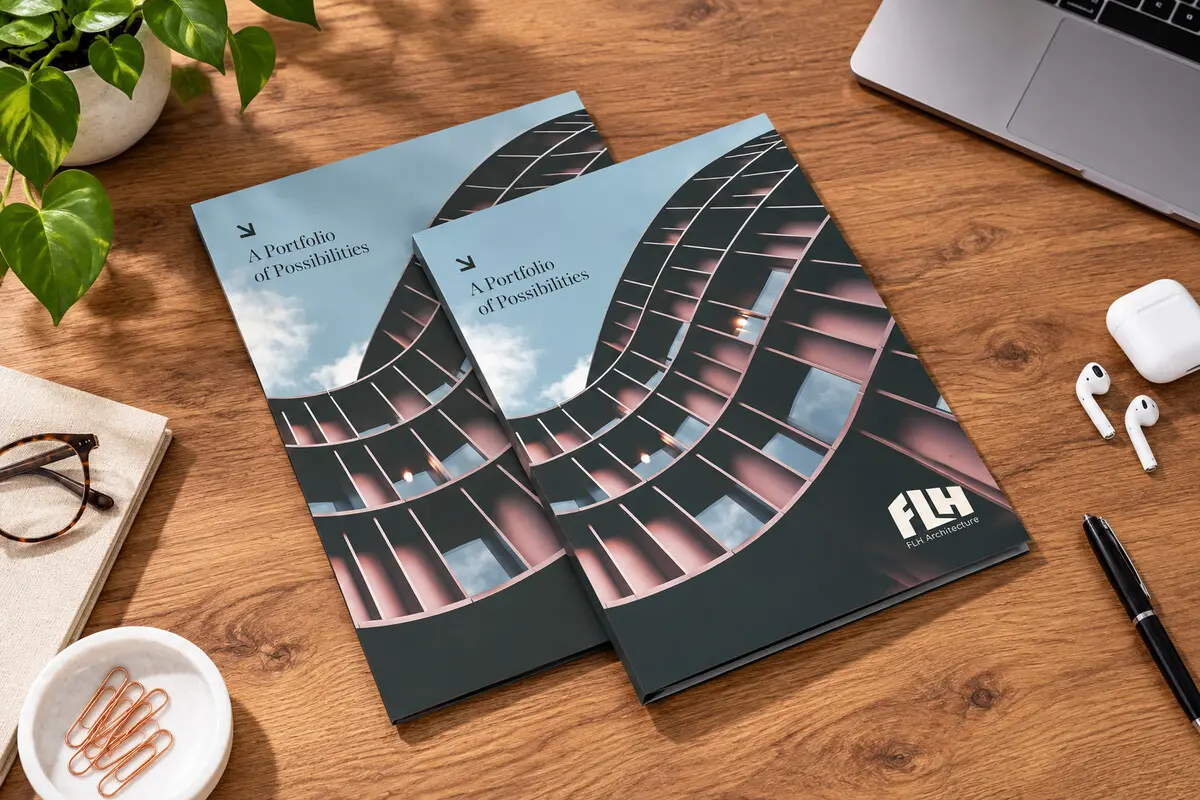
Four lamination levels: matte 1 side, matte 2 sides, gloss 1 side and gloss 2 sides. The 2-sided version also covers the inside so it resists scratches when documents are pulled in and out many times – suited to folders used long-term rather than handed out once.
The 200-piece level is the smallest, only available for standard matte-laminated folders. Box-spine folders and all gloss-laminated versions start from 500 pieces, then go up to 1,000, 2,000 and 5,000 pieces.
Frequently asked questions about Trung Son folder printing
Can I drop by the workshop to see folder samples?
Yes, and Trung Son customers often do because it is close. The workshop has real samples of the pocket styles, lamination levels and even the box-spine version for you to hold and compare.
Which style should I choose for a clinic folder?
It depends on the file thickness and how often documents are pulled in and out – the workshop lets you hold both pocket styles and the 2-sided laminated version to compare yourself. You settle whichever suits; the workshop does not choose for you.
How long does folder production take?
Folders have to go through printing, lamination, die-cutting, folding and pocket gluing, so they need more time than loose printed items. The workshop gives a specific pickup time as soon as the file is settled and the flat-laid layout is approved.
Order printing at In Quảng Cáo Q7
If you are in the Trung Son area and need folders printed, drop by 49 Mai Van Vinh to see real samples and settle the pocket style, or message us on Zalo for the workshop to send the die-cut template file and quote by quantity.
In Quảng Cáo Q7 direct print workshop – 49 Mai Van Vinh, Tan Hung Ward, Ho Chi Minh City. Production and delivery hours: Monday – Saturday, 8:00–12:00 and 13:00–18:00 · Orders via Zalo/hotline: Monday – Saturday 8:00–12:00 and 13:00–20:00, Sunday 14:00–19:00. Quick message via Zalo or call 0866.511.099.
See more printing services on the In Quảng Cáo Q7 home page, see all corporate print products or contact us quickly via the contact page; you can also get directions to the workshop on Google Maps.
What service premises in the area use folders for
The Trung Son area has many clinics, dental clinics, spas and real estate offices on the ground floors of townhouses. This group uses document folders in a very specific way: to hand clients a set of papers so they take it home without creasing and still remember where they went.
A clinic hands over results and follow-up appointment slips. A dental clinic hands over a treatment plan with a cost sheet. A spa hands over treatment plans and membership cards. A real estate office hands over project documents with many A4 sheets and a folded drawing.
In all four cases, clients open it right there and then take it home, so the cover is what stays around the longest. This is why service premises pay more attention to the look of the folder than to the price per piece.
| Premises | What is handed to clients | Number of sheets inside |
|---|---|---|
| Clinics, dentists | Results, appointment slips, cost sheets | 3 to 8 sheets |
| Spa, beauty | Treatment plans, membership cards | 2 to 5 sheets |
| Real estate | Project documents, folded drawings | 10 to 20 sheets |
| Consulting office | Contracts, quotations | 5 to 15 sheets |
| Training centres | Course programmes, forms | 5 to 10 sheets |
The number of sheets inside is the figure that decides the spine fold width. Sets under ten sheets do not need a spine fold; from ten sheets up, a spine fold of three to five millimetres helps the folder still close fully.
Business card slots and small details
For service premises, the business card slot is the detail most worth having. Clients take the papers home, open them and immediately see the card with the phone number, without searching their wallet.
The second detail is a blank box on the pocket face for writing the client's name with a pen. Clinics and spas use this box to write the name and next appointment date, turning the cover into an appointment slip as well.
The third detail is printing useful information on the inside. Clinics print post-treatment instructions; spas print product care instructions; real estate offices print a route map to the project. Printing the inside adds almost no cost because the sheet already goes through the machine.
- Business card slot on the pocket face, a diagonal cut about 55mm long.
- Blank box for the client's name and appointment date, about 60x20mm.
- Print instructions or a map on the inside, do not leave it blank.
- Print the address, opening hours and a QR code leading to the map on the back.
- Round the corners if clients carry it a lot, to avoid worn corners.
Opening hours are the only information worth weighing up before printing, because changing hours means reprinting. If hours often change by season, only print a QR code leading to a page with updated information.
Related products

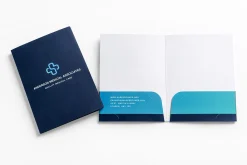
Folder

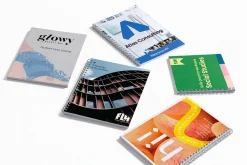
Catalogue – Company Profile

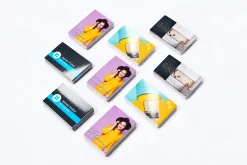
Business cards

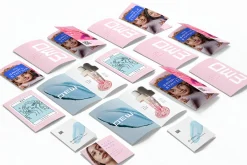
Leaflet / Brochure
Size and how to choose by what is kept inside
A4 is the standard size and also the cheapest because the cutting die already exists. But for premises handing over only a few small sheets, A5 is more compact and clients can easily put it in a bag.
The principle is an inner size about five millimetres wider than what it holds in each dimension. A4 sheets need an inner size of 215x302mm minimum, and 225x315mm is the commonly used size because there is room for thick sets.
For project documents with folded A3 drawings, the inner size needs to be wider because the folded sheet is thicker at the fold. In this case there should be a spine fold of five to eight millimetres, otherwise the cover will spring open.
| What is kept | Cover size | Spine fold |
|---|---|---|
| 2 to 5 A4 sheets | Standard A4 | Not needed |
| 10 to 20 A4 sheets | Standard A4 | 3 to 5mm |
| With folded A3 drawings | Standard A4 | 5 to 8mm |
| A5 slips | A5 | Not needed |
| Rigid cards with loose sheets | A4 or A5 | 3mm |
A5 needs a separate cutting die so the first round has an extra die cost. The die is kept so later rounds in the same size are not charged for this part again, and for premises reordering every year this cost works out very small.
Design for small premises without a brand identity yet
Service premises in the area usually do not have a full brand identity yet, so the cover is designed at the same time as the shop sign and menu or price list. Keeping the same colour tone and font helps clients recognise it is the same place.
The outside should be tidy: logo, facility name and one line describing the service. Cramming lots of text on the outside makes the cover look cluttered, and nobody reads it anyway.
If the facility only has a JPG logo image left, the logo is redrawn in vector first and then used for the folder, shop sign and price list. Doing it once like this avoids three items coming out in three different logo shades.
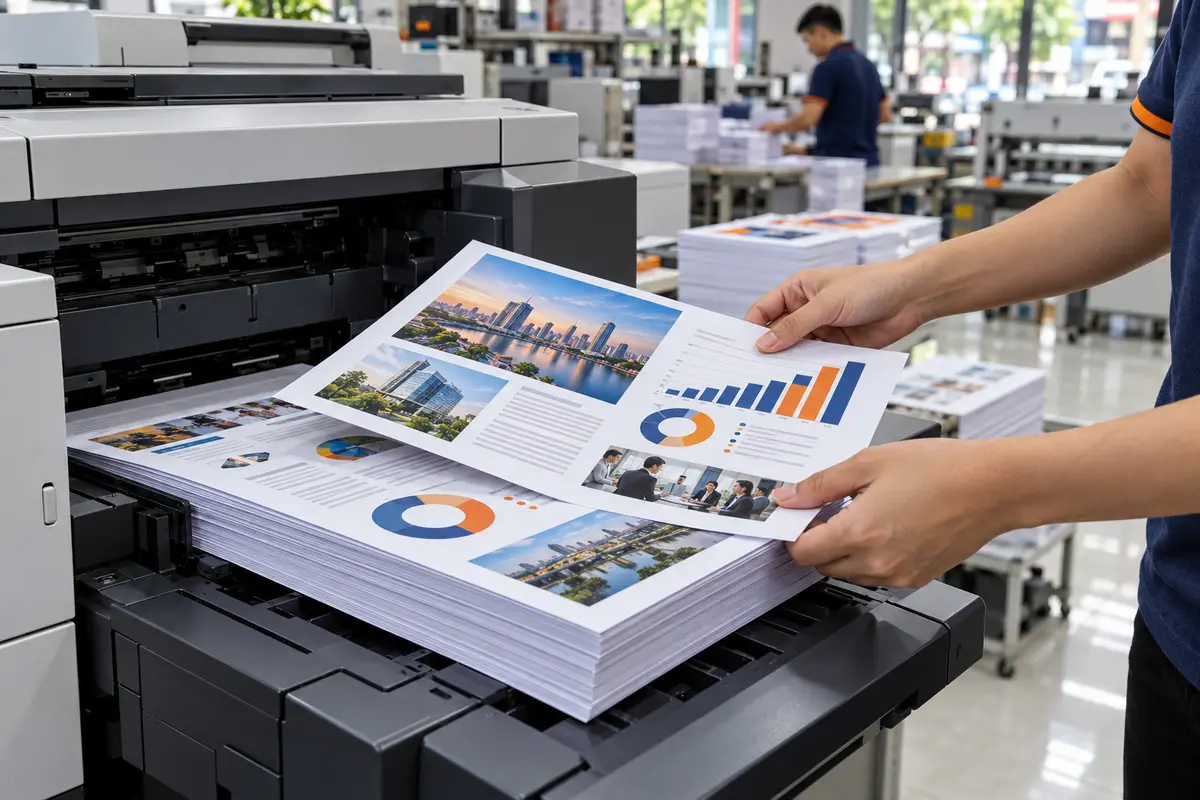
With dark backgrounds, matte lamination is almost the only choice. Dark backgrounds without lamination or with gloss lamination show fingerprints after a few handlings, and the cover handed to clients then looks very old.
Quantity for small premises
Service premises in the area usually only need a few dozen to two hundred folders for six months, so the practical question is how many to order. The calculation is the number of clients receiving documents each week times the number of weeks, plus a spare.
A clinic handing over about ten sets a week needs about two hundred and sixty pieces for a year. A real estate office handing over five sets a week needs about one hundred and thirty.
Thirty pieces are accepted as normal because it runs on digital printing; the only difference is that the price per piece is the highest. From two hundred pieces upwards, offset printing starts to pay off and the price drops clearly.
| Quantity | Technology | Price per piece |
|---|---|---|
| 30 to 100 pieces | Digital printing | Highest |
| 100 to 200 pieces | Calculate both ways | Medium |
| 200 to 500 pieces | Offset printing | Clear reduction |
| Over 500 pieces | Offset printing | Lowest |
Because the cover has no adhesive layer, it keeps for a long time without damage, as long as it is stored dry and upright. Premises with storage space get a better price ordering a year's worth than ordering twice, once every half year.
Accompanying printed set
The cover is the outer shell of a set, so the sheets inside should be printed in the same round so the colours match. For clinics, the set includes result slips, appointment slips and price lists; for spas it includes treatment plan sheets and membership cards.
Slips filled in by hand should be printed on Fort paper, not gloss-coated paper, because ballpoint pens do not take ink on a glossy surface. This is a common mistake when the whole set is printed on the same nice paper.
Membership cards and business cards are the opposite: printed on thick laminated paper to last when clients carry them in their wallets.
- Folders: Couche paper 300gsm, matte laminated.
- Handwritten slips: Fort paper 100gsm, no lamination.
- Treatment plan sheets, price lists: Couche paper 150gsm.
- Membership cards: Couche paper 300gsm, laminated, rounded corners.
- Business cards: Couche paper 300gsm, laminated.
The whole set ordered in one round takes only one delivery and one sample approval. This is a more practical reason than price for combining small items into one order.
Common mistakes and how to approve samples
The four mistakes below account for most cases where a round of folders has to be redone, and all four show up right away on a die-cut fold mock-up.
The first mistake is an inner size too close to A4, so documents inserted get bent at the edges. The second is having no spine fold yet using it to hold a set of fifteen sheets, so the cover springs open and cannot hold the documents.
The third mistake is important text or images running across the spine fold, broken up after folding. The fourth is skipping lamination to save money, and then the cover peels at the corners after just one month.
| Mistake | Consequence | How to avoid it |
|---|---|---|
| Inner size too close to A4 | Documents bent at the edges | Inner size 5mm wider |
| Missing a spine fold | Cover springs open, does not hold documents | Leave a fold of 3 to 8mm |
| Content across the fold | Image broken up | Avoid the fold zone when laying out |
| No lamination | Corners peel after a month | Matte lamination on both sides |
A die-cut fold mock-up is delivered before running a large round, for testing with the real document set. Premises in the Trung Son area receive the sample within the day because the workshop is right next door.
Storage and how to take it out for use
This item is already folded into shape so it takes up more space than other paper items. A carton of two hundred pieces takes up about forty litres, not small for ground-floor premises that are already cramped.
The correct way to store them is upright in a carton, in a dry place, away from sunlight through glass doors. Stacking them flat in layers for a long time presses the spine fold flat, and then the cover no longer opens out to hold thick sets.
Each time, only take out the amount used in one or two weeks and place it at the reception counter. The rest stays in the carton so it does not gather dust or curl at the edges from morning humidity.
- Store upright in a sealed carton, in a dry place, away from sunlight.
- Do not stack in layers on top of each other because it flattens the spine fold.
- Take out one or two weeks' worth and keep it at the counter.
- Receive in trips if the premises have no large storage space.
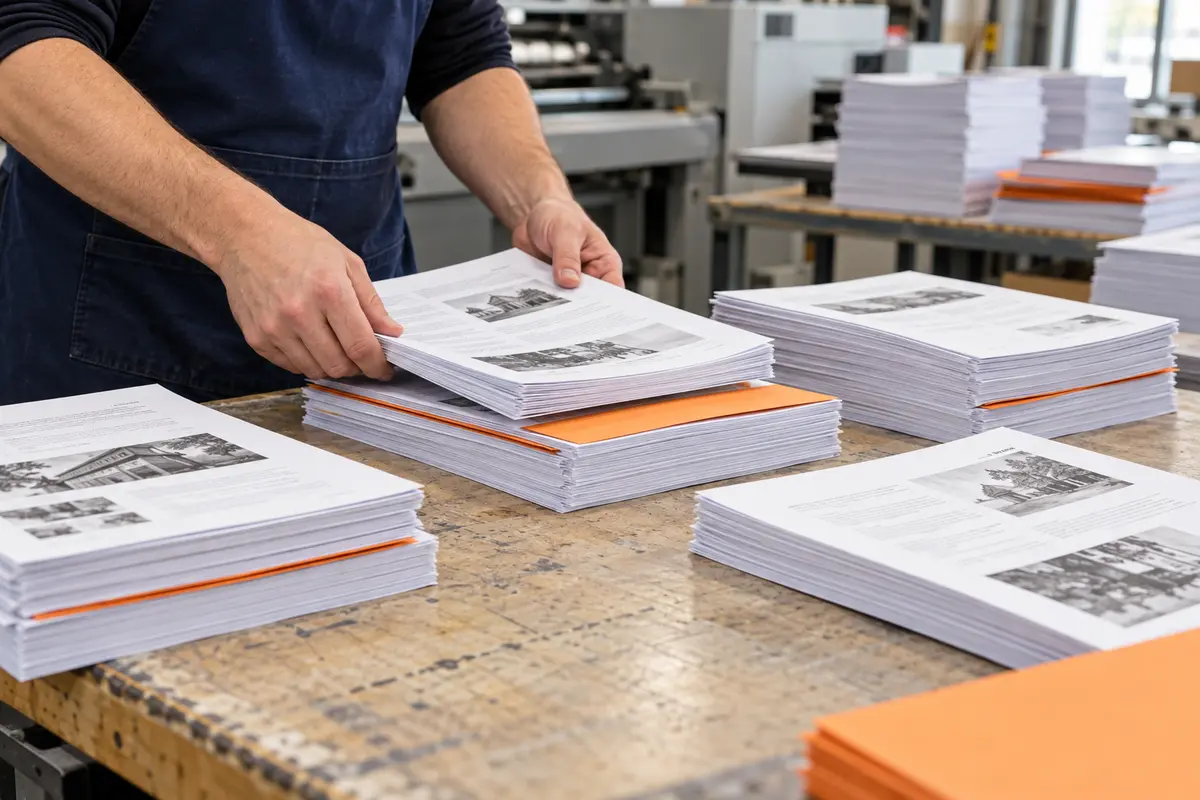
For premises without storage space, unused goods are left at the workshop and received in trips. The part stored at the workshop is kept in a dry environment so the lamination does not curl and the corners do not wear.
Receiving goods and ordering folder printing in Trung Son
The workshop is located at 49 Mai Van Vinh, Tan Hung Ward, Ho Chi Minh City, and from here to the Trung Son area is only a few minutes, so samples and goods are both delivered fast. Premises can drop by to collect directly or receive delivery to their door.
- Information 1: size and what will be held inside, with the number of sheets.
- Information 2: quantity, paper type and lamination level.
- Information 3: whether there is a business card slot, a name box and printing on the inside.
- Information 4: the date you need it and the hours someone is at the premises.
Production time is usually two to three days for digital printing orders and three to four days for offset printing orders, because die-cutting and folding-gluing are done by hand. Send your request via Zalo to receive a quote split into printing, die-cutting and lamination.
Need printing or signage in Ho Chi Minh City?
In Quảng Cáo Q7 runs its own print workshop in Tân Hưng Ward (former District 7), Ho Chi Minh City, producing and installing signage, banners, window graphics, exhibition booths and event displays. Send us the size, material, quantity and a photo on WhatsApp and we will get back to you.

Phone: +84 866 511 099 · Also on WeChat
Workshop: 49 Mai Văn Vĩnh, Tân Hưng Ward, Ho Chi Minh City