




































































Retail Invoice Book Printing District 7 – Carbonless A5, A4, Numbered
Oct
Does your shop or company need District 7 retail invoice printing? This article sets out self-copying carbonless paper, two sizes A5 and A4, three part configurations, the sequential numbering option and order levels at the In Quảng Cáo Q7 workshop.
Retail invoice printing right in District 7
Retail invoice books are something shops use every day and run out of before they notice. The In Quảng Cáo Q7 workshop has its machines at 49 Mai Van Vinh, Tan Hung Ward, so shops, eateries and facilities around Phu My Hung, Tan Hung, Tan Quy and Tan Phong get goods quickly when they reorder.
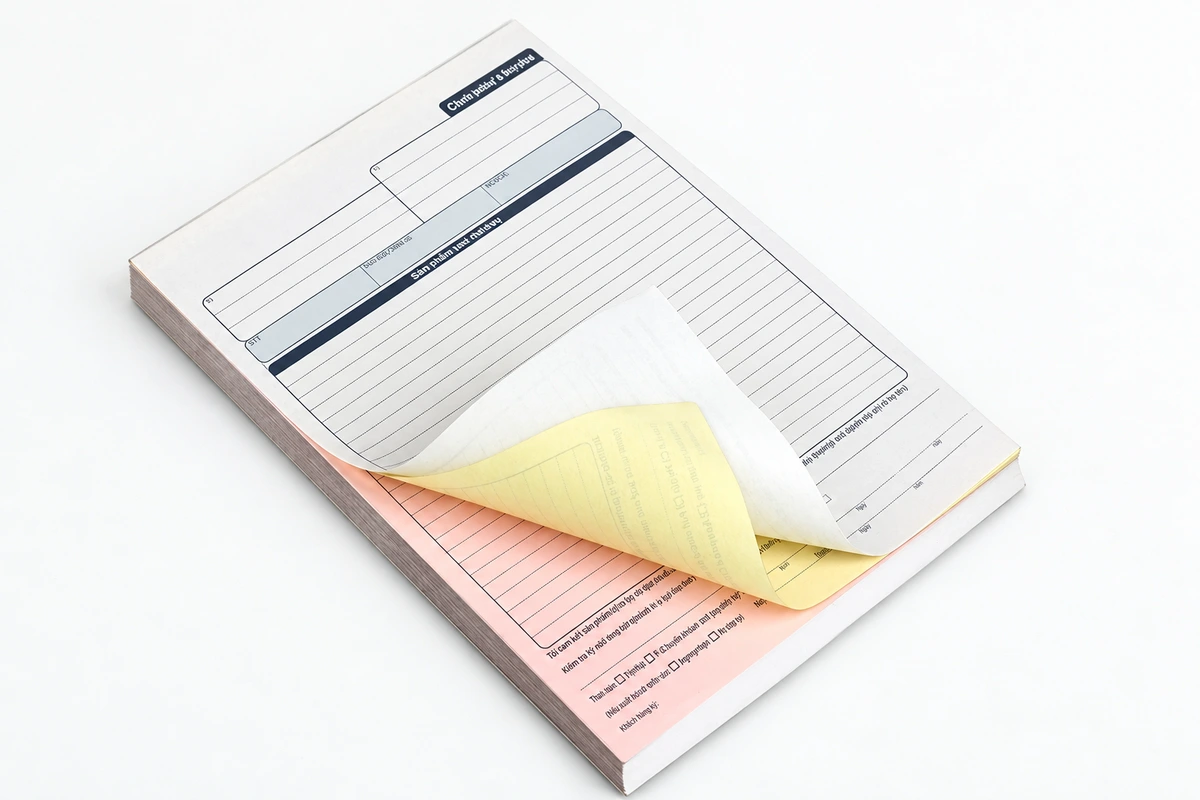
This is a handwritten type of invoice: staff fill in the item name, quantity and amount on the top sheet, and the parts below pick up the writing thanks to self-copying carbonless paper – no carbon paper needed. Completely different from e-invoices printed from a machine.
Choosing size and number of parts
A5 is the common size for eateries and small shops, with room for about ten item lines. A4 is for orders with many lines or needing an extra specification column, often used at building material shops and wholesale facilities.
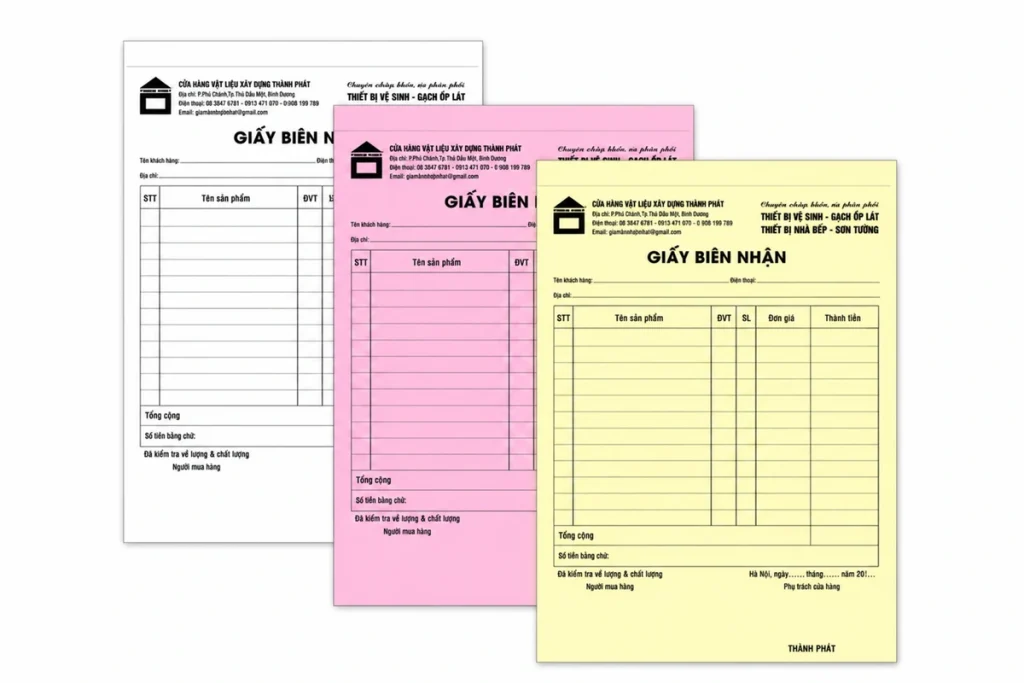
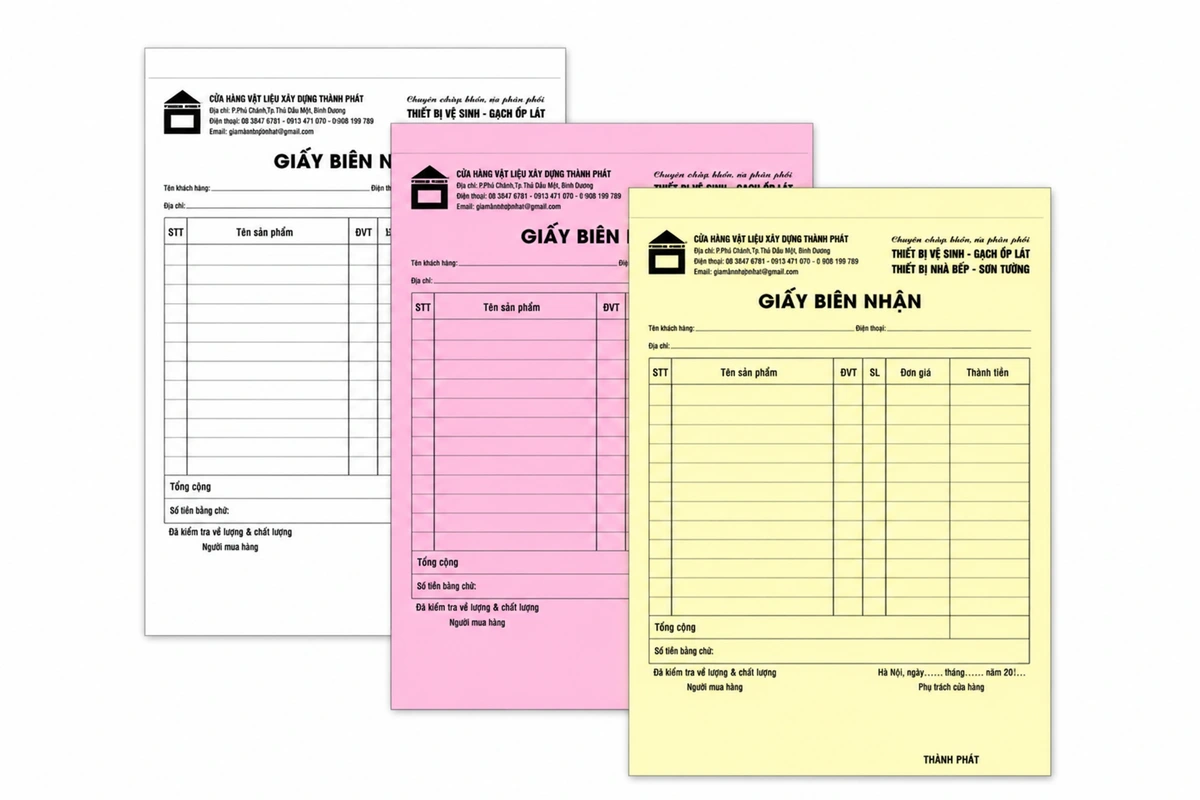
Three part configurations: 1 part, 100 sheets per book – given only to the customer, no copy kept; 2 parts, 50 sets per book – one part to the customer, one part kept; 3 parts, 50 sets per book – an extra part for accounting or the warehouse. The two sizes and three configurations can be combined freely with each other.
Sequential numbering and print color
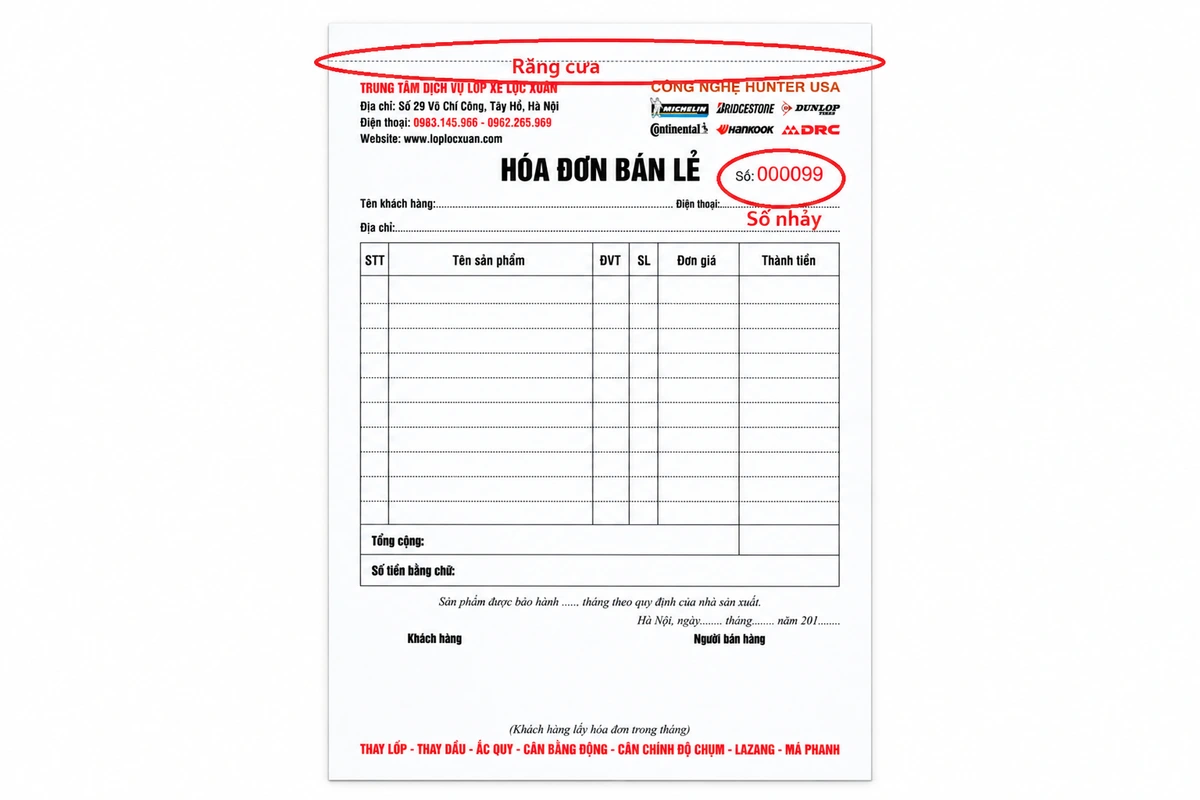
Sequential numbering is a pre-printed number sequence, each sheet with a unique number, used when you need to reconcile the books or control lost sheets. With multi-part sets, the parts in the same set carry the same number so they match when kept and when given to customers.
Print colour is chosen between one colour and multiple colours. The one-colour option runs a single ink command; state black, red or blue when ordering. The multi-colour option runs all four colours, used when the logo is multi-colour or the table frame has a colour background.
Other forms with the same specifications
With the same carbonless paper and binding method, the workshop prints receipt vouchers, payment vouchers, delivery notes, warehouse issue slips, order slips and 3-part white, pink and yellow receipts. Only the table frame in the file changes; the specifications stay the same.
The smallest order level is 10 books, because carbonless paper has to run by the roll and is bound by hand. Shops usually order 10–20 books for a few months of use; wholesale facilities order more.
Frequently asked questions about District 7 retail invoice printing
How long does delivery within District 7 take?
Delivered to your shop as soon as binding is done, usually within the day. The distance within the area is very short so many customers also drop by to collect on their way.
Will the next order round have duplicate numbers?
No, if you tell us the last number of the old book when reordering. The workshop prints continuing from that number so the sequence is continuous with no duplicates.
What if I do not have an invoice template?
Send the shop name, address, phone number, tax code if any and the columns needed in the table; the workshop builds a preview for approval before printing.
Order printing at In Quảng Cáo Q7
If your shop in District 7 needs retail invoices or carbonless forms printed, message us on Zalo with the old template or content so the workshop can build the design and quote by size, number of parts and number of books.
In Quảng Cáo Q7 direct print workshop – 49 Mai Van Vinh, Tan Hung Ward, Ho Chi Minh City. Production and delivery hours: Monday – Saturday, 8:00–12:00 and 13:00–18:00 · Orders via Zalo/hotline: Monday – Saturday 8:00–12:00 and 13:00–20:00, Sunday 14:00–19:00. Quick message via Zalo or call 0866.511.099.
See more printing services on the In Quảng Cáo Q7 home page, see all corporate print products or contact us quickly via the contact page; you can also get directions to the workshop on Google Maps.
What retail invoices are used for
A retail invoice is the sheet shops write by hand and give to customers when selling, recording items, quantities and amounts. This is an internal document between seller and buyer, different from e-invoices used for tax declaration.
Many shops in District 7 use both in parallel: handwritten retail invoices given to customers right at the counter, and e-invoices issued later for customers who need to declare them. The two do not replace each other but serve two different purposes.
For shops selling to walk-in customers, the retail invoice is also the basis for customers to return or exchange goods. So the date and items need to be written clearly, and the book needs sequential numbers so the shop can look it up again.
| Document type | Who uses it | Purpose |
|---|---|---|
| Handwritten retail invoice | Retail shops | Given to customers immediately, basis for returns |
| E-invoice | Business | Tax declaration |
| Receipt voucher | Shops, offices | Records money received |
| Warehouse issue slip | Shops with a warehouse | Records goods leaving the warehouse |
| Warranty slip | Equipment shops | Records the warranty date |
The bottom four items in the table share specifications with retail invoices: same size, same binding method, same sequential numbering method. So they are usually ordered together in one round to combine quantities and lower prices.
Related products

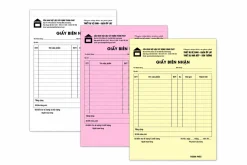
Invoice books

Business cards

Envelopes

Letterhead
Size and number of parts
The common size for a retail invoice sheet is landscape A5, with just enough room for five to eight item lines. The A6 retail invoice is smaller, used by shops selling few items each time; A4 is used when many lines and lots of information need to be written.
The number of parts of a retail invoice decides who keeps which copy. Part one goes to the customer, part two is kept by the shop, part three if any is for the warehouse or accounting. Each part uses a different paper colour for quick identification.
Multi-part paper is self-copying paper; writing on part one makes the text appear on the parts below, with no carbon paper needed. This paper is thin so writing needs gentle pressure, and ballpoint pens give clearer results than gel pens.
| Number of parts | Allocation | Price compared with one part |
|---|---|---|
| 1 part | Customer only | Lowest |
| 2 parts | Customer and shop | About a third higher |
| 3 parts | Customer, shop, warehouse | About two thirds higher |
| 4 parts | An extra copy for accounting | Calculated per part |
Two parts is the most common retail invoice level at shops. Three parts are only needed when the shop has its own warehouse and needs a copy to reconcile goods released, such as building material shops or spare parts shops.
Sequential numbering and managing number ranges
Sequential numbers are numbers pre-printed on each retail invoice sheet, increasing sheet by sheet through the book. Thanks to these numbers, the shop can look up an old transaction and also check whether any sheet has been torn out.
The retail invoice number range is specified by the shop, usually starting from 00001. When ordering the next round, the number range must continue from the previous round, otherwise two sheets have the same number and look-ups become confusing.
So the number range of each round should be recorded in a ledger or a file. Record clearly which round runs from which number to which number, the date goods were received and the number of books. This takes a minute per round but avoids trouble later.
- The number range is specified by the shop, continuing from the previous round.
- Numbers printed in the same position on every part of the same sheet.
- Record each round's number range in a ledger or file.
- Numbers are usually printed in red ink so they are easy to spot.
- Books of 50 or 100 sheets, with the book number on the cover.
Numbers in red ink are a common convention and also practical, because they stand out on light-coloured paper. With multi-part books, the numbers on the parts of the same sheet must be identical for reconciliation.
Binding methods and covers
Retail invoices are usually bound into books of fifty or one hundred sheets. A fifty-sheet retail invoice book is thin and easy to carry; a one-hundred-sheet book lasts longer but is thicker and heavier when kept at the counter.
Retail invoice books are commonly bound by gluing the spine at one end, with a rigid backing board behind to lean on when writing. This backing board is important for multi-part books, because without it the writing imprints onto the sheet below.
Some retail invoice books have perforations at the spine so part one can be torn off easily without creasing the other parts. This detail is small but convenient when the shop writes many sheets each day.
| Detail | Description | Needed or not |
|---|---|---|
| 50-sheet book | Thin, easy to carry | For small shops |
| 100-sheet book | Lasts longer | For busy shops |
| Rigid backing board | Lean on when writing | Needed for multi-part books |
| Perforations at the spine | Tear off part one easily | Convenient when writing a lot |
| Cover printed with the shop logo | Brand identity | Option |
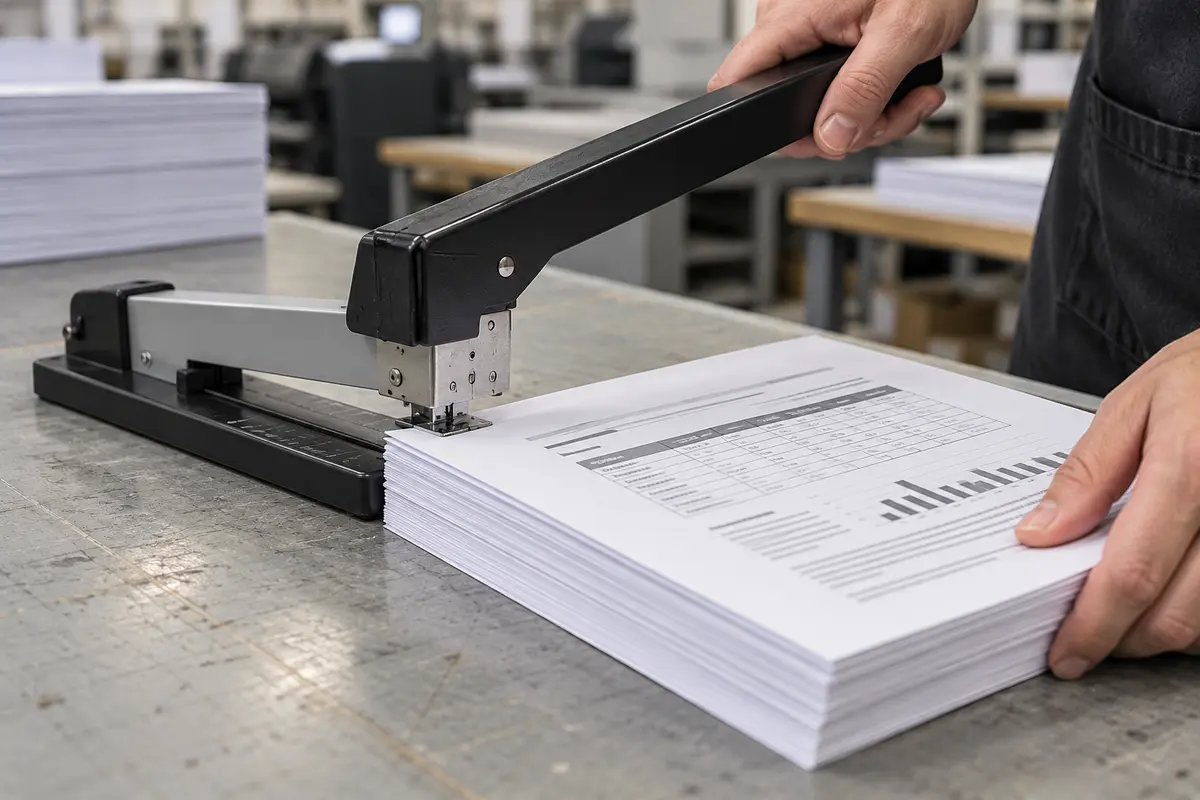
A cover printed with the shop logo is optional; it does not affect use but makes the book look neater at the counter. This adds almost no cost because the cover has to be printed anyway.
Content pre-printed on the sheet
The pre-printed part of a retail invoice sheet includes the shop information block at the top, a ruled table in the middle and the total block with signature space at the bottom. This layout is already standard so it does not need much change.
The number of lines in the retail invoice table needs to match how you actually sell. Shops selling many items each time need eight lines; shops selling one or two items find four lines enough and the sheet will be more compact.
The height of each line should be at least seven millimetres for handwriting to fit. Narrower lines make the writing cramped and hard for customers to read, especially when the writer uses a thick ballpoint pen.
- Top block: shop name, address, phone number, date space.
- Middle table: columns for item name, quantity, unit price, amount.
- Bottom block: total, signature space for seller and buyer.
- Number of lines by how you actually sell, 4 to 8 lines.
- Minimum line height 7mm.
The date space on the retail invoice should be in the top right corner with a pre-ruled line. Without a ruled line, writers often skip the date, and that is the most important information when customers come back to exchange goods.
Quantity and reorder cycle
A shop writing about twenty retail invoices a day uses up a one-hundred-sheet book in five days, meaning about seventy books a year are needed. This figure shows why it is worth ordering in large quantities.
The price per book of retail invoices drops clearly with quantity because the prepress and numbering costs are divided among more books. The clear price break is around fifty books, and the lowest level around two hundred books.
Retail invoice paper has no adhesive layer so it keeps for a long time without damage, as long as it is stored dry. So ordering a year's worth is reasonable, as long as the number range is recorded clearly.
| Quantity per run | Lasts | Price level |
|---|---|---|
| 10 calendars | 1 to 2 months | Highest |
| 30 calendars | 4 to 5 months | Slight reduction |
| 50 calendars | 7 to 8 months | Clear reduction |
| 100 calendars | About 1 year | Common level |
| Over 200 copies | 1 to 2 years | Lowest |
When ordering retail invoices in large quantities, many shops receive part and leave the rest at the workshop, receiving in trips. This solves the problem of limited storage space at an already cramped counter.
Paper and paper colour of each part
Multi-part retail invoice paper is self-copying, made of three layers coated with chemicals on the back and front of the sheets. When writing, pen pressure brings the two layers together and colour appears on the sheet below, so no carbon paper is needed.
Each part uses a different paper colour for quick identification. The common convention is part one white for the customer, part two pink kept by the shop, part three blue for the warehouse. Shops can change the colour order but should keep it fixed between rounds.
Self-copying paper is thinner than ordinary paper, so the retail invoice needs a rigid backing board behind when writing. Without a backing board, the writing imprints onto the sheet below in the book, making later sheets hard to use.
| Part | Conventional paper colour | Keeper |
|---|---|---|
| Part 1 | White | Customers |
| Part 2 | Pink | Kept by the shop |
| Part 3 | Green | Warehouse or accounting |
| Part 4 | Yellow | Spare copy |
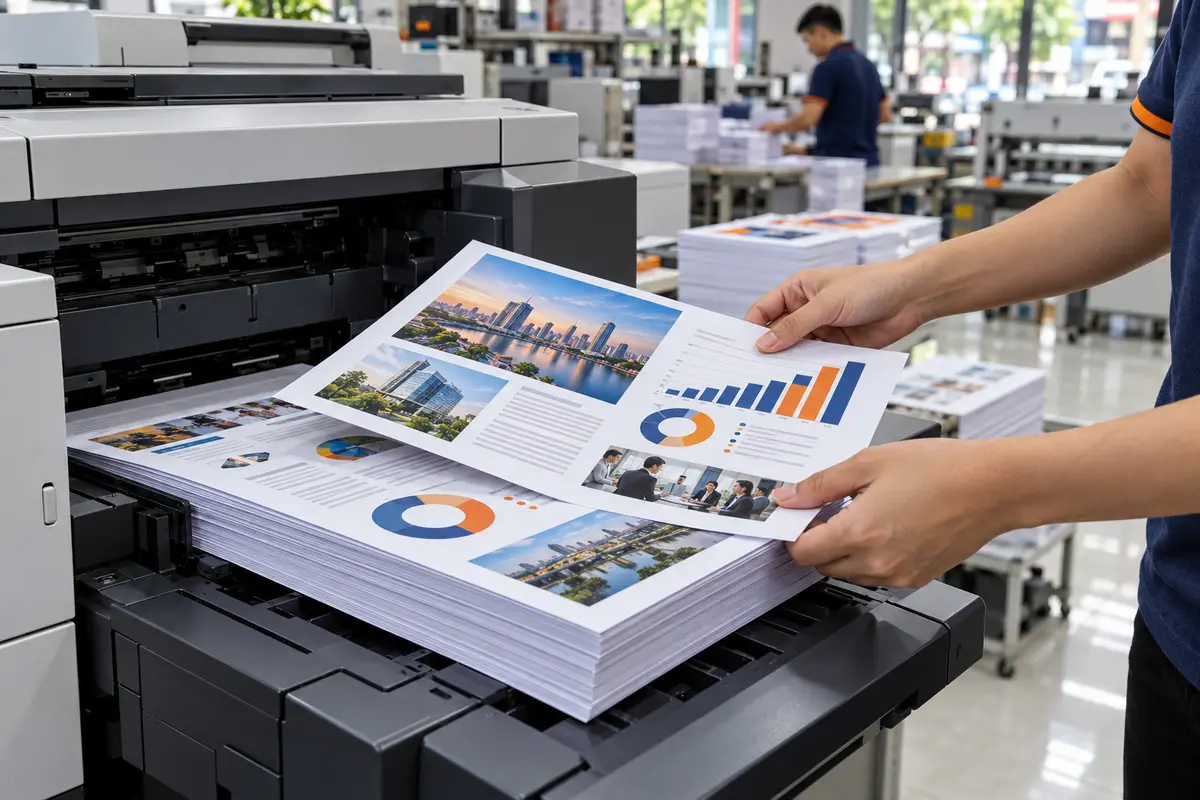
Ballpoint pens give the clearest results on self-copying paper. Gel pens and fountain pens create little pressure so the lower parts of the retail invoice show faint text; this is something to tell counter staff in advance.
Common mistakes in the first order round
The five mistakes below account for most cases where a round of retail invoices has to be reprinted. All five show up right away on a sample sheet, so the sample approval step is worth keeping.
The first mistake is a number range duplicating the previous round, making look-ups confusing. The second is line height that is too narrow, under seven millimetres, so handwriting gets cramped.
The third mistake is forgetting to leave a date space or signature space. The fourth is the shop information printed with the wrong phone number, requiring the whole round to be scrapped because customers cannot call back.
The fifth mistake is choosing one part for a shop that needs to keep a copy. With one part the shop keeps no copy, and when customers come back to exchange goods the old transaction cannot be looked up.
| Mistake | Consequence | How to avoid it |
|---|---|---|
| Number range duplicating the previous round | Confusing to look up | Record each round's number range |
| Lines too narrow | Handwriting cramped | Minimum line height 7mm |
| Missing a date space | Writers skip the date | Pre-rule a date box in the top corner |
| Wrong phone number | Scrap the whole round | Proofread the preview |
| Choosing one part | The shop cannot keep a copy | Choose at least two parts |
A sample sheet is delivered before running a large round, with a backing board for real test writing with a ballpoint pen. Testing it the way it is actually used shows right away the line height and how clearly the text appears on the lower parts of the retail invoice.
Delivery and ordering printing in District 7
The workshop is right in District 7 at 49 Mai Van Vinh, Tan Hung Ward, Ho Chi Minh City so shops in the district receive goods fast and dropping by to collect is convenient too. Retail invoice books are light so they are delivered by motorbike, reaching even the alleys.
- Information 1: sheet size and number of parts.
- Information 2: number of books and sheets per book.
- Information 3: starting number range, continuing from the previous round.
- Information 4: the content of the shop information block and the number of lines in the table.
Production time for a round of retail invoices is usually two to three days because there are numbering and binding steps, both done by hand. Send your request via Zalo to receive a quote by number of books and number of parts.
Need printing or signage in Ho Chi Minh City?
In Quảng Cáo Q7 runs its own print workshop in Tân Hưng Ward (former District 7), Ho Chi Minh City, producing and installing signage, banners, window graphics, exhibition booths and event displays. Send us the size, material, quantity and a photo on WhatsApp and we will get back to you.

Phone: +84 866 511 099 · Also on WeChat
Workshop: 49 Mai Văn Vĩnh, Tân Hưng Ward, Ho Chi Minh City