




































































Brochure Printing District 8 – A4 Bi-Fold, Tri-Fold, Couche 150–300gsm
Oct
Does your company need District 8 brochure printing? This article sets out the three sizes A5, A4 and A3, four Couche paper weights, fold styles and offset printing quantity levels at the In Quảng Cáo Q7 workshop.
Brochure printing for businesses in District 8
From Pham The Hien, Ta Quang Buu or Binh Dong, cross Nguyen Van Cu Bridge or Pham Hung Bridge and you reach the In Quảng Cáo Q7 workshop at 49 Mai Van Vinh, Tan Hung Ward. Cartons of flyers in large quantities are quite heavy, but the distance is short so they are still delivered within the day.
Brochures differ from single-sheet flyers in having folds, dividing content into panels so they hold a lot of information while staying compact in hand. Customers for District 8 brochure printing are mostly production facilities and distributors who need to introduce product lines to wholesale customers.
Choosing size and fold style
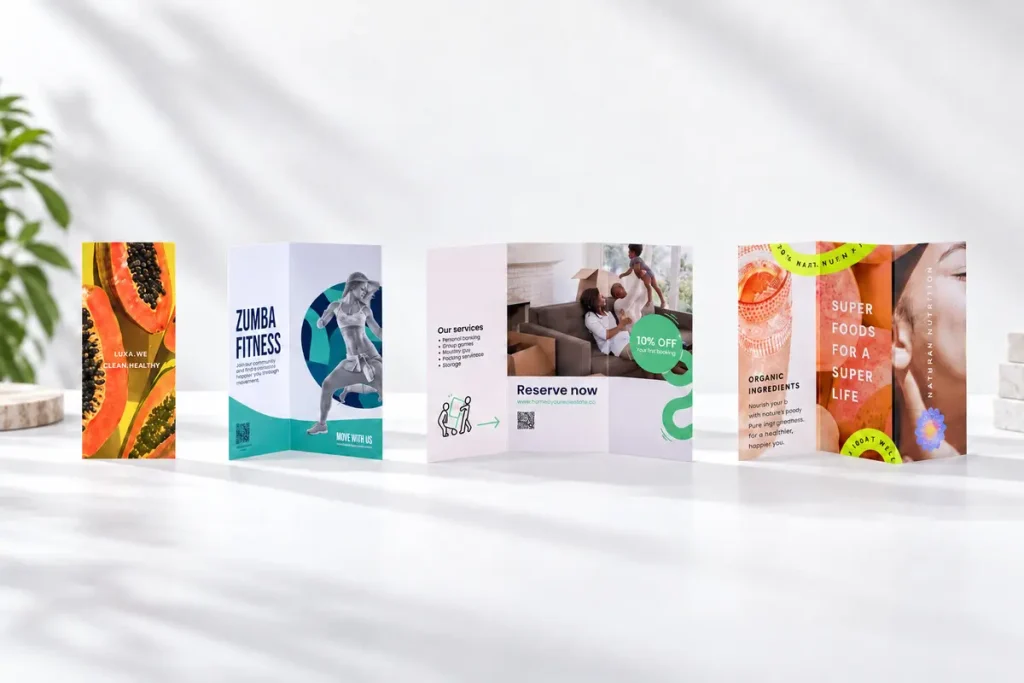
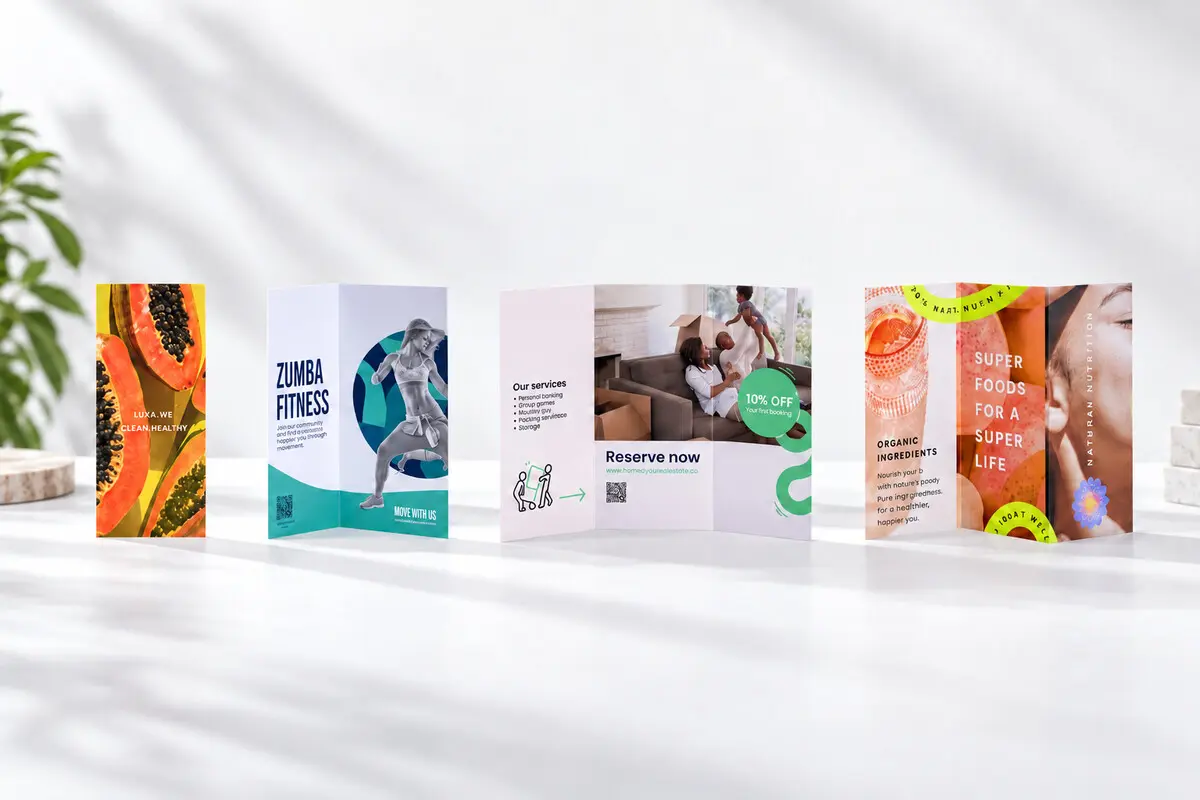
A4 bi-fold brochures divide the sheet into two panels, one topic per side – the simplest and easiest to read. A4 tri-fold brochures divide it into three panels; when opened, one side presents seamlessly, suited to introducing a process or a product range in order.
The A3-to-A4 fold takes an A3 sheet folded in half to A4; when opened it has twice the presentation space of a normal A4 sheet – used when you need a large specification table or diagram. A5 is for single-sheet hand-out versions, unfolded.
Paper and lamination
Couche paper 100gsm is thin and light, the cheapest, suited to large-quantity distribution rounds. Couche 150gsm is thicker, firm in hand. Couche 200gsm starts to be stiff, curling less when stood on the counter. Couche 300gsm is stiff like card, used for desk versions or premium introduction sheets.
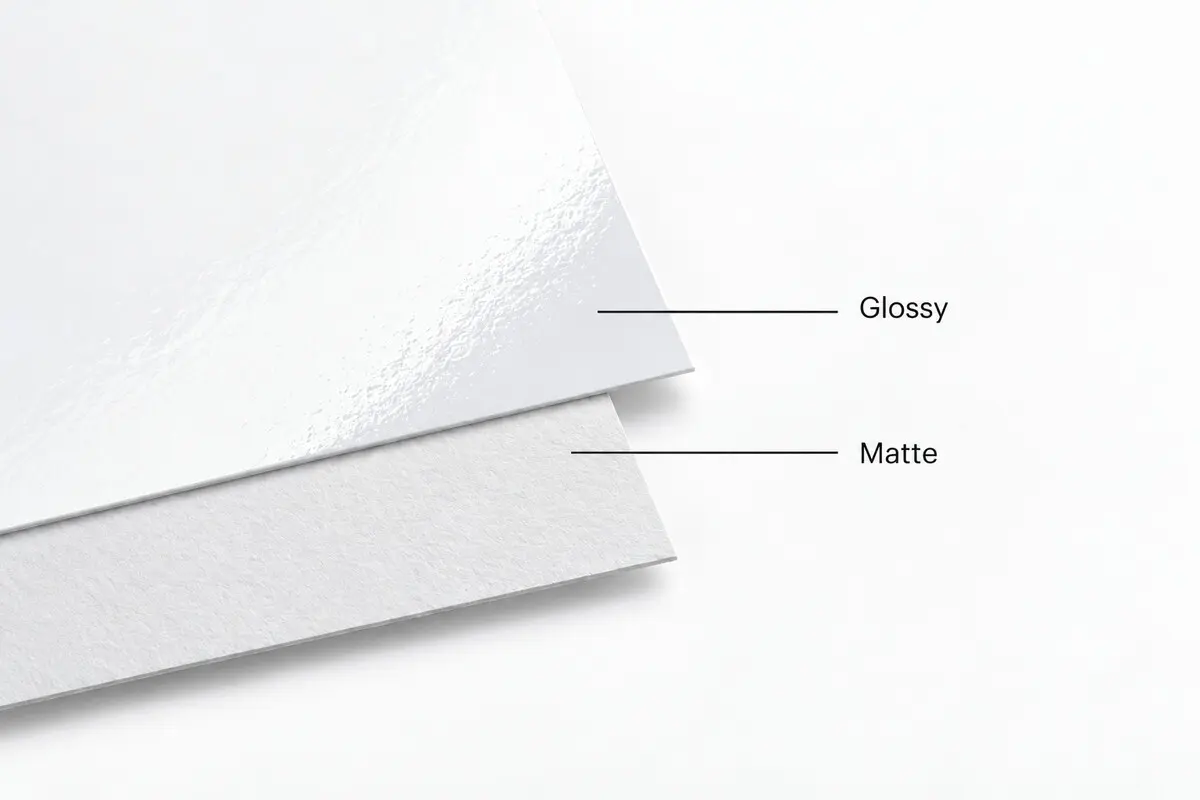
Lamination is optional: single-sided lamination covers the front against scratches, double-sided lamination covers both sides so the paper is stiffer and does not absorb moisture from hands. Folded versions should weigh this up because thick film makes folds harder to set – combined with the scoring option, the fold stays sharp.


Fold scoring and quantity levels
Scoring is a recessed line pressed in advance with a scoring die so the paper folds in the right place and the ink does not crack at the fold. Brochures with folds should always choose the Scoring option, especially with paper from 200gsm upwards because thick paper cracks very easily when folded without scoring.
Flyers and brochures run on offset printing so they have a fixed prepress cost: levels start from 500 sheets, through 1,000, 2,000, 3,000, 4,000, 5,000, 6,000, 10,000 and up to 20,000 sheets. If you need fewer than 500 sheets, message us on Zalo so the workshop can quote digital printing.
Frequently asked questions about District 8 brochure printing
How long does delivery to District 8 take?
Usually within the day once ready. Cartons of 5,000 A4 sheets or more are quite heavy, so tell us the address and floor beforehand so the workshop arranges the vehicle.
Is single-sided cheaper than double-sided?
The price list on the page is not split by number of sides, so make full use of both sides. Single-sided printing just means the back is left blank.
What if I do not have a brochure design file?
Send the content for each panel with the logo and images; the workshop's designer lays out the pages to match the folds and sends a preview for approval.
Order printing at In Quảng Cáo Q7
If you are in District 8 and need brochures printed, send the file or content via Zalo so the workshop can quote by size, paper weight, fold style and quantity – delivered over the bridge within the day once ready.
In Quảng Cáo Q7 direct print workshop – 49 Mai Van Vinh, Tan Hung Ward, Ho Chi Minh City. Production and delivery hours: Monday – Saturday, 8:00–12:00 and 13:00–18:00 · Orders via Zalo/hotline: Monday – Saturday 8:00–12:00 and 13:00–20:00, Sunday 14:00–19:00. Quick message via Zalo or call 0866.511.099.
See more printing services on the In Quảng Cáo Q7 home page, see all corporate print products or contact us quickly via the contact page; you can also get directions to the workshop on Google Maps.
How brochures differ from flyers and catalogues
These three items are often confused with each other. A flyer is a single unfolded sheet, distributed quickly and read in a few seconds. A brochure is a folded sheet, usually tri-fold, with room for six panels of content. A catalogue is a bound booklet with many pages, used for reference.
Because it has six panels, a brochure suits introducing a product group or a process, more than a flyer but not yet needing a booklet. This is why production and distribution facilities in District 8 use this item a lot.
Another practical difference is the distribution method. Flyers are distributed on the street, brochures are placed at the counter or sent with orders, catalogues are given to agents. Choosing the right item by distribution method avoids reprinting.
| Item | Number of content panels | How it is distributed | Cost per copy |
|---|---|---|---|
| A5 flyer | 2 sides | Street distribution | Lowest |
| Tri-fold brochure | 6 panels | At the counter, sent with orders | Medium |
| Bi-fold brochure | 4 panels | At the counter, handed to customers | Medium |
| 16-page catalogue | 16 panels | Given to agents | Higher |
| 32-page catalogue | 32 panels | Given to large agents | Highest |
Many facilities in District 8 do both: a flyer for wide distribution and a brochure to send with orders to customers who have bought. Both items ordered in the same round match in colour and take only one delivery.
Fold styles and the corresponding number of panels
The fold style decides the number of content panels and also how the reader opens it. The roll fold tri-fold is the most common style, but not the only one.
The roll fold tri-fold has two folds in the same direction, with three parts rolling into each other. Readers open it from right to left, so the outer right panel is the first one they see. This is where the main headline goes.
The accordion tri-fold has two folds in opposite directions, opening into a Z shape. This style shows three panels at once when half opened, suited to content with three steps or three parallel groups.
The bi-fold has one fold in the middle, giving four panels, like a slim booklet. The four-panel fold gives eight panels but such brochures are quite thick at the folds and hard to open neatly, so it is rarely used.
| Fold style | Number of folds | Number of sides | Suitable content |
|---|---|---|---|
| Bi-fold | 1 | 4 panels | Short introduction |
| Roll fold tri-fold | 2 | 6 panels | Product categories |
| Accordion tri-fold | 2 | 6 panels | Three steps, three parallel groups |
| Four-panel fold | 3 | 8 panels | Long content, rarely used |
| Gate fold | 2 | 6 panels | Opens into two wings, striking |
For roll fold tri-fold brochures, the panel folding inside must be about two millimetres narrower than the other two. Without this step, the edge of the inner panel bulges and the brochure cannot fold flat.
Related products


Leaflet / Brochure

Catalogue – Company Profile

Folder

Business cards
How to divide content across six panels
The six panels of a tri-fold brochure are not equal in importance. Readers see the front cover first, then open it to see the three inner panels at once, and only look at the back last.
The usual division is the cover with the name and one positioning line, the three inner panels with the main content, and the back with contact information. The panel folding inside is the weakest so it holds secondary content.
The three inner panels open at the same time so they should be laid out as one continuous page, not as three disjointed columns. Images or tables running across two panels make the content flow better, as long as they avoid the fold zone exactly.
- Cover: facility name, one positioning line, one main image.
- Panel folding inside: secondary content, short catalogue.
- Three inner panels: main content, laid out as one continuous page.
- Back: address, phone number, QR code, small map.
- Avoid placing important text within 3mm of the fold.
A small map on the back is an effective detail for facilities in District 8, because many areas of small streets are hard to find. With a QR code leading to the map, customers can follow their phone without reading directions in words.
Paper and weight for brochures
Brochures need paper thick enough not to go limp when held, but not too thick because the folds will crack. Around one hundred and twenty to one hundred and seventy grams is the most suitable range.
Couche paper 150gsm is the common level: stiff enough, takes colour well and folds without cracking. 120gsm is lighter, economical when printing large quantities and when brochures are sent with orders by post.
Above 200gsm, folds need to be scored first, meaning a recessed line is pressed along the fold before folding. Without scoring, the ink layer at the fold cracks into white streaks, especially on dark backgrounds.
| Weight | Scoring needed | Use when |
|---|---|---|
| 120gsm | No | Large quantities, sent by post |
| 150gsm | No | Standard grade |
| 170gsm | Scoring recommended | Need a firm feel in hand |
| 200gsm and above | Scoring mandatory | Premium brochures with few panels |
Lamination for brochures is optional, not mandatory as with catalogue covers. Many facilities only laminate brochures left at the counter for a long time, while those sent with orders are left unlaminated to save money.
Quantity and reprint cycle
Brochures have a prepress cost so the price per copy drops clearly with quantity. The threshold for switching to offset printing is around one thousand copies, and above that the price per copy reaches the lowest range.
Production facilities in District 8 usually print in rounds of one to two thousand copies for six to twelve months. If the content has prices, the cycle is shorter, because a price change means reprinting.
The approach many facilities use is not printing prices in the brochure, only the catalogue and specifications. Prices go on a separate insert sheet, very cheap to reprint when an update is needed.
| Quantity | Technology | Time | Price level |
|---|---|---|---|
| 50 to 300 copies | Digital printing | 1 to 2 days | Highest |
| 300 to 1,000 copies | Calculate both ways | 2 to 3 days | Medium |
| 1,000 to 5,000 copies | Offset printing | 3 to 4 days | Clear reduction |
| Over 5,000 copies | Offset printing | 4 to 5 days | Lowest |
For print runs over one thousand copies, folding is the step that decides the time because the folding machine runs at a fixed speed. Accordion tri-fold orders are slightly slower than roll fold because two opposite folds have to be aligned.
Common mistakes and how to approve samples
The five mistakes below account for most cases where a round of brochures has to be reprinted. All five show up right away on a fold mock-up, so the sample approval step is worth keeping.
The first mistake is important text falling into the fold zone, broken up or smudged at the fold. The second is the panel folding inside not being narrower, so the brochure does not fold flat.
The third mistake is dividing content into three disjointed columns even though the three inner panels open at the same time, making it look patched together to readers. The fourth is choosing paper over 200gsm without scoring the folds, so the ink cracks into white streaks.
The fifth mistake is placing the QR code too small or on a dark background, so phones cannot scan it.
| Mistake | Consequence | How to avoid it |
|---|---|---|
| Text falling into the fold | Broken up, smudged | Leave 3mm around the fold |
| Inner folding panel not narrower | Does not fold flat | 2mm narrower |
| Three inner panels laid out disjointedly | Looks patched together | Lay out as one continuous page |
| Thick paper without fold scoring | Ink cracks into white streaks | Score the folds before folding |
| QR code small or on a dark background | Cannot be scanned | At least 15x15mm, light background |
A fold mock-up is delivered before running a large round, folded in the chosen style. Opening and folding it a few times shows right away whether the ink cracks at the folds, which cannot be seen on the preview.
How to distribute and where to place brochures
Printing and then leaving them in cartons in the warehouse is how a round of brochures creates no value at all. The five ways below are places where customers pick them up themselves or receive them without anyone standing there distributing.
The first way is sending them with orders. Customers see it when they open the carton, and this is the moment they are most interested in the facility's products. This method has the highest read rate of the five.
The second way is placing a small rack at the reception counter or warehouse door for customers to pick up when collecting goods. The third is sending agents a stack so they can pass them on to their own customers.
The fourth way is taking them along when sales staff visit customers. The fifth is placing them at shops with reciprocal relationships in the area, and in return they also leave their materials at yours.
- Sent with orders, the highest read rate.
- Small rack at the counter or warehouse door for customers to pick up.
- Send stacks to agents for them to pass on.
- Sales staff take them along when visiting customers.
- Place them at shops with reciprocal relationships in the area.
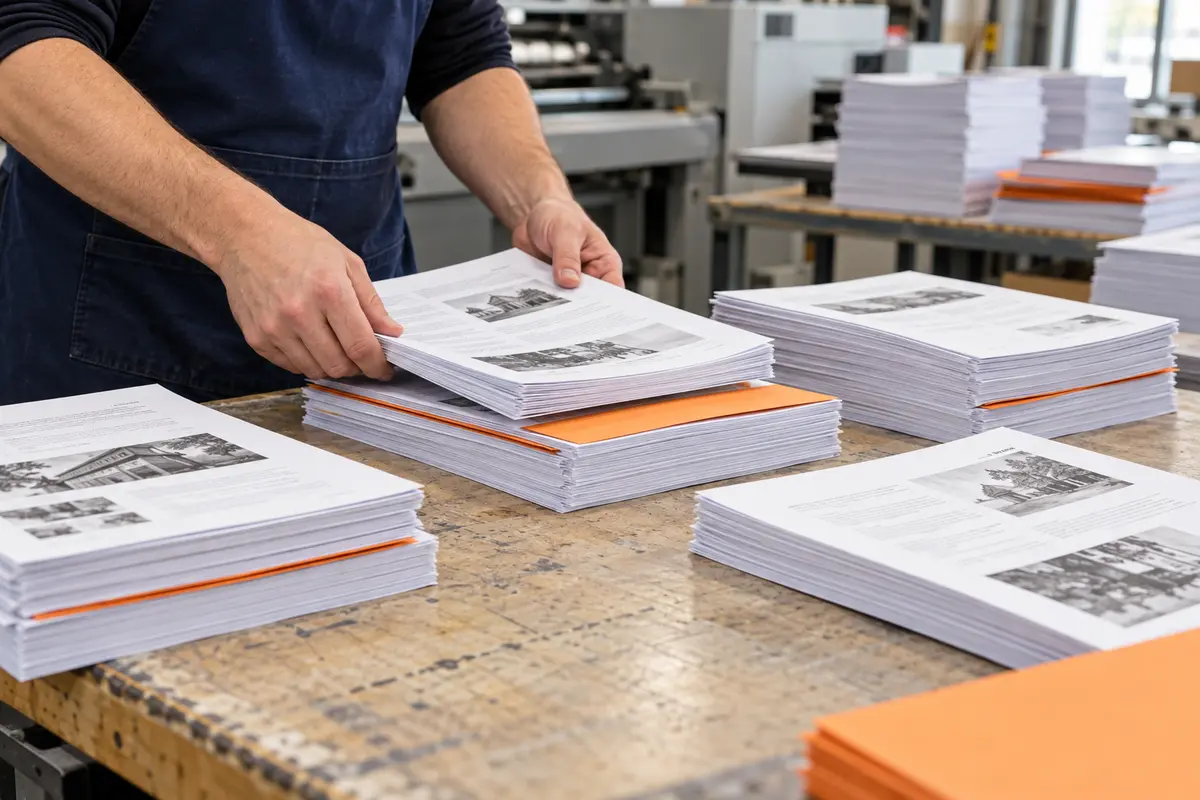
With the method of sending with orders, the brochure quantity should be calculated by the number of orders each month. A facility delivering one hundred orders a month needs about one thousand two hundred copies for a year, and that level also reaches a good price threshold.
Delivery and ordering brochure printing in District 8
Workshop at 49 Mai Van Vinh, Tan Hung Ward, Ho Chi Minh City, to District 8 via Nguyen Van Cu Bridge or Chanh Hung Bridge. Brochures are packed in cartons by quantity, delivered by motorbike for a few hundred copies and by small truck for many cartons.
- Information 1: finished size and fold style.
- Information 2: quantity and paper type, with or without lamination.
- Information 3: content or design file, with product photos.
- Information 4: the date you need it, delivery address and gate opening hours if delivering into a warehouse.
If you do not have a file, send the text content, logo and separate images; the layout is done at the workshop and a preview is sent with a fold diagram. Send your request via Zalo to receive a brochure quote by quantity and fold style.
Need printing or signage in Ho Chi Minh City?
In Quảng Cáo Q7 runs its own print workshop in Tân Hưng Ward (former District 7), Ho Chi Minh City, producing and installing signage, banners, window graphics, exhibition booths and event displays. Send us the size, material, quantity and a photo on WhatsApp and we will get back to you.

Phone: +84 866 511 099 · Also on WeChat
Workshop: 49 Mai Văn Vĩnh, Tân Hưng Ward, Ho Chi Minh City