




































































Leaflet Printing Trung Son – A5, A4, A3 Couche, Offset From 500 Sheets

Oct
Does your company need Trung Son leaflet printing? This article sets out the three sizes A5, A4 and A3, four Couche paper weights, fold styles and offset printing quantity levels at the In Quảng Cáo Q7 workshop.
Leaflet printing for the Trung Son area
The Trung Son residential area sits right on the border of the former District 7; from Road 9A or the Nguyen Van Cu extension, cross the bridge and you reach the In Quảng Cáo Q7 workshop at 49 Mai Van Vinh, Tan Hung Ward. Being close, customers in this area often drop by to approve the colours of the test print before running the whole order.
Demand for Trung Son leaflet printing comes from clinics, training centres, shops and service companies – the group handing out introduction sheets to walk-in customers or tucking them into shopping bags. A leaflet is a single sheet read in a few dozen seconds, unlike a brochure with folds.

Choosing the size by distribution method
A5 is the most common size for hand distribution: fits a jacket pocket, light, printed in large quantities at low cost. A4 is for a fuller introduction, placed on the counter or clipped into files. A3 is for a spread version, which can be hung or folded in half to A4.
Many clinics and centres make two versions: A5 handed out to walk-in customers and A4 kept at the reception desk. The content is shared, only the layout differs, so design work does not double.
Four Couche paper weights
Couche 100gsm is thin and light, the cheapest, for large-quantity distribution rounds on the street or tucked into shopping bags. Couche 150gsm is thicker, firm in hand, the balanced level chosen most.
Couche 200gsm starts to be stiff, curling less when stood on the counter or clipped into a folder. Couche 300gsm is stiff like card, used for desk versions, service cards or introduction sheets handed to important customers.
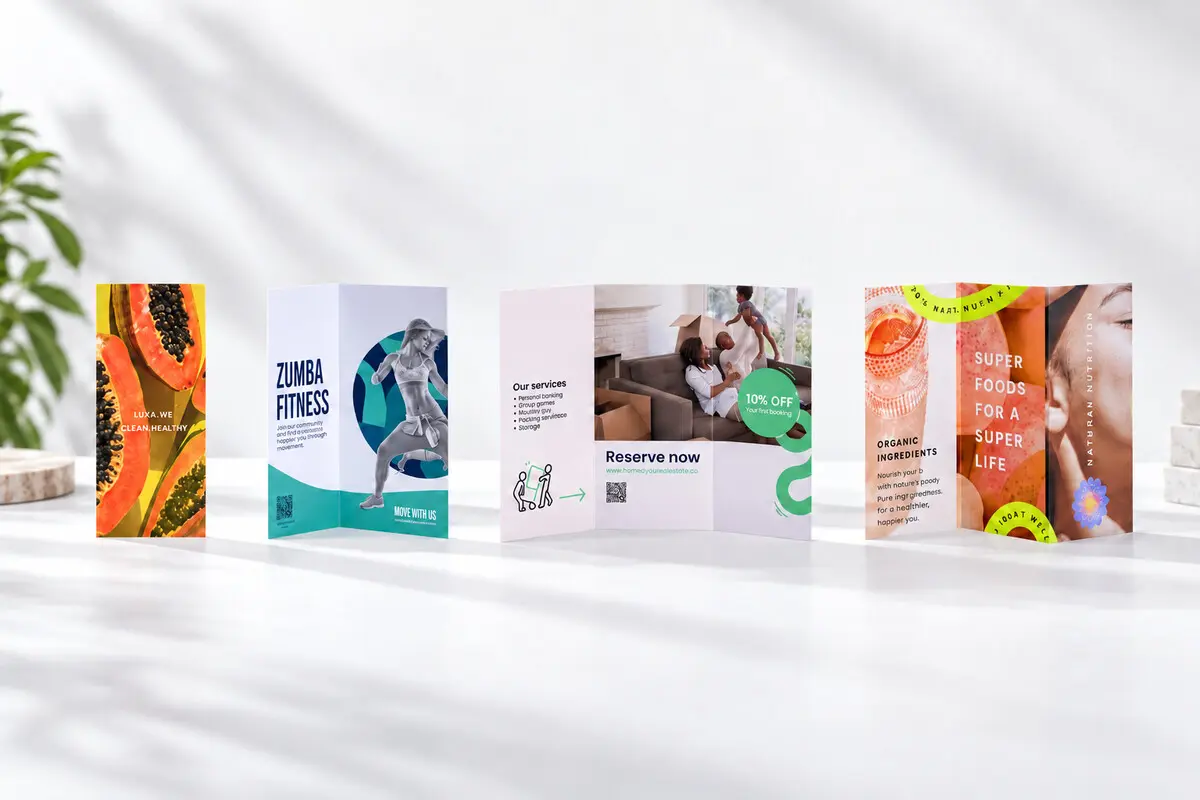

Lamination, scoring and offset printing levels
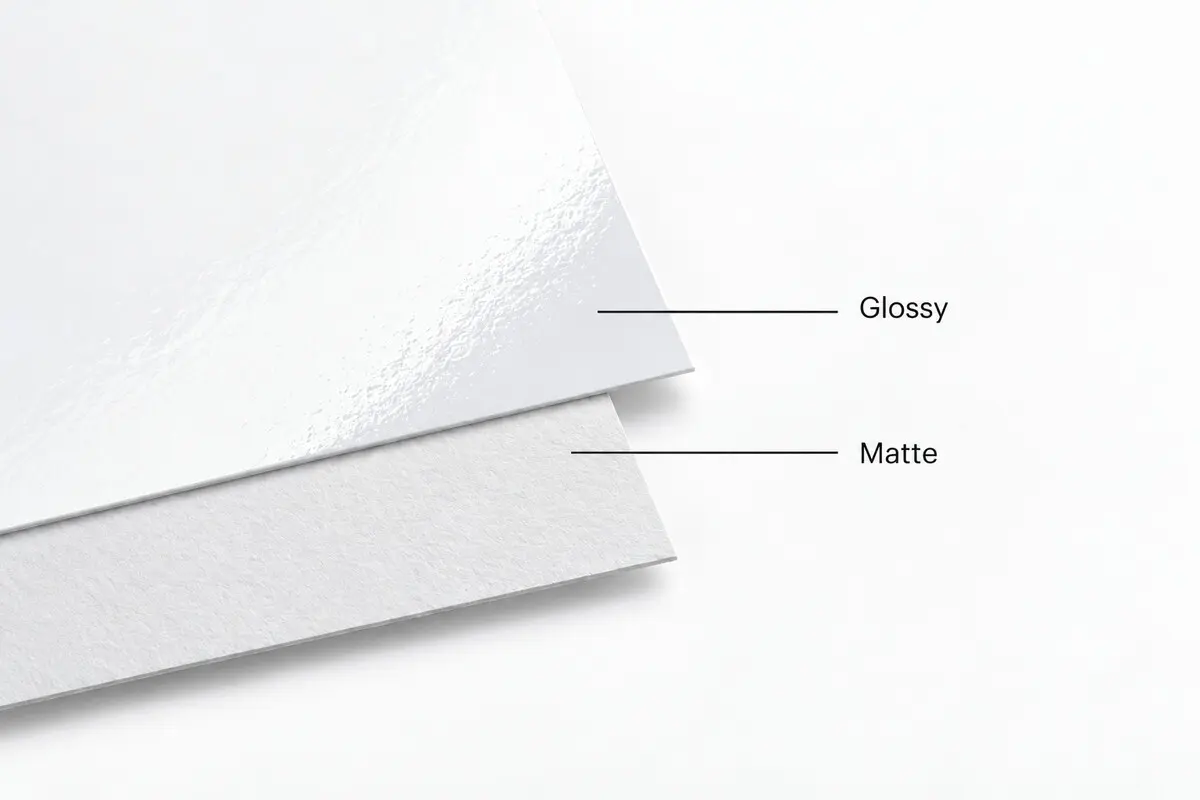
Single-sided lamination covers the front against scratches; double-sided lamination covers both sides so the paper is stiffer and does not absorb moisture from hands – worth considering for counter sheets used for a long time. No lamination keeps the original paper surface and can be written on with a pen.
Scoring is a recessed line pressed in advance so the paper folds in the right place and the ink does not crack – choose it when the version has folds. Flyers run on offset printing so levels start from 500 sheets, through 1,000, 2,000, 3,000, 4,000, 5,000, 6,000, 10,000 and up to 20,000 sheets.
Frequently asked questions about Trung Son leaflet printing
Can I drop by the workshop to approve the colours?
Yes, and Trung Son customers often do because it is close. For colour-critical orders, the workshop prints a test copy on the exact paper type to be used so you can see it directly before running the whole order.
What if I need 300 sheets?
The price list on the page starts from the 500-sheet level because it runs on offset printing. If you need fewer, message us on Zalo so the workshop can quote digital printing.
Will the printed colours match the colours on screen?
Screens display in RGB while printers use CMYK, so there is always a difference, most noticeable in blue and vivid orange tones. Files prepared in CMYK give the closest result; the workshop checks the file and warns you in advance of colour areas that may shift.
Order printing at In Quảng Cáo Q7
If you are in the Trung Son area and need leaflets printed, send the file via Zalo and then drop by 49 Mai Van Vinh to approve the test print – once settled, the workshop runs the whole order and delivers to your door.
In Quảng Cáo Q7 direct print workshop – 49 Mai Van Vinh, Tan Hung Ward, Ho Chi Minh City. Production and delivery hours: Monday – Saturday, 8:00–12:00 and 13:00–18:00 · Orders via Zalo/hotline: Monday – Saturday 8:00–12:00 and 13:00–20:00, Sunday 14:00–19:00. Quick message via Zalo or call 0866.511.099.
See more printing services on the In Quảng Cáo Q7 home page, see all corporate print products or contact us quickly via the contact page; you can also get directions to the workshop on Google Maps.
Leaflets for a gated residential area
Trung Son is a gated residential area, with townhouses along the roads and businesses on the ground floor. This makes leaflets an effective item, because door-to-door distribution within the area is feasible and recipients are potential customers right nearby.
Unlike flyers distributed on main roads, a leaflet distributed in a residential area is kept longer. The recipients are residents and the service is a few hundred metres from home, so they put it away to use when needed.
So the content of leaflets in the area should lean towards long-lasting information: services, address, opening hours and phone number. Time-limited promotions get one small line, not the main content.
| Premises | Main content on the leaflet | Distribution cycle |
|---|---|---|
| Clinics, dentists | Service list, clinic hours | Once every 6 months |
| Spa, beauty | Treatment plans, reference price list | Once every 3 months |
| Eateries, cafés | Main menu, time-based offers | Once every 2 months |
| Repair shop | Services, service area | Once every 6 months |
| Training centres | Programmes, enrolment schedule | By term |
The distribution cycles in the table are the levels many premises in Trung Son are using. Distributing too often makes residents feel it is excessive; too rarely and the old leaflet has been thrown away and people forget.
Size and folding
A5 is the most common size for leaflets because it fits the hand, has enough room for content and is reasonably priced. A6 is smaller, suited when only one image and one phone number are needed.
A4 tri-fold gives six content panels, used when there are many services and a list is needed. But for door-to-door distribution, unfolded sheets are usually read more, because recipients only look once and then decide whether to keep or throw it away.
So many premises choose unfolded A5 leaflets printed double-sided. The front has one big message, the back has the list and contact information.
| Size | Number of sides | Features | Cost per copy |
|---|---|---|---|
| Unfolded A6 | 2 sides | Small, quick to read | Lowest |
| Unfolded A5 | 2 sides | Standard grade | Low |
| A5 bi-fold | 4 panels | Like a slim booklet | Medium |
| Unfolded A4 | 2 sides | Striking, lots of room | Medium |
| A4 tri-fold | 6 panels | Lots of content | Higher |
For leaflets distributed door to door, unfolded A5 is the most popular choice because it balances cost and amount of information. Folded sheets should only be used when the content really needs more than two sides.
Related products


Leaflet / Brochure

Catalogue – Company Profile

Folder


Business cards
Content on both sides
A leaflet is looked at for about two seconds before the recipient decides to keep or throw it away. So the front should only have one message, not a list.
That message should answer the recipient's question: what service is this and where is it. The facility name and one line describing the service in a large font is enough, with one relevant image.
Only the back holds the list, reference price list, opening hours, address and phone number. This is the part recipients read after deciding to keep the leaflet.
- Front: facility name, one line describing the service, one main image.
- Back: list, reference prices, opening hours, address, phone number.
- Phone number and Zalo in a large font, easy to see when needing to call.
- Add a small map if the premises are deep inside the area.
- Leave a handwriting box if the leaflet doubles as a discount voucher.
A handwriting box on the back turns the leaflet into a single-use discount voucher. Recipients bring it to the premises, staff write the date or stamp it, so the facility can count how many sheets brought in customers.
Paper and paper weight
Leaflets distributed door to door usually use Couche paper 120 to 150gsm. This level is stiff enough that the sheet does not go limp when slipped through a door, and takes colour well.
100gsm is lighter and cheaper, suited to very large quantities. The drawback is that thin sheets crease easily when slipped through door gaps, and look less good when recipients pick them up.
200gsm and above gives the leaflet the feel of a card, used when the facility wants recipients to keep it long. The price is higher so it is usually only printed in small quantities for a select group of customers.
| Weight | Feel | Use when |
|---|---|---|
| 100gsm | Thin, light | Very large quantities |
| 120gsm | Fits the hand | Standard grade |
| 150gsm | Firm in hand | Want recipients to keep it |
| 200gsm | Like a card | Small quantity, select customers |
Lamination for leaflets is hardly needed because the sheet is single-use. Only items doubling as discount vouchers carried back and forth many times should be laminated on one side, leaving the other side blank for handwriting.
Quantity by number of households in the area
For leaflets distributed door to door, the quantity is calculated by the number of households in the area, not by feel. The Trung Son area has a known number of households, so this figure is fairly certain.
The calculation is the number of households within the desired distribution range, plus about one tenth for damaged sheets and redistribution. If distributing twice a year, double it.
The clear price break is around two thousand copies, and the lowest level around five thousand copies. So many premises combine the whole year's quantity into one print round and then split it up to distribute in rounds.
| Quantity | Technology | Time | Price level |
|---|---|---|---|
| 200 to 500 copies | Digital printing | 1 day | Highest |
| 500 to 2,000 copies | Calculate both ways | 1 to 2 days | Medium |
| 2,000 to 5,000 copies | Offset printing | 2 to 3 days | Clear reduction |
| Over 5,000 copies | Offset printing | 3 to 4 days | Lowest |
Combining the whole year's quantity should only be done when the content has no dates and no specific prices. Leaflets with a programme deadline must be printed round by round, even though the price per copy is higher.
How to distribute in the area and what to know
Distributing leaflets in a gated residential area differs from street distribution in a few ways. The area has a management board, security guards, and residents are sensitive about paper being slipped into their doors.
So ask the management board's rules first. Some areas allow placing in mailboxes, some only at the reception desk or common notice board, and some do not allow door-to-door distribution.
The way that causes the least objection is leaving leaflets in mailboxes rather than slipping them through door gaps, and distributing in the morning rather than the evening. Avoiding the same days as other facilities also helps your sheet not get thrown away in the same pile.
- Ask the area management board's rules before distributing.
- Leave them in mailboxes, do not slip them through door gaps.
- Distribute in the morning, avoid the evening.
- Distribute road by road, recording the roads covered to avoid duplication.
- Include a handwriting box to count how many sheets brought in customers.
Recording the roads covered is a small but useful task. After one or two rounds, the facility knows which roads give better responses and focuses the leaflet quantity there in the next round.
Common mistakes and how to approve samples
The five mistakes below account for most cases where a round of leaflets brings no results. Unlike other items, the mistakes here are usually not printing mistakes but content mistakes.
The first mistake is cramming too much text on the front, so recipients cannot read anything in two seconds. The second is missing a specific address, only writing the area name.
The third mistake is a phone number printed too small. The fourth is printing specific prices and then the prices change, requiring the whole round to be scrapped. The fifth is choosing paper that is too thin so the sheet creases when distributed.
| Mistake | Consequence | How to avoid it |
|---|---|---|
| Cramming text on the front | Nobody reads it | One message, one image |
| Missing a specific address | Customers cannot find the place | State the house number and street name |
| Phone number too small | Customers do not call | Make it the second largest after the headline |
| Printing specific prices | A price change means scrapping the whole round | State reference prices or drop the prices |
| Paper too thin | Sheets crease when distributed | Use 120gsm or more |
A test print of one leaflet is delivered before running a large round. A quick check is to give it to someone who does not know the service, let them look for two seconds and then ask what they remember.
Measuring the effectiveness of a distribution round
Unlike shop signs or business cards, a round of leaflets can have measurable results if a few details are prepared in advance. Without measurement, the next round is still done by feel, without knowing whether to increase or decrease.
The simplest way is to print a short discount code on the sheet; customers read the code when calling or bring the sheet in. Each round uses a different code so you know which round customers came from.
The second way is to use a separate phone number or a separate QR code for each round. The number of calls to that number or the number of QR code scans is a measurable figure.
The third, the simplest yet skipped by many premises, is to ask new customers where they heard about the facility and record it. It takes five seconds per customer but after a month you have data.
- Print a short discount code, a different code for each round.
- Use a separate QR code for each round to count scans.
- Ask new customers where they heard about the facility and record it.
- Record the roads covered to compare responses between roads.
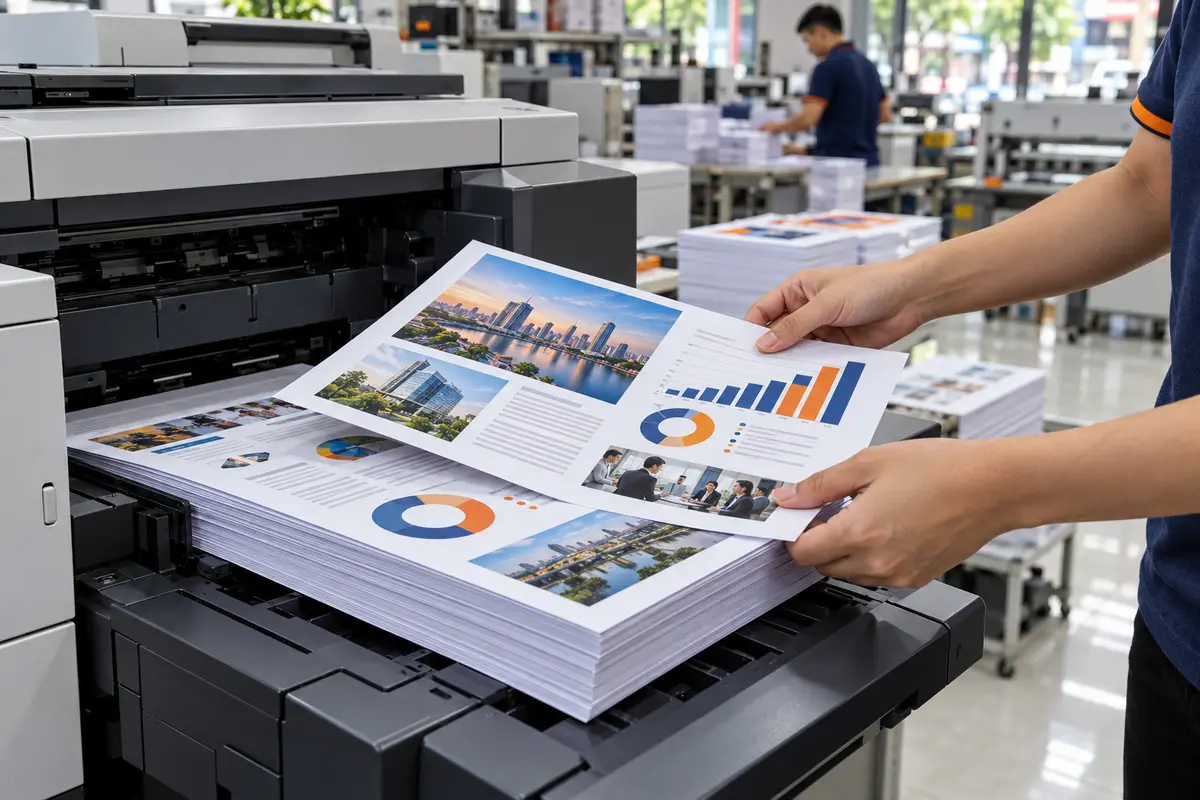
After two or three rounds with data, the leaflet quantity printed for the next round is decided by the numbers rather than by guesswork. This is also how you know whether to change the content or just change the distribution area.
Receiving goods and ordering leaflet printing in Trung Son
The workshop is located at 49 Mai Van Vinh, Tan Hung Ward, Ho Chi Minh City, and from here to the Trung Son area is only a few minutes, so samples and goods are both delivered fast. Print runs of a few thousand copies are packed in cartons and delivered by motorbike or small truck depending on the number of cartons.
- Information 1: size and whether single-sided or double-sided.
- Information 2: quantity and paper type.
- Information 3: content or design file, with images if any.
- Information 4: the date you need it and the premises address.
If you do not have a file, send the text content and logo; the layout is done at the workshop and a preview is sent. Send your request via Zalo to receive a leaflet quote by quantity and paper weight.
Need printing or signage in Ho Chi Minh City?
In Quảng Cáo Q7 runs its own print workshop in Tân Hưng Ward (former District 7), Ho Chi Minh City, producing and installing signage, banners, window graphics, exhibition booths and event displays. Send us the size, material, quantity and a photo on WhatsApp and we will get back to you.

Phone: +84 866 511 099 · Also on WeChat
Workshop: 49 Mai Văn Vĩnh, Tân Hưng Ward, Ho Chi Minh City