




































































Lamination: Glossy or Matte, Cold or Hot, and How to Choose
Oct
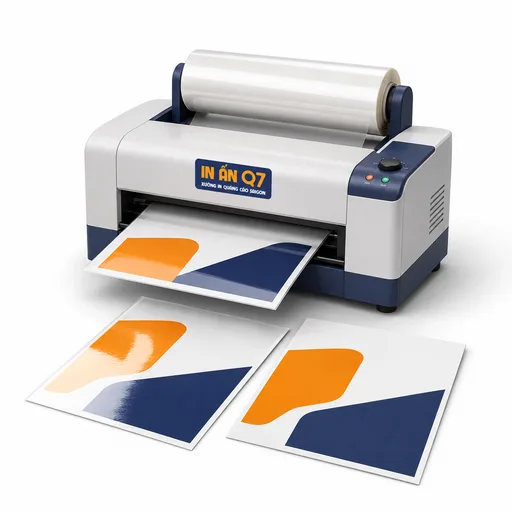
Lamination is the finishing step that covers a printed sheet with a thin plastic film. The film doesn't change the content, but it completely changes how the piece feels in the hand, how durable it is and how the print colors look under light. This article covers four concepts customers often confuse: glossy and matte film are two surfaces, while cold and hot lamination are two methods.
What lamination is and which materials it works on
The machine bonds a thin BOPP or PET film onto the paper surface with heat and pressure. The film is about 12 to 32 microns thick, thinner than a hair, yet enough to keep water away from the ink and stop paper edges from fraying after repeated handling.
| Material | Can it be laminated | Notes |
|---|---|---|
| Couche Paper | Yes, the most common | Coated surface, film bonds evenly |
| Bristol Paper | Yes | Gloss side bonds better than matte side |
| Ivory Paper | Yes | Usually the outer side of boxes is laminated |
| Kraft Paper | Yes | Film takes away some of the natural feel |
| Textured fine art paper | Limited | Film covers the texture, so usually not laminated |
| Fort Paper | No | Uncoated paper, film tends to peel in streaks |
| Paper and plastic decals | Yes | Laminate before die-cutting or cutting |
| Large-format PP | Yes | Large-format lamination on a dedicated machine |
| Hiflex Banner | Not needed | Surface is already water-resistant |
| Synthetic paper | Not needed | The material itself is waterproof |
Coated papers give the best lamination results because their flat, sealed surface lets the film's adhesive bond evenly. Uncoated paper such as Fort paper absorbs adhesive unevenly, so the film bonds in some spots but not others and peels in streaks after a few weeks.
How glossy and matte lamination differ
| Criterion | Glossy film | Matte film |
|---|---|---|
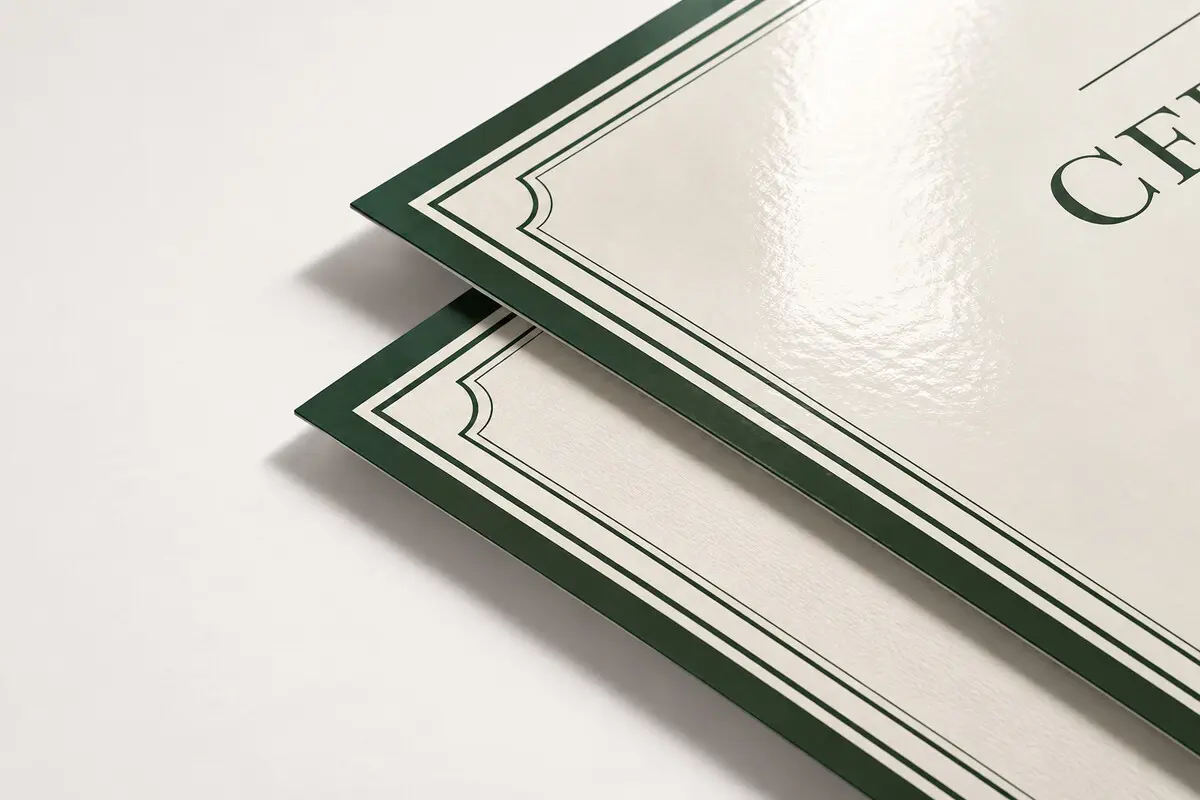
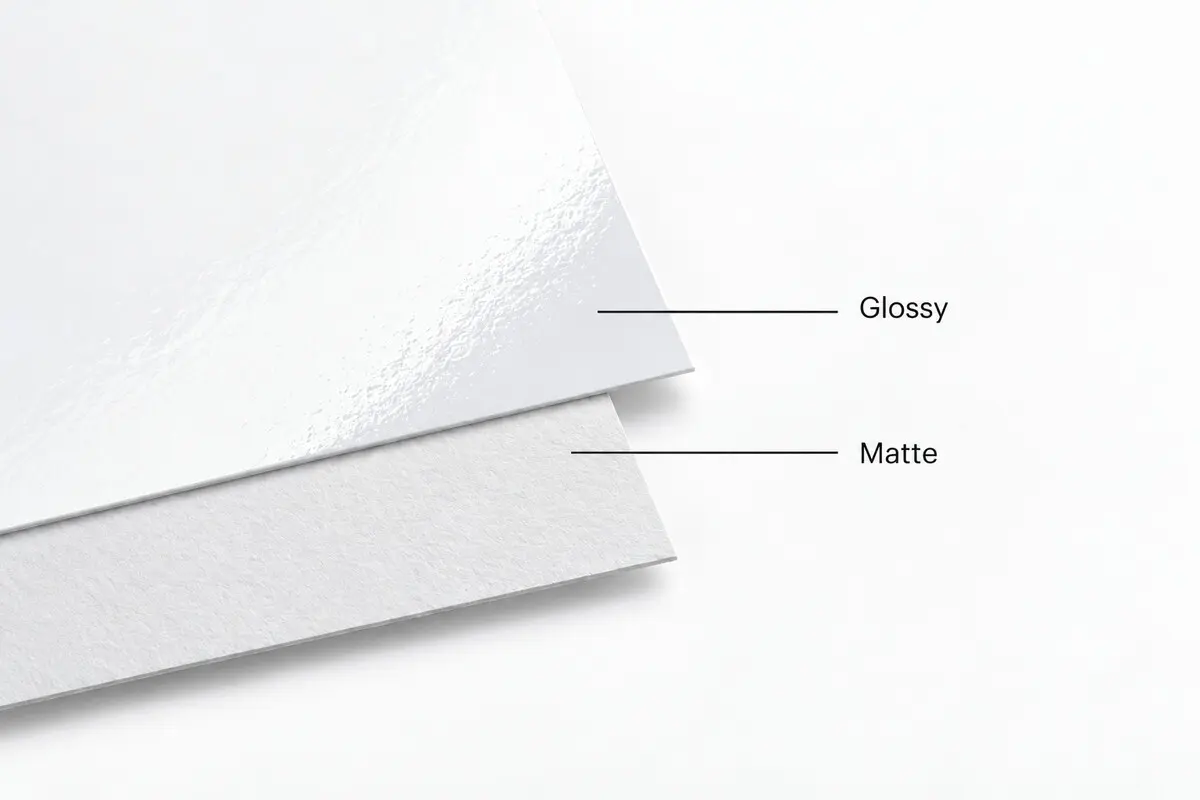
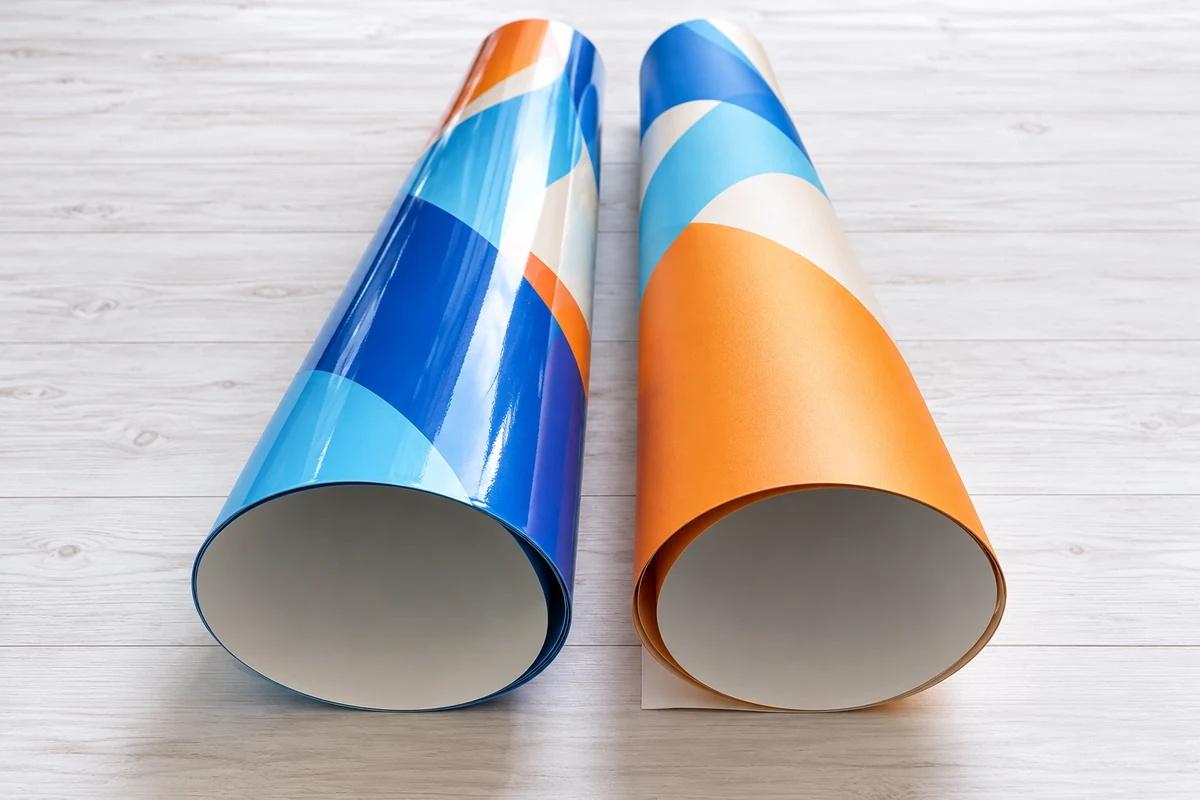
| How print colors look | Deep, vivid, high contrast | Softer, about one step more muted |
| Light reflection | Yes, glare under direct light | Almost none, readable from any angle |
| Feel in the hand | Slick, cool to the touch | Lightly velvety, slightly grippy |
| Fingerprints | Clearly visible | Less visible |
| Scratches | Clearly visible, bright scratches on a glossy background | Hard to see |
| Writing on the surface | Ballpoint pens don't write, oil-based markers do | Both oil-based markers and gel pens work |
| Photographing | Reflects the camera flash | Photographs well without glare |
| Cost | The same | The same |
Both types have the same durability and the same price, so the choice depends only on where the piece will be viewed. Under spotlights or where people photograph it, matte film is clearly better; where colors need to look vivid and deep, as in product photos, glossy film does what matte cannot.
Choosing glossy or matte for each print product
| Item | Recommended lamination | Reason |
|---|---|---|
| Business cards | Matte film on both sides | The back can be written on, no fingerprints showing in a wallet |
| Flyers and leaflets | Glossy film | Vivid colors, grasped by customers in seconds |
| Catalogue covers | Matte film | Covers are handled a lot, matte film shows fewer scratches |
| Catalogue inner pages | Matte film or no lamination | Glossy inner pages glare when read under ceiling lights |
| Venue menu | Matte film | Customers read under lights without glare |
| Product photo posters | Glossy film | Deep colors, details stand out |
| Paper boxes | Glossy film on the outside | Withstands rubbing during shipping |
| Premium gift boxes | Matte film | Looks more subdued and elegant |
| Presentation folders | Matte film | Handled a lot, dark backgrounds don't show marks |
| Loyalty cards | Matte film | Stamp ink adheres to the matte surface |
| Food labels | Glossy film | Withstands moisture in the fridge |
| Certificates | Matte film | No reflection behind the frame glass |
The simplest rule: pieces people read get matte lamination, pieces people look at get glossy lamination. Loyalty cards are a notable exception, because on a glossy surface stamp ink wipes right off.
Cold lamination and hot lamination
These are two lamination methods, not two surfaces. Both cold and hot films come in glossy and matte versions, so these four concepts can be combined.
| Criterion | Cold lamination | Hot lamination |
|---|---|---|
| How it bonds | Film with pressure-sensitive adhesive, pressed by rollers | Film with heat-activated adhesive, melted then pressed |
| Machine temperature | Room temperature up to about 40 degrees | About 90 to 120 degrees |
| Adhesion | Good, but lower than hot film | Very strong, film and paper become one |
| Surface after lamination | May ripple slightly if pressure is uneven | Flatter and tighter |
| Thin paper under 150 gsm | Suitable, paper doesn't curl | Paper curls easily as heat removes moisture |
| Thick paper from 250 gsm | Yes | Most suitable |
| Heavy ink coverage | Suitable, doesn't make ink run | High heat may smudge ink slightly |
| Heat-sensitive materials | Suitable, that's why it exists | Not usable |
| Machine speed | Slower | Faster |
| Cost | Slightly higher | Lower |
| Film durability | Good | Better, hard to delaminate |
Most paper print orders at our workshop use hot lamination because it bonds more strongly and costs less. Cold lamination is used when the material cannot take heat, such as thin plastic decals, large-format PP sheets or prints with very heavy ink that smudges with heat.
Film thickness and when you need it thicker
| Thickness | Feel | Used for | Notes |
|---|---|---|---|
| 12 micron | Thin, flexes with the paper | Flyers, catalogue inner pages | The thinnest grade, lowest cost |
| 15 micron | Standard grade | Business cards, catalogue covers, menus | Most used |
| 20 micron | Noticeably stiffer | Paper boxes, folders, loyalty cards | Better scratch resistance |
| 25 micron | Very stiff | Menus flipped many times, hard covers | The sheet feels noticeably thicker |
| 32 micron | Like a thin plastic layer | Outdoor cards, small boards | Almost like plastic laminating |
Increasing film thickness also increases the stiffness of the print, so it is sometimes a way to reach the desired stiffness without moving up a paper weight. A sheet of 250 gsm Couche paper laminated with 25 microns on both sides feels almost the same in hand as a 300 gsm sheet laminated with 15 microns.
Related products

Business cards

Leaflet / Brochure

Catalogue – Company Profile

Folder
Special films beyond glossy and matte
Besides the two basic surfaces, there are several films for print products that need a special feel. These cost more and are usually applied to the outer side only.
- Velvet film, also called soft touch: a velvety smooth surface that feels very different, used for gift boxes and premium business cards.
- Brushed film: a surface with fine one-directional brushed lines that catch light softly, used for catalogue covers and cosmetic boxes.
- Anti-slip film: a rough surface, required for floor graphics.
- Hologram film: a rainbow effect that changes with the viewing angle, used for seal labels and anti-counterfeit packaging.
- Metallic gloss film: a metallic base, used for Tet gift boxes and wine labels.
- UV-protective film: reduces fading for prints placed near windows.
- Anti-mold film: used for prints exported to humid climates.
Velvet film is the most requested in this group. Note that the velvet surface easily shows fingernail marks and oil from hands, so it suits pieces that are viewed and put away better than pieces handled every day.
Single-sided or double-sided lamination
| Case | Sides to laminate | Reason |
|---|---|---|
| Business cards | Double-sided | Both sides are viewed, and the sheet stays balanced without curling |
| Double-sided flyers | Double-sided | Balanced, the sheet doesn't curl to one side |
| Catalogue cover | Outer side only | The inner side faces the inner pages, not needed |
| Paper boxes | Outer side only | The inner side touches the product |
| Single-sheet menus | Double-sided | Waterproof on both sides |
| Wall posters | Outer side only | The back is stuck to the wall |
| Loyalty cards | Front side only | The back is left bare for stamp boxes |
| Presentation folders | Outer side only | The inside is usually left white |
Single-sided lamination is cheaper but makes the sheet curl toward the laminated side, because the film shrinks differently from the paper. On thin sheets under 200 gsm laminated on one side only, the curl is clearly visible after a few days, so we recommend double-sided lamination for thin pieces.
The right order between lamination and other steps
The order of finishing steps cannot be changed, because each step depends on the one before. Doing them in the wrong order means redoing the whole batch.
- After printing, wait for the ink to dry before laminating. Laminating while the ink is wet drags it into streaks.
- Laminate first, trim after. Cutting first and then laminating leaves film spilling over the edge of each piece.
- Laminate first, then die-cut and crease. Creasing first and then laminating puts film over the crease line, which cracks when folded.
- Foil stamping and embossing are done after lamination, because the film is the base the foil adheres to.
- Spot UV is done after matte lamination; this is how a gloss effect is created on a matte background.
- Hole punching and corner rounding come last.
- Binding comes last, after the cover is laminated and the inner pages are printed.
The exception is when the customer wants the ink to go directly onto the paper, such as stamp boxes on loyalty cards. In that case we laminate leaving an area uncovered, or more simply laminate only the front and leave the back unlaminated.
Lamination sizes, quantities and lead time
| Lamination size | Quantity | Time | Notes |
|---|---|---|---|
| A4 and A3 | From 10 sheets | Same day | No significant minimum |
| A2 | From 10 sheets | Same day | Medium-format laminator |
| 50 x 70 cm size | From 20 sheets | Same day | Common size for covers and posters |
| 65 x 86 cm size | From 50 sheets | Same day to 1 day | Standard offset size |
| Roll width up to 1,6 m | By the running meter | Same day | For large-format PP and decal |
| Over 5.000 offset-size sheets | By batch | 1 to 2 days | Laminated in batches, then cut |
Lamination is priced by the sheet area before cutting, not by the number of finished pieces. So a batch of business cards printed many-up on a large sheet has a very low lamination cost per card, from the listed price on the product page.
Common laminating defects
| Mistake | Visible sign | Cause and prevention |
|---|---|---|
| Air bubbles under the film | Tiny white specks | Dust on the surface; sheets must be cleaned before laminating |
| Film peeling at the edges | Sheet edges delaminate after a few weeks | Uncoated paper or insufficient edge pressure |
| Ink smudged into streaks | Streaks along the machine direction | Laminated before the ink dried; allow enough drying time |
| Sheet curls to one side | The sheet doesn't lie flat | Single-sided lamination on thin paper; laminate both sides |
| Film cracking on the fold line | A white line running along the fold | Creased before laminating, or crease not deep enough |
| Film wrinkling in waves | Ripples across the sheet | Uneven tension on the film roll |
| Colors lighter than expected | The print looks more muted than the approved proof | Matte lamination reduces contrast; approve a laminated sample |
| Stamp boxes don't take ink | Stamp ink wipes right off | Glossy film over the stamp area; leave it uncovered or use matte |
The most common issue above is colors looking more muted than the approved proof on screen. Matte film reduces contrast by about one step, so when color matters, the safe way is to check a laminated sample sheet before running the whole batch.
Quick Q&A on lamination
| Question | Answer |
|---|---|
| Is lamination fully waterproof | Waterproof on the laminated side, but water still gets in through the cut edges |
| Is there a price difference between glossy and matte | No, both cost the same |
| Is there a price difference between cold and hot | Cold lamination is slightly more expensive because the film material costs more |
| Can you write on it after lamination | Matte film takes oil-based markers and gel pens; glossy film only oil-based markers |
| Can it still be foil stamped after lamination | Yes, foil stamping is done after lamination |
| Can the film be peeled off a laminated sheet | No, the film and paper become one |
| Can fine art paper be laminated | It can, but loses its raised texture, so it usually isn't |
| How soon after lamination can it be cut | Hot lamination can be cut right away; cold lamination needs about 30 minutes |
| Do you laminate sheets printed elsewhere | Yes, we offer lamination as a service; bring your printed sheets |
| Does lamination make the sheet much thicker | Each side adds 12 to 32 microns, noticeable but not significant |
Ordering lamination at the workshop
We laminate print products printed at our workshop as well as those customers bring in, in District 7 and nearby districts. The process has four steps.
- Tell us what the piece is, the sheet size, quantity, glossy or matte, and one side or both.
- If you're unsure which to choose, describe where the piece will be viewed and we'll name the matching type.
- Get a laminated sample sheet to see the real colors before the whole batch runs.
- Pick up at the workshop at 49 Mai Van Vinh, Tan Hung Ward, Ho Chi Minh City or get inner-city delivery.
Listed prices are on the laminationpage. For related finishing, see plastic laminating, trimming and offset finishing. Message us via Zalo and we will reply during working hours.
Lamination versus plastic laminating and UV coating
These three surface coatings are often confused. The table below puts them side by side by exactly what customers see on the finished product.
| Criterion | Lamination | Plastic laminating | Full UV coating |
|---|---|---|---|
| Coating | Thin plastic film 12 to 32 microns | Thick plastic film 60 to 250 microns | A very thin UV varnish layer, no film |
| Finished edges | Cut flush, paper edge exposed | Plastic border left around the sheet, edges sealed | Cut flush, paper edge exposed |
| Waterproofing | On the film side, edges still absorb water | Fully sealed, can be submerged | Light moisture resistance |
| Added stiffness | Slight | A lot, the sheet becomes like a plastic board | Almost none |
| Can it be folded | Yes, if properly creased | Cannot be folded | Can be folded |
| Cost | Low | Higher | Low |
| Used for | Most paper print products | Cards, price lists, single-sheet menus for long use | Flyers in very large quantities |
Plastic laminating is the only one of the three that seals the edges too, thanks to the plastic border welded around the sheet. When a piece must truly withstand water, such as a price list on an outdoor counter or a card hung outside, plastic laminating lasts longer than lamination even though both are plastic coatings.
Need printing or signage in Ho Chi Minh City?
In Quảng Cáo Q7 runs its own print workshop in Tân Hưng Ward (former District 7), Ho Chi Minh City, producing and installing signage, banners, window graphics, exhibition booths and event displays. Send us the size, material, quantity and a photo on WhatsApp and we will get back to you.

Phone: +84 866 511 099 · Also on WeChat
Workshop: 49 Mai Văn Vĩnh, Tân Hưng Ward, Ho Chi Minh City