




































































Hiflex or PP? Choosing the Right Material for Each Location

Aug
Hiflex or PP — these two materials make up most large-format print orders at our workshop, and are also where customers hesitate most when ordering. Choose wrong and you either pay too much or have to reprint a few months later. This article explains the real difference between them and how to choose by hanging position.
What Hiflex banner is
Hiflex is a woven plastic banner material with very fine fibres on the surface, printed with solvent ink or UV ink. It is the most popular outdoor advertising material in Vietnam for three reasons: it withstands sun and rain, can be printed in very large sizes without joins, and is much cheaper than other materials of the same area.
Our workshop has four commonly used Hiflex types. White banner 3.2z is the standard type for banners and shopfront banners. Backlit banner for light boxes, with light passing evenly across the banner face. Grey double-sided banner has a grey light-blocking layer on the back so no shadows of people or lights behind show through, very suited to stage backdrops. Smooth banner a smooth surface with no visible weave, used when the printed image needs high sharpness.
What PP paper is
PP is essentially large-format photo paper. The surface is completely smooth so the printed image is noticeably sharper than Hiflex, and the colours are brighter too. In return, PP cannot withstand water and sun — left outdoors for a few days it gets damp, curls at the edges and then tears.
PP comes in two forms: the regular type used for mounting on boards or framing, and Adhesive PP with a ready-applied adhesive layer on the back to stick straight onto walls. Both have options for anti-glare matte lamination or gloss lamination for vivid colours and scratch resistance.
Hiflex or PP: quick comparison table
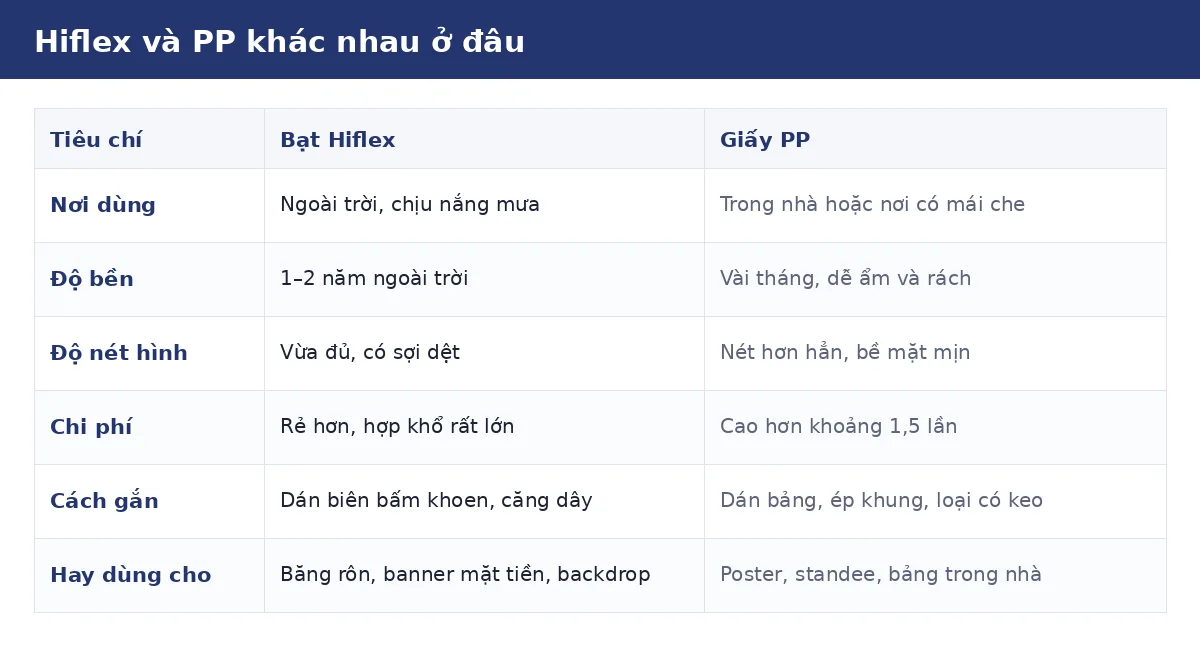
Hiflex or PP – choosing by hanging position
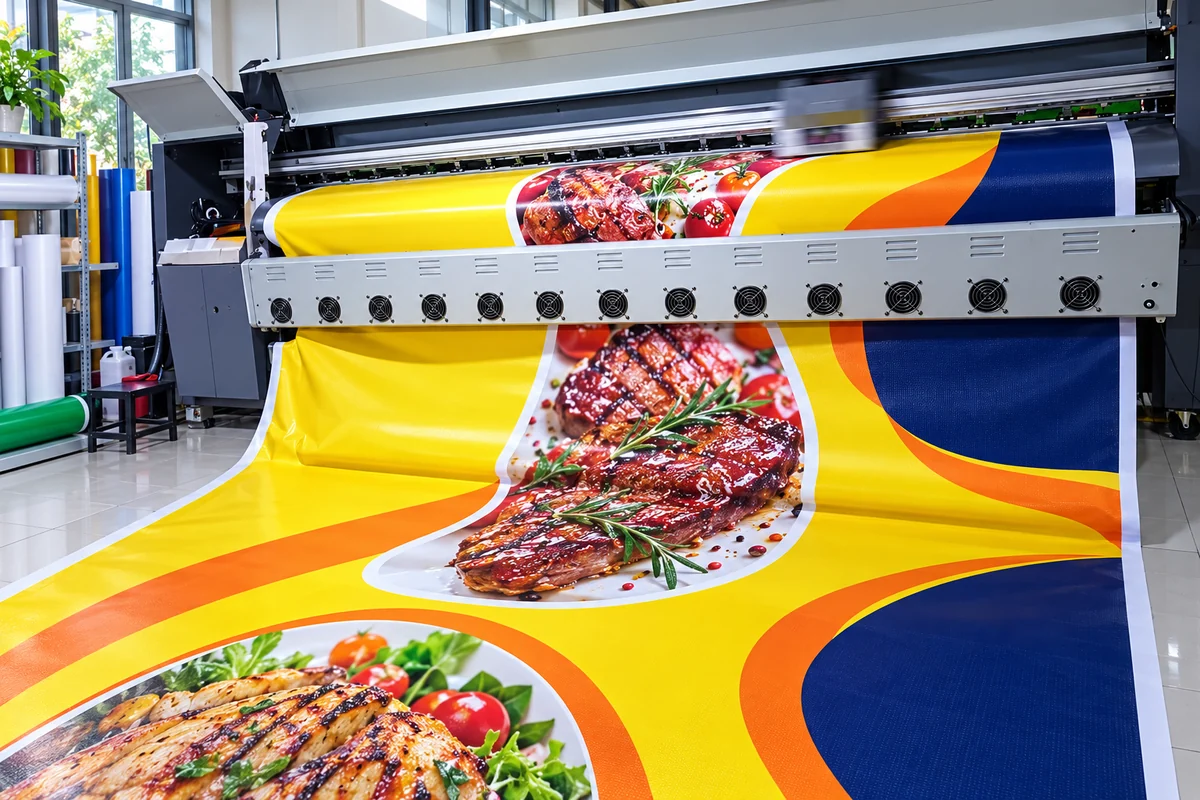
The simplest way to choose is to look at where you will hang it.
Outdoors, no cover — only Hiflex. Opening banners, shopfront banners, outdoor stage backdrops, construction boards. PP placed here only lasts a few days.
Outdoors but under cover — still Hiflex if hung long-term. If only used for an event of a few days and a really sharp image is needed, laminated PP is still fine.
Indoors — PP gives superior image quality. Wall posters, standees, menu boards, indoor photo backdrops. But for large indoor backdrops used many times, grey double-layer Hiflex is still more durable.
Stuck directly on walls or glass — use adhesive PP or decal, not Hiflex, because Hiflex has no adhesive and is too thick.
About cost
Both are priced per square metre with four area tiers; the larger the area, the lower the unit price. The difference between the two is about 1.5 times, with PP being more expensive. For small sizes the difference is negligible, but at tens of square metres the figure starts to matter.
You can see the specific price of each type in the Hiflex category and PP category. We accept any size, including odd figures such as 1.2m² or 1.5m².
Do not forget hemming and eyelets
This is the part customers often overlook. If a printed Hiflex banner is not hemmed and fitted with metal eyelets, it is very hard to hang, and a single gust of wind is enough to tear the edges. This part does not cost much compared with the total order but decides the actual durability.
PP does not need it, because PP is usually mounted on a rigid board or framed rather than stretched with cords.
A few notes when preparing files
Large formats do not need 300dpi files. Designing at the true scale with a resolution of 100–150dpi is sharp enough at the actual viewing distance, while the file is much lighter. Important content should be at least 5cm from the edge, because the edge will be folded when hemmed.
Full details are on the page file submission guide. If you are not sure whether your file is fine, just send it to us first to check — file checking is free.
In short
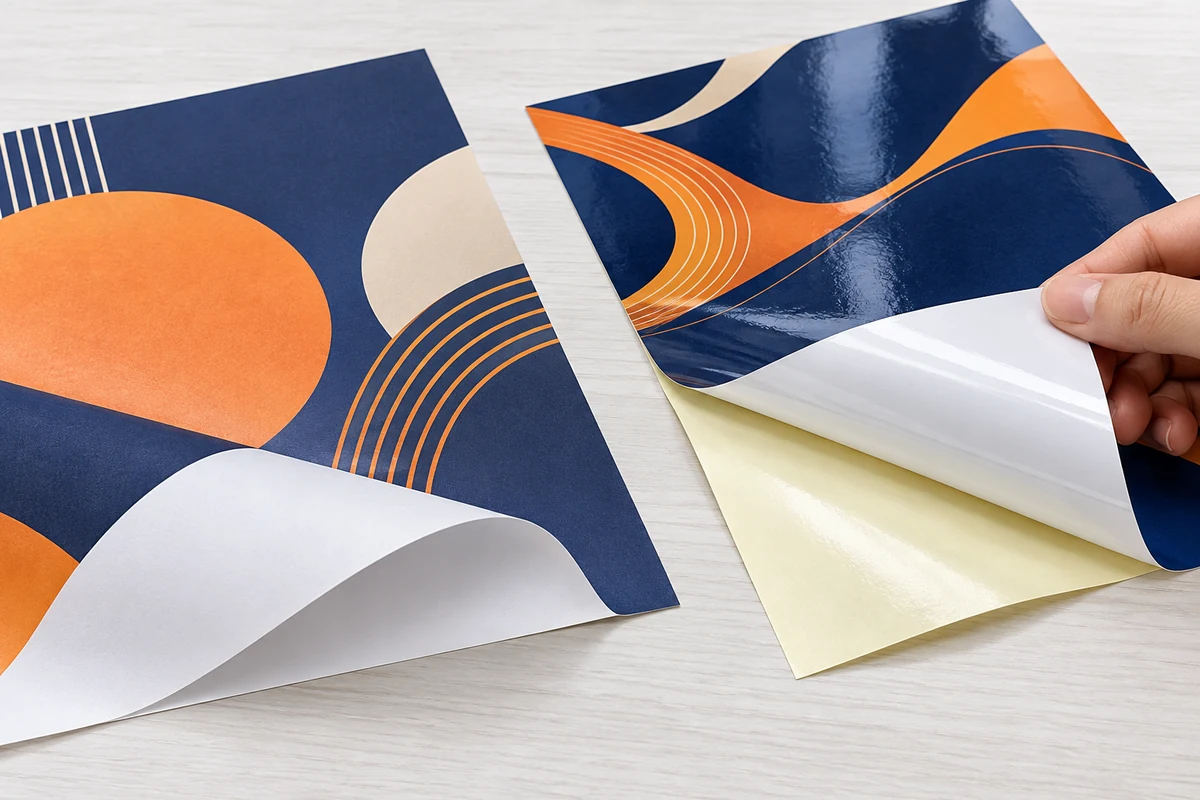
Outdoors choose Hiflex, indoors choose PP. For really sharp images choose PP or ribless Hiflex. To block light from behind choose grey double-layer Hiflex. To stick straight onto a surface choose adhesive PP.
If you are still unsure, message us on Zalo describing the hanging position and size, and we will advise within minutes. Or send a quote request to receive a specific price list for your case.
View directions to the workshop on Google Maps
Measurable specifications of the two materials
The comparison above is about how they feel in use. The table below shows the measurable figures of the two materials, because when choosing Hiflex Banner or PP paper, thickness and roll width are the two things that decide whether the print has to be joined or not.
| Specification | Hiflex Banner | PP paper |
|---|---|---|
| Common weight | 280 – 440 gsm | 120 – 160 gsm |
| Thickness | 0.30 – 0.45 mm | 0.12 – 0.18 mm |
| Common roll widths | 1.52 m / 2.50 m / 3.20 m | 0.91 m / 1.27 m / 1.52 m |
| Inner fabric core | Load-bearing polyester mesh | None, it is a printing plastic film |
| Water resistance | Withstands direct rain | Only withstands damp; creases when wet |
| Sun resistance | Keeps its colour for about one year outdoors | Fades after a few weeks outdoors |
| Printing ink | Solvent ink, bonding to the PVC coating | Water-based or solvent ink, coated surface |
| Sharpness | Suited to viewing from 2 m and more | Sharp enough to read up close |
| Weight per square metre | About 300 – 450 g | About 130 – 170 g |
| Can it be folded? | Can be folded but leaves creases | Folding leaves white creases, so roll it |
The roll width is where unexpected costs often arise. A piece 1.6 m high printed on 2.5 m Hiflex Banner still charges for the nearly one metre left over, while the same piece printed on 1.27 m PP has to be joined. So the question of Hiflex or PP must always come with the exact measurements of the piece to be printed.
Hiflex or PP by how long the piece must stand
How long the piece has to stand outdoors is the factor that most clearly separates the two materials. The table below is ordered by actual period of use rather than by type of printed item.
| Period of use | Where it hangs | Suitable material | Reason |
|---|---|---|---|
| One session to one week | Indoors, under cover | PP paper | Low cost, sharp, discarded when done |
| One to three months | Indoors, in busy places | Laminated PP paper | The lamination resists scratches and mild damp |
| One to three months | Outdoors under an awning | Hiflex Banner | Does not crease even with driving rain |
| Three months to one year | Outdoors in direct sun | Hiflex Banner 440 gsm | Thick fabric core withstands wind and sun |
| Over one year | Permanent shopfront | Hiflex Banner or switch to a rigid board | A soft sheet will sag in the middle over time |
| Reusable many times | Carried around when moving | PP paper rolled in a tube | Light, rolls up compactly, no creases if rolled correctly |
The most common case forcing customers to reprint is choosing PP paper for a piece hung outdoors because the print looks sharper. After the first rain the piece creases and the ink starts to delaminate. When the piece has to stay outdoors, the answer to Hiflex or PP is almost always Hiflex Banner.
Related products

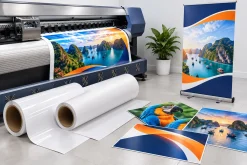
Hiflex


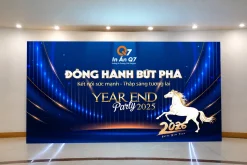
Backdrop

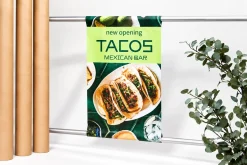
Banner
Edge finishing for each material
Edge finishing differs between the two materials, and this is where many quotes leave things out. Hiflex Banner can take eyelets and sewn edges, while PP paper cannot, so the hanging methods differ accordingly.
- Hemming and eyelets: only done on Hiflex Banner, eyelets 40 – 50 cm apart, 2 cm from the edge.
- Sewn edges and bar pockets: done on Hiflex Banner for horizontally hung pieces, with a 5 cm pocket for a 25 mm bar.
- Reinforcing the four corners with patches: done on Hiflex Banner when hung in windy places.
- Matte or gloss lamination: done on PP paper to resist scratches, not needed for Hiflex Banner.
- Mounting PP on Formex or Alu: the most common use of PP printing when a flat, stable standing board is needed.
- Plastic battens top and bottom: used for PP pieces hung indoors; the battens keep the sheet from curling.
- Contour cutting: possible on both, but PP cuts more cleanly because it is thin.
- Fitting into a roll-up standee aluminium cassette: only PP paper; Hiflex Banner is too thick to roll.
Because these items are charged separately, two quotes with the same price per square metre can still differ quite a lot after adding the finishing. When comparing prices between two suppliers, compare the total including hemming, eyelets or lamination.
Roll widths and how the actual area is calculated
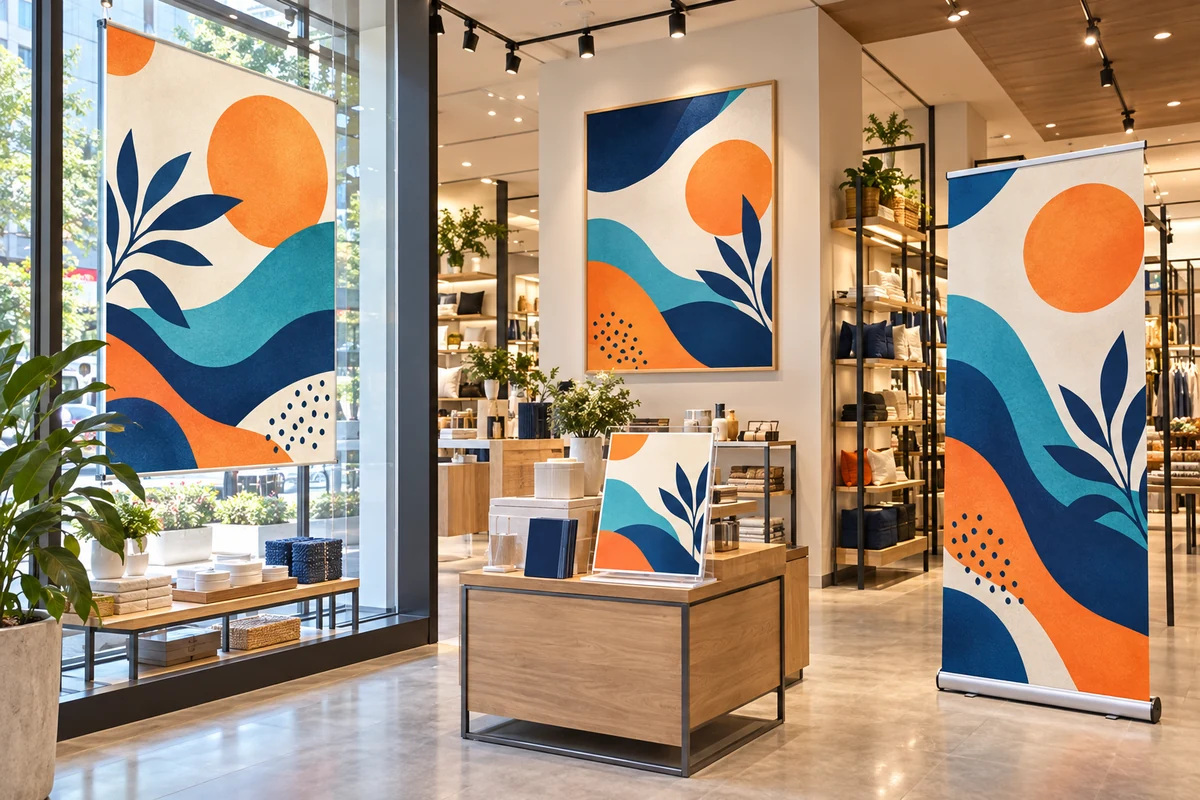
The billable area is the area of material actually used, not the area of the finished piece. The calculation below applies to both materials, differing only in roll width.
- Take the finished length and width, and add the edge allowance for the chosen finish.
- Match one dimension of the piece to the nearest roll width; the leftover of the roll width is still charged.
- If both dimensions are larger than the roll width, the piece must be joined, with a 3 cm joint and extra gluing labour.
- Multiply the material area by the unit price per square metre, priced from the listed rate by type and weight.
- Add the finishing charged per linear metre or by the number of eyelets.
When a piece ends up with a lot of leftover, the usual solution is to adjust the measurements slightly to divide evenly across the roll width, or combine two small pieces in one run on the same Hiflex Banner width. We calculate both options and give you the figures to compare yourself.
Common mistakes when choosing the material
The mistakes below recur on large-format orders, and most only show up after the piece has been hung for a while.
| Mistake | Consequence | How to avoid it |
|---|---|---|
| Choosing PP paper for a piece hung outdoors | Creases after rain, fades after a few weeks | Use Hiflex Banner for every position exposed to sun and rain |
| Choosing Hiflex Banner for a roll-up standee | The banner is too thick to roll into the aluminium cassette | Use matte-laminated PP printing for roll-up standees |
| Eyelets spaced too widely | The edges ripple and tear from the eyelet holes | Eyelets 40 – 50 cm apart, with reinforced corners |
| Not hemming before fitting eyelets | The eyelets rip back into the banner after a few windy spells | Hem with a 3 cm fold before fitting eyelets |
| Laying out the file to the finished size when the finish needs an edge allowance | Text close to the edge is eaten by the fold | Add the edge allowance to the file size before printing |
| Leaving the file at 72 dpi for a piece viewed up close | The image looks pixelated when standing about a metre away | Use 100 – 150 dpi at the actual size |
| Folding PP sheets for storage | White streaks along the fold, cannot be fixed | Roll around a core with the printed side facing out |
| Comparing prices only by the unit price per square metre | Large total difference after adding finishing | Compare the total including hemming and eyelets |
Quick Q&A about the two materials
Below are the questions customers often message our workshop about, answered briefly according to what we actually do.
| Question | Answer |
|---|---|
| Which is cheaper, Hiflex or PP? | PP paper is cheaper per square metre, but outdoor pieces that must be reprinted many times end up costing more in total |
| Can Hiflex Banner be printed on both sides? | Yes, the dedicated double-sided type has a light-blocking layer in the middle so the two sides do not show through each other |
| What can PP printing be mounted on to stand up? | Mount it on Formex for a light board, or on Alu for a board that needs to be stiff and long-lasting |
| Can an old piece be reprinted on itself? | No, ink does not bond on the old ink layer; a new piece must be printed |
| What is the maximum width printed in one go? | 3.20 m for Hiflex Banner and 1.52 m for PP paper; anything larger must be joined |
| Do you accept same-day rush printing? | Yes, for pieces that do not need complex finishing; hemming and eyelets need a few extra hours |
| Will the printed colours be exactly as on screen? | A slight difference is normal; if you need accuracy, we print a colour test strip first |
| What reinforcement is needed for hanging large pieces outdoors? | Reinforce the four corners, fit eyelets more densely along the top edge, and cut wind holes if the piece is over 6 square metres |
Order Hiflex Banner and PP printing at our workshop
We print Hiflex Banner and large-format PP for shops, restaurants, events and construction sites in District 7 and neighbouring districts. Listed prices per square metre are on the page Hiflex Banner and Large-format PP, and edge finishing at hemmed edges with eyelets.
- Tell us the piece measurements, where it will hang and how long it is needed so we can name the matching material.
- Send the file via Zalo, and we check the size and edge allowance and then tell you the billable area.
- Confirm the preview, and we print and finish exactly according to the confirmed version.
- Pick up at the workshop at 49 Mai Van Vinh, Tan Hung Ward, Ho Chi Minh City or get inner-city delivery.
For all other large-format items, see the group advertising printing; ordered together, they share one machine run and one delivery.
Storing prints between uses
Pieces taken down can still be reused if the content has no dates. Storage differs between the two materials, and getting this step wrong ruins the piece even though the print is still good.
- Lay it flat and wipe both sides dry before storing; water trapped in folds leaves marks after a few days.
- Roll it around a core at least 10 cm in diameter, printed side out, not folded in four.
- Store Hiflex Banner pieces upright in a dry corner, without heavy objects on the roll.
- Roll PP pieces loosely; rolling too tight presses the coating and leaves glossy streaks.
- Label the end of the roll with the measurements and content so next time you take the right piece.
- Do not use alcohol or solvents to clean; only use a damp cloth with clean water.
When you need to change the content but the frame and measurements stay the same, the next cost is only the printing and edge finishing. Bring the old piece to the workshop to measure and the new one will fit the existing frame exactly.
Need printing or signage in Ho Chi Minh City?
In Quảng Cáo Q7 runs its own print workshop in Tân Hưng Ward (former District 7), Ho Chi Minh City, producing and installing signage, banners, window graphics, exhibition booths and event displays. Send us the size, material, quantity and a photo on WhatsApp and we will get back to you.

Phone: +84 866 511 099 · Also on WeChat
Workshop: 49 Mai Văn Vĩnh, Tân Hưng Ward, Ho Chi Minh City