




































































A-frame standees: one-sided or two-sided, and three frame details
Sep
A-Frame Standee: Single- or Double-Sided, and Three Frame Details
The A-frame standee is so familiar that few people ask much before ordering. But two decisions directly affect its effectiveness – single- or double-sided printing – and three details on the frame decide whether setting it out and bringing it in every day is easy or not. This article covers both.
Why an A-frame standee stands firm without a heavy base
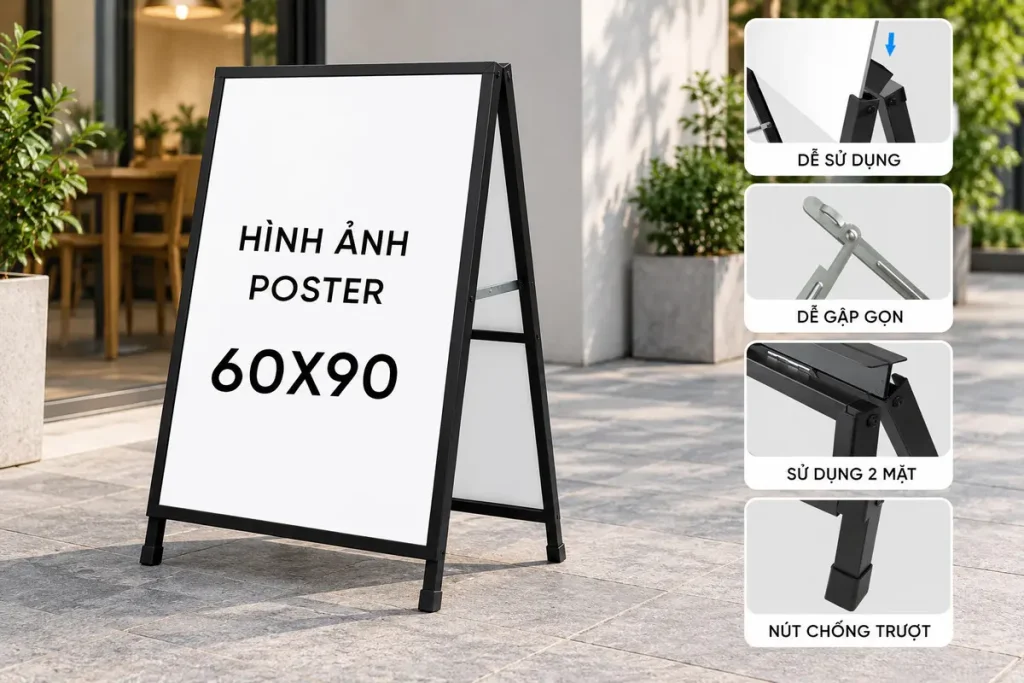
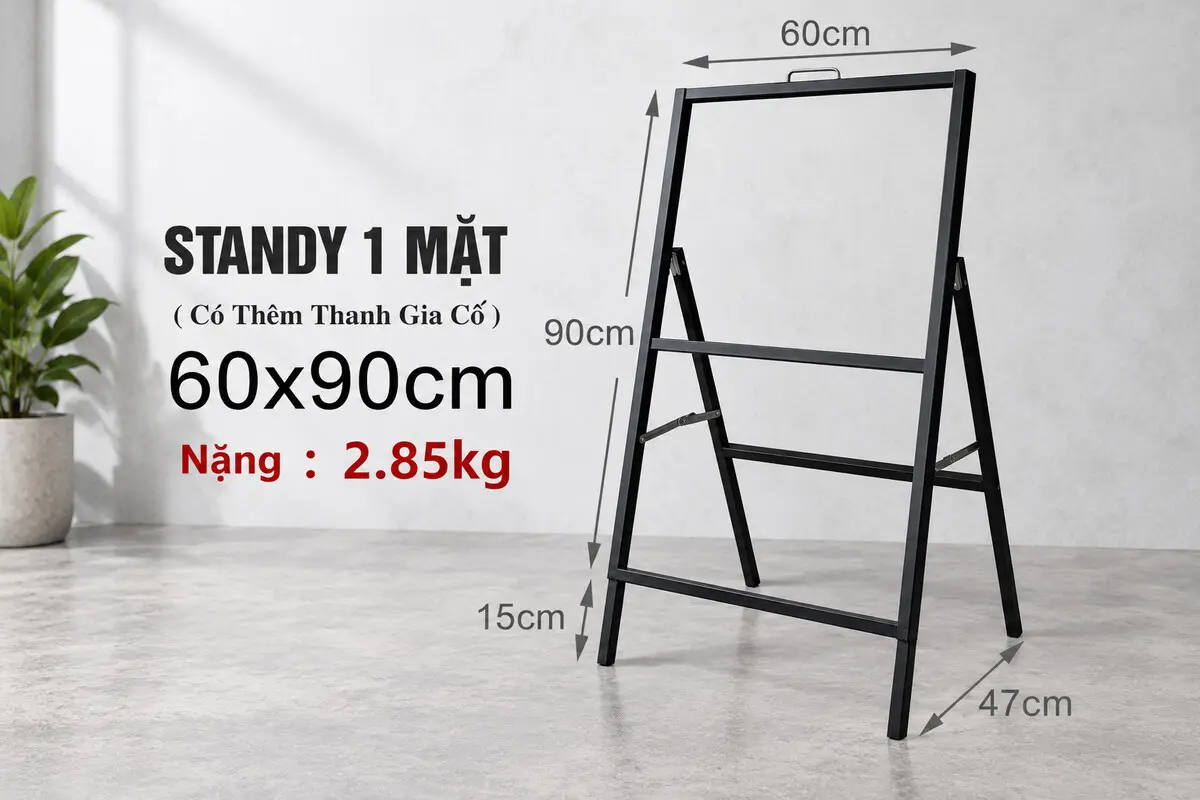
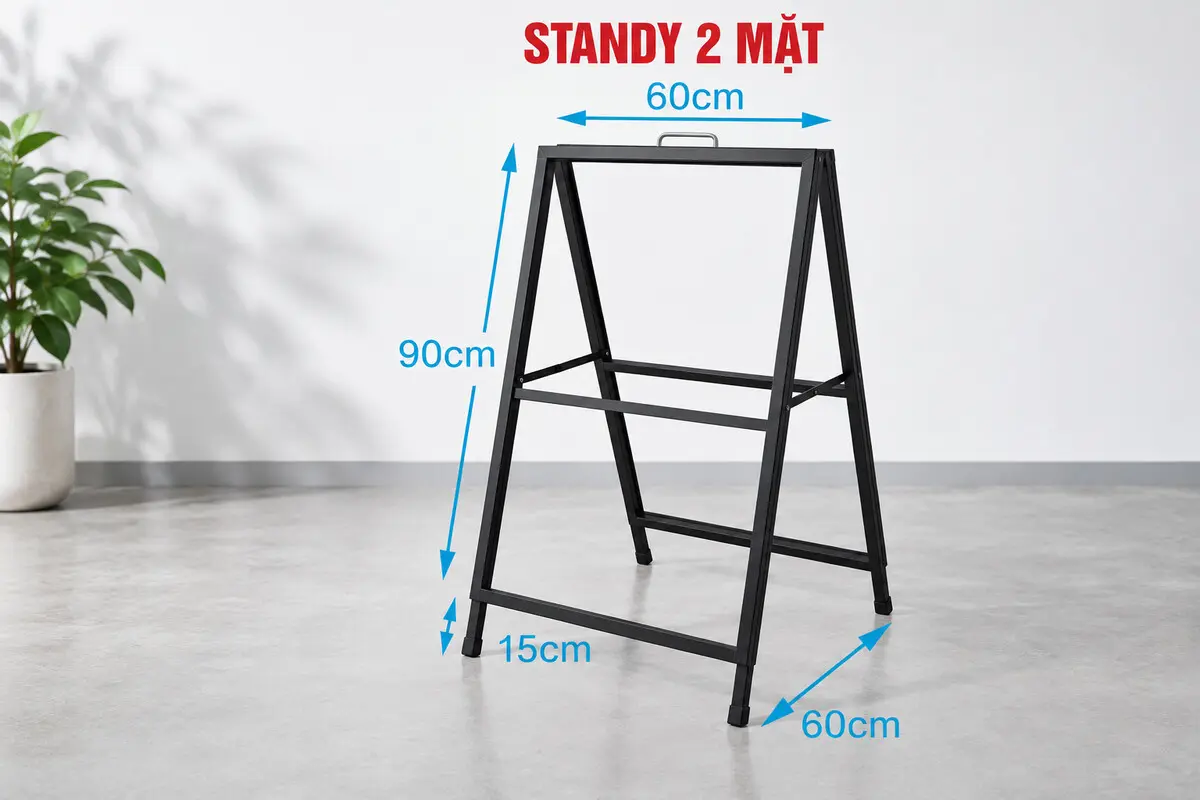
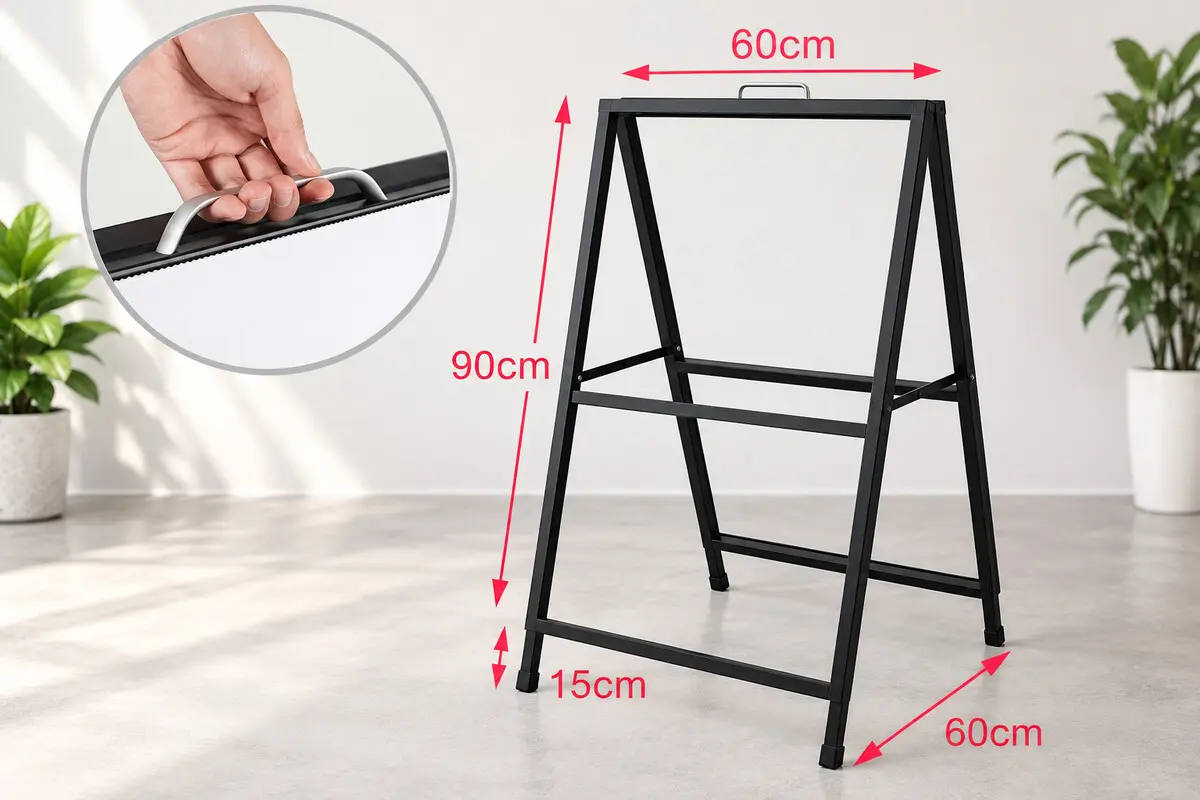
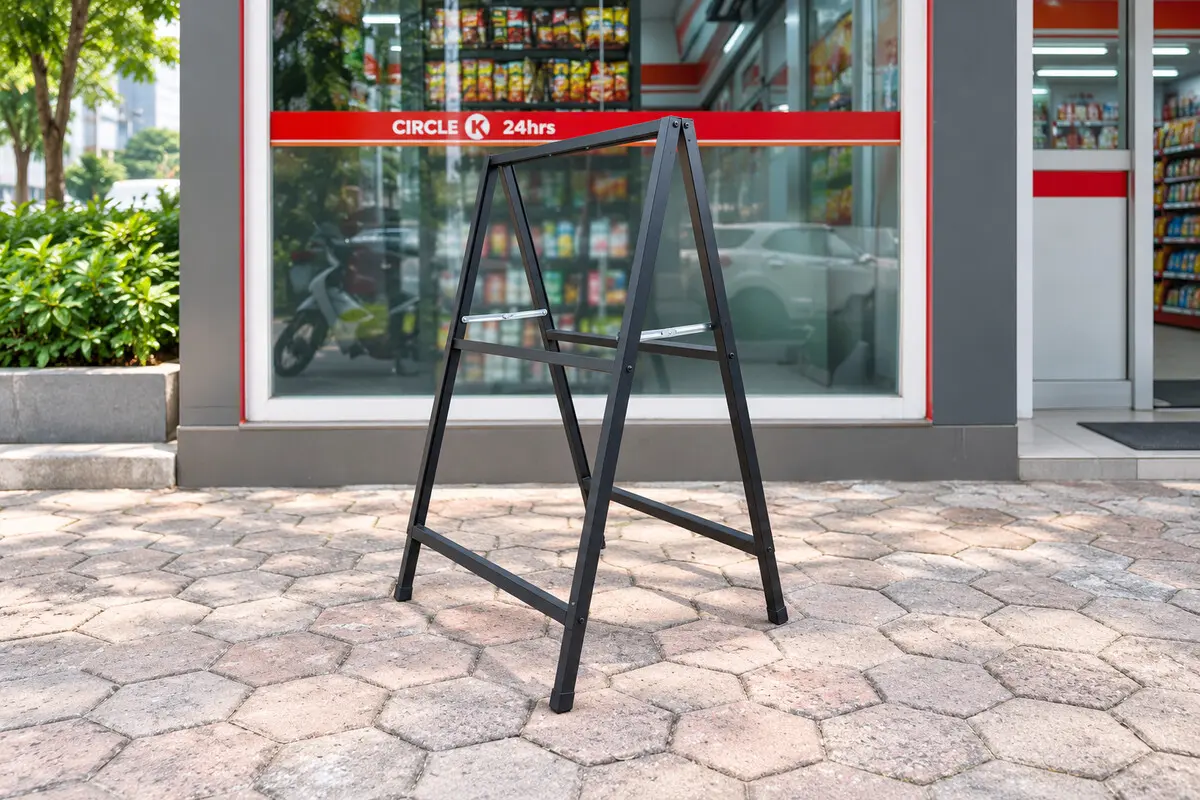
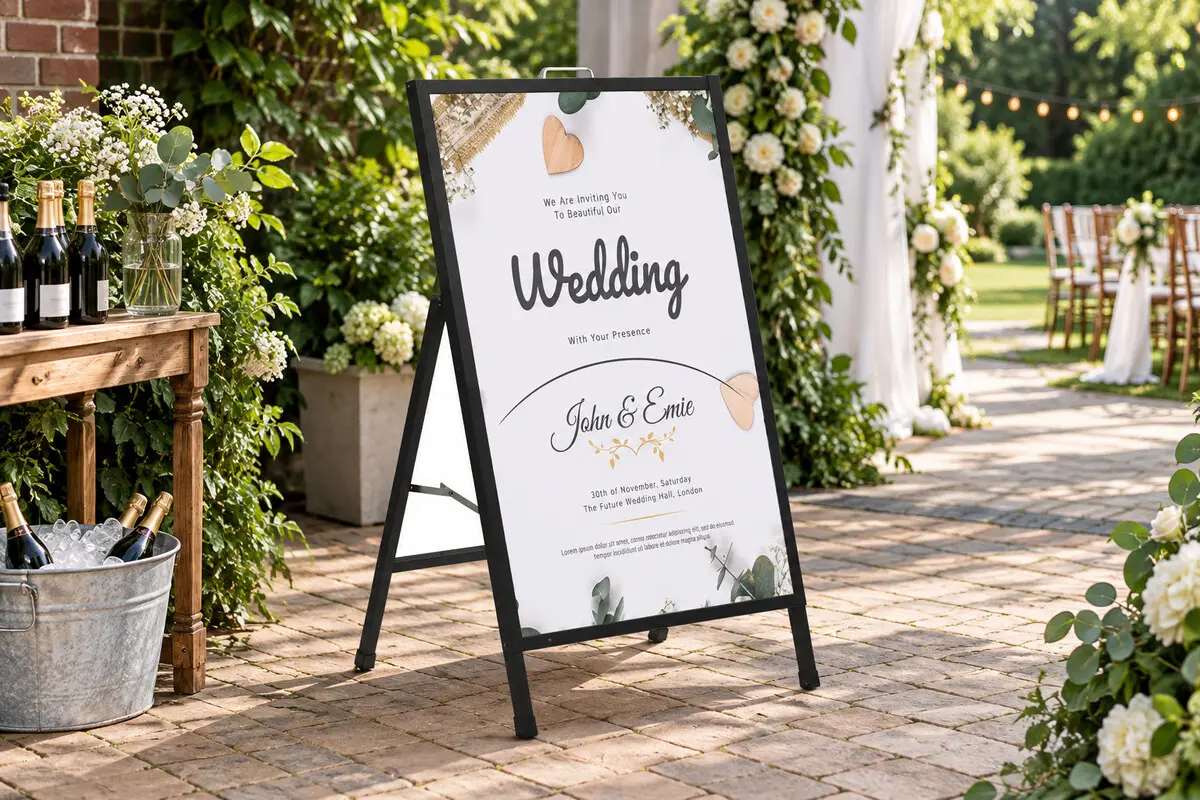
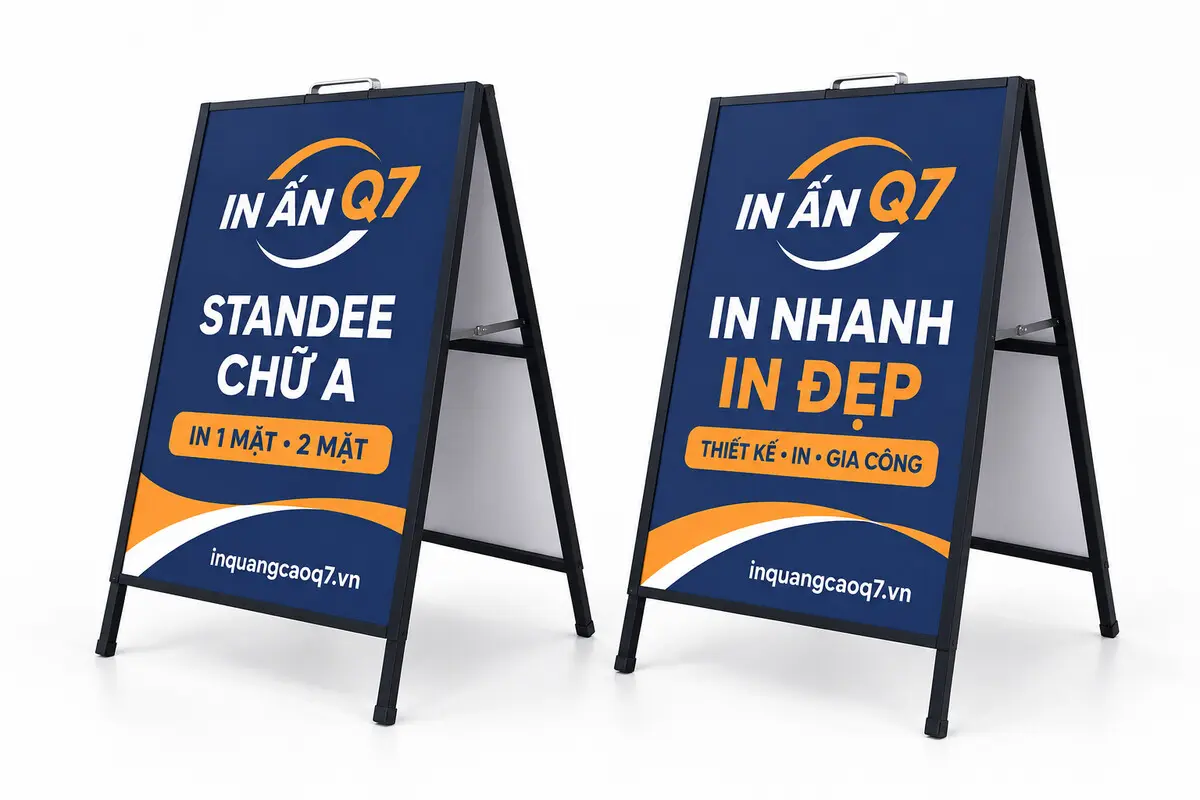
The folding frame forms a triangle – the most stable geometric shape when placed on a flat surface. The weight spreads evenly down to four leg points instead of concentrating on one base, so the A-frame standee weighs only about 2.85kg and still does not fall over. In return, it takes up more floor space: a base of about 47cm for the single-sided type and 60cm for the double-sided type.
This is also its limitation: 2.85kg is light, so in windy places you need to put extra weight on the lower brace. Pavements with wind gusting off the road are the most common case.
Single-sided or double-sided?
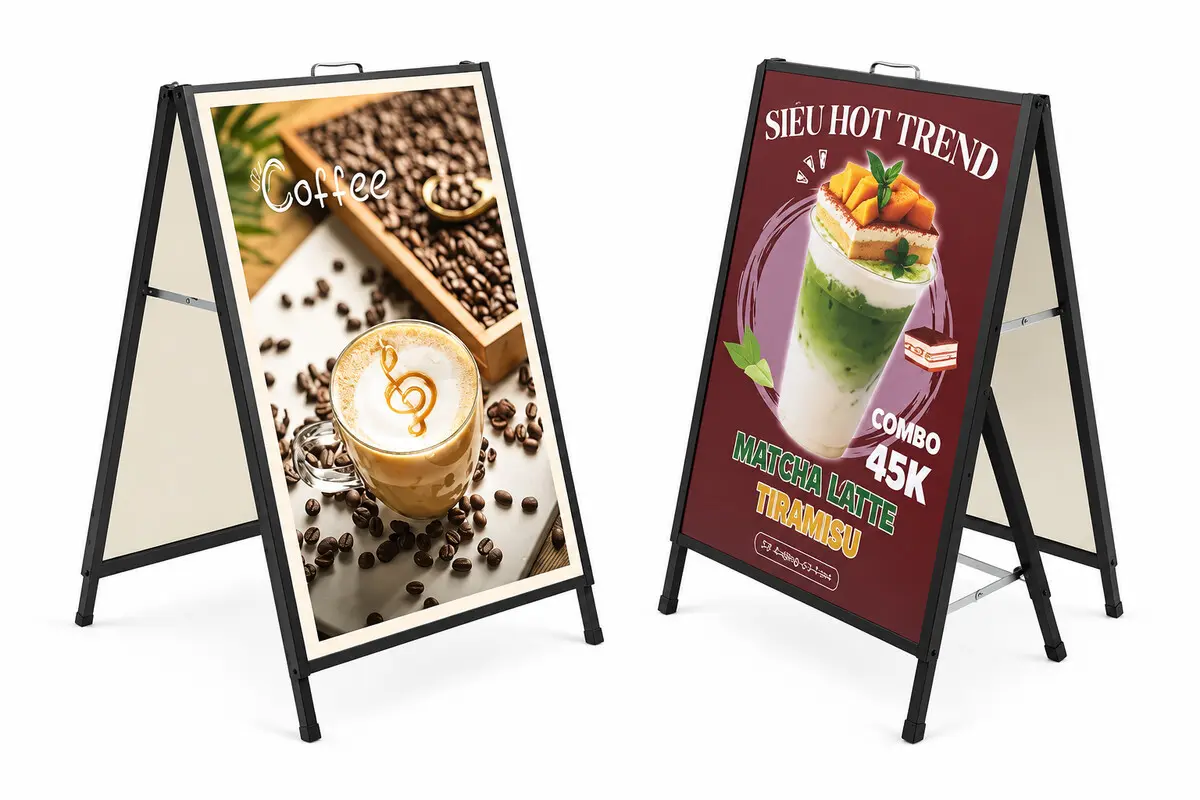
Single-sided: only the side facing the street has a print board, the other side is an empty frame with reinforcing bars. Cheaper and lighter. Suits standees placed against a wall, against a glass door, or in a corner approached from only one side.
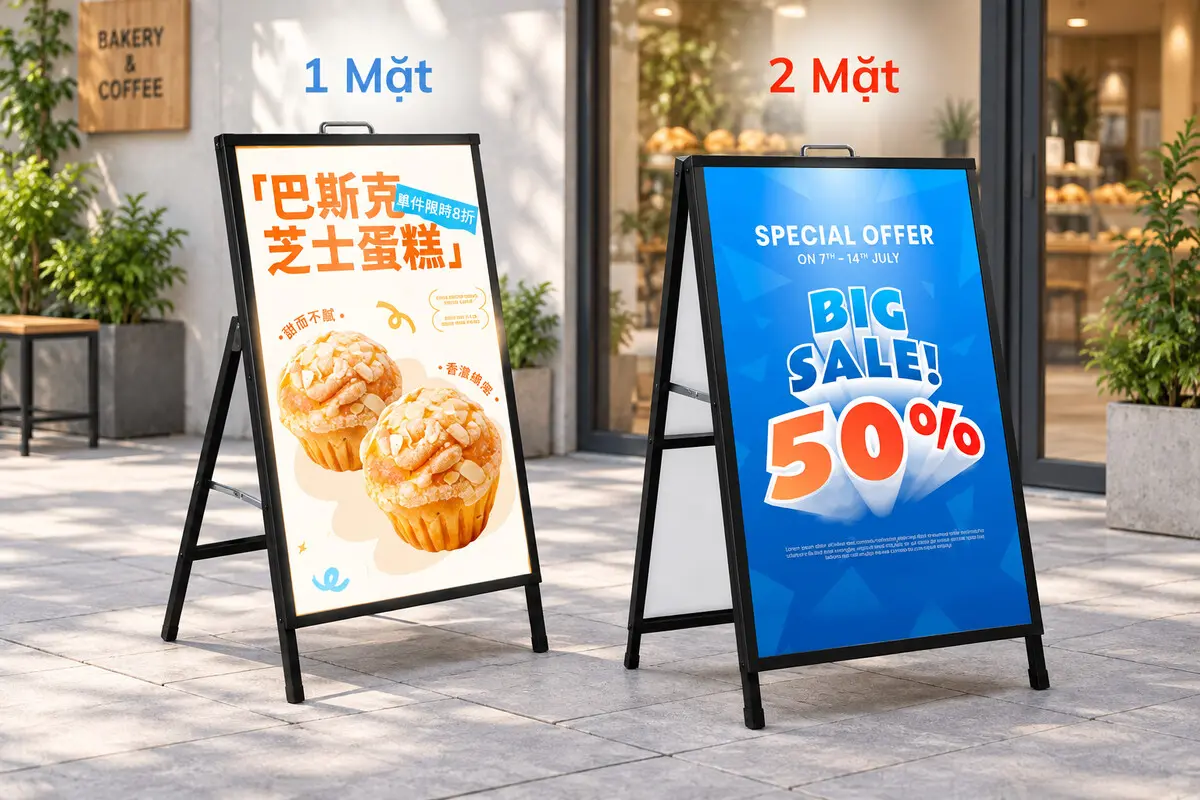
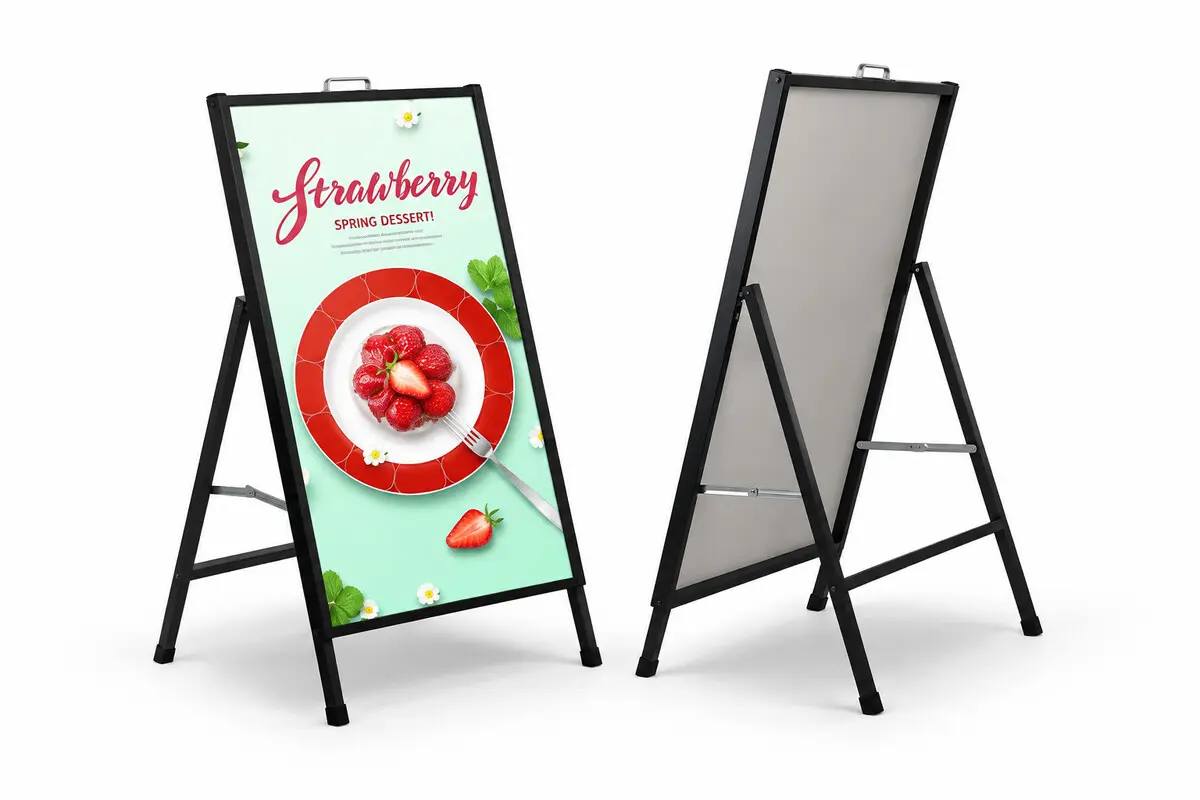
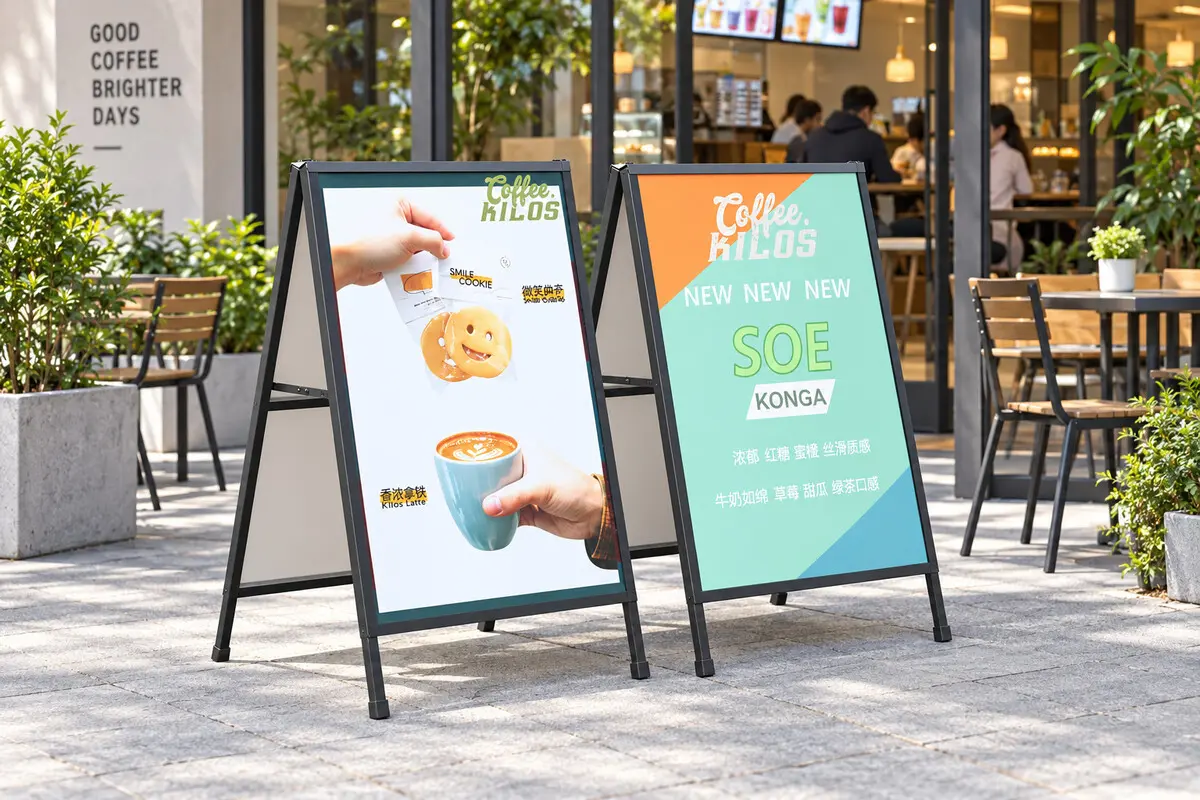
Double-sided: both sloping sides have print boards. Placed in the middle of a pavement or walkway, people coming from both directions can read it – the most common case for street-front shops. Both sides can be printed the same, or one side menu and the other promotions to make full use of it.
Three details on the frame
The carry handle
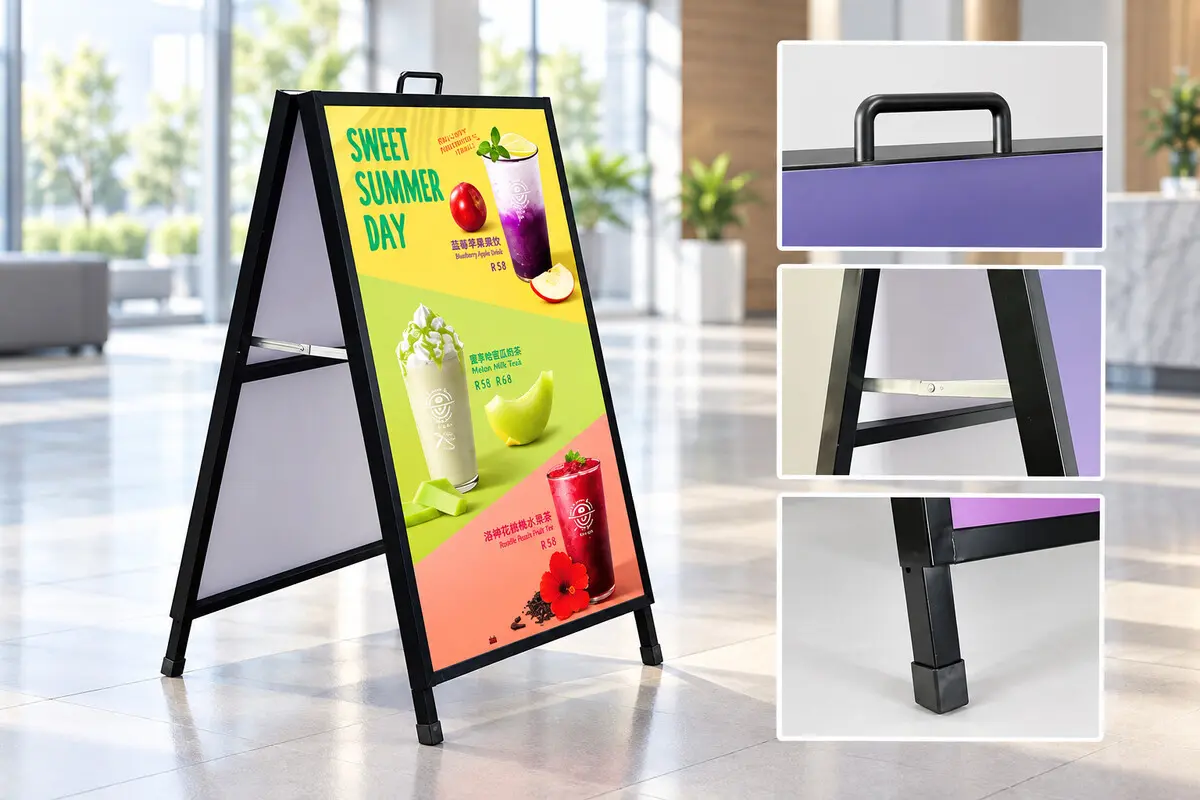
Fitted on the top edge, carried with one hand like a briefcase. It sounds simple, but for a shop that has to take the standee out and in twice a day, all year round, this is the most used detail on the whole set.
The crossbar
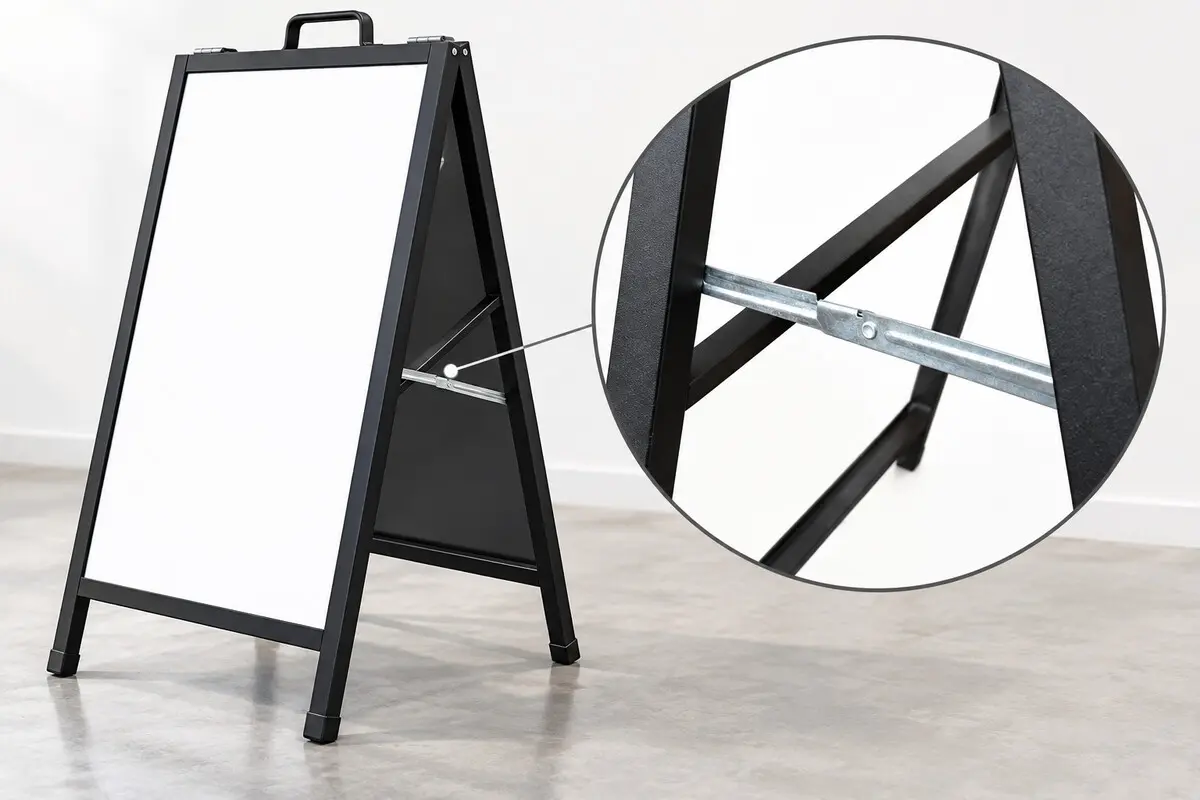
Located at the back, it holds the two legs open at the right angle – not too narrow (falls over easily) and not too wide (takes up the pavement). Fold this bar in and the standee collapses flat, standing in a corner without taking up space.
Anti-slip feet
Four rubber or plastic pads on the leg tips keep the standee from sliding on slippery tiles and from scratching the floor when placed indoors. These are usually the first thing to wear out: when the pads are worn down, the standee starts to slide and scrape metal on the floor – so check them regularly and replace them when needed.
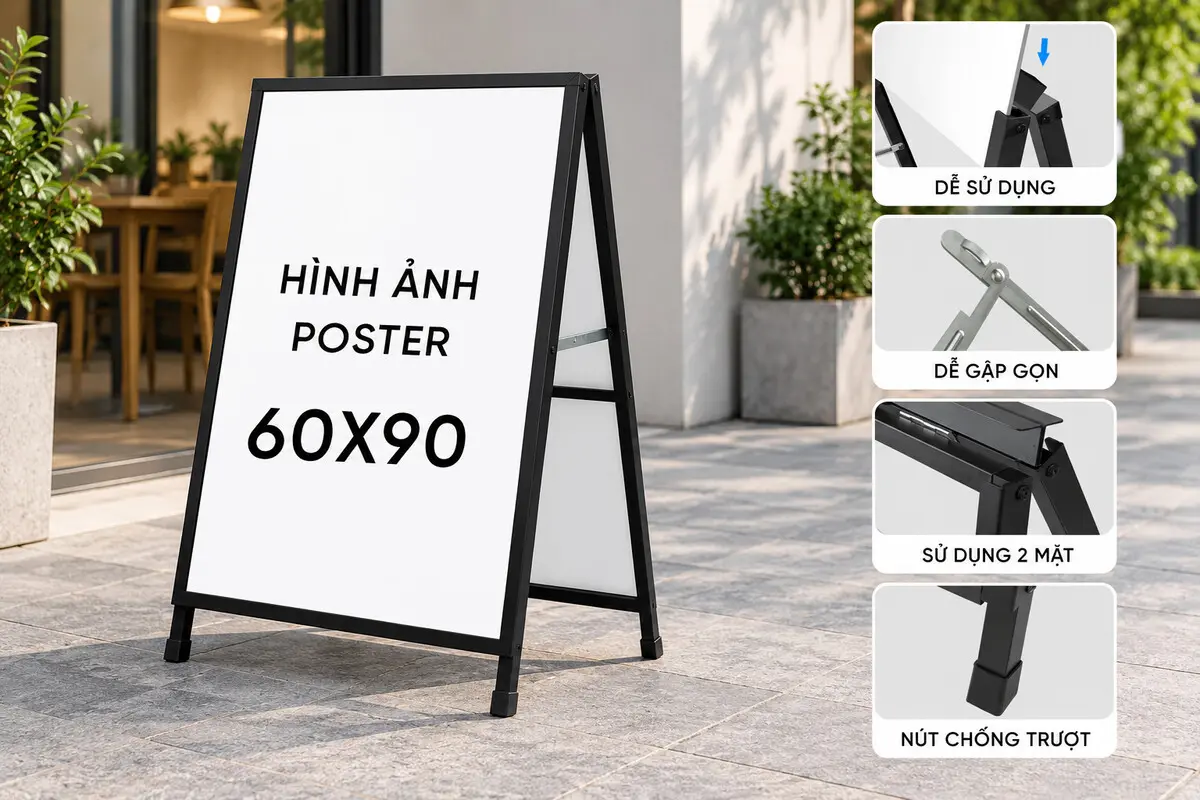
5mm Formex print board and how to change content
Formex (PVC foam) is a rigid 5mm foam plastic board, white, waterproof, termite-proof and warp-free. For standees placed on the pavement – sun, driving rain, high humidity – this material is far more durable than paper or cardboard.
The print board slides into grooves on both sides of the frame, so changing content just means pulling out the old board and pushing in the new one. The steel frame lasts for many years; each promotion only needs a new print board – a clearly economical approach for shops that change menus by season.
A-frame or iron-leg stand – choose by how it is used
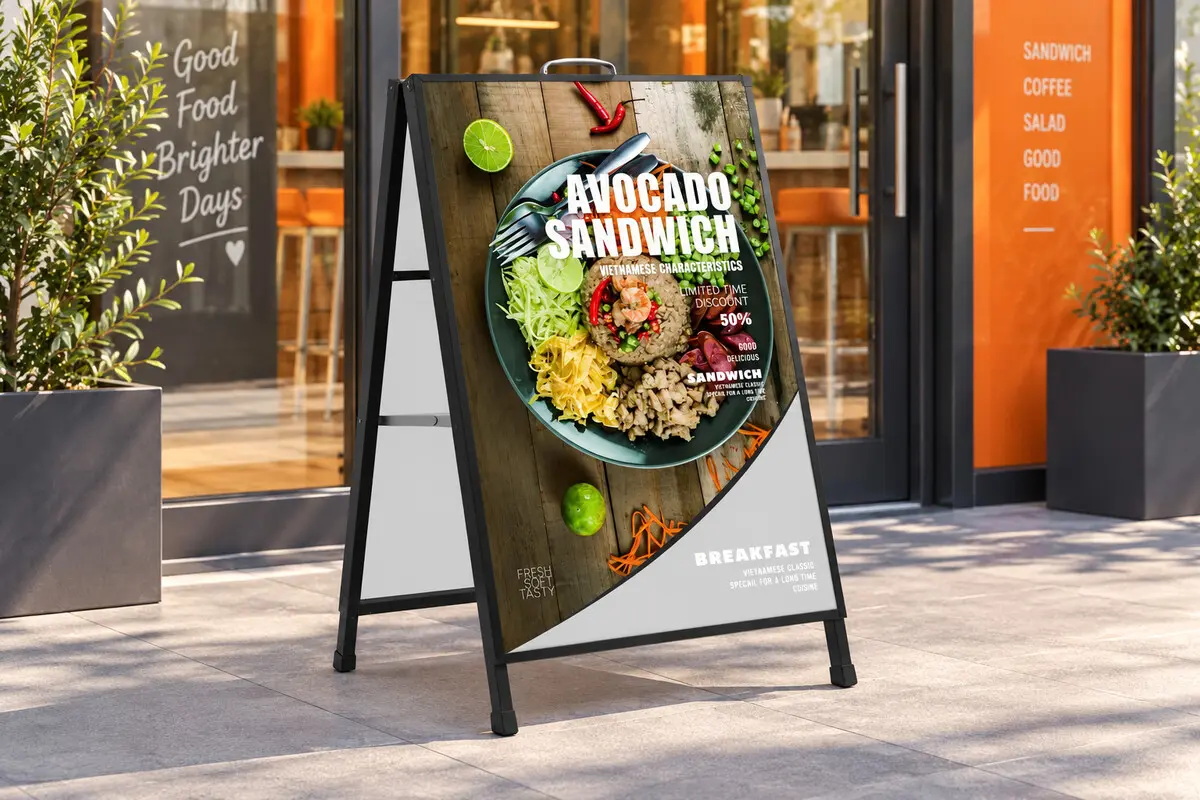
Both use a Formex face and a steel frame, but their functions are quite different. Iron stands stands upright, 1.6–2m tall, visible from afar, standing in one place all day – suits lobbies, fairs and shopping malls. A-frame is lower (about 90cm), tilted towards passers-by, and folds up – suits street-front shops that have to set it out and bring it in every day.
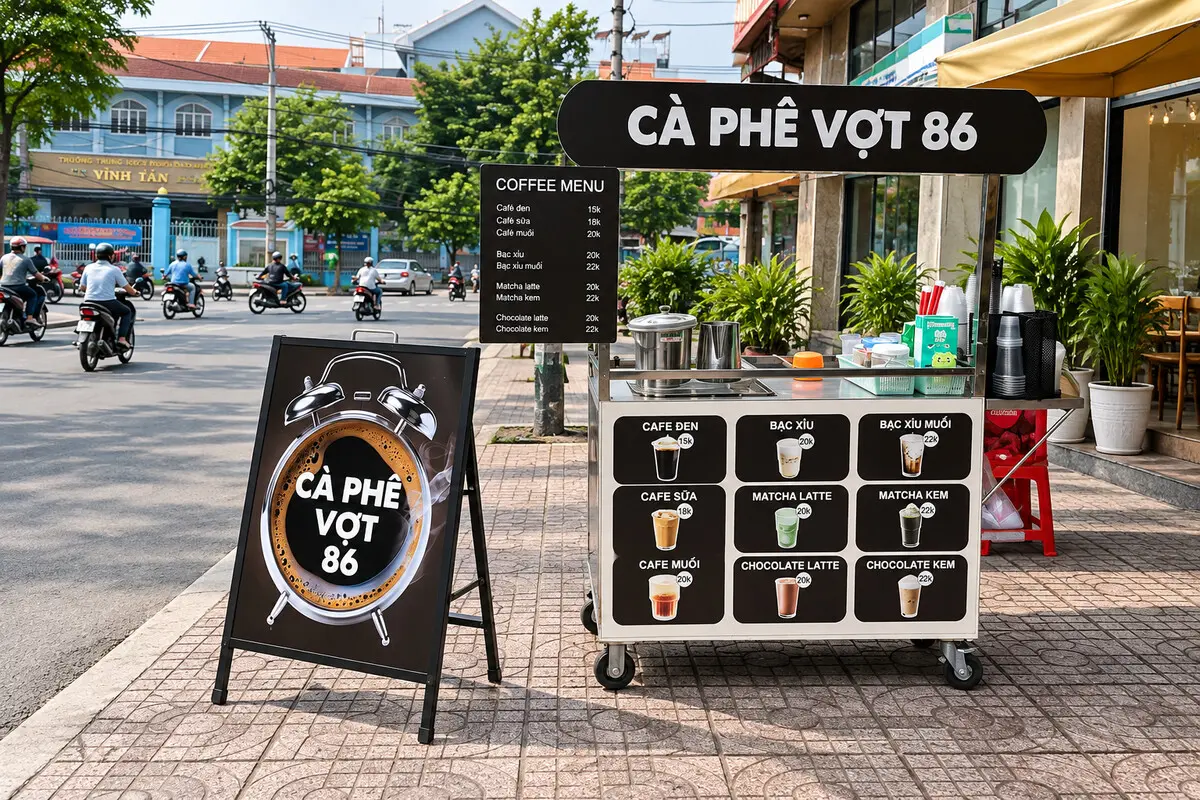
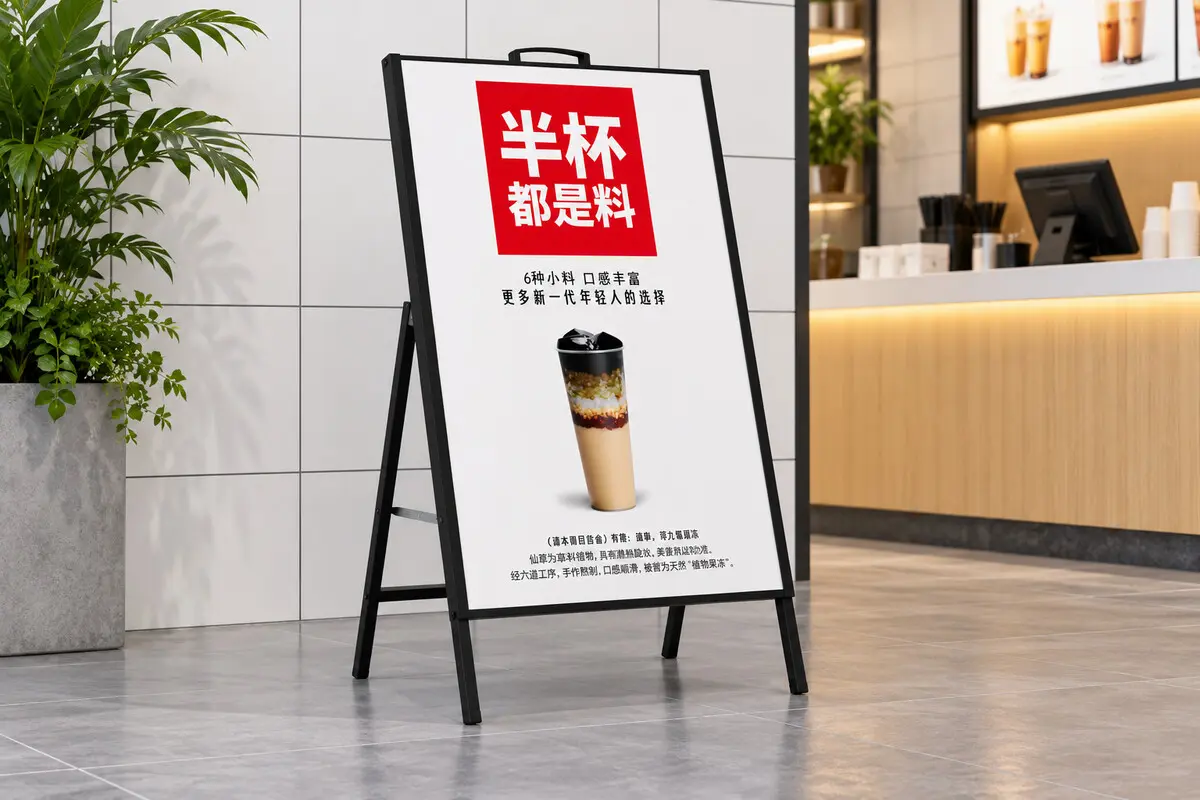
One more point few people notice: the A-frame is low so it does not block the view into the shop. Putting a 2m-tall standee right in front of a small shop can hide the very shop it is advertising.
Designing for a sloping board
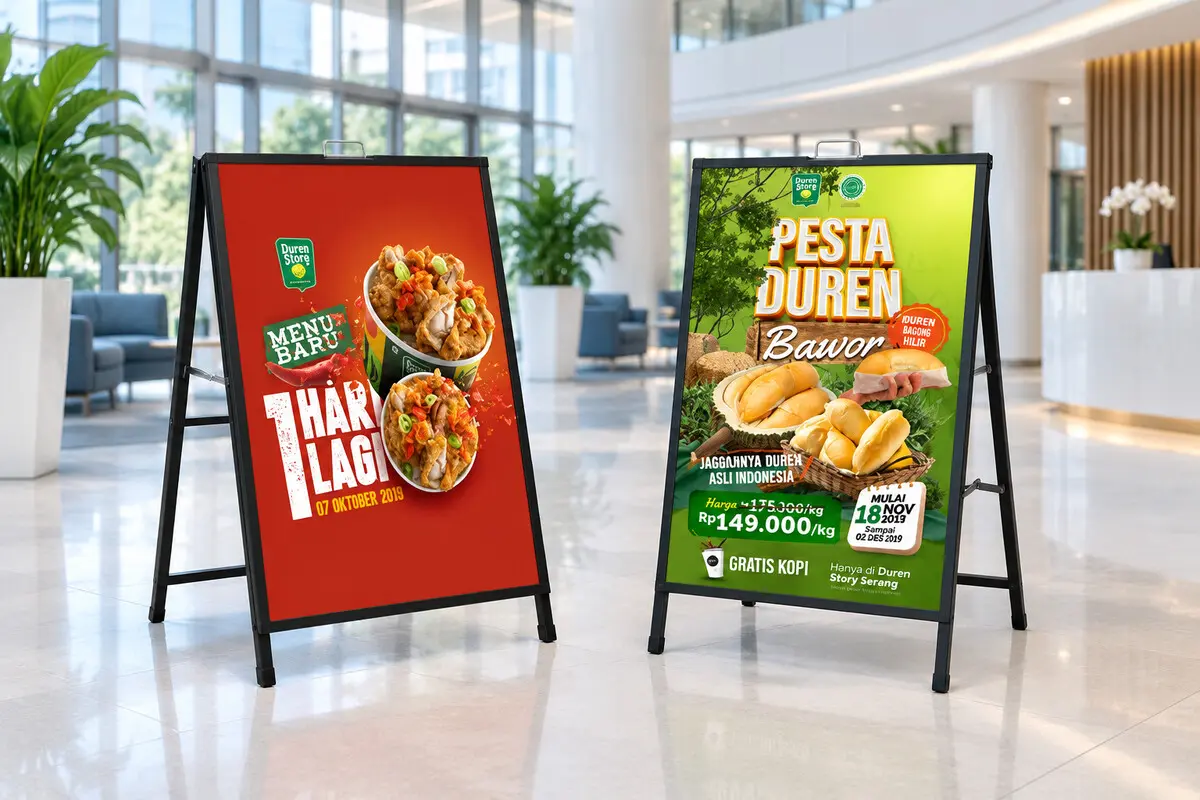
The A-frame standee is tilted, so passers-by look at it from above – unlike upright standees viewed at eye level. As a result: important content should be placed in the upper half of the board; the lower part is easily hidden behind pedestrians in front or viewed at too steep an angle.
For the file: PDF or AI, CMYK, at least 150dpi at the actual size of 60 × 90cm, 3mm bleed, text converted to outlines. And leave about 2–3cm on each edge no text there, because this part sits inside the frame groove.
Need a quote or want to order an A-frame standee?
See the single- / double-sided options and the three price levels (full set / print only / frame only) on the A-Frame Standee product page. Or message on Zalo / call 0866.511.099 — we will quote within 30 minutes during working hours. In Quảng Cáo Q7, 49 Mai Van Vinh, Tan Hung Ward, Ho Chi Minh City.
Related products


Standee

Standee


Standee

Standee
Choosing single- or double-sided by location
Whether an A-frame standee should be single- or double-sided depends entirely on the direction people approach from. The table below gathers common situations for a quick choice.
| Placement | Direction people approach from | Recommended |
|---|---|---|
| Against a wall, against a roller shutter | One direction | Single-sided |
| Middle of the pavement | Both directions | Double-sided |
| One-way street | One direction | Single-sided, facing oncoming traffic |
| At an alley entrance | Both directions | Double-sided |
| Building lobby, next to the lift | Both directions | Double-sided |
| Corner of an indoor counter | One direction | Single-sided |
The price difference between single- and double-sided is mainly in the printing, because the A-frame already has two sloping sides. If only one side is printed, the other side should be printed with a brand colour block instead of being left blank.
Many shops make double-sided A-frame standees with different content: the side facing the main road shows the shop name and flagship dish, the side facing the door shows the day's offers. One frame serves two purposes.
Three frame details that decide durability
The A-frame standee's frame looks simple, but three points decide whether it lasts a few months or a few years.
- Top hinge: the point under the most stress because it is folded open and shut every day. A wide hinge with a bushing lasts much longer than a thin one.
- Lower crossbar: keeps the two sides from splaying apart. Without this bar, the A-frame standee gradually spreads its legs and falls over in the wind.
- Print board clamps: decide whether content can be changed quickly or slowly. Screwed clamps are secure but slow, snap-edge clamps are faster.
- Powder coating: protects frames placed outdoors from rust, especially at the welds.
- The carry handle: seems minor but decides whether staff are willing to set it out and bring it in every day.
- Plastic leg caps: prevent scratching tiled floors and reduce sliding on smooth surfaces.
When comparing quotes between suppliers, ask clearly about the first three details. Most of the price difference for A-frame standees lies in the frame thickness and hinge quality, not in the printing.
A good frame lasts for many years, with only the print face changed by promotion. Cheap frames usually splay their legs after a few months, and then the whole set has to be bought again, so it is not cheaper.
Designing for the sloping face
The A-frame standee face is tilted rather than upright, so the pedestrian's viewing angle is quite different from a wall-mounted board. A few small adjustments make the content easier to read.
- Push content to the upper half: the lower part of the sloping face is viewed at an angle, so text there is hard to read.
- Larger font size than usual: the main line should take up about a third of the face height.
- Dark background, light text stands out more on a sunny pavement; white backgrounds glare easily and show dust clearly.
- Avoid small details: pedestrians walk past in two to three seconds.
- Leave a 20 mm margin around the edges, since the clamp trim covers part of the border.
- QR code in the upper half, at least 40 mm per side so it can be scanned while standing.
If the shop changes content weekly, build a template file that keeps the same layout and background colour and only change the text. Regular customers will recognise the shop's A-frame standee from afar before even reading it.
No file yet? Send your logo and content via Zalo; our designers lay it out to size and send a preview. Printing and fitting into the frame only happen after approval.
Daily use and care
This folding type lives outdoors all day, so it wears faster than indoor boards. A few small habits help the set last for many years.
| What to do | Frequency | Why |
|---|---|---|
| Fold it up when closing | Every day | Prevents loss and keeps dew from dampening the hinge |
| Weigh down the feet in strong wind | When needed | A-frame standees are light and easily blown over by gusts |
| Wipe the print face | Every week | Street dust left for a long time dulls the face |
| Oil the hinges | Every few months | The folding joint does not squeak or creak |
| Check the clamp screws | Every time the content is changed | Loose screws make the print face vibrate and crack at the edges |
| Wipe dry after a rainy day | When needed | Prevents rust at the welds and frame feet |
Do not drag the frame across cement floors; lift it by the handle so the legs do not wear unevenly. Legs worn on one side make the whole set stand crooked, which is very noticeable next to the door.
The print face is the consumable part; the frame lasts much longer. Shops that change content often should order a few spare print faces from the first batch; replacing one takes less than a minute.
See the finished product at A-Frame Standee, or compare with Iron-Base Standee and Roll-up Banner. For print face materials, see Formex.
Shop types that order most
Below are the groups of shops that order A-frame standees most and the content they usually print, for your reference when making one for the first time.
| Shop type | Typical printed content | Placement |
|---|---|---|
| Cafés | New dishes, breakfast combos, happy hour | Edge of the pavement, next to the door |
| Takeaway milk tea | Buy 2 get 1 free, free toppings | In front of the order counter |
| Lunch eateries | Lunch sets with prices | Edge of the pavement facing office buildings |
| Fashion shops | Discount level, new collection | Entrance, set back half a metre inside |
| Spas, salons | Service packages, new customer offers | In the lobby or next to the glass door |
| Pharmacies, clinics | Working hours, services | In front of the entrance |
What they have in common is that each board should say only one thing. A shop that wants to convey three messages should make three print faces and swap them by time of day, which is more effective than cramming all three onto one A-frame standee.
Many shops place two sets at both ends of the pavement instead of one set right at the door. This catches customers coming from both directions while each board keeps a short message.
Quick Q&A when ordering
This section collects the questions we're asked most, with short answers so you know before ordering.
- Do you accept an order for one set? Yes, from one set, with no minimum quantity.
- Does an A-frame standee stay stable in the wind? It is stable thanks to its triangular shape; in strong wind, put extra weight on the crossbar.
- Can the printed face be replaced? Yes, remove the clamps and fit the new sheet into the old frame.
- Does the frame rust? The powder-coated frame withstands sun and rain; wiping it dry after rainy days is enough.
- Is single-sided much cheaper? Cheaper on the printing; the frame is the same.
- How soon is it ready? Usually 2 to 3 working days.
- Do you make custom sizes? Yes, tell us the desired size and we will quote.
Former District 7, Nha Be, District 4 and District 8 get door-to-door delivery. Other districts of Ho Chi Minh City are delivered according to the day's vehicle schedule; other provinces via intercity bus.
If the shop has several branches, print for all locations in one batch. The colours between print faces will be consistent and the price per set is also lower than ordering separately for each place.
Comparison with other standing boards
When choosing between an A-frame standee and other types of standing boards, the distinguishing points are where it is placed and how often it is set out and brought in.
| Standing board type | Folds up | Outdoors | Best suited to |
|---|---|---|---|
| A-frame standee | Yes, folds flat | Yes | Sidewalks, set out and taken in daily |
| Iron-base standee with Formex face | No | Yes | Placed permanently in one spot |
| X-banner stand | Yes, folds into a tube | Limited | Indoors, low budget |
| Aluminium roll-up standee | Yes, rolls into the cassette | No | Events, carried around |
| Backlit banner standee | No | Yes | Shops open in the evening, needs light |
| Table boards | Not needed | No | On tables, cashier counters |
The A-frame standee's special advantage is that it both withstands the outdoors and folds flat for storage. Other folding types are usually less stable in the wind, while types that withstand wind well are bulky.
If the shop only needs a board placed permanently in one spot and not moved every day, the iron-leg version gives a flatter, sturdier print face. If it has to be brought in every evening, the A-frame standee is still the most compact choice.
In short, choosing a single- or double-sided A-frame standee only requires looking at the direction people approach from: one direction means single-sided, two directions means double-sided.
Need printing or signage in Ho Chi Minh City?
In Quảng Cáo Q7 runs its own print workshop in Tân Hưng Ward (former District 7), Ho Chi Minh City, producing and installing signage, banners, window graphics, exhibition booths and event displays. Send us the size, material, quantity and a photo on WhatsApp and we will get back to you.

Phone: +84 866 511 099 · Also on WeChat
Workshop: 49 Mai Văn Vĩnh, Tân Hưng Ward, Ho Chi Minh City