




































































Catalogue Printing District 8 – A4, A5, C300 Cover, C150 Pages, Bound
Oct
Does your company need District 8 catalogue printing? This article sets out the size, number of pages, cover and inner paper types, four binding styles and how prices are calculated at the In Quảng Cáo Q7 workshop.
Catalogue printing for District 8 customers
From Pham The Hien, Ta Quang Buu or Binh Dong, cross Nguyen Van Cu Bridge or Pham Hung Bridge and you reach the In Quảng Cáo Q7 workshop at 49 Mai Van Vinh, Tan Hung Ward. Catalogues are bound goods so they are a little heavy, but the distance is short so they are still delivered within the day once ready.
Customers for District 8 catalogue printing are mostly production facilities, trading companies and distribution agents – the group with many item codes that need presenting with photos and specification tables. Product catalogues in this group are usually thicker than capability profiles because they must list the full product lines.
Size and page orientation
A4 portrait suits specification tables with many rows; A4 landscape suits product photos in landscape format, as placed on a landscape page the photo is larger without cropping. A5 portrait and A5 landscape are used for pocket versions handed out at trade fairs or kept at the counter.
Many production facilities make two versions: a full A4 version for agents and a condensed A5 version handed to retail customers. The content is shared; only the layout differs, so the design work does not take twice the time.
Number of pages and paper
Pages from 8 to 76, in steps of 4 pages, including the 4 cover pages. Product catalogues often fall at 16 pages for one product line, 32 pages when there are several lines, and 48 pages for companies with many product categories.
Cover and inner pages are chosen separately, both from Couche paper 150gsm to 300gsm. The most familiar combination is a Couche 300gsm cover with Couche 150gsm inner pages. The cover is laminated on one side, matte for a smooth surface or gloss for deep colours.
Binding style and quantity levels
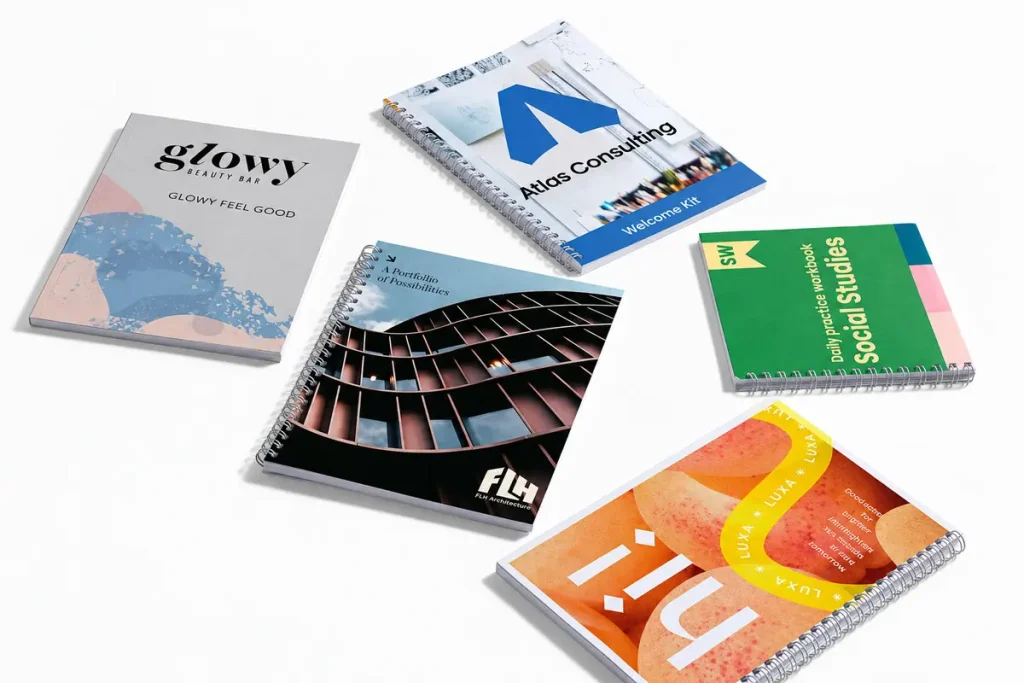
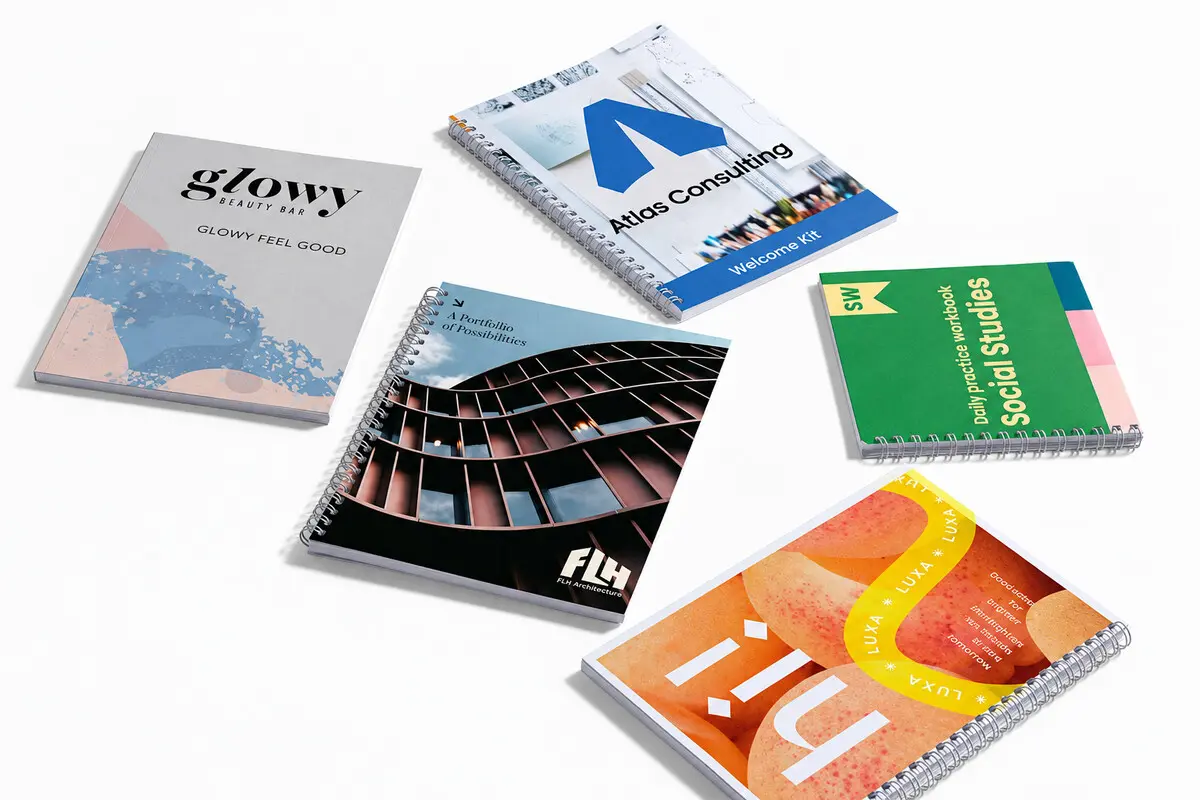
Saddle stitching for thin books that open flat; perfect binding for thick books, with a square spine printable with the company name so it is easy to find on agents' shelves; spiral binding with a clear cover when the catalogue must open flat to compare specification tables; carton-mounted covers for formal versions.
The page lists prices for orders up to 200 books, running from just a few books – for example, an order of 20 books is calculated at the unit price per book of that level. Above 200 books, the workshop switches to offset printing and the unit price per book drops further considerably, so it is quoted separately.
Frequently asked questions about District 8 catalogue printing
How long does delivery to District 8 take?
Usually within the day once ready. Cartons of catalogues in large quantities are heavy, so the workshop arranges a specific time for you to have someone receive them.
How is 300 books calculated?
Above 200 books, the workshop runs offset printing and quotes separately because the unit price per book drops considerably. Message us on Zalo with the size, number of pages, paper type and binding style to receive a quote.
Can product photos taken on a phone be printed?
Yes, if the photos are high resolution and not digitally zoomed. Send the original files, not compressed ones through messaging apps; the workshop checks each photo and warns you in advance which ones are not of sufficient quality.
Order printing at In Quảng Cáo Q7
If you are in District 8 and need catalogues printed, send the file or content and photos via Zalo so the workshop can advise on size, number of pages and binding style, then quote per book – delivered over the bridge within the day once ready.
In Quảng Cáo Q7 direct print workshop – 49 Mai Van Vinh, Tan Hung Ward, Ho Chi Minh City. Production and delivery hours: Monday – Saturday, 8:00–12:00 and 13:00–18:00 · Orders via Zalo/hotline: Monday – Saturday 8:00–12:00 and 13:00–20:00, Sunday 14:00–19:00. Quick message via Zalo or call 0866.511.099.
See more printing services on the In Quảng Cáo Q7 home page, see all corporate print products or contact us quickly via the contact page; you can also get directions to the workshop on Google Maps.
Catalogues for production and distribution facilities
District 8 has many small production facilities and distributors, so catalogues here lean towards function rather than display. Their customers are agents and shops, so the catalogue must allow quick look-up: item code, specifications, packing unit and price.
Unlike retail brand catalogues, this group rarely uses large full-page photos. Instead, each page holds many item codes, with small photos and specification tables. This layout increases the number of codes per page, reducing the number of pages and the printing cost.
Prices are where it gets tricky. Prices change with each import round, so printing them fixed into the book makes the catalogue go out of date quickly. Many facilities handle this by separating the price list into a loose sheet inserted in the book, only reprinting that sheet when prices change.
| Price handling method | Advantages | Limited |
|---|---|---|
| Prices printed in the book | Neat, not scattered | A price change means reprinting the whole book |
| Loose price sheet inserted | Only reprint the price sheet | Loose sheets easily lost |
| No prices, only item codes | Usable for many years | Agents must look up a separate price list |
| QR code leading to the price list | Always up to date | Needs someone to maintain the website |
Separating a loose price sheet is the most popular choice of facilities in District 8, because the cost of reprinting is very low compared with reprinting the whole catalogue. The price sheet is usually printed single-sided A4, easy to replace and easy to send by message.
Related products

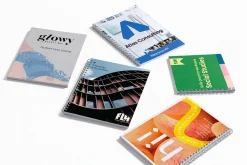
Catalogue – Company Profile

Folder

Letterhead

Envelopes
Number of pages and binding method
The number of pages of a catalogue is always a multiple of four, because paper is printed double-sided and folded in half. So when counting content, round to 8, 12, 16, 20 or 24 pages instead of an odd number.
The binding method depends on the number of pages. Books under forty pages use saddle stitching, opening flat and cheapest. From forty to one hundred and twenty pages, perfect binding gives a square spine with the name printable on it. Above that, thread sewing then gluing the spine is the most durable for frequent look-ups.
For catalogues that agents open to look things up every day, spiral binding is worth considering even though it looks less upscale. Spiral-bound books open completely flat and stay still on the desk, convenient when looking up and writing orders at the same time.
| Number of pages | Binding method | Features |
|---|---|---|
| 8 to 36 pages | Saddle stitch | Cheapest, opens flat |
| 40 to 120 pages | Perfect binding | Square spine, name printable |
| Over 120 pages | Thread sewing, glued spine | Most durable |
| Looked up every day | Spiral binding | Opens flat, stays still on the desk |
| Books needing extra pages later | Ring binder, punched holes | Pages can be replaced |
Ring binders with punched holes are the solution for facilities constantly adding item codes. Each time there is a new code, just print extra pages and clip them in, without reprinting the whole catalogue.
Paper for inner pages and cover
Paper decides both the feel in hand and durability when the book travels with sales staff. Catalogues kept in a vehicle or bag all day need a thick, laminated cover, otherwise the cover corners wear white after just a few weeks.
Inner pages usually use Couche paper 100 to 150gsm. 100gsm is light, suited to books with many pages; 150gsm is thicker, photos look better and there is less show-through from the next page. For catalogues with many data tables, matte Couche paper is easier to read than gloss because it does not glare under lights.
Covers use Couche paper 250 to 300gsm, gloss or matte laminated. Lamination is a step not to cut, because unlaminated covers peel at the corners very quickly, especially when the book is opened and closed many times a day.
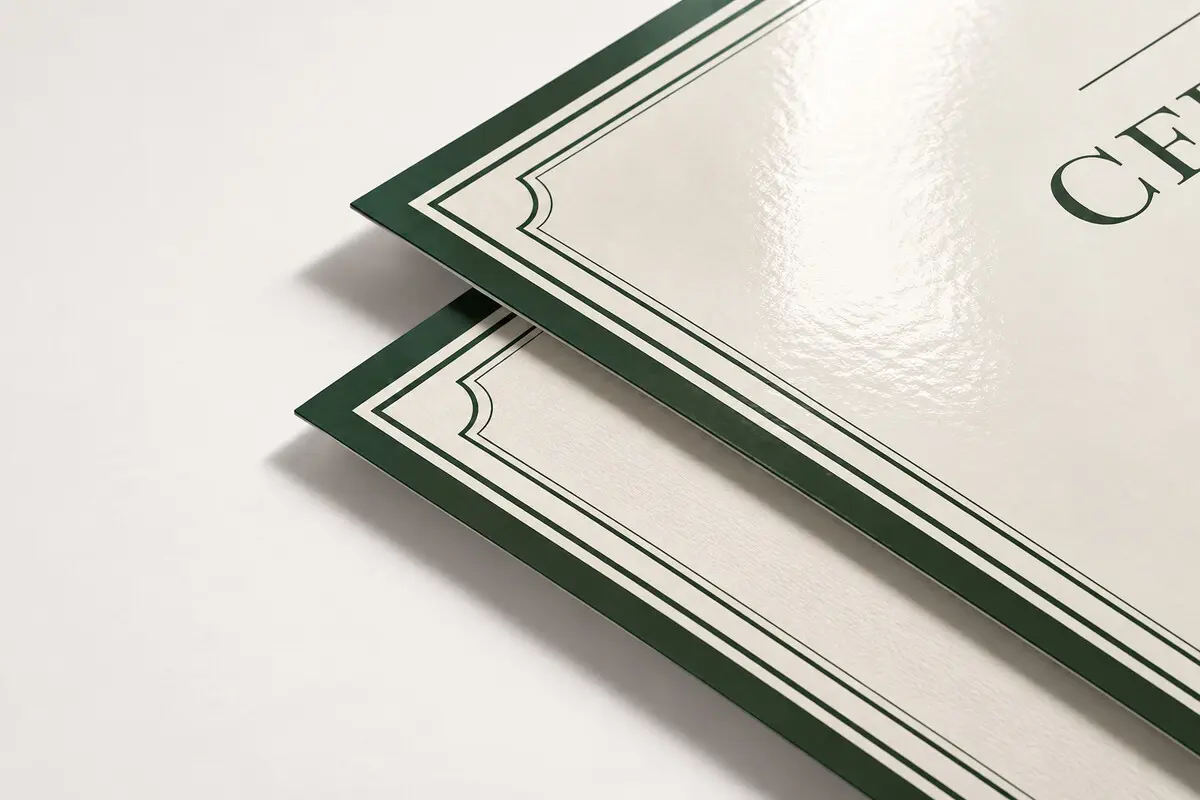
When the paper is not yet settled, test prints of a few pages on two or three types help compare directly. Seeing the real thing before choosing is surer than deciding based on paper names and weight figures.
Product photos and preparing files
The most time-consuming part of a catalogue is not printing but photos. Photos taken on a phone are enough for small photos in tables, but not for photos taking up half a page.
The minimum is 150dpi at the actual size on the page. A photo printed ten centimetres wide needs about 1200 pixels across; a small photo three centimetres wide in a table needs about 350 pixels. Images downloaded from websites usually do not reach this level.
Photo backgrounds should also be consistent throughout the book. A page of white-background photos next to a page of grey-background photos makes the book look patched together, and this is a common mistake when photos are collected from many sources over many years.
- Photos at 300dpi at actual size on the page.
- Consistent photo backgrounds, ideally white for the whole book.
- Set the file in CMYK, not RGB.
- Leave 3mm bleed and extend colour backgrounds past the trim line.
- Convert text to outlines or embed fonts when exporting PDF.
Facilities without a designer can send separate photos with specification tables; the layout is done at the workshop. This step is quoted separately by number of pages, and a preview is sent back before running.
Quantity and reprint cycle
Catalogues are an item with high preparation costs so the price per book drops very clearly with quantity. In return, if many books are printed and the catalogue changes, they have to be scrapped, so the order level needs to be weighed against how often item codes change.
Facilities with a stable catalogue usually print five hundred to one thousand books for one to two years. Facilities constantly adding item codes print two hundred books per round, or switch to a ring binder format with replaceable pages.
| Quantity | Technology | Price per book |
|---|---|---|
| 30 to 100 books | Digital printing | Highest |
| 100 to 300 books | Calculate both ways | Medium |
| 300 to 1,000 books | Offset printing | Clear reduction |
| Over 1,000 books | Offset printing | Lowest |
When the quantity is around the two-to-three-hundred-book threshold, quotes are calculated in parallel for both technologies so the facility can compare. The difference at this threshold is usually large enough to decide whether to combine rounds or split them.
Size and page arrangement in the book
The common catalogue size is A4 portrait, because paper runs through the machine at this size so there is little waste and the price is lowest. A5 is used for books carried around; square and landscape sizes stand out more but use more paper and are harder to fit into file folders.
In a book, two facing pages are always viewed together so they should be laid out in pairs. Placing large photos on the right page and specification tables on the left page is the common arrangement, because the reader's eye falls on the right page first.
The inside cover and last page are often left blank in self-laid-out books. These two pages work well for a table of contents, contact information or a unit conversion table, making use of space already paid for in paper.
A table of contents is only necessary for books over twenty pages. Below that, a colour strip in the page margin grouping products is enough for agents to flip to the right part, without taking up an extra page.
| Size | Features | Used for |
|---|---|---|
| A4 portrait | Common, lowest price | Full catalogue |
| A5 portrait | Compact, portable | Short introduction book |
| A4 landscape | Wide photos, airy look | Catalogues with large photos |
| Square 21x21cm | Striking, uses more paper | Brand book |
| A5 landscape | On the desk, opens landscape | Price list book |
For facilities in District 8 sending catalogues to agents by post, A5 saves noticeably on postage. Many make two versions: a full A4 version for staff to carry and a compact A5 version for posting.
Common mistakes in a first printed book
The five mistakes below account for most cases where a catalogue has to be reprinted, and because quantities are large, reprinting is very costly. All five can be detected on a test print of one complete book.
The first mistake is text or images too close to the spine. The part near the spine is hidden once the book is bound, especially with perfect-bound books. Leaving an inner margin about five millimetres wider than the outer margin is the solution.
The second mistake is page numbers not matching the table of contents, usually because pages were added or removed after the contents were made. This should be left to last, checked once on the final PDF before running.
The third mistake is low-resolution images, only visible when printed on paper. The fourth is page background colours that are not even because they come from many different files. The fifth is specification tables using too small a font, under eight points, so agents have to peer closely to read them.
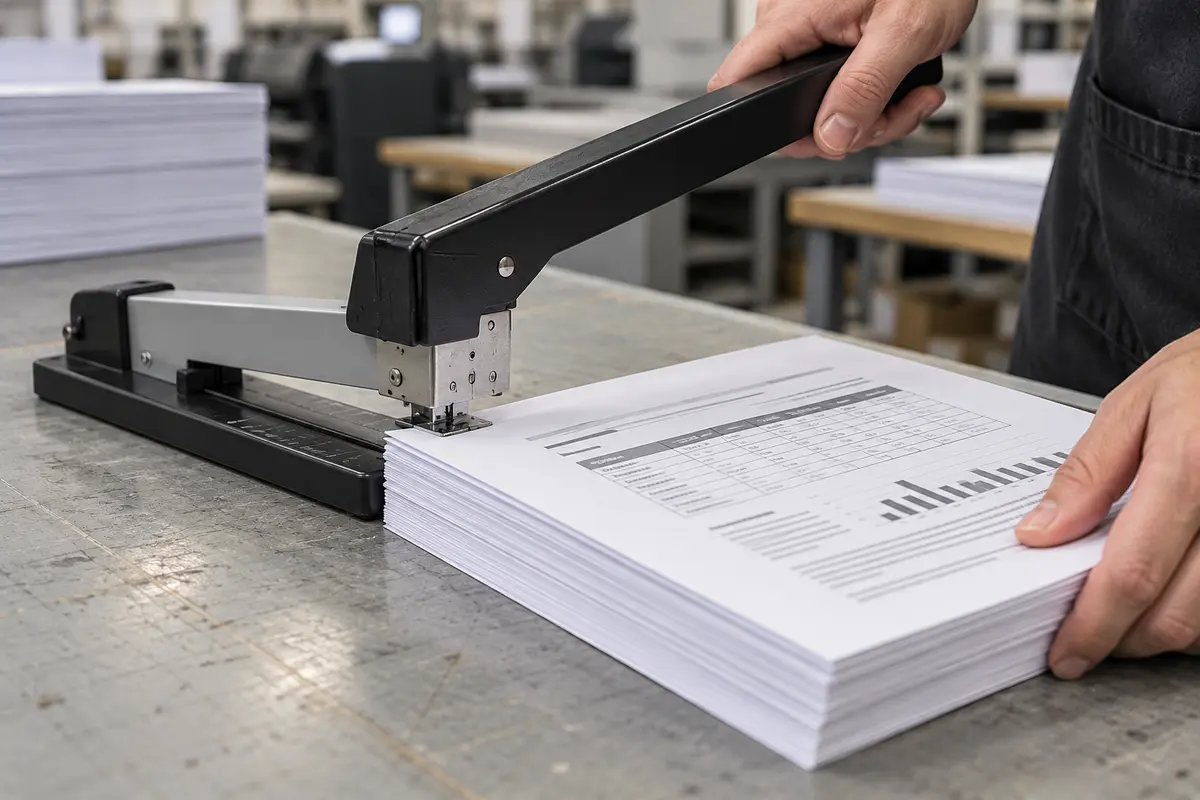
A test print of one complete book is the only way to see the thickness, whether the spine opens flat and the colour of adjacent pages. With large-quantity catalogues, this step takes an extra day but removes the risk of reprinting the whole batch.
Delivery and ordering catalogue printing in District 8
Workshop at 49 Mai Van Vinh, Tan Hung Ward, Ho Chi Minh City, to District 8 via Nguyen Van Cu Bridge or Chanh Hung Bridge. Printed catalogues are packed in cartons by quantity, delivered by small truck for many cartons and by motorbike for a few dozen books.
- Information 1: expected number of pages and number of item codes to include.
- Information 2: number of books and desired binding method.
- Information 3: whether to separate a loose price sheet or print prices in the book.
- Information 4: the date you need it, delivery address and gate opening hours if delivering into a warehouse.
Even if the number of pages is not settled, a quote can be given by range and adjusted when the final file is ready. Send your request via Zalo to receive a quote split into printing, finishing and layout.
Need printing or signage in Ho Chi Minh City?
In Quảng Cáo Q7 runs its own print workshop in Tân Hưng Ward (former District 7), Ho Chi Minh City, producing and installing signage, banners, window graphics, exhibition booths and event displays. Send us the size, material, quantity and a photo on WhatsApp and we will get back to you.

Phone: +84 866 511 099 · Also on WeChat
Workshop: 49 Mai Văn Vĩnh, Tân Hưng Ward, Ho Chi Minh City