




































































Certificate Printing District 8 – A4 Foil Logo, Fine Art Paper, Framed
Oct
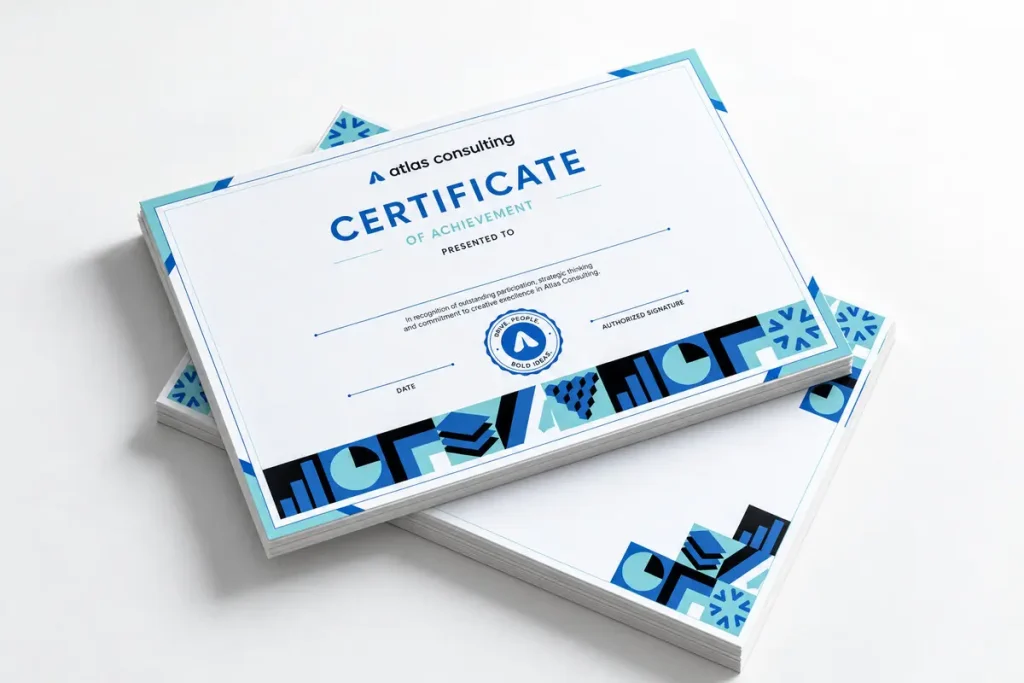
Does your company need District 8 certificate of merit printing? This article sets out the A4 size, three paper types, foil stamping – embossing finishes, frame options and how to print from a name list at the In Quảng Cáo Q7 workshop.
Certificate of merit printing for District 8 businesses
From Pham The Hien, Ta Quang Buu or Binh Dong, cross Nguyen Van Cu Bridge or Pham Hung Bridge and you reach the In Quảng Cáo Q7 workshop at 49 Mai Van Vinh, Tan Hung Ward. Certificates of merit are light goods, delivered quickly; framed versions are packed individually by the workshop.
Customers for District 8 certificate of merit printing are mostly production facilities and trading companies holding year-end reviews, rewarding production teams or presenting certificates to agents. The quantity is usually a few dozen sheets, exactly matching the award list.
Choosing paper by level of formality
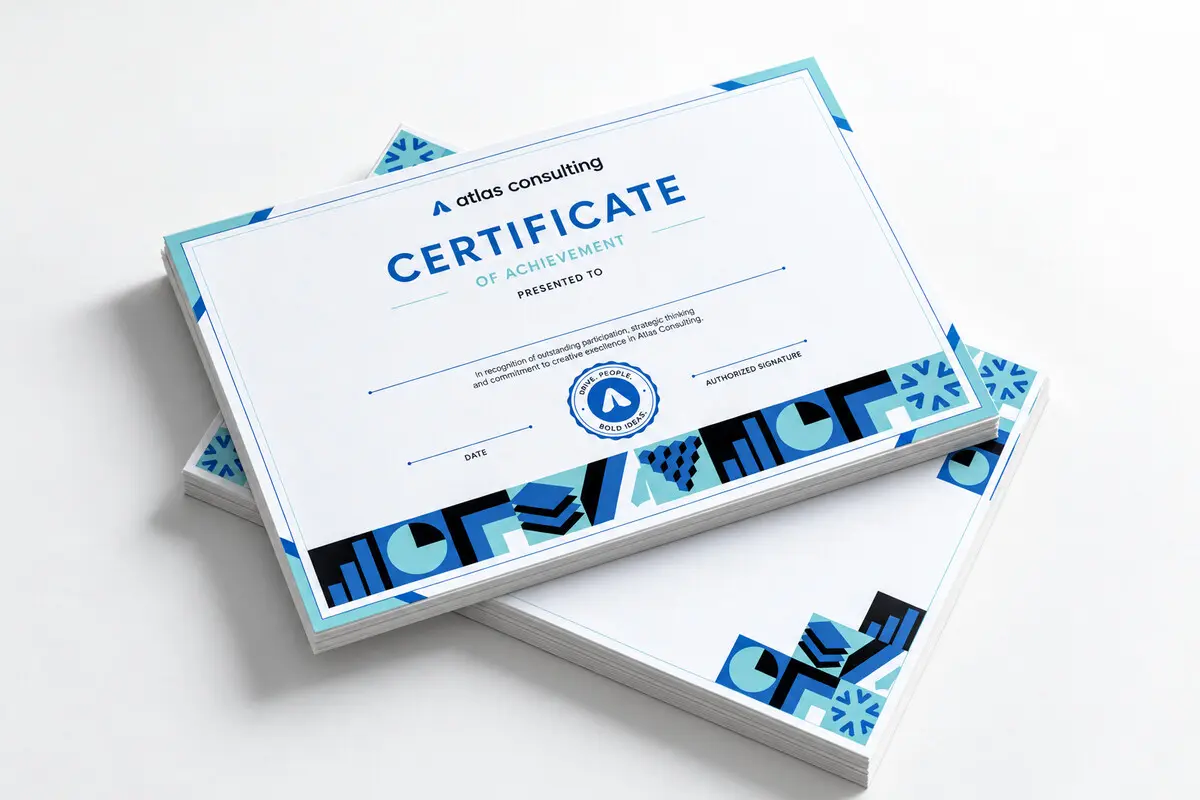
Fine Art Paper is the most formal version: the surface has raised texture and a soft sheen, thick in hand, with text and borders standing out. Used for certificates of merit presented on stage or certificates given to major agents.
Photo Paper has a glossy surface with deep, sharp colours, suited to versions with full colour backgrounds or photos. Fort 250gsm is the common version, with a matte ivory-white surface that can be signed with a fountain pen, suited to internal commendation certificates printed in large quantities.
Logo foil stamping and finishing styles
Logo foil stamping uses gold or silver metallic foil hot-stamped onto the company logo, the style chosen most in the certificate of merit group. Border foil stamping runs a metallic line around the four edges of the sheet, forming a decorative frame right on the paper.
Die embossing makes text or patterns stand right out from the paper surface, with a ridge you can feel. The embossed seal is a round seal pressed in the corner, usually placed over the signature. These styles are done after printing, on the certificate surface itself.

Printing from a name list and frame options
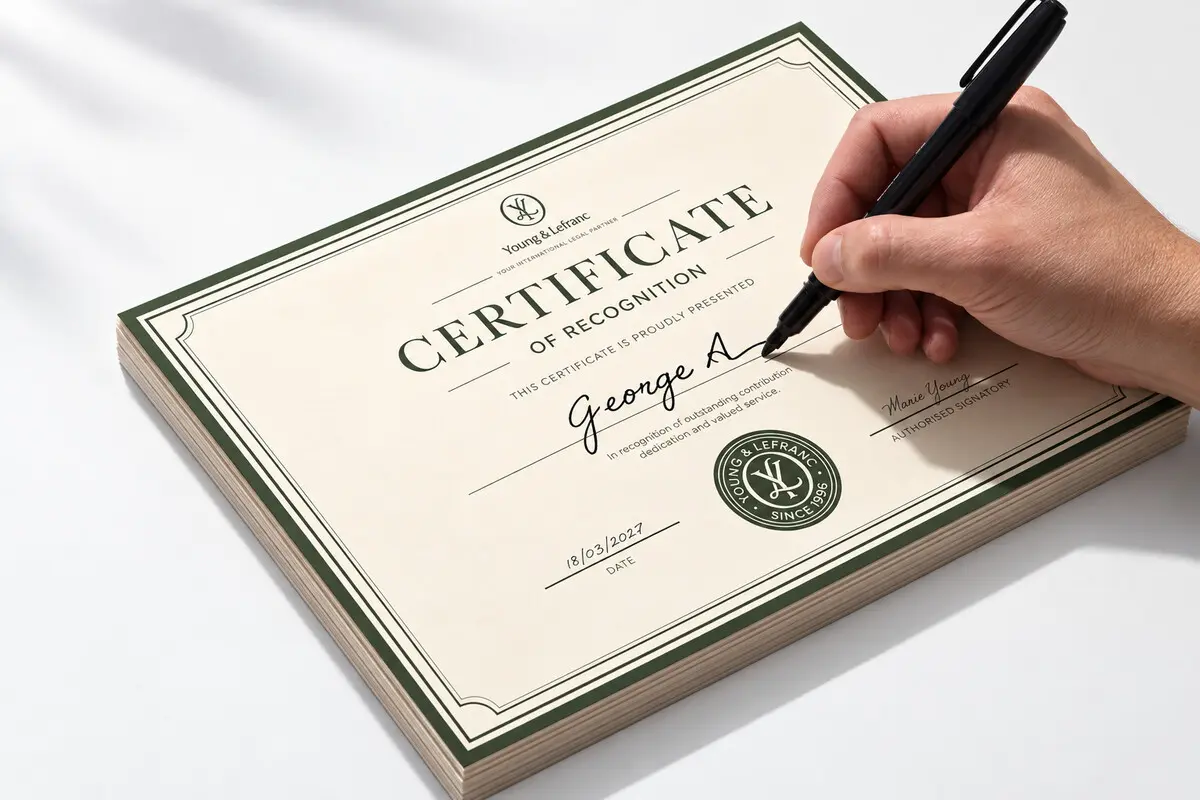
The version with recipients' names pre-printed merges them from a list file and prints in one pass, one name per sheet – send an Excel file with names and job titles or teams, departments. The version with space left for the name is used when the list is not settled until just before the date.
The frame is chosen right on the page. The framed version is delivered already mounted, ready to hang right after the ceremony; the unframed version is just the certificate sheet, suited when the company already has frames or presents it with an envelope.
Frequently asked questions about District 8 certificate of merit printing
How long does delivery to District 8 take?
The unframed version is delivered quickly, usually within an hour after the goods leave the workshop. The framed version has a glass front so it is packed more carefully, and the workshop arranges a specific time.
Is foil stamping charged extra?
Yes. Foil stamping, embossing and embossed seals are extra finishing after printing, charged separately by area and quantity. Send the file so the workshop can quote correctly by design.
How long does printing a list of 50 people take?
The version with pre-printed names merges from the file in one pass, so quantity does not slow it down much; the time-consuming part is foil stamping and framing if any. Tell us the event date so the workshop can schedule.
Order printing at In Quảng Cáo Q7
If you are in District 8 and need certificates of merit or certificates printed, send the logo, content and name list via Zalo so the workshop can build a sample and quote by paper type, foil stamping style and frame option.
In Quảng Cáo Q7 direct print workshop – 49 Mai Van Vinh, Tan Hung Ward, Ho Chi Minh City. Production and delivery hours: Monday – Saturday, 8:00–12:00 and 13:00–18:00 · Orders via Zalo/hotline: Monday – Saturday 8:00–12:00 and 13:00–20:00, Sunday 14:00–19:00. Quick message via Zalo or call 0866.511.099.
See more printing services on the In Quảng Cáo Q7 home page, see all corporate print products or contact us quickly via the contact page; you can also get directions to the workshop on Google Maps.
Occasions for certificates of merit and commendation certificates
Certificates of merit are an item with very clear timing: used at year-end, end of term or after an emulation campaign. So most orders are concentrated in a few weeks, and ordering early is the only way to keep a comfortable schedule.
In businesses, certificates of merit are used for year-end reviews, rewarding outstanding staff by quarter and rewarding agents who meet targets. In schools and training facilities, this group uses them for end-of-term reviews and internal exams.
Production facilities and warehouses in District 8 also use them for occupational safety campaigns or monthly productivity campaigns. This group orders small quantities but many times a year, so they usually pre-print the frame and fill in the content later.
| Occasion | Quantity per run | Usual approach |
|---|---|---|
| Year-end review | 20 to 100 sheets | Print full content from the list |
| Quarterly commendation | 5 to 20 sheets | Pre-print the frame, fill in by hand |
| Rewarding agents who meet targets | 10 to 50 sheets | Print from the list |
| Monthly campaign | 3 to 10 sheets | Pre-print the frame, fill in by hand |
| End-of-term review | 50 to 300 sheets | Print from the list |
Pre-printing the frame and filling in by hand is the most economical for small repeated rounds. The frame is printed once in a large quantity, and each round just takes some out to fill in names, so the price per certificate drops clearly compared with printing separately each round.
Related products

Certificate

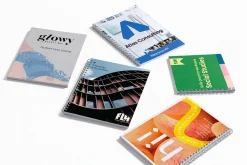
Catalogue – Company Profile


Business cards

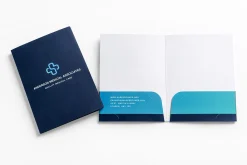
Folder
Materials and paper weight
Paper decides the feel when the recipient holds the certificate. Thin paper creases at a slight fold, and for a sheet meant to be hung or kept for many years, that is a clear drawback.
The common level is Couche paper 250 to 300gsm, stiff, taking colour well, reasonably priced. This level suits most commendation rounds in businesses and schools.
Textured or ribbed fine art paper is a higher level, giving the certificate a formal and distinctive feel to the touch. This type is ordered separately by paper source so it needs extra time, and writing with a fountain pen on a textured surface is also harder to make look neat.
For sheets to be filled in by hand, an uncoated or lightly coated surface is the suitable choice because fountain pens and ballpoint pens take ink. With gloss-coated paper, handwriting smudges easily, so if you choose this type the names should be pre-printed.
| Material | Features | Can be filled in by hand |
|---|---|---|
| Couche paper 250gsm | Common level, takes colour well | Difficult, smudges easily |
| Matte Couche paper 300gsm | Stiff, no glare | Yes |
| Fort paper 200gsm | Lighter, writes well | Yes |
| Textured fine art paper | Formal, distinctive | Depends on the texture type |
| Couche paper 300gsm with foil stamping | Most striking | No |
When the paper is not yet settled, test prints on two or three types help compare by hand. With certificates of merit, the feel in hand matters almost as much as the printed look.
Content and layout on the certificate
The layout of a certificate of merit is already quite standard, so it does not need much change. The important part is leaving enough space for the recipient's name and for signing and stamping, two places often cramped.
The top block contains the organisation name and logo. The middle block contains the large title CERTIFICATE OF MERIT or COMMENDATION, followed by the awarded-to line and the recipient's name. The bottom block contains the reason for the award, date, job title and signature space.
The signature space needs at least four centimetres of height, because a stamp also has to be placed over the signature. Many self-designed templates leave too little room so the stamp overlaps the date line.
- Leave a wide line for the recipient's name, in the second largest font after the title.
- Keep the reason for the award short, one or two lines, not written as a paragraph.
- Leave at least 4cm of height for signing and stamping.
- Place the date away from the stamp area.
- Decorative borders do not encroach on the text area; leave an inner margin of 15mm.
For sheets filled in by hand, the name line should have a thin rule so the writing stays straight. This rule is printed very lightly, enough to act as a guide without standing out more than the handwriting.
Printing from a list and pre-printing frames
The two common approaches differ in whether the recipient's name is pre-printed or filled in later. Which to choose depends on the quantity and whether the list can be settled in time.
Printing from a list gives the neatest result because the names are printed in the same ink colour and font as the whole sheet. The machine reads data from a spreadsheet and fills in the right field, so printing one hundred sheets with one hundred names runs in one pass.
Pre-printing the frame is more flexible when the list is not settled or when an unscheduled commendation is needed. The drawback is that handwriting is not uniform between sheets, and the writer needs good handwriting.
| Criterion | Print from the list | Pre-printed frame |
|---|---|---|
| Format | Uniform, neat | Depends on handwriting |
| Time | Needs the list in advance | Ready to use immediately |
| Flexible | Low | Height |
| Price per sheet | The same | Lower when printing a large quantity at once |
| Suitable when | Large rounds, list already settled | Small rounds repeated many times |
Many businesses do both: printing from a list for the year-end review and pre-printing a quantity of frames for small commendation rounds during the year. This split keeps big occasions neat and small occasions flexible.
Presentation covers and hanging frames
A certificate of merit usually comes with something to protect or display it. There are three options, differing in price and in how the recipient uses it afterwards.
The clip-in presentation cover is the common option, made of rigid board covered with fine art paper or leatherette, with four corner clips. The certificate lies inside so it does not crease, and the recipient takes it home neatly.
Glass frames or Mica frames are used when the certificate is hung right at the workplace. This type is heavy and takes up more space so it is usually only ordered for a few important certificates.
The third option is a simple clear plastic sleeve, just to prevent creasing when taken home. Cheapest but cannot be used for display.
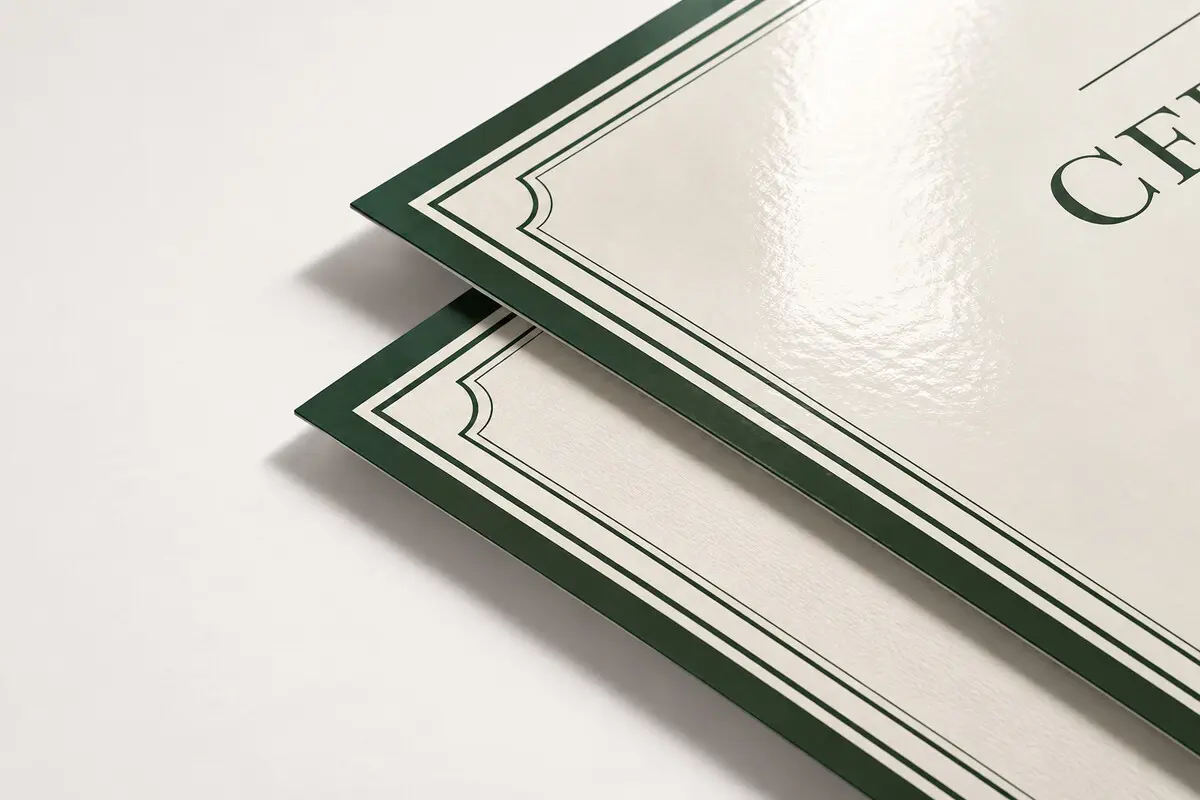
Presentation covers and frames ordered in the same printing round will match the size of the certificate. Ordering them separately later often results in the certificate being a few millimetres wider than the clips and not fitting.
Finishing styles for certificates
Beyond printing, each added finishing step makes the certificate stand out more but adds time and cost. The four steps below are the commonly used group, and not every round needs them.
Foil stamping is the most visible step: the logo or title text is stamped with a gold or silver metallic layer, catching the light and standing out from the normal print. This step needs a separate die so the first round has an extra die cost, but the die is kept for later rounds.
Embossing raises the logo, which can be felt when touched. The effect is subtler than foil stamping but needs no metallic layer, so it looks more understated and formal with some designs.
Matte lamination protects the surface from fingerprints, used when the certificate is held and passed around a lot. In return, a laminated surface cannot be written on by hand, so it is only used with sheets pre-printed with full content.
| Step | Effect | Extra time | Needs a die |
|---|---|---|---|
| Gold, silver foil stamping | Glittering, most striking | 2 days | Yes |
| Embossed logo | Raised when touched | 1 to 2 days | Yes |
| Matte lamination | Resists fingerprints | Half a day | No |
| Rounded corners | Softer corners, less wear | A few hours | No |
For small certificate rounds under ten sheets, the foil stamping die cost is divided among few sheets so the price per sheet is high. Many businesses make the die once for the big year-end round and reuse it for small rounds the following year.
Common mistakes and how to check before printing
The five mistakes below account for most cases where a round of certificates of merit has to be reprinted, and because each certificate is tied to a specific person's name, a mistake means redoing that exact sheet.
The most common mistake is a wrong recipient name, usually wrong diacritics or a missing letter. The list sent should be a spreadsheet with correct Vietnamese diacritics, not a photo of a handwritten list, because handwriting is easily misread.
The second mistake is a wrong job title or organisation name in the awarded-to line. The third is leaving the date blank and forgetting to fill it in, or keeping the previous round's date when reusing an old file.
The fourth mistake is a signature space too narrow so the stamp overlaps the text. The fifth is a decorative border encroaching on the text area, clearly visible after trimming because of cutting tolerance.
- Send the list as a spreadsheet with diacritics, not as a photo.
- Proofread names and job titles once before approving.
- Check the date, especially when reusing the previous round's file.
- Leave at least 4cm for the signature and place the date outside the stamp area.
- Test-print one complete sheet and then try stamping on it.

A test print of one complete sheet is a step worth keeping, especially for certificate rounds of over twenty sheets. Stamping on the test sheet shows right away whether the signature space is wide enough, which cannot be seen on the preview.
Production time and ordering printing in District 8
Workshop at 49 Mai Van Vinh, Tan Hung Ward, Ho Chi Minh City, to District 8 via Nguyen Van Cu Bridge or Chanh Hung Bridge. Printing the certificates is quick, but the foil stamping and presentation cover steps need extra time, so the schedule has to be counted from those steps.
| Item | Lead time | Order ahead |
|---|---|---|
| Ordinary printed certificate | Same day to 1 day | Before 11:00 |
| Certificate with foil stamping | 2 to 3 days | The day before |
| Certificate on fine art paper | 2 to 3 days | The day before |
| Clip-in presentation cover | 3 to 4 days | 3 days before |
| Glass frame, Mica frame | 3 to 5 days | 5 days before |
- Information 1: number of sheets and whether printed from a list or with a pre-printed frame.
- Information 2: paper material and desired finishing level.
- Information 3: whether presentation covers or frames are ordered with it.
- Information 4: the date you need it and the delivery address.
Send your request via Zalo with the four pieces of information above and you will have a quote within working hours. If you do not have a file, send the organisation name, logo and text content; the layout is done at the workshop and a preview is sent.
Need printing or signage in Ho Chi Minh City?
In Quảng Cáo Q7 runs its own print workshop in Tân Hưng Ward (former District 7), Ho Chi Minh City, producing and installing signage, banners, window graphics, exhibition booths and event displays. Send us the size, material, quantity and a photo on WhatsApp and we will get back to you.

Phone: +84 866 511 099 · Also on WeChat
Workshop: 49 Mai Văn Vĩnh, Tân Hưng Ward, Ho Chi Minh City