



































































Our commitments
Printed directly in our workshop, no middlemen
Digital and offset presses right in our workshop. You deal directly with the people who make your order, so every request is understood and handled immediately.
Fast production, many orders ready the same day
Business cards, documents, decals, standees… printed and delivered the same day. See production times for each product group.
One point of contact, all-in-one from file to finished product
Quotes, orders, Zalo messages, delivery booking and invoicing run automatically on one system. Design – printing – finishing – installation all happen in-house, so you don't have to go anywhere else.
Full VAT invoices, issued fast
E-invoices issued right after delivery, with urgent support for businesses that need documents early for payment.
Invitations
Contact us for a quote
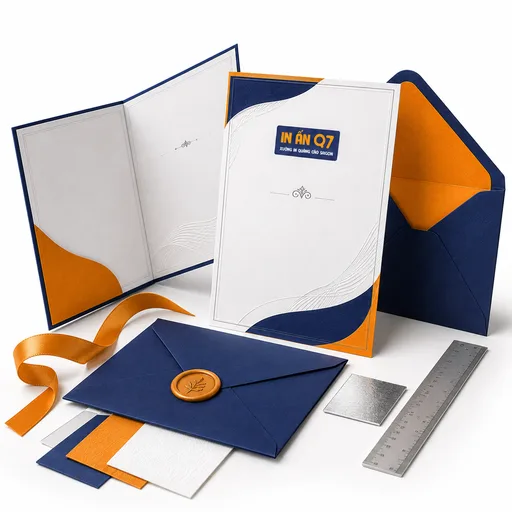
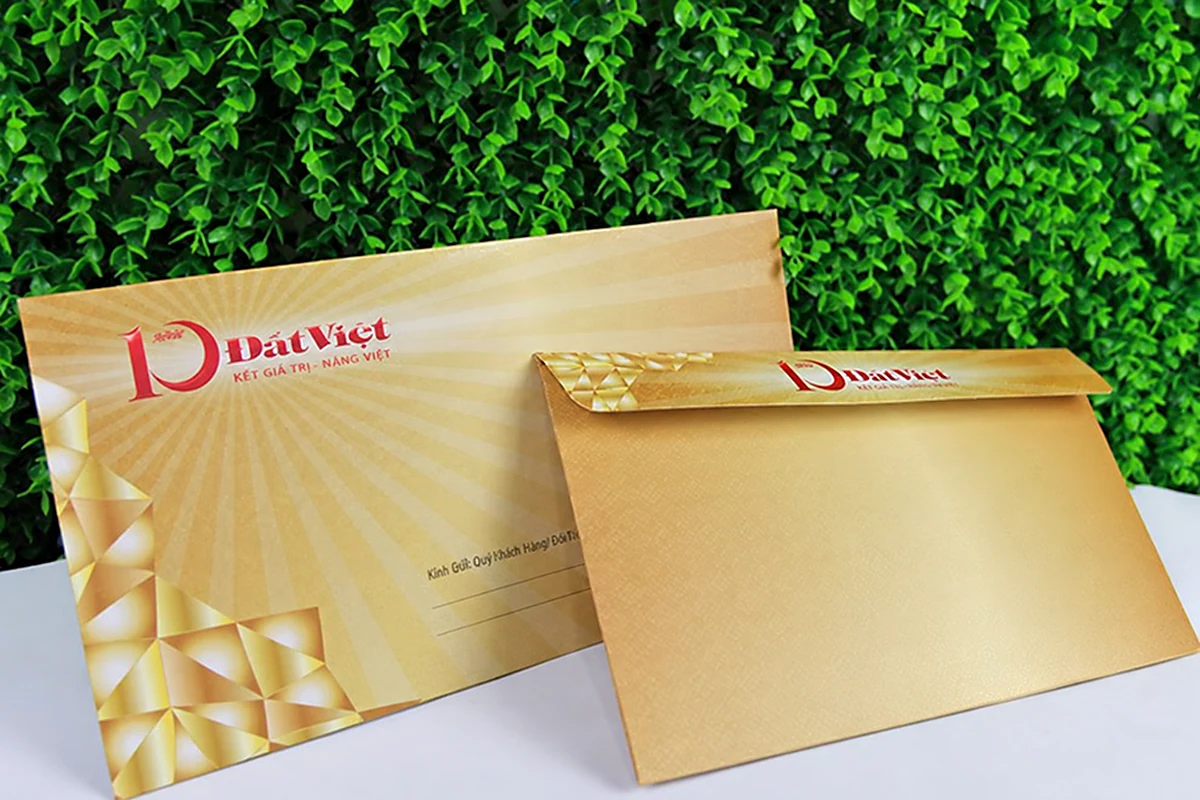
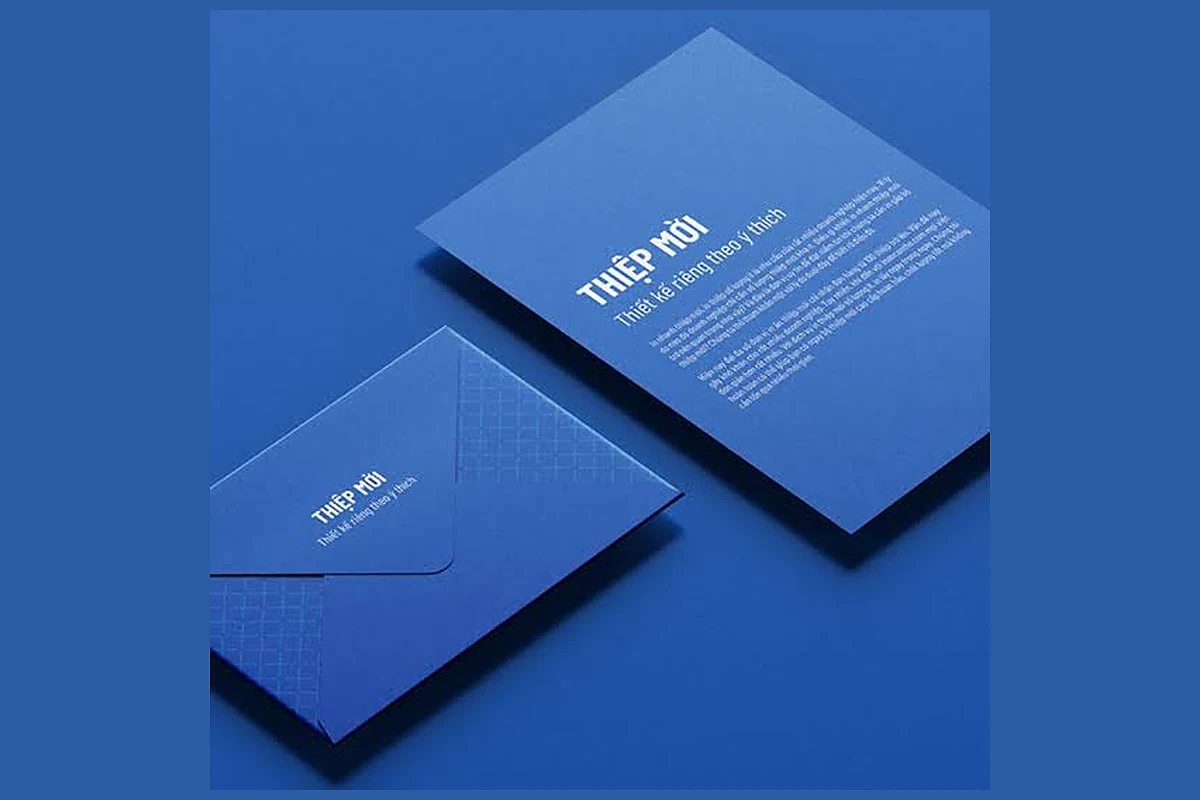
Invitations for weddings, grand openings and conferences printed on fine art paper with matching envelopes. Send a request for a quote within 30 minutes.
Quote-on-request product
This item is quoted based on actual size, materials and quantity. Send a request and In Quảng Cáo Q7 will reply within 30 minutes during office hours.
When messaging, please include size · quantity · date needed and your design file if you have one.
Wedding, Grand Opening and Event Invitation Printing With Envelopes
An invitation represents the whole event before guests walk through the door. In Quảng Cáo Q7 prints invitations for weddings, grand openings, conferences and company parties on fine art paper, with matching envelopes, quoted by card size, paper type and quantity.
What an invitation set includes
A complete invitation set usually isn't just one sheet. Depending on the event, it may include the main card, an envelope, an RSVP card, a direction map or a seating card. When ordering, settle how many items your set includes, since each item is a separate print job.
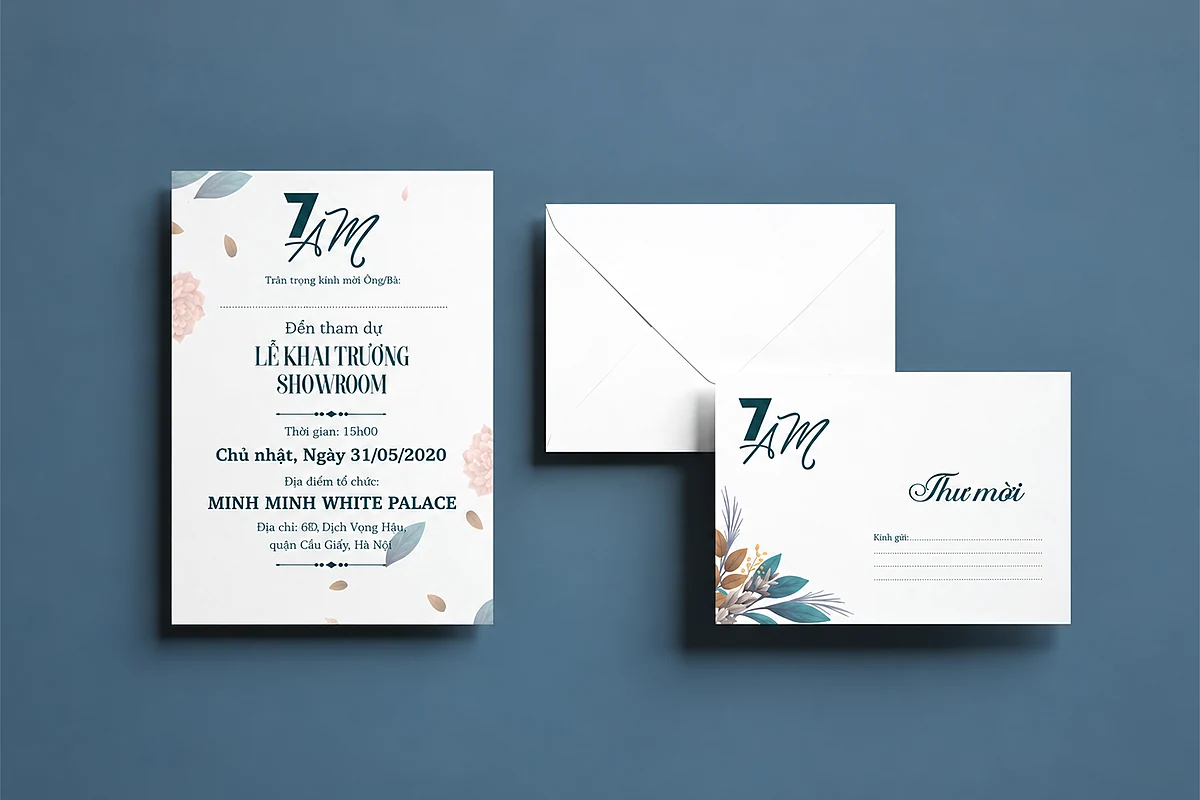
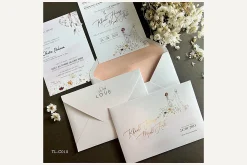
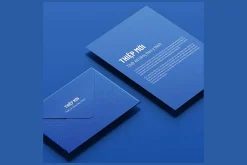
Most orders at our workshop are two items: the main card and the envelope. The main card carries the invitation content, while the envelope keeps the card clean and adds formality when handed over. These two should be made in the same run so paper colors and print tones match.
RSVP cards — small cards for guests to confirm attendance — are common for weddings and conferences that need to finalize the number of seats. If the event needs an exact guest count, adding this item from the start is cheaper than reprinting later.
Invitations for each type of event
They're all invitations, but each type of event is handled differently, mainly in color tone, paper and the amount of information on the card.
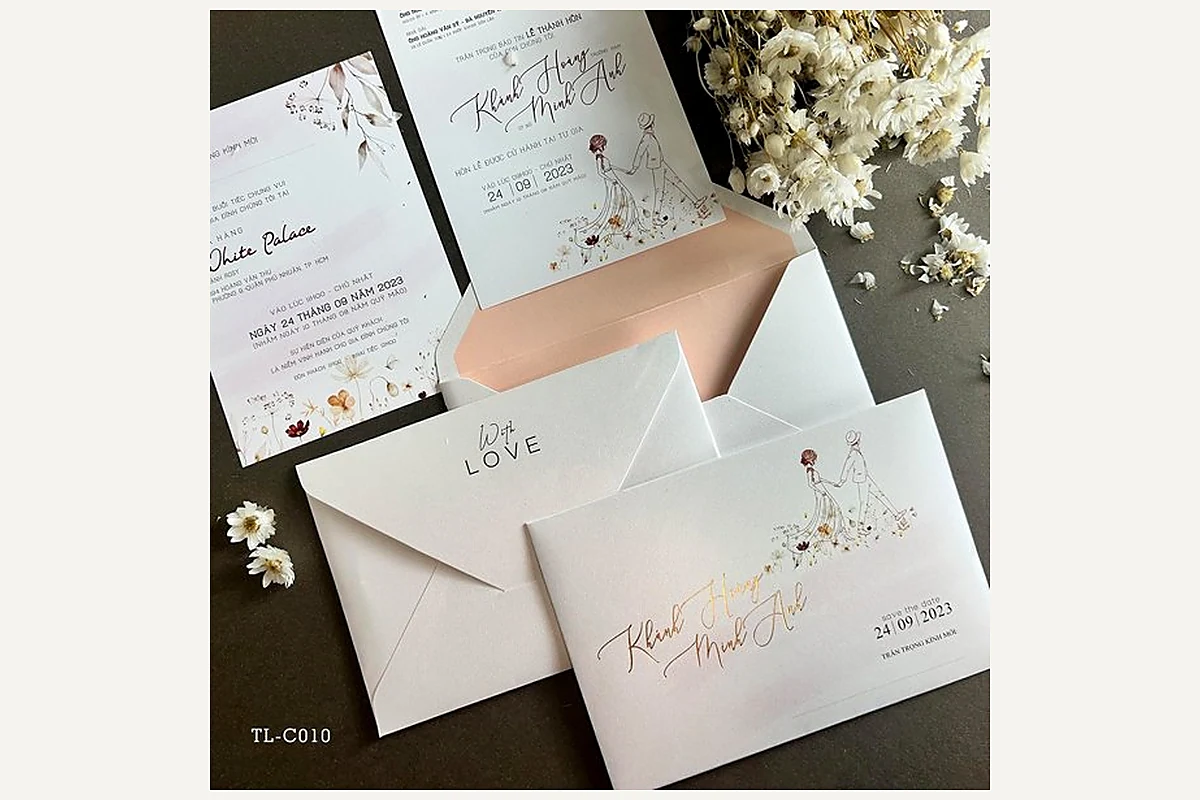
Wedding invitations — the largest quantities, usually a few hundred to over a thousand cards. Soft tones, floral motifs, textured or metallic fine art paper. Many couples also choose cards with a photo slot or photos printed directly on the inside.
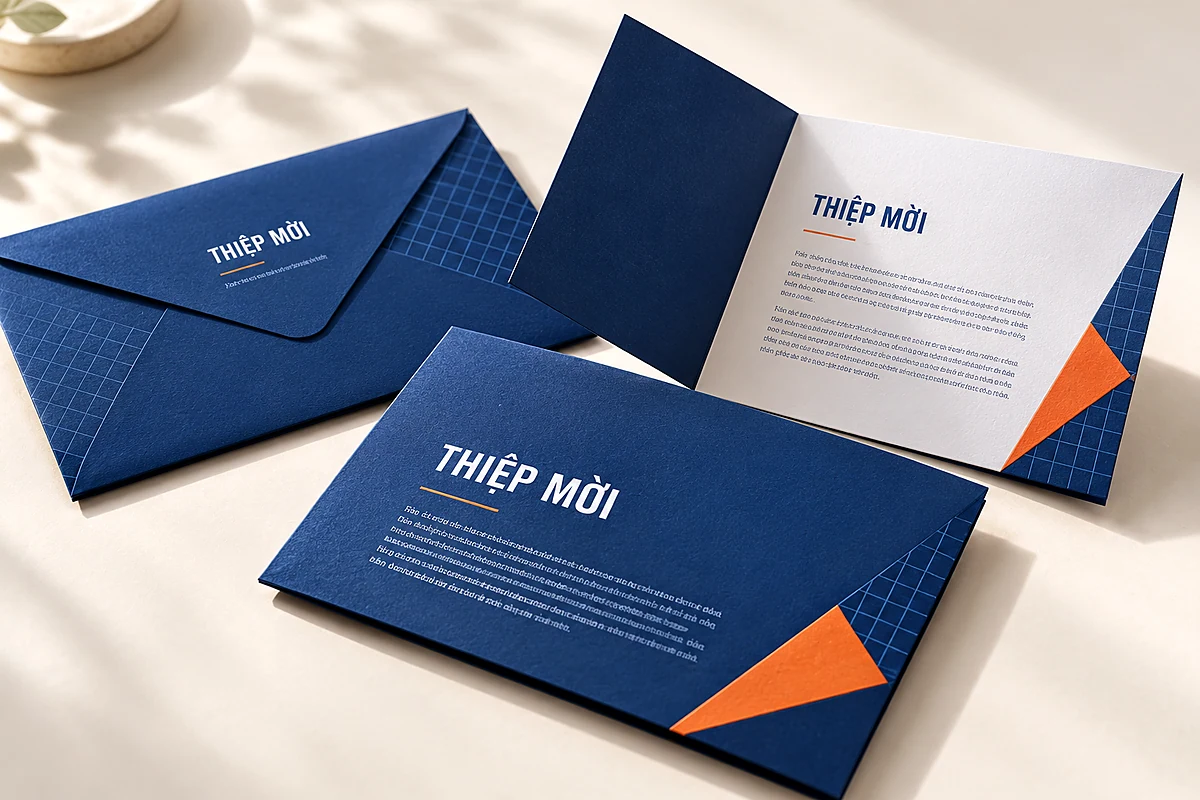
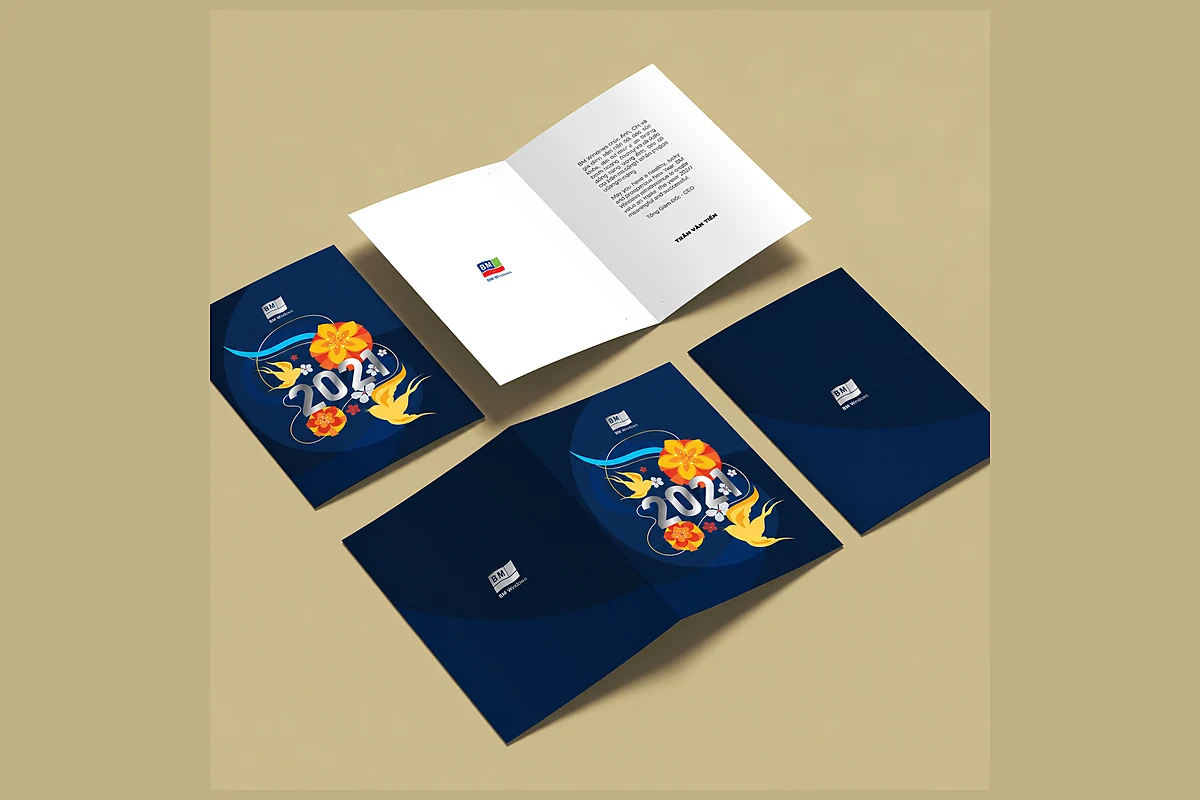
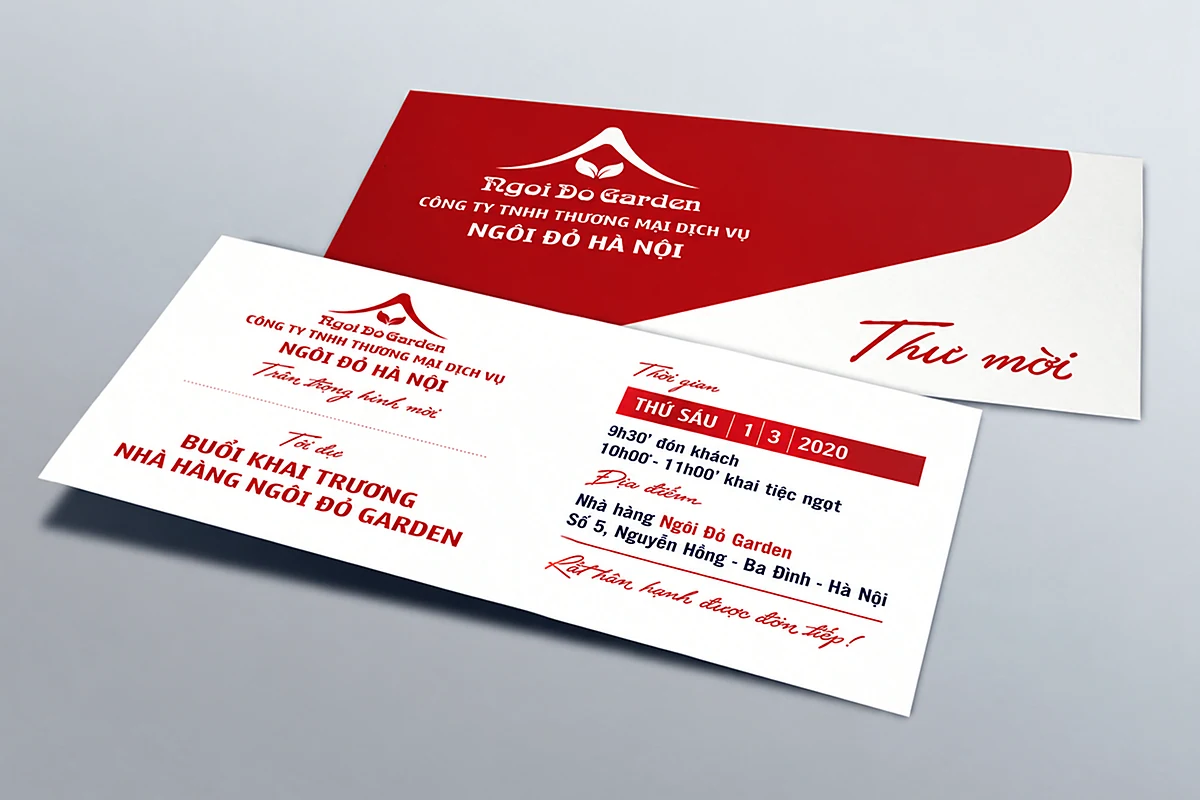
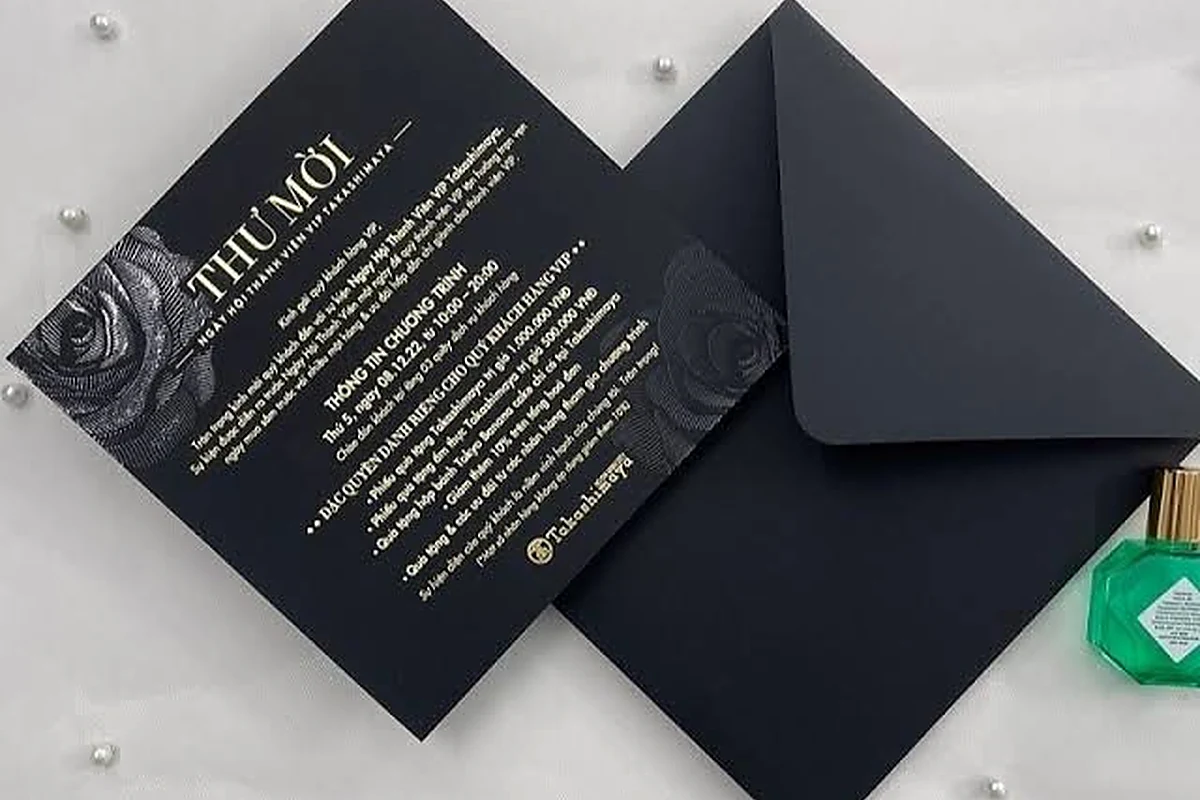
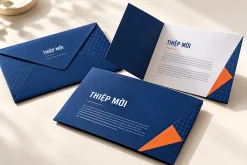
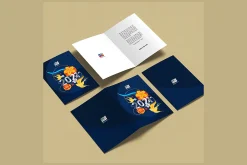
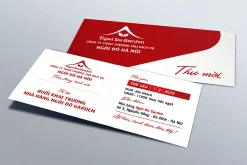
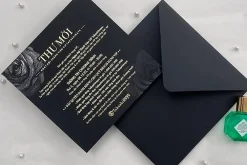
Grand opening and corporate event invitations — in the company's brand colors, with concise text and a logo. These are usually fold-open so the inside holds the program and a direction map. A dark background with gold foil lettering is a popular choice for evening parties and launches, often paired with a welcome gate and backdrop in the same tones.
Conference and year-end party invitations — denser content: a timed program, a list of special guests, registration codes. These should be a larger size or tri-folded to have enough room without tiny text. For year-end parties with a lucky draw, also make raffle tickets in the same print run.
Fold styles and invitation structure
The fold style decides both the feel of opening the card and how many printed faces you have to work with:
- Flat single card — printed on one or two sides, not folded. Neat and cheapest, suited to short content.
- Half fold — the most popular style. Four printed faces: front cover, two inside faces and back cover.
- Tri-fold — six printed faces, enough room for a detailed program and a map.
- Card with a fold-over flap — a die-cut shaped flap that reveals the content when opened. Looks distinctive but needs its own cutting die.
- Pull-out card — the card sits inside a sleeve and is pulled out to read. The most finishing steps of all.
Cards with die-cutting or special folds need a die, so small quantities cost more since the die cost is spread over few cards. For under 100 cards, a bi-fold style usually prices far better than a die-cut shaped card.
Envelopes to go with invitations
Envelopes are often overlooked when budgeting and then added in a rush. There are two approaches: use ready-made white envelopes in a standard size, or print custom envelopes to your design.
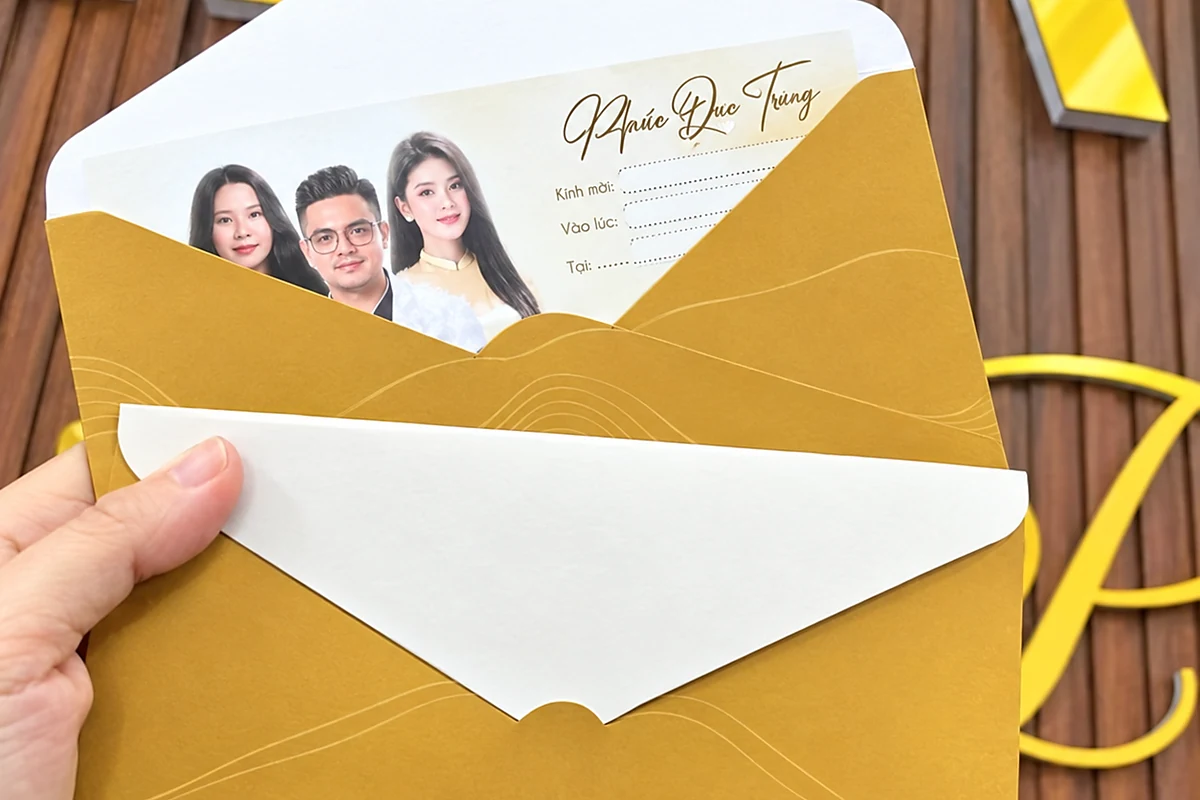
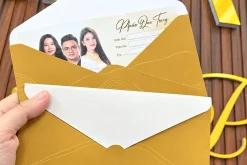
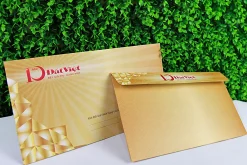
Custom envelopes are cut and folded to the exact card size, printed in color on the outside and inside the flap if desired. This keeps the invitation set completely consistent in color, but needs a folding die, so it adds to production time.
When choosing the size, remember to make the envelope about 5 mm larger than the card in each dimension. A card that fits the envelope exactly sounds nice, but in practice it's very hard to insert, especially when the card has thick finishes like debossing or foil stamping.
Paper and surface finishing
Paper is the first thing guests feel when receiving an invitation. Commonly used papers:
- Textured fine art paper — a lightly ribbed surface with a substantial feel. The most used type for wedding invitations.
- Metallic fine art paper — a subtle shimmer depending on the viewing angle, suited to evening parties and corporate events.
- Matte-laminated Couche paper — prints photos and deep colors very accurately, at a reasonable price for large quantities.
- Kraft Paper — a rustic brown tone, suited to nature-style parties.
As for finishing, the styles often added to invitations are foil stamping (gold, silver or rose gold foil for names and borders), embossed or debossing for letters you can feel, matte or glossy to protect the printed surface, and die-cutting for non-square edges. Each is a separate machine step, so it directly affects price and time.
If you're unsure what to choose, the most practical approach is to set a budget per card and let us suggest a combination of paper and finishing within it, rather than choosing each item separately and then adding up the total.
Content an invitation needs
One missing line on an invitation means reprinting the whole batch, so this is the part to check most carefully before approving for print:
- The name of the host person or organization, and if guest names are handwritten on each card, a blank line left for them.
- The event name, written exactly as it will be used on the backdrop and other printed items.
- Date, weekday, time — include the weekday so guests don't have to check a calendar.
- The full venue: venue name, street number, street, ward, province or city.
- Contact details for confirmation: a phone number or Zalo.
- A timed program, if it's a conference or a party with several parts.
Check the date and address by reading them aloud to someone else, not just looking on screen. The most common error isn't spelling but the wrong weekday or the wrong street number.
What a quote request needs
Invitations are quoted on request since card size, fold style, paper type and finishing differ for every set. For an accurate quote the first time, please send:
- Quantity of invitations and number of envelopes.
- Invitation size you want, or a reference sample for us to work from.
- Fold style: flat, bi-fold, tri-fold or with a die-cut flap.
- Paper type or the feel you're after (rustic, metallic, smooth white).
- Finishing needed: foil stamping, embossing, matte lamination, die-cutting.
- Whether to print custom envelopes or use white envelopes.
- Date needed — invitations always need to go out some time before the event.
- Design file if you have one; if not, send the invitation content and logo.
With all the above, we'll quote the whole set with a delivery date. If anything is missing we can still give a price range, but it will need finalizing once all the information is in.

Vouchers & Gift Cards

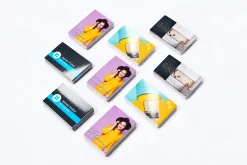
Business cards

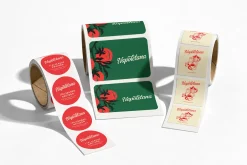
Labels & stickers

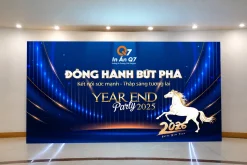
Backdrop
Preparing design files
Invitations are small-format prints in large quantities, so one wrong detail in the file shows across the whole batch:
- File PDF or AI, color mode CMYK, images at least 300dpi at actual size.
- Leave 3 mm bleed on each edge; text at least 5 mm from the cut line.
- Clearly mark the fold lines on each face, and put die-cut lines on a separate layer if any.
- The foil stamping or embossed on a separate layer, filled 100% black exactly on the areas to be finished.
- Text must be converted to outlines, or send the fonts along.
- Custom envelopes need a file laid out to the folding template, not a flat-face file.
No file yet? We design it from your existing content: invitation text, logo, photos and desired color tones. We build a full mockup of all faces with the envelope and send it for approval before printing. If you need to print more business cards in the same identity tones, combine them into one order to match the paper color.
How many invitations to print
The number of invitations isn't the number of guests, since one card often invites two people or a whole family. The table below shows the usual way to calculate.
| Type of event | How to count invitations | Spare allowance |
|---|---|---|
| Wedding parties | By number of families or guest couples | Add 10 percent |
| Grand opening | By number of partners and main guests | Add 10 percent |
| Customer conferences | By number of companies invited | Add 5 percent |
| Internal year-end parties | By number of employees or departments | Add 5 percent |
| Founding anniversary ceremonies | By number of external and internal guests | Add 10 percent |
| Award ceremonies | By number of award recipients and companions | Add 10 percent |
| Client appreciation | By the loyal customer list | Add 10 percent |
- The spare allowance covers cards with wrongly written names or damaged in transit.
- If guest names are handwritten, allow more spares since mistakes are easy.
- If guest names are printed directly, send a list checked twice.
With a list still changing, the common approach is to print the confirmed part first and add more later. Envelopes should be printed with slightly more spares than cards, since envelopes often get spoiled when writing names or sealing.
Timeline for printing and sending invitations
Invitations need to reach guests early so they can plan, so work backward from the event date. The table below shows reference milestones.
| Timing | Task | Notes |
|---|---|---|
| 5 – 6 weeks before | Finalize content and guest list | The guest list is the part most likely to change |
| 4 – 5 weeks before | Finalize paper, fold style and envelopes | See real paper samples before deciding |
| 3 – 4 weeks before | Approve the print proof | Check the spelling of names and dates |
| 2 – 3 weeks before | Print the whole batch and receive the goods | Including surface finishing if any |
| 2 weeks before | Write guest names and send invitations | Leave time for guests to respond |
| 1 week before | Send the additional invitations | For guests invited close to the date |
The milestones above are for important events such as weddings and anniversaries. For internal parties or compact conferences, the whole process can be shortened to about two weeks, but the print proof approval step should still be kept.
Inserts printed with invitations
Besides the card and envelope, an invitation set can include a few other small cards. These are printed in the same batch, so paper and colors stay consistent.
| Insert | Content | When it's needed |
|---|---|---|
| RSVP card | A box for guests to confirm attendance | When the number of party tables needs finalizing |
| Direction card | A map or directions to the venue | When the venue is hard to find |
| Seating card | Table number or table name | When the party has pre-arranged seating |
| Program information card | The order of parts in the ceremony | When the program has many parts |
| Thank-you card | A thank-you message sent after the event | When you want to follow up after the event |
- Inserts should be smaller than the card to fit neatly in the envelope.
- Use the same paper type as the card so the set looks seamless.
- If the envelope is already full, reduce the number of inserts rather than enlarging the envelope.
List the parts you need printed right in your quote request, since the number of inserts affects the envelope size and folding. Finalizing them together lets the whole set be laid out in one consistent design.
Checking invitations before printing the whole batch
Invitations are hard to fix after printing, since one wrong word means reprinting the whole batch. The table below is a checklist for the print proof.
| Part to check | Common error | How to check |
|---|---|---|
| Host names | Missing diacritics, wrong order of names | Read each name aloud |
| Date and time | Weekday doesn't match the date | Compare with a calendar |
| Venue address | Wrong street number or street name | Look it up again on a map |
| Contact phone number | A missing or wrong digit | Make one test call |
| Spelling of the invitation text | Typing errors | Ask someone else to read it again |
| Fold position | Text falling on a fold line | Fold the print proof as a test |
The surest way is to ask someone who hasn't read the draft to review it, since writers often don't see their own mistakes. After approval, keep the approved print proof as the reference for checking when you receive the goods.
Invitation printing and delivery areas
Invitations are printed at our workshop at 49 Mai Van Vinh, Tan Hung Ward, Ho Chi Minh City. Cards and envelopes are boxed by quantity and delivered to your door within the city.
- Around the workshop — District 7, Phu My Hung, District 4, District 8, Nha Be, Binh Chanh. If you're nearby, drop by to see paper samples before finalizing, especially when torn between fine art paper and regular paper.
- Central area — District 1, District 3, Binh Thanh, Phu Nhuan, Tan Binh. Delivered to your home or office at the time you arrange.
- Rest of the city — Thu Duc, Go Vap, Tan Phu, District 10, District 11, District 12, Binh Tan, Hoc Mon, Cu Chi.
- Other provinces — sent by delivery service. Cards are boxed tightly so corners don't bend, with envelopes in a separate layer.
Invitations are the item to order earliest in the whole set of event materials, since after printing you still have to write guest names and send them out. Receiving the cards five to six weeks before the event gives breathing room, enough even if you need to reprint a few dozen for additional guests.
Frequently asked questions
Why is there no listed price? Because card size, fold style, paper type and finishing differ for every set. Send the quantity and expected card style, and we'll quote right away.
What's the minimum number of cards? We accept small quantities too, but cards with die-cutting or foil stamping cost more per card in small quantities because of the die cost.
How many extra should I print? About 10% extra. Additional guests often come up, and handwriting guest names also spoils some cards.
Do you write guest names on the cards? We print the blank space; you can write the names yourself or order names printed from a list — printing names from a list adds a variable data charge.
Can photos be printed on wedding invitations? Yes. Photos need at least 300dpi at actual print size; send original phone photos rather than via chat apps.
Are envelopes mandatory? No, but cards handed over without envelopes get dirty corners easily. If cutting the budget, choose standard white envelopes rather than skipping them entirely.
How far in advance should I order? Invitations with folding, die-cutting and foil stamping need finishing time after printing. Contact us early so we can schedule it in time for your sending date.
Get an Invitation Quote at In Quảng Cáo Q7
Message Zalo 0866.511.099 with the quantity, card size, fold style and desired finishing — we reply within 30 minutes during business hours.
Workshop address: 49 Mai Van Vinh, Tan Hung Ward, Ho Chi Minh City.
Consultation and orders: 8:00–12:00 and 13:00–20:00 Monday – Saturday, Sunday 14:00–19:00. Production and delivery: 8:00–12:00 and 13:00–18:00 Monday – Saturday, closed Sunday.
Some images on this page are illustrations.
| Made at | In Quảng Cáo Q7 workshop – 49 Mai Van Vinh, Tan Hung Ward, Ho Chi Minh City |
|---|---|
| Origin | Vietnam |
| Status | Made to order |
| Warranty | 24 hours from receipt: if you find a printing error or a difference from the approved file, let us know and we will reprint free of charge. |
Quote-on-request product. Prices quoted exclude 8% VAT; the invoice adds the tax as required by law.
Ordering
Three ways to order: choose the specifications and quantity on the website and click Place order; message us on Zalo or call 0866.511.099; or visit the workshop to see material samples at 49 Mai Van Vinh, Tan Hung Ward, Ho Chi Minh City. During working hours, In Quảng Cáo Q7 replies within about 30 minutes. Most products have listed prices by size, material and quantity – prices exclude 8% VAT.
→ Online ordering guide · Quick quote
Sending design files
PDF or AI preferred, CMYK color mode, 300dpi for small formats, 3mm bleed. Send via Zalo, email inquangcaoq7@gmail.com, the form on our website, or a Google Drive link for large files. We check your file for free before printing; if you have no file yet, In Quảng Cáo Q7 can help with the design.
→ Design file submission guide
Payment
Bank transfer, QR code or cash at the workshop. Orders are confirmed and scheduled for production after payment; after transferring, send a photo of the receipt with your phone number via Zalo. Transfer note: Your name – Phone number – Product.
→ Payment guide
Timing & delivery
Completion time is shown on each product, counted from receipt of a print-ready file and payment confirmation. Pick up at the workshop Monday – Saturday, 8:00–12:00 and 13:00–18:00; urgent orders within Ho Chi Minh City delivered within 2 hours; other provinces via bus courier or express delivery. On receipt, please check quantity, size, material and condition of the products.
Order tracking
Enter the phone number used when ordering to see your orders from the last 90 days and their status: Unpaid → Printing → Printed → Delivering → Invoiced → Completed. For orders placed via Zalo, send your name and phone number to get progress updates.
→ Order tracking
E-invoice (VAT)
In Quảng Cáo Q7 issues 8% VAT e-invoices. Provide the company name, tax code, address and email within 24 hours of ordering; the invoice is issued within 24 working hours and sent by email, and cannot be changed once issued.
→ E-invoice (VAT) details
Misprints – reprints
Products that differ from the order or the approved proof are reprinted free of charge – report within 24 hours with photos. Spelling mistakes in a file you approved are not covered by free reprints.
→ Frequently asked questions (FAQs)
Be the first to review “Invitations”
Related products


Fast Printing
Reviews
There are no reviews yet.