




































































Standard standee sizes and how to choose the right type
Aug
Standees are the item customers order most at the workshop, but also the easiest to choose wrongly. Wrong here does not mean the wrong measurements but the wrong type, such as taking an X-stand for a hotel lobby or taking a lit type for an event used for just one session. This article lists the six types available, the standard standee size of each, and which cases usually use which type.
The most common standee sizes
If you just need one number to start designing, here it is: 60 × 160cm for X-stands, and 80 × 200cm for roll-up standees. These two sizes account for most orders because they balance prominence and cost, and sit at eye level for someone standing about 2–3 metres away.
The 80 × 180cm size is used when you need something bigger without going all the way to roll-up size. The 60 × 90cm size is for the A-frame standee placed on the pavement.
Six standee types and their standee sizes
| Standee type | Kích thước standee phổ biến | Suitable for |
|---|---|---|
| X-banner stand | 60 x 160 cm (cỡ lớn 80 x 180 cm) | Hội thảo, lễ khai trương, cửa hàng cần nhiều tấm: lắp nhanh, nhẹ, chi phí thấp |
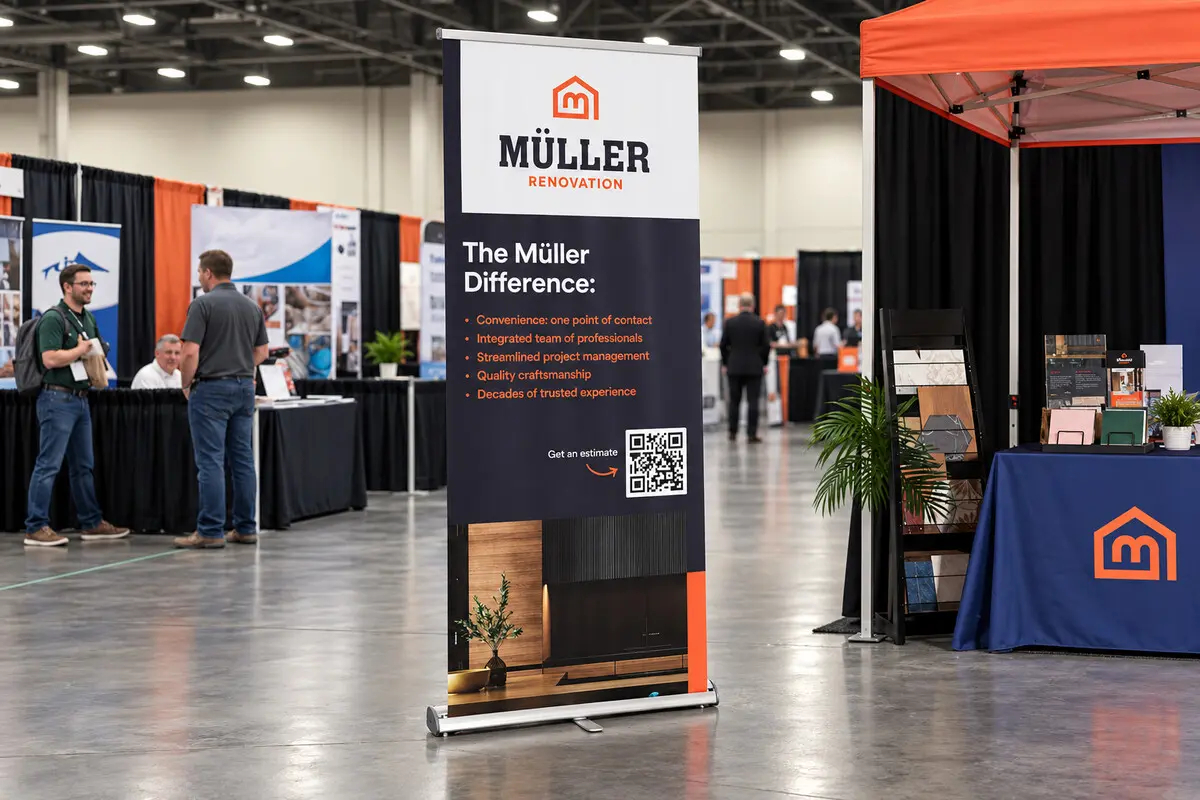
| Roll-up standee | 80 x 200 cm (cỡ nhỏ 60 x 160 cm) | Sảnh khách sạn, hành lang công ty, gian hàng triển lãm: hộp nhôm đứng thẳng, cuốn gọn |
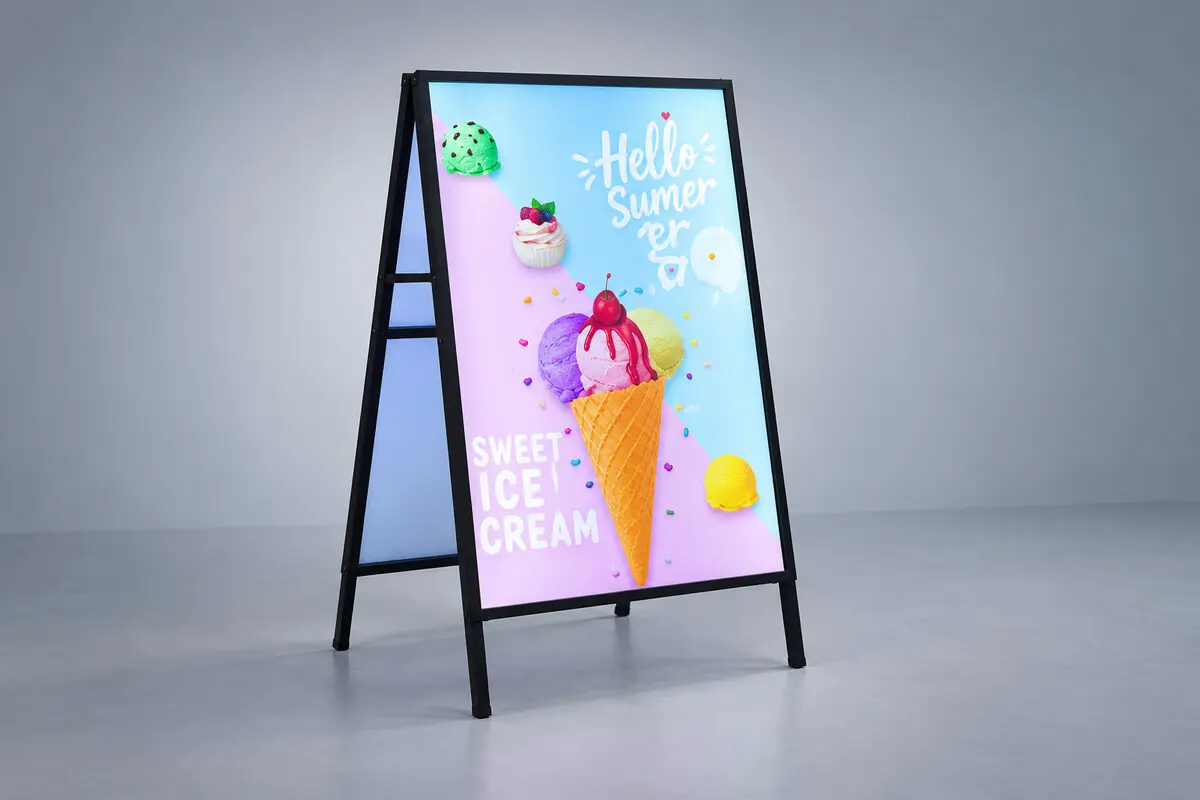
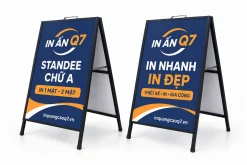
| A-frame standee | 50 x 70 cm or 60 x 90 cm | Trước cửa quán ăn, cửa hàng, vỉa hè: đứng vững, gấp gọn khi đóng cửa |
| Iron-base standee | 60 x 160 cm | Mặt tiền nhiều gió, gian hàng dựng tháo nhiều lần |
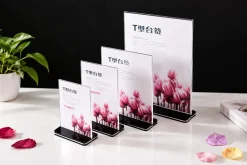
| Tabletop standees | A4 or A5 portrait | Quầy thu ngân, bàn tư vấn: đọc ở khoảng một mét |
| Backlit banner standee | 80 x 200 cm | Lối vào ban đêm: đèn phía sau làm nền sáng đều |
Which type to choose for your case
X-banner stand is the default choice for eateries, shops and small events. The X-shaped steel frame folds compactly, sets up in a minute and comes with a carry bag. The downside is that the banner is tensioned at four corners so it creases slightly in the middle, and the light frame topples easily in the wind.
Roll-up standee costs more but the difference is clear: the banner rolls into the aluminium housing at the base so it is always flat, and the aluminium housing also protects the banner when stored. If you use it over and over — seminars, showrooms, company lobbies — this is the type worth investing in.
Iron-base A-frame standee has a 5mm Formex face and a steel frame that opens like the letter A, so it stands firmly on the pavement. This is the only one of the six types that can really be used outdoors all day.
Formex standee with base is UV printed on both sides with a fixed metal base. Sturdy and classy, but heavy and does not fold. It suits hotel lobbies, exhibitions and reception areas — places where it stands in one fixed spot.
Lit standee uses backlit banner with an LED system inside. By day it looks like a regular standee; at night it really stands out. Eateries and cafés open in the evening are the main users.
Double-sided LED standee is the top-end line: aluminium frame, mica face, evenly lit on both sides. Used for showrooms and shopping centres, where people pass from both directions.
Buy the full set or only the banner
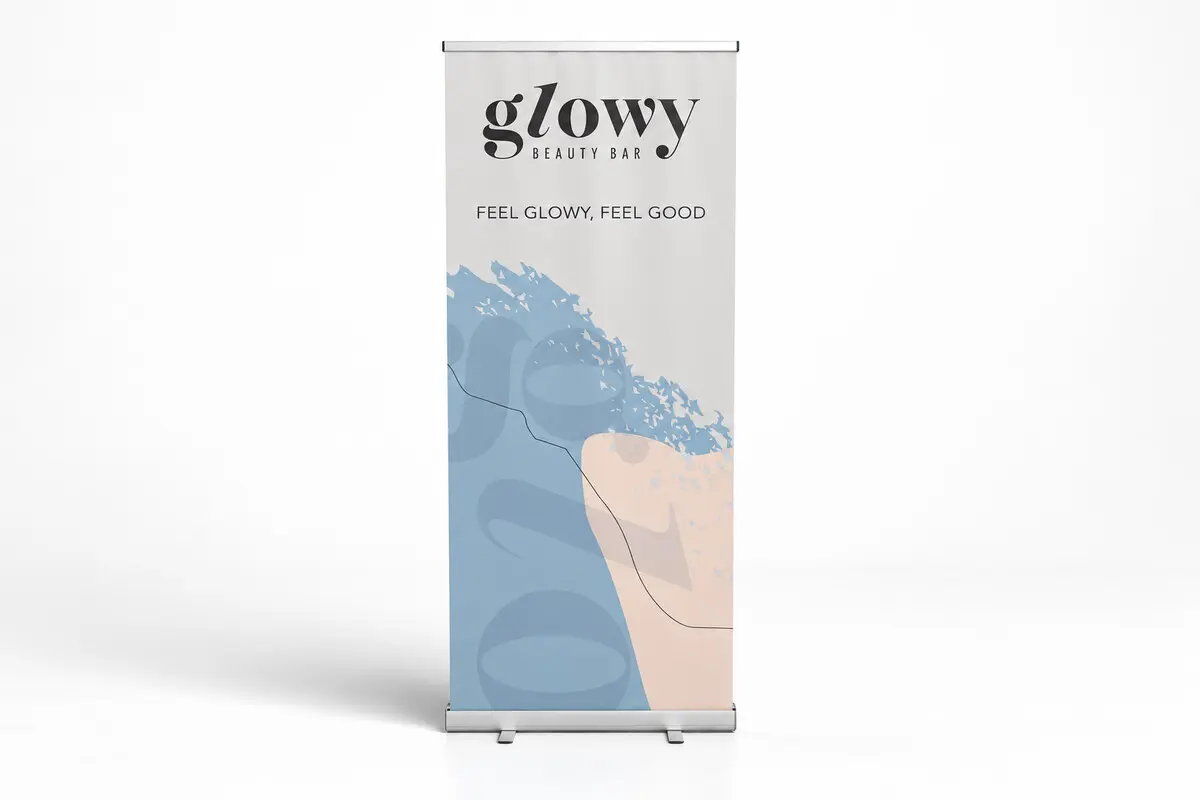
One point many customers do not know: you can buy each part separately. If you already have a standee frame from a previous campaign, just order a newly printed banner at a much lower price than buying the full set. Conversely, if the banner is still good but the frame is broken, buy the frame separately.
The workshop sets out these three options on each product: full set, printed banner only, base only. See at the Standee category.
Gloss or matte lamination
Standee banners are usually printed on PP and then laminated. Gloss lamination gives vivid colours that stand out in places with lots of natural light. Matte lamination does not reflect lights so it looks easier on the eyes in places with direct spotlights — halls, lobbies with ceiling lights.
The price difference between the two types is very small, so choose based on where the standee is placed, not on price.
Designing the file for a standee
Design at the actual size, for example 60 × 160cm. A resolution of 100–150dpi is enough.
Notes specific to standees: the bottom 15–20cm is usually covered by the base or blocked by people standing in front, so do not put important information there. The logo and title should be in the top third, because that is the eye-level zone.
The phone number and QR code should be around the middle, about 1.2 metres from the ground — the right height for customers to stand and scan with a phone.
Production time
Standees in common sizes are usually done in 2 to 6 hours if the file meets the standard. Lit standees need 3–5 days, double-sided LED standees need 5–7 days because the frame must be fabricated and the lighting system fitted.
If you need it urgently within the day, choose an X-stand or roll-up; the workshop has frames in stock for these two types.
Where to start
See the price of each type and each size at the Standee category, or send a quote request with a description of where it will be placed so the workshop can suggest a suitable type. If you do not have a design file, the workshop designs from 80.000đ.
View directions to the workshop on Google Maps
Standard standee sizes and the banner sizes to print
The standard standee size on the price list is the visible finished measurement, while the banner size sent to the printer is always larger because of the allowance for the rod sleeve or the part clamped into the frame. Mixing up these two figures is the most common reason text at the edges gets swallowed by the frame.
| Frame type | Standard standee size | Banner size to print | Extra allowance |
|---|---|---|---|
| X-banner stand | 60 x 160 cm | 62 x 162 cm | 1 cm on each edge to punch eyelets at the four corners |
| Large X-stand | 80 x 180 cm | 82 x 182 cm | 1 cm on each edge |
| Roll-up standee | 80 x 200 cm | 80 x 206 cm | 3 cm at the top and 3 cm at the bottom to clamp into the aluminium housing |
| Small roll-up standee | 60 x 160 cm | 60 x 166 cm | 3 cm at top and bottom |
| A-frame standee | 50 x 70 cm or 60 x 90 cm | Same as the finished measurement | No allowance, the banner fits inside the frame |
| Iron-base standee | 60 x 160 cm | 62 x 162 cm | 1 cm on each edge |
| Tabletop standees | A4 or A5 portrait | Same as the paper size | No allowance |
| Backlit banner standee | 80 x 200 cm | 80 x 206 cm | 3 cm at top and bottom |
When customers send a file exactly at the standard standee size but the frame type needs extra allowance, the workshop says so clearly before printing rather than stretching the image on its own. The usual fix is to extend the background at both ends and keep the text unchanged, so the layout is not distorted.
Text height readable from a distance
A standee in a lobby is read from about three to five metres, while one next to the counter is read at one metre. Text height decides whether passers-by can read it, and this figure is based on reading distance, not standee size.
| Reading distance | Title text height | Body text height | Typical position |
|---|---|---|---|
| Under 1 m | 3 – 4 cm | 1.5 – 2 cm | Table standee next to the cashier counter |
| 1 – 2 m | 5 – 7 cm | 2.5 – 3 cm | A-frame standee in front of the door |
| 2 – 4 m | 8 – 12 cm | 3.5 – 5 cm | X-stand in the lobby |
| 4 – 7 m | 14 – 20 cm | 6 – 8 cm | Roll-up standee in a hall |
| Over 7 m | Over 22 cm | Over 9 cm | Outdoor backlit banner standee |
The top thirty percent of the panel is the zone passers-by see first, so the title goes in that zone. The bottom twenty percent of X-stands and roll-up standees is usually blocked by bodies when customers stand close, so do not put important information at the bottom of the panel.
File standards by the chosen standee size
A correct file is one that opens and can be printed straight away without resizing. The list below applies to every frame type, differing only in the edge allowance given in the table above.
- Lay out the file at one-to-one scale with the banner size; do not lay it out small and let the machine enlarge it.
- A resolution of 100 dpi at actual size is enough for large formats, 150 dpi for panels placed close to viewers.
- CMYK colour mode, with dark background colours declared by number rather than chosen by eye on screen.
- Text converted to outlines; original fonts do not travel with the file.
- Leave 5 cm clear from the top and bottom edges for roll-up standees; that part sits inside the aluminium housing.
- Leave 3 cm clear on each edge for X-stand frames; the four corners have eyelets pulled taut.
- Place the logo and QR code at least 8 cm from the edge; the banner edge is where it is clamped and curls.
- Send a photo or mock-up along with it so the workshop can check the orientation of the panel.
If you only have a design file in A3 or A4 size, the workshop scales it in exact proportion and lets you know which parts are blurry if the original image is not sharp enough. Vector text stays sharp when enlarged, so usually only the photos need replacing with larger versions.
Related products


Standee

Standee

Standee

Tabletop standees
Standee sizes by placement
The placement decides both the frame type and the standee size. The table below lists common positions with the types usually used there, based on orders the workshop receives in the area.
| Location | Type usually used | Common standee size | Reason |
|---|---|---|---|
| In front of eateries and shops | A-frame standee | 50 x 70 cm | Stands firmly on the kerb, the wind does not tip it over, folds away at closing time |
| Hotel lobbies, company corridors | Roll-up standee | 80 x 200 cm | The aluminium housing stands upright, just roll it up, the banner does not fall |
| Seminars, opening ceremonies | X-banner stand | 60 x 160 cm | Quick to set up, light, low cost when many panels are needed |
| Cashier counters, consultation desks | Tabletop standees | A4 or A5 portrait | Read at about one metre, takes up no space |
| Exhibition booths | Roll-up standee or steel-leg standee | 80 x 200 cm | Withstands being set up and taken down many times a day |
| Entrances at night | Backlit banner standee | 80 x 200 cm | The light behind gives an evenly lit background, the text stands out clearly |
| Windy shopfronts | Iron-base standee | 60 x 160 cm | Heavy base, add a sandbag and it will not tip over |
For events used for just one session, the frame makes up most of the cost, so customers usually keep the frame and only order a newly printed banner for next time. Then you only need to state the frame type you have and the standee size of the old set, and the workshop prints to fit straight away.
Print materials for each standee type
The banner printed for a standee is not a single type. The material decides whether the panel creases when rolled up, whether light shows through when placed in front of a glass door, and how long it keeps its colour outdoors.
| Material | Features | Used for | Notes |
|---|---|---|---|
| PP Polypropylene | Slightly textured surface, not glossy, light | X-stands, indoor A-frame standees | Lamination protects against scratches; without lamination it scuffs easily |
| Matte-laminated PP | Readable under spotlights, no glare | Roll-up standees in lobbies with lights | The most used choice for roll-up standees |
| Gloss-laminated PP | Deeper, fresher colour | Panels that need product photos to stand out | Glares under direct lighting |
| Hiflex Banner | Thick, water-resistant, sun-resistant | Panels placed outdoors for a long time | Heavier, not suitable for rolling up neatly |
| Backlit Film | Lets light through evenly with lighting behind | Backlit banner standee | Needs a light box or a frame with LEDs |
| Decal mounted on Formex | Perfectly flat, no ripples | Panels standing permanently in one place | Cannot be folded |
For roll-up standees, the material must withstand being rolled into the aluminium housing every day without leaving creases. This is why the matte-laminated type is used more than the gloss-laminated type for this line, even though colours on the gloss version look a little fresher.
Storing standees between uses
Most damaged panels are not caused by printing but by how they are stored between uses. The list below applies to both loose panels and sets fitted with frames.
- Roll around a core tube at least 10 cm in diameter, printed side facing out, without folding.
- Store roll-up standees inside their aluminium housing; do not pull the banner out of the housing to roll it separately.
- Put the rods and frame legs in the bag provided; avoid letting the steel legs press on the banner surface.
- Wipe with a cloth dampened with clean water; do not use alcohol or solvents because the ink layer will fade.
- Dry in the shade before storing; a damp banner stored airtight will grow mould at the edges.
- Stick a label with the frame type and standee size at the end of the roll so you take the right panel next time.
- Store upright in a dry corner; do not put heavy objects on the roll.
When the frame is still good and only the content needs changing, the next cost is only the banner printing. Send back the measurements of the old panel or bring it to the workshop to be measured, so the new panel fits the frame you have without realignment.
Quick Q&A about standee sizes
Below are the questions customers often message the workshop before ordering, answered briefly according to what the workshop can actually do.
| Question | Answer |
|---|---|
| What is the most common standard standee size? | 60 x 160 cm for X-stands and 80 x 200 cm for roll-up types; these two sizes account for most orders |
| Can I order an unusual size outside the table? | Yes for loose panels, but frames follow the available sizes; unusual sizes need a separately ordered frame |
| Can I buy only the banner without the frame? | Yes; tell us the frame type you have and the old panel's measurements and the workshop prints to fit |
| Can both sides be printed? | Yes for A-frame and table types; roll-up types are printed on one side only because the back rolls into the housing |
| How long does a panel placed outdoors last? | Hiflex banner keeps its colour for about a year in direct sun, longer under a shelter |
| Is the frame delivered already assembled? | Frames are delivered as unassembled sets with instructions; assembly on site takes about two minutes |
| How long does it take? | Loose panels within the day, sets with frames one to two days depending on quantity |
| What if text gets swallowed by the frame? | Extend the background at both ends and keep the text area unchanged; the workshop lets you know before printing |
Ordering standee printing at the workshop
The workshop prints standees for restaurants, cafés, spas, showrooms and event organisers in the District 7 area and neighbouring districts. All sizes and list prices are in the group standee, and multi-item orders are declared on the quote page.
- Tell us the frame type and standee size needed, or where the panel will be placed so the workshop can name the corresponding size.
- Send the file via Zalo, and the workshop checks the size and edge allowance and replies.
- Confirm the preview, and the workshop prints and fits the frame exactly per the confirmed version.
- Pick up at the workshop at 49 Mai Van Vinh, Tan Hung Ward, Ho Chi Minh City or get inner-city delivery.
Accompanying items for the same campaign, such as banners or backdrop ordered together in one order share the machine run and one delivery.
Need printing or signage in Ho Chi Minh City?
In Quảng Cáo Q7 runs its own print workshop in Tân Hưng Ward (former District 7), Ho Chi Minh City, producing and installing signage, banners, window graphics, exhibition booths and event displays. Send us the size, material, quantity and a photo on WhatsApp and we will get back to you.

Phone: +84 866 511 099 · Also on WeChat
Workshop: 49 Mai Văn Vĩnh, Tân Hưng Ward, Ho Chi Minh City