




































































Plastic Paper for Menus – Waterproof, Tear-Proof, Wipe Clean
Oct
Synthetic paper (also called plastic paper) looks and prints like paper but has a plastic core: spill water on it and it does not soak in, crumple it and it does not crease, and it is very hard to tear. For eateries — where menus are handled, folded and get greasy every day — this is the most worthwhile material for menu inner pages. In Quảng Cáo Q7 prints synthetic paper 150gsm at the workshop 49 Mai Van Vinh, Tan Hung Ward, Ho Chi Minh City, with 1 test copy printed for approval first.
What synthetic paper is
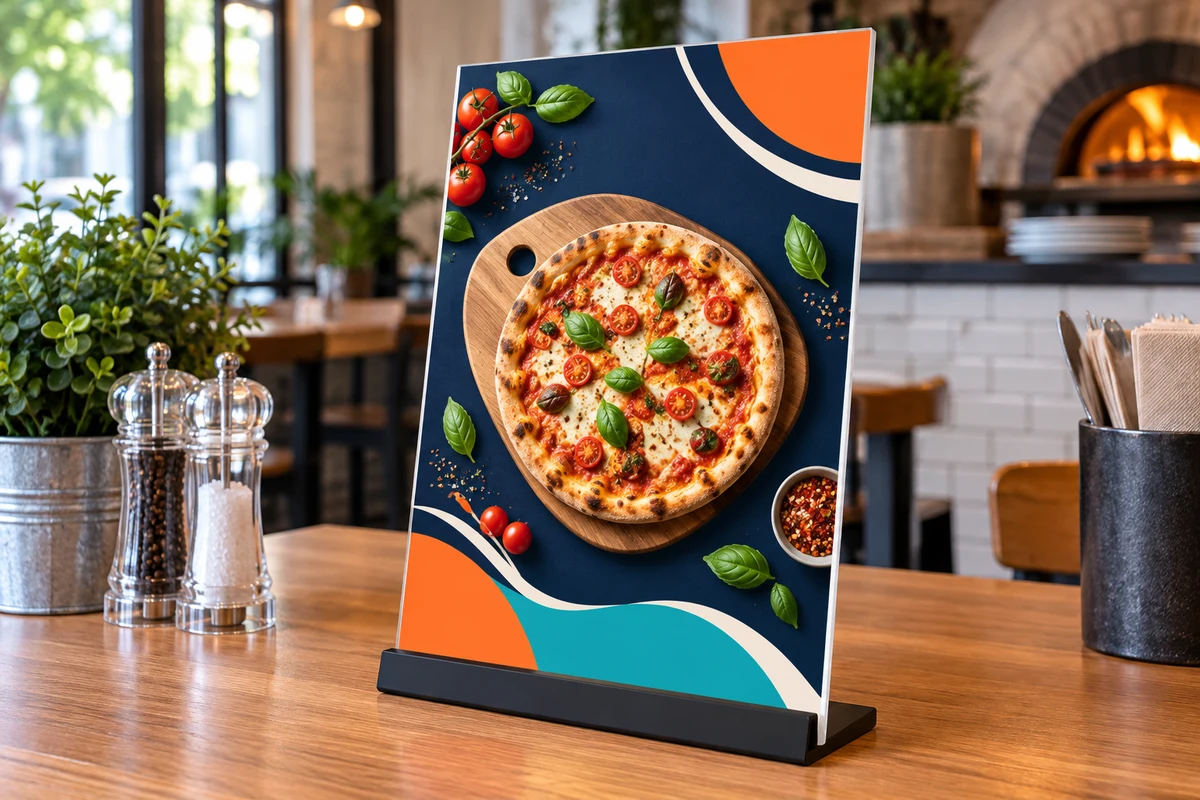
Synthetic paper can be printed by offset and digital printing just like Couche paper, with vivid, even food colours. The difference lies in durability: completely water-resistant, and wiping with alcohol or dish soap does not fade the printed surface. The workshop uses it most for the inner pages of PVC plastic menus and replacement inner pages for board-mounted menus.
Why it suits menu inner pages
- Customers handle menus hundreds of times a day — synthetic paper does not curl at the corners or split at the spine.
- Splashed with fish sauce or grease: wipe it and it is clean, without stains like ordinary paper.
- Changing prices or dishes means reprinting only the sheet that changes, not remaking the whole book.
- Still looks as thin and light as paper, not bulky like plastic pouch-laminated menus.
Related products

Menu

Menu

Labels & stickers

Sticker
Compared with laminated ordinary paper
| Criterion | Laminated Couche paper | Synthetic paper |
|---|---|---|
| Water resistance | Only protected on the surface; exposed edges soak up water | Water-resistant throughout, including cut edges |
| Folding and tearing durability | Repeated folding cracks the film; tears easily | Does not crease when crumpled, very hard to tear |
| Cleaning | Can be wiped gently; hard scrubbing peels the film | Wipe freely with alcohol or dish soap |
| Cost | Cheaper at the start | Higher, but lasts many times longer |
Quick choice: menus that change dishes constantly on a tight budget — laminated Couche paper is enough; menus used for 6 months or more in a busy venue — synthetic paper is far better value. A tip from venues that order a lot: make the cover a board-mounted cover for a premium look and use synthetic paper for all inner pages — when prices change, just reprint the sheets with changed dishes and put them into the old book. See more menu styles on the page menu printing in District 7.
Contact 0866.511.099 (Phone/Zalo) or visit the workshop at 49 Mai Van Vinh, Tan Hung Ward, Ho Chi Minh City. Production and delivery: Monday – Saturday, 8:00–12:00 and 13:00–18:00. Consultation & orders via Zalo/hotline: Monday – Saturday 8:00–12:00 and 13:00–20:00, Sunday 14:00–19:00.
View directions to the workshop on Google Maps
Frequently asked questions
How many thicknesses does synthetic paper come in?
The most common at the workshop is 150gsm for menu inner pages — firm enough to turn yet still soft to the touch; for thicker uses such as hang tags and small boards, or thinner ones for folded leaflets, discuss it when ordering so the workshop can advise the right weight.
How long does synthetic paper printing take?
A menu test copy for approval takes 1–2 days; a full set usually takes 2–4 days depending on the number of books and binding style.
What else can synthetic paper be used to print besides menus?
Product hang tags, handheld maps, outdoor instruction cards, cold-storage labels — wherever ordinary paper wears out quickly, synthetic paper comes into its own; discuss your specific needs so the workshop can advise a suitable weight.
Some images on this page are illustrations.
Synthetic paper thicknesses available
Synthetic paper is not a single type. The thickness decides whether a menu sheet feels firm or soft, and whether it creases after many turns. The table below shows the weights the workshop prints.
| Thickness | Feel in the hand | Used for | Note |
|---|---|---|---|
| 150 micron | Soft like thick paper | Extra sheets inserted into an existing menu | Curls at the corners when turned a lot |
| 200 micron | Lightly firm, still bendable | Multi-page spiral-bound menu inner pages | The most used weight |
| 250 micron | Clearly firm, stays flat when stood up | Single-sheet double-sided menus, table price stands | Suits menus turned by hand a lot |
| 300 micron | Very firm, cannot bend much | Board-style menus, table number cards | Spiral binding needs machine-punched holes |
| 350 micron | Like a thin plastic sheet | Outdoor information boards under cover | Heavy in the hand above A3 |
For venues where menus are turned by hand hundreds of times a day, 250 micron is the level the workshop finds most durable while still turning smoothly. 200 micron is cheaper and suits menus with many pages, because the total thickness of the whole set is what decides how thick the menu book is.
Menu size and number of dishes per side
The menu size decides how customers hold it and how it sits on the table. The table below shows the sizes the workshop makes most for menu inner pages printed on synthetic paper.
| Size | Dishes per side | How it is used | Commonly seen at |
|---|---|---|---|
| A5 14.8 x 21 cm | 8 to 12 dishes | Multi-page spiral-bound menus | Cafés, milk tea shops |
| A4 21 x 29.7 cm | 15 to 25 dishes | Menus of 2 to 4 pages | Eateries, small restaurants |
| A3 29.7 x 42 cm | 30 to 45 dishes | Single-sheet menus folded in half | Restaurants, hotpot and grill venues |
| 10 x 21 cm | 5 to 7 dishes | Strip menus clipped upright on the table | Drinks shops, bars |
| 21 x 21 cm | 10 to 14 dishes | Square menus, a modern look | Concept cafés |
| Custom sizes | Per design | Menus following the brand's packaging style | Multi-outlet chains |
A4 and A5 account for most orders because these two sizes divide evenly from the material size, with no waste. Unusual sizes can still be made, but the waste material is still charged, so the workshop states this clearly before printing.
Finishing for menu inner pages
Finishing decides how many times the menu inner pages can be turned and whether individual pages can be replaced.
- Rounded corners with a 5 mm radius: corners do not dig into customers' hands and do not curl when turned.
- Holes punched for plastic spiral binding: individual pages can be replaced when the venue changes dishes or prices.
- One hole punched for a single stainless steel ring: the menu fans out like a fan, used for menus with few pages.
- Two sheets glued back to back: a sheet twice as thick, used for single-sheet menus standing on the table.
- Creased for a centre fold: a half-folded menu; the crease on synthetic paper does not crack like on ordinary paper.
- Drilled hanging hole: menus hung on stands or wall hooks.
- Cut to an outline: menus in the shape of a cup, a mug or the brand logo.
- No lamination needed: the material surface is already waterproof, and extra lamination only adds thickness and cost.
The biggest difference from ordinary paper is creasing. Laminated ordinary paper cracks along the fold line after a few months, while synthetic paper stays in one piece after folding.
Menu covers to go with synthetic paper inner pages
Synthetic paper menu inner pages usually come with a type of cover. The cover decides what quality the menu book shows and how long it lasts in the venue environment.
| Cover type | Features | Suitable for | Lifespan |
|---|---|---|---|
| Hard board-mounted cover wrapped in fine art paper | Thick, solid in the hand, looks premium | Restaurants, venues with dark interiors | 1 to 2 years |
| Pressed PVC plastic cover | Completely waterproof, wipeable | Eateries, hotpot and grill venues, places prone to grease | 2 to 3 years |
| Synthetic leather cover | Soft to the touch, can be embossed with a logo | Restaurants, bars | 2 years |
| Thin wooden cover | Rustic, a handmade look | Concept cafés | 1 to 2 years |
| Formex cover wrapped in decal | Light, low cost | Newly opened venues, menus that change often | 1 year |
| No cover, inner pages only | Neatest, pages easy to replace | Drinks shops, menus left on the table | According to the inner pages' life |
The common approach is a durable cover with replaceable inner pages. The cover stays the same through many dish changes, and each time the venue changes prices only the relevant inner pages are reprinted, costing only a small part of remaking the whole book.
Ink and adhesion on the plastic surface
The synthetic paper surface does not absorb ink like paper, so printing needs ink that can bond to the plastic surface. This is also why not every workshop can print this material.
- Printed with UV ink or oil-based ink; water-based ink does not bond and will peel when wiped.
- UV ink dries instantly under the lamp, so finishing can follow straight after printing without waiting to dry.
- Dark background colours can still be printed solidly, without the white surface showing between ink dots.
- Colours printed on the material's opaque white base come out deeper than printing on uncoated paper.
- Small text from 6 pt is still readable because the surface is smooth and ink does not spread along fibres.
- Food photos should be 300 dpi at actual size so they are not pixelated.
- Do not print with office inkjet printers; the ink will run when it gets wet.
UV ink on synthetic paper withstands daily wiping with a damp cloth. Wiping with strong cleaning solutions or alcohol gradually dulls the ink, so the workshop still recommends wiping with a damp cloth and clean water or diluted dish soap.
Cleaning and lifespan of the menu
The lifespan of a menu book depends more on how it is cleaned than on the material. The list below shows how to keep menus usable for longest.
- Wipe with a damp cloth after each shift; grease left overnight soaks into the fold lines.
- Use diluted dish soap for grease stains, not alcohol or solvents.
- Do not wipe with abrasive scourers; the surface will scratch into dull streaks.
- Do not leave menus in the sun; high heat permanently warps the plastic sheet.
- Store them upright; stacking them flat for long periods makes sheets stick together in hot weather.
- Replace only the damaged page instead of remaking the whole book — this is the advantage of spiral binding.
- Keep one unused sample book to compare colour when reprinting.
Under normal eatery conditions, a menu printed on 250 micron synthetic paper lasts about two years. The first part to wear is not the printed surface but the spiral binding holes, because that is where the force falls with each turn.
Other items printed on synthetic paper
Besides menu inner pages, this material is also used for other items that need to be waterproof or tear-resistant. The table below shows the items the workshop prints most on synthetic paper.
| Item | Thickness often used | Why this material is used |
|---|---|---|
| Table number cards | 300 micron | Wipeable, does not curl when wet |
| Spa service price lists | 250 micron | Customers flip through them many times a day |
| Outdoor hanging price tags | 250 micron | Rain does not blur the text |
| Instruction cards in hotel rooms | 250 micron | Disinfected by wiping daily |
| Swimming pool rules boards | 350 micron | A constantly humid environment |
| Process slips in the factory | 200 micron | Do not degrade even when handled with greasy hands |
| Suitcase and luggage tags | 300 micron | Pulled and knocked a lot |
| Direction boards in warehouses | 350 micron | Dust and damp, wiped periodically |
| Temporary notebooks used with marker pens | 250 micron | Write and wipe off again many times |
What these items have in common is that the print has to survive a humid environment or heavy handling. In those places laminated ordinary paper still fails at the edges, because water gets in through the cut line between the two layers of film.
Common mistakes when making menus
The mistakes below recur in menu orders, and most only show up after the venue has used them for a while.
| Mistake | Consequence | How to avoid it |
|---|---|---|
| Choosing 150 micron for hand-turned menus | Corners curl after a few weeks | Use 200 micron or more for menu inner pages |
| Printing with water-based ink | Text washes off when wiped | Print with UV ink or oil-based ink |
| Adding lamination on the surface | Thicker and costlier without being more durable | No lamination; the surface is already waterproof |
| Spiral holes punched too close to the edge | Holes tear into slots after many turns | Leave at least 8 mm from the edge to the hole centre |
| No rounded corners | Sharp corners dig into customers' hands and gradually curl | Round corners to 5 mm on every hand-turned sheet |
| Printing prices directly onto pages with many dishes | Changing prices means reprinting the whole page | Move prices onto a separate page |
| Wiping with alcohol | The ink layer gradually dulls | Use a damp cloth with clean water |
| Stacking flat when stored | Sheets stick together in hot weather | Store upright |
Quick Q&A about synthetic paper menus
Below are the questions customers often message our workshop about, answered briefly according to what we actually do.
| Question | Answer |
|---|---|
| What is the minimum number of sheets to order? | From 10 sheets per design, digitally printed, delivered within the day if the file meets the standard |
| Can one page in an old book be replaced? | Yes with spiral binding; the workshop prints the new page in exactly the old size |
| Can this material be torn? | It is very hard to tear by hand, which is why it is called tear-resistant synthetic paper |
| Can I write on it with a marker and wipe it off? | Yes with whiteboard markers; oil-based markers need alcohol to remove, which will dull the printed ink |
| Do you make both the cover and inner pages? | Yes, the workshop makes the complete book including cover, inner pages and binding |
| How does the price compare with laminated ordinary paper? | Higher per sheet, starting from the list price, but there is no need to remake it after six months |
| Can both sides be printed? | Yes, both sides print with the same quality because ink does not show through the material |
| How long does delivery take? | Delivered within the day in the city after finishing; customers outside the city are sent by intercity coach |
Ordering menus printed on synthetic paper
The workshop prints menus on synthetic paper for cafés, bubble tea shops, eateries, restaurants, spas and hotels in the District 7 area and neighbouring districts.
- Send the list of dishes with prices, or a ready design file, via Zalo.
- Choose the size, thickness and binding style, and the workshop replies with the number of pages and delivery time.
- Receive a one-sheet test print to check colour before running the whole book.
- Pick up at the workshop at 49 Mai Van Vinh, Tan Hung Ward, Ho Chi Minh City or get inner-city delivery.
Other menu styles are at spiral-bound laminated menus, PVC plastic menus and board-mounted menus. Item groups for shops and eateries are at restaurants and shops.
Need printing or signage in Ho Chi Minh City?
In Quảng Cáo Q7 runs its own print workshop in Tân Hưng Ward (former District 7), Ho Chi Minh City, producing and installing signage, banners, window graphics, exhibition booths and event displays. Send us the size, material, quantity and a photo on WhatsApp and we will get back to you.

Phone: +84 866 511 099 · Also on WeChat
Workshop: 49 Mai Văn Vĩnh, Tân Hưng Ward, Ho Chi Minh City