





































































UV Printing on Metal – Stainless Steel, Brass and Brushed Aluminium, Sharp in Every Detail
Oct
UV printing on metal is the way to put images and logos onto stainless steel, brass and aluminium without applying decals: the Flatbed UV prints ink directly onto the surface and cures it instantly with UV lamps — the ink bonds firmly, fine lines stay sharp, and there is a slight raised feel to the touch. In Quảng Cáo Q7 prints at the workshop 49 Mai Van Vinh, Tan Hung Ward, Ho Chi Minh City, from a single name plate to a series of signboards.
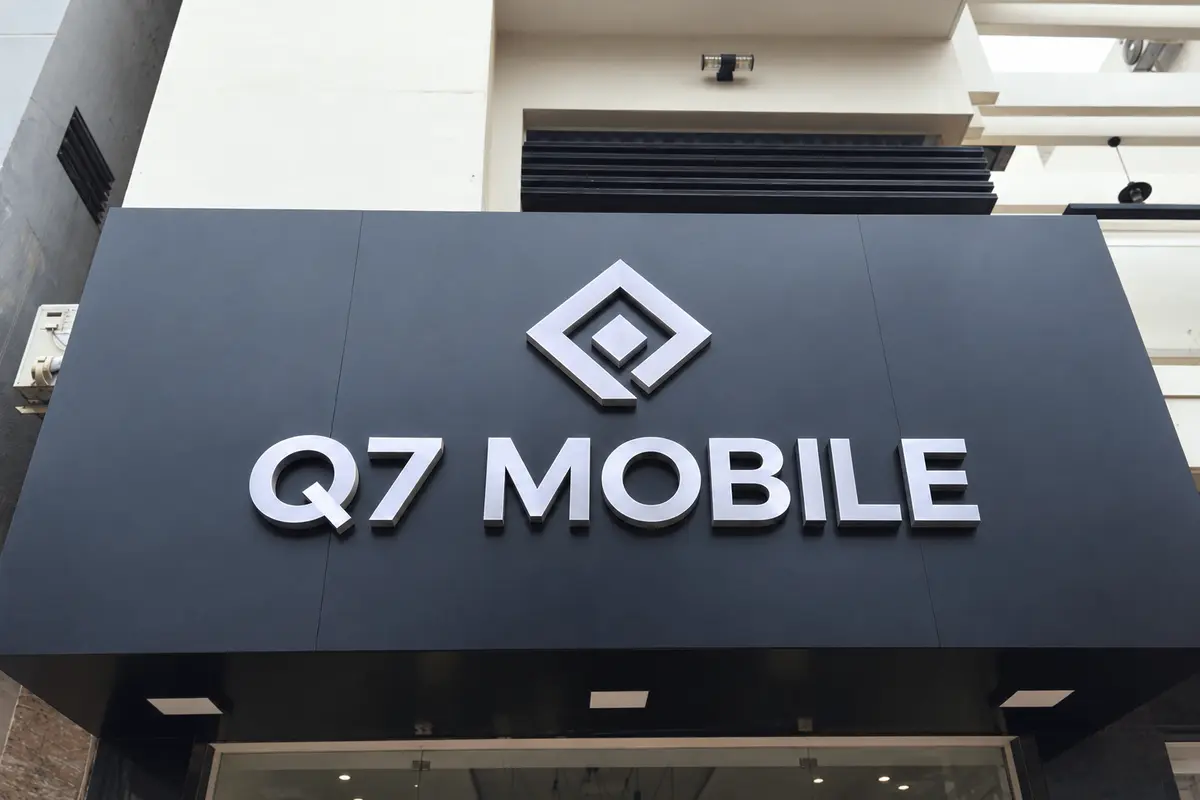
What UV printing on metal is
Unlike heat transfer printing or decals, UV ink cures right on the metal surface, so it does not peel at the edges, is not afraid of water and can be wiped freely. The surface does not need to be perfectly flat — panels with a light brushed grain can still be printed, and the metal grain showing through the ink creates a very “high-end” effect. White base ink makes colours stand out clearly even on dark metal backgrounds. That is why UV printing on metal is gradually replacing applied decals for premium name plates.
Stainless steel, brass, brushed aluminium — which to choose
| Material | Features | Suitable for |
|---|---|---|
| Mirror stainless steel | Glossy as a mirror, premium, easy to wipe | Company name plates, department plates |
| Brushed stainless steel | Matte brushed grain, does not show fingerprints | Signboards, direction signs |
| Brass (golden brass) | Warm, classic tone | Plates for law offices, spas, restaurants |
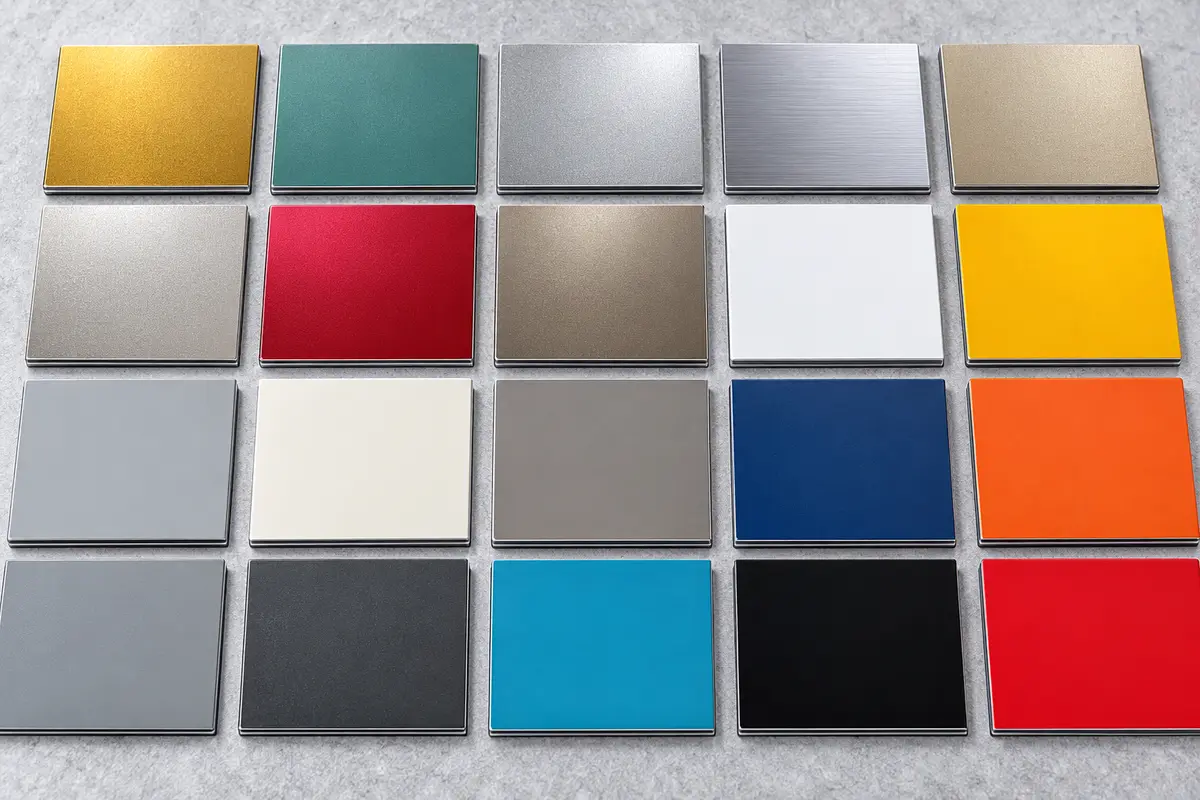
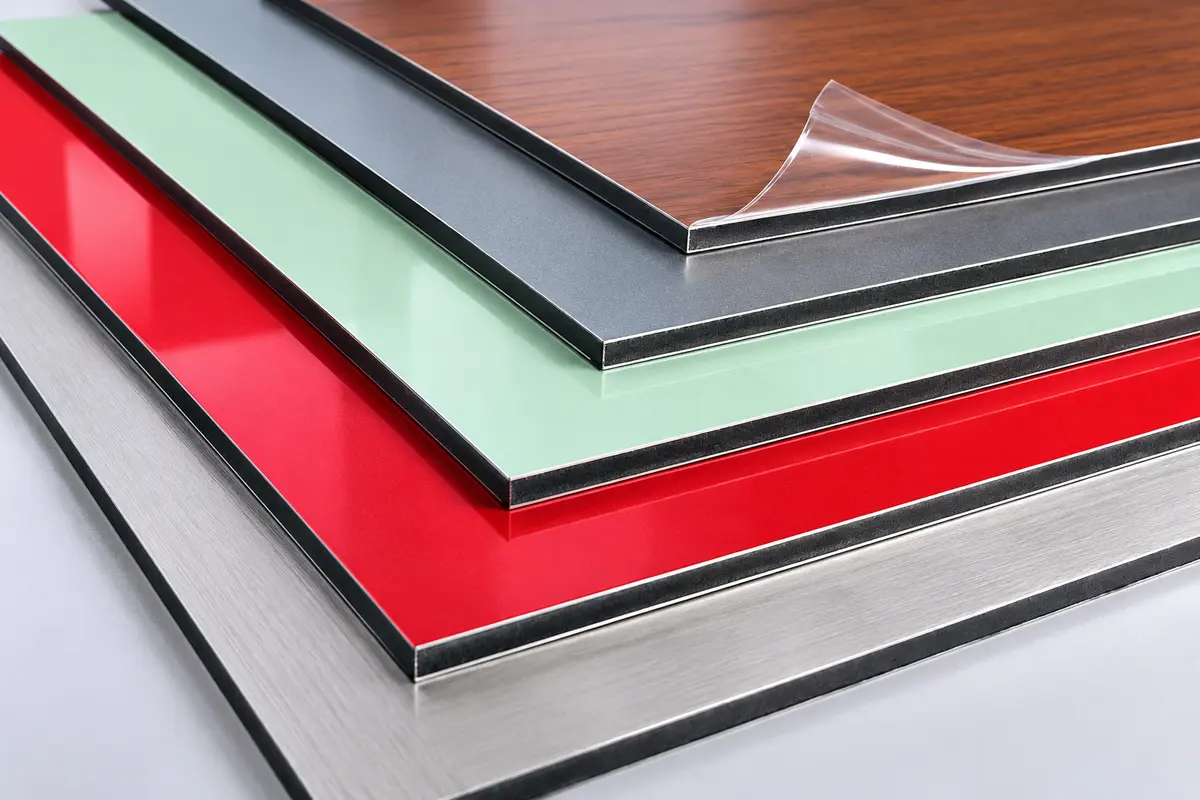
| Brushed aluminium / Alu | Light, flat, many base colours | Signboard faces, wall-mounted menu boards |
Not sure which to choose? Drop by the workshop to see them in person: the same logo printed on brushed stainless steel and on Alu feels completely different. The cost of UV printing on metal is based on print area and number of panels — orders of many panels should test print one sample panel for approval before running the whole series.
Related products

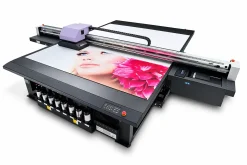
Flatbed UV

Advertising signs

Light boxes
Real-world applications
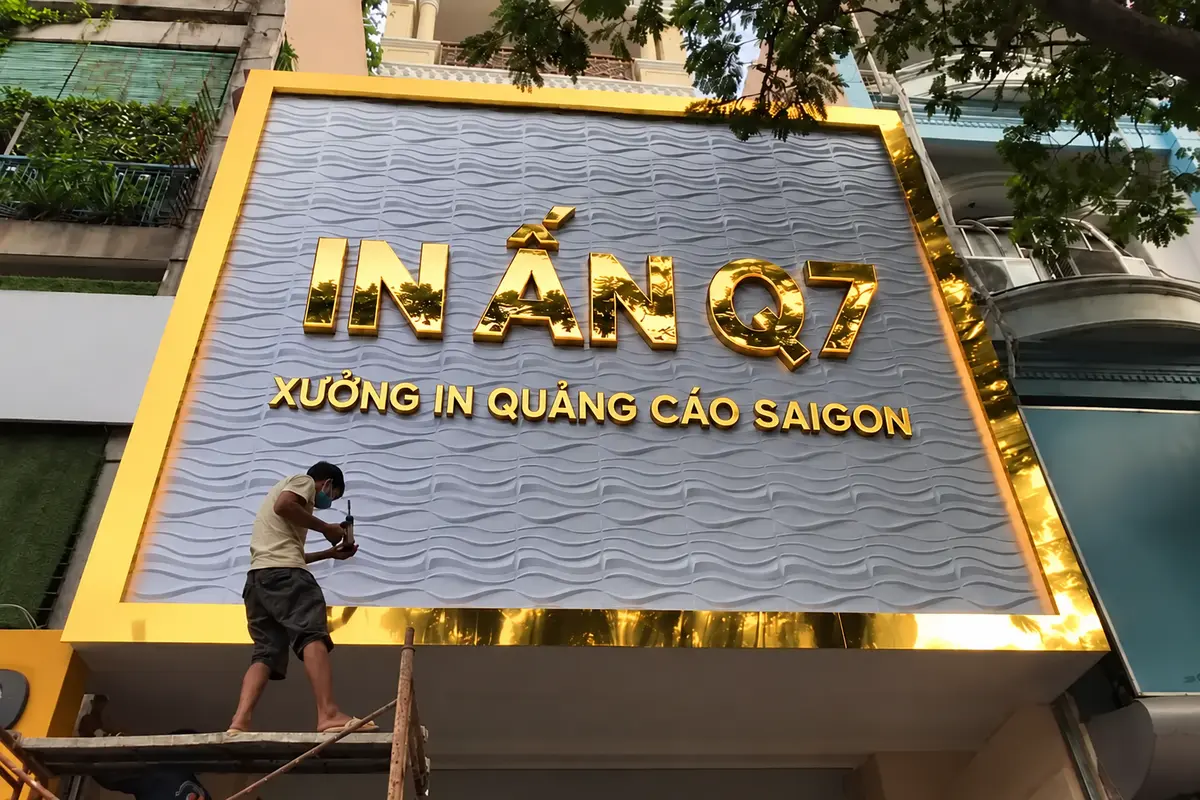
Most common is the storefront identity set: the face of the signboard in Alu combined with raised letters, stainless steel company name plates in the lobby, department plates and room numbers. There are also corporate gifts — commemorative plaques and logo-printed honour boards — and functional signs: house number plates, lift direction signs, workshop rules boards. Where installation is needed, the workshop's installation team drills and mounts on site as for any project signboard making in District 7.
Contact 0866.511.099 (Phone/Zalo) or visit the workshop at 49 Mai Van Vinh, Tan Hung Ward, Ho Chi Minh City. Production and delivery: Monday – Saturday, 8:00–12:00 and 13:00–18:00. Consultation & orders via Zalo/hotline: Monday – Saturday 8:00–12:00 and 13:00–20:00, Sunday 14:00–19:00.
View directions to the workshop on Google Maps
Frequently asked questions
Is UV printing on metal durable outdoors?
Yes — UV ink withstands sun and rain well; for spots in constant harsh sun, an extra protective coat is advisable, and the workshop advises based on the mounting location.
Do you accept printing a single panel?
Yes — UV printing needs no die, so even one name plate can be printed, priced by size.
Can small details and QR codes be done?
Yes — QR codes, small text and fine patterns are all sharp; send the file via Zalo so the workshop can check the resolution before printing.
Some images on this page are illustrations.
Which metals can be UV printed
UV printing on metal differs from printing on paper in that the ink does not soak into the material but sits on the surface and is cured hard immediately by UV lamps. The table below shows the metals the workshop can print.
| Material | Printable thickness | Ink adhesion | Notes before printing |
|---|---|---|---|
| Stainless steel 304 sheet | 0.5 to 3 mm | Good if the surface is treated | Wipe with alcohol; mirror surfaces need a primer |
| Brushed stainless steel | 0.5 to 3 mm | Very good | The brushed grain helps ink bond more firmly |
| Alu aluminium composite panel | 3 mm | Very good | Peel off the protective film before printing |
| Aluminium sheet | 1 to 3 mm | Good | Wipe off machining oil |
| Powder-coated steel sheet | 0.5 to 2 mm | Very good | The paint layer is a good base for UV printing |
| Copper and brass | 1 to 3 mm | Medium | Needs a primer; the surface oxidises easily |
| Painted iron | 1 to 3 mm | Good | Wait for the paint to dry completely |
| Chrome-plated metal | Any thickness | Poor | Must be surface-treated or use another method |
The rougher the surface, the better ink bonds. This is why UV printing on brushed stainless steel lasts longer than on mirror stainless steel, and for mirror surfaces the workshop applies a primer before printing so the ink has something to anchor to.
Limits on size, thickness and number of ink layers
Print size and material thickness are limited by the machine. The table below shows the real limits of the flatbed UV printer at the workshop.
| Specification | Limits | Notes |
|---|---|---|
| Single-pass print size | By the machine bed; larger panels are printed in joined sections | Joins aligned along straight lines in the image |
| Material thickness | Up to about 5 cm | Thicker panels are printed on an adhesive layer and then applied |
| Number of ink layers | Multiple layers for deep colours | A white base layer, then colour layers on top |
| White ink | Printable | Necessary when printing on dark metal backgrounds |
| Raised effect | Multiple layers create raised ridges | Can be felt by touch |
| Spot gloss coating | Printable | Makes the logo stand out on a matte background |
| Resolution | Down to small 4 pt text | Very sharp on flat surfaces |
White ink is the important difference. On dark stainless steel or aluminium backgrounds, without a white base layer the printed colours sink and look dull. The workshop prints the white layer first and then the colour, so the image stands out clearly on the metal background.
Items that often use UV printing on metal
The items using this printing method are quite varied, from small name plates to storefront signboards.
| Item | Material | Why UV printing is used |
|---|---|---|
| Company nameplates | Brushed stainless steel or Alu | Printed directly, no decals needed |
| Room plates and direction signs | Alu 3 mm | Light, wipeable, text does not peel |
| Machine labels and specification plates | Stainless steel 304 | Withstands grease and wiping with mild solvents |
| Safety rules boards | Powder-coated steel sheet | Hung outside the factory, withstands rain |
| Logo engraved gifts | Brass, copper, stainless steel | Colour printing instead of engraving, many colours in one go |
| House number plates | Stainless steel or aluminium | Withstands sun and rain for many years |
| Light box faces | Alu | Printed then the lettering is cut out for light to shine through |
| Metal menu boards | Brushed stainless steel | Wipeable, looks premium |
What these items have in common is the need to be durable and wipeable. Compared with applying decals to metal, UV printing has no film layer to peel at the corners, so it lasts longer where it is touched or wiped often.
File standards for UV printing
Files for UV printing need a few things that paper printing files do not, mainly related to the white layer and to cut-outs.
- AI, PDF or TIFF format, with fonts converted to outlines.
- CMYK colour mode, with brand colours specified by number.
- Resolution of 300 dpi at the panel's actual size.
- Areas needing a white layer drawn on a separate clearly named layer, or a note to print white over everything.
- Areas left blank for the metal to show through are also drawn separately, because that is the part where nothing is printed.
- Cut lines and drill holes drawn on a separate layer, as thin strokes in a spot colour.
- Spot gloss areas drawn separately if a raised effect is needed.
- Send a mock-up image so the workshop can check the layer order.
The most often missing part is the white layer. When the file does not show clearly where white is needed, the workshop has to ask again or print white over everything, and printing white over everything loses the effect of metal showing through in the background.
Durability of the ink layer by conditions
The durability of the ink layer depends on the surface and on how it is cleaned. The table below shows the real-world levels the workshop has recorded.
| Condition | Indoors | Outdoors under cover | Outdoors in direct sun |
|---|---|---|---|
| Brushed stainless steel | 5 years or more | 4 to 5 years | 3 years |
| Alu | 5 years or more | 4 years | 3 years |
| Powder-coated steel sheet | 5 years | 4 years | 3 years |
| Mirror stainless steel with a primer | 4 years | 3 years | 2 years |
| Copper and brass | 3 years | 2 years | Not recommended |
UV-printed ink layers withstand daily wiping with a damp cloth. Wiping with strong solvents or scrubbing with abrasive pads gradually dulls the ink, so for name plates and machine labels the workshop still recommends wiping with a damp cloth and clean water.
Common mistakes when UV printing on metal
The mistakes below recur in UV printing orders, mostly related to surface preparation and to files.
| Mistake | Consequence | How to avoid it |
|---|---|---|
| Not wiping machining oil off the panel | Ink peels in streaks after a few weeks | Wipe with alcohol and dry before printing |
| Printing on chrome-plated surfaces | Ink does not bond | Change material or treat the surface |
| Missing white layer | Colours sink on dark metal backgrounds | Draw the white area on a separate layer |
| Printing white over everything when you want metal to show | Loses the metal background effect | Print white only in areas that need colour |
| Not peeling the Alu protective film | Printed on the film; peeling it loses the image | Peel the film before printing |
| 72 dpi images for boards viewed up close | Pixelated image | Use 300 dpi at actual size |
| Drilling holes close to the image after printing | The ink layer cracks around the hole | Draw holes in the file so they are drilled before printing |
| Wiping with strong solvents | The ink layer gradually dulls | Wipe with a damp cloth and clean water |
Quick Q&A before ordering
Below are the questions customers often message our workshop about, answered briefly according to what we actually do.
| Question | Answer |
|---|---|
| Can a single panel be ordered? | Yes, there is no minimum quantity |
| Can customers bring their own materials? | Yes, the workshop only charges for printing and finishing |
| How many colours can be printed? | Four colours plus a white layer, so even photos can be printed |
| Can you engrave? | Engraving uses laser or CNC machines; the workshop can do it, charged separately |
| Can the panel be bent after printing? | Not advisable; the ink layer cracks along the bend, so bend first and then print |
| Can thick objects be printed? | Up to about 5 cm; thicker items are printed on an adhesive layer and then applied |
| How long does it take? | Small panels within the day, large boards from 1 to 2 days |
| How is the price calculated | By print area plus material and finishing, with starting prices from the list price |
Ordering UV printing on metal at the workshop
The workshop does UV printing on metal for companies, factories, clinics, showrooms and gift makers in the District 7 area and neighbouring districts.
- Tell us the material, panel measurements and where it will be mounted so the workshop can advise on surface treatment.
- Send the file with the white layer and cut lines via Zalo.
- Receive a preview with the chargeable area and delivery time.
- Pick up at the workshop at 49 Mai Van Vinh, Tan Hung Ward, Ho Chi Minh City or get inner-city delivery.
Related items can be seen at Flatbed UV, company nameplates, laser cutting and the group advertising printing.
Compared with decals and laser engraving
Compared with two other familiar methods, decals and laser engraving, UV printing has its own area of use. The table below puts the three side by side.
| Criterion | UV printing | Decal application | Laser engraving |
|---|---|---|---|
| Number of colours | Many colours and even photos | Multi-color | One colour, the metal's own colour |
| Durability where touched by hand | High, no film layer to peel | Medium, corners peel over time | Very high, sunk into the material |
| Small details | Text as small as 4 pt | Small text blurs when cut | Very sharp |
| Raised effect | Yes, multiple layers printed | No | No, only recessed |
| Fixing when wrong | A new panel must be made | Peel and reapply | A new panel must be made |
| Single panel cost | Medium | Low | Medium |
| Best suited to | Name plates, machine labels, multi-colour gifts | Large panels, panels replaced by campaign | Premium name plates, single-colour gifts |
When a panel needs many colours and needs to be durable where it is touched, UV printing is the most suitable method. When the panel is very large or will be replaced after a few months, decals are more economical, and when only one colour is needed with a premium look, laser engraving fits better.
Finishing and mounting the panel after printing
Post-print finishing decides how the panel is mounted on the wall. The list below shows the styles the workshop makes.
- Screw holes drilled at the four corners: the simplest way to mount, with holes drilled before printing.
- Thick double-sided tape: used for small panels on flat, clean surfaces.
- Studs welded on the back: the panel stands 1 to 2 cm off the wall, giving it depth.
- Hanging brackets: the panel can be removed for wiping or replacing.
- Rounded and polished edges: avoids sharp edges, mandatory for panels within reach.
- Cut to an outline by laser or CNC: panels in the shape of a logo.
- Folded edges: creates a thin box shape, and must be folded before printing.
Rounded and polished edges are what the workshop always does for panels mounted within people's reach, because cut metal edges are very sharp. The extra cost is small, but this part relates to safety.
Need printing or signage in Ho Chi Minh City?
In Quảng Cáo Q7 runs its own print workshop in Tân Hưng Ward (former District 7), Ho Chi Minh City, producing and installing signage, banners, window graphics, exhibition booths and event displays. Send us the size, material, quantity and a photo on WhatsApp and we will get back to you.

Phone: +84 866 511 099 · Also on WeChat
Workshop: 49 Mai Văn Vĩnh, Tân Hưng Ward, Ho Chi Minh City