




































































Edge LED or Lights Inside the Box: Two Ways to Make an Illuminated Sign
Sep
Edge LED or Lights Inside the Box: Two Ways to Make an Illuminated Sign
Both are illuminated advertising signs, but there are two completely different ways of arranging the lights – and they produce two quite different products in terms of thickness, evenness of the lit face, print sharpness and price. This article explains that difference so you can choose the right type for your space.
Lights inside the box: cheap, sturdy, needs depth
The most common method is to place LED strips inside the box, shining straight onto the banner face in front. Simple, low cost, strong light – suited to signs on the pavement that need to stand out among street lights.
Its limitation lies in distance: the light needs some space to spread evenly before reaching the banner face. If the box is too thin, streaks of light from each lamp are clearly visible. That is why this type of light box is always deep, usually 10cm or more.
Edge LED: thin, even, sharper
The second method is edge-lit LEDs (edge-lit): LED strips run along the frame edges, shining light into the edges of the acrylic panel. The acrylic sheet acts as a light guide – the light travels inside the sheet and then reflects evenly forward, similar to the principle of an LCD screen.
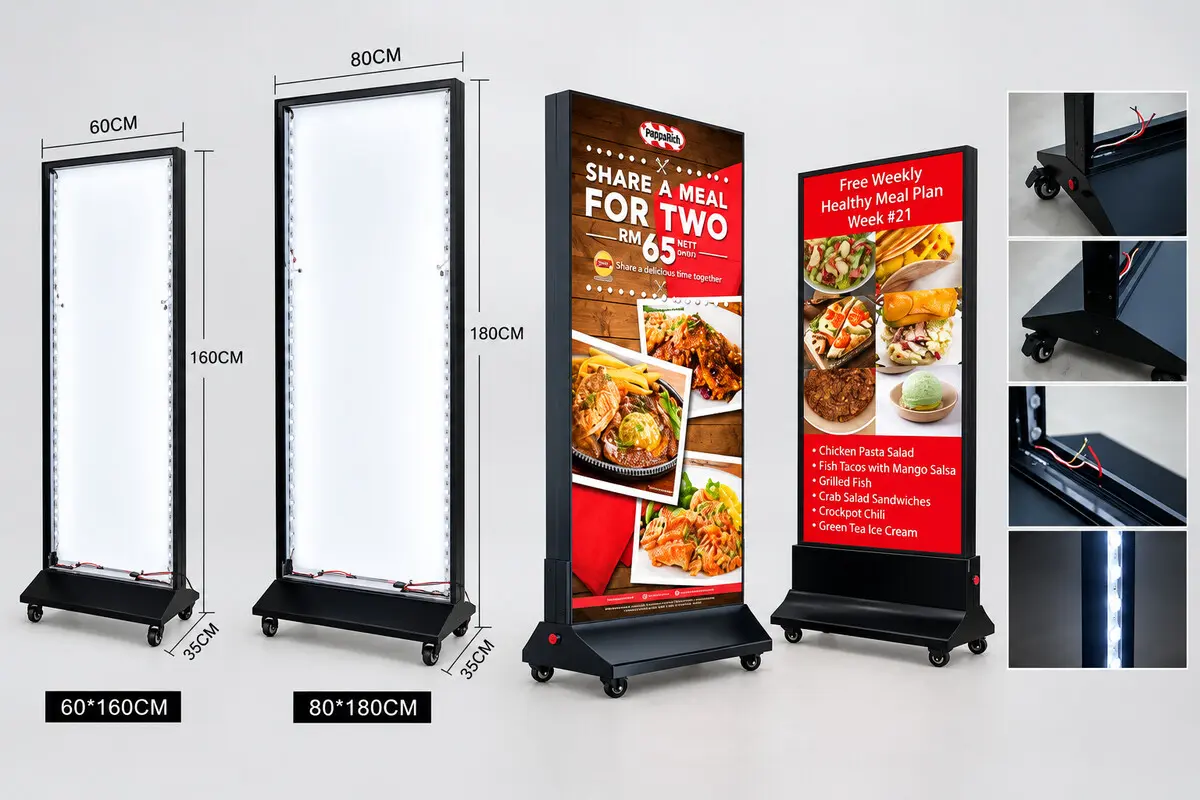
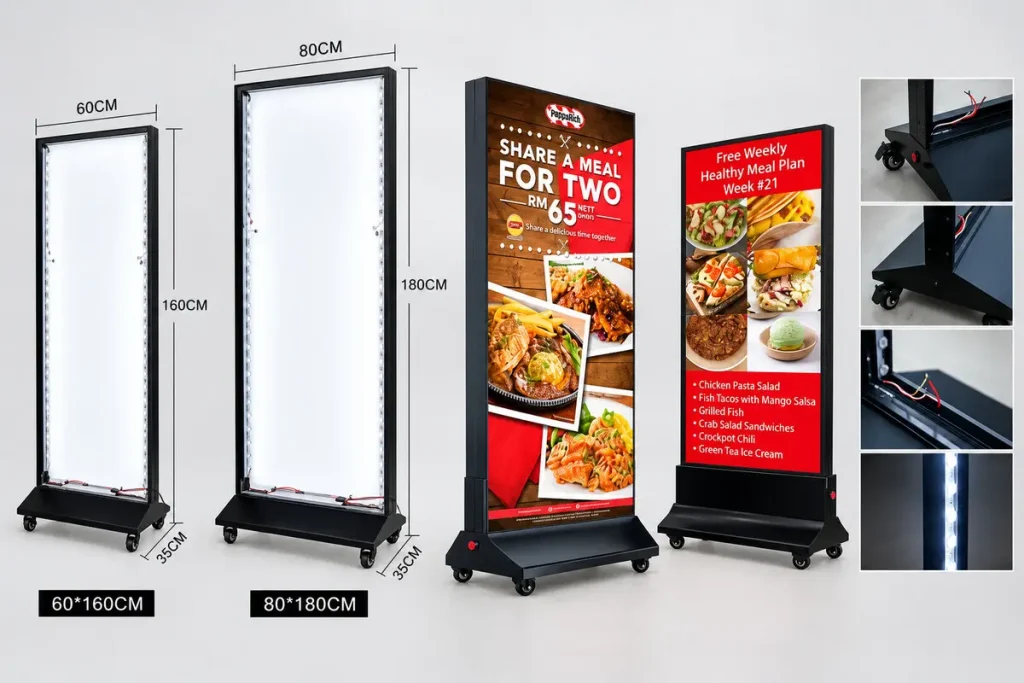
The result: the sign body is only a few centimetres thick while the lit face is perfectly even, with no streaks. The aluminium border is neat, and the face is flat like a screen. In return, the construction is more complex so the price is considerably higher than a banner light box.
The print face material is also different
Light boxes usually use backlit banner – durable, weather-resistant, good price, but the surface has a fibre texture so small details soften. Suited to signs viewed from a distance.
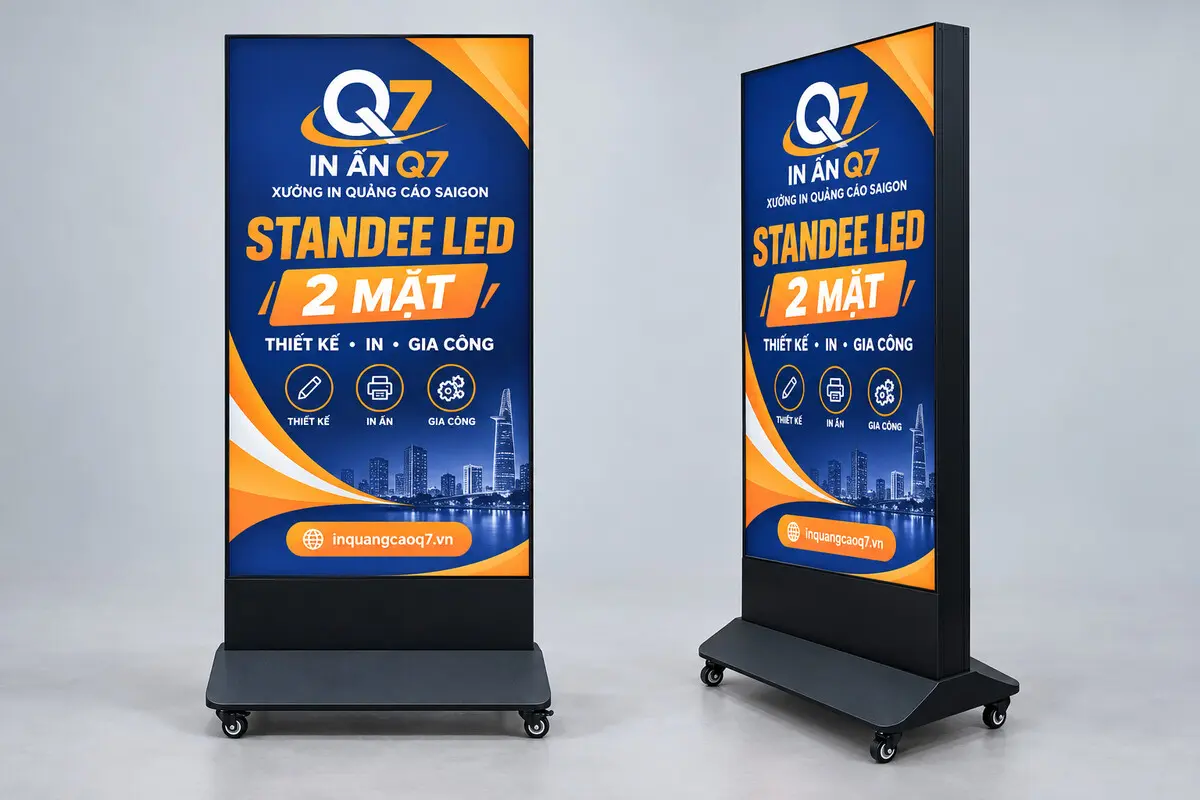
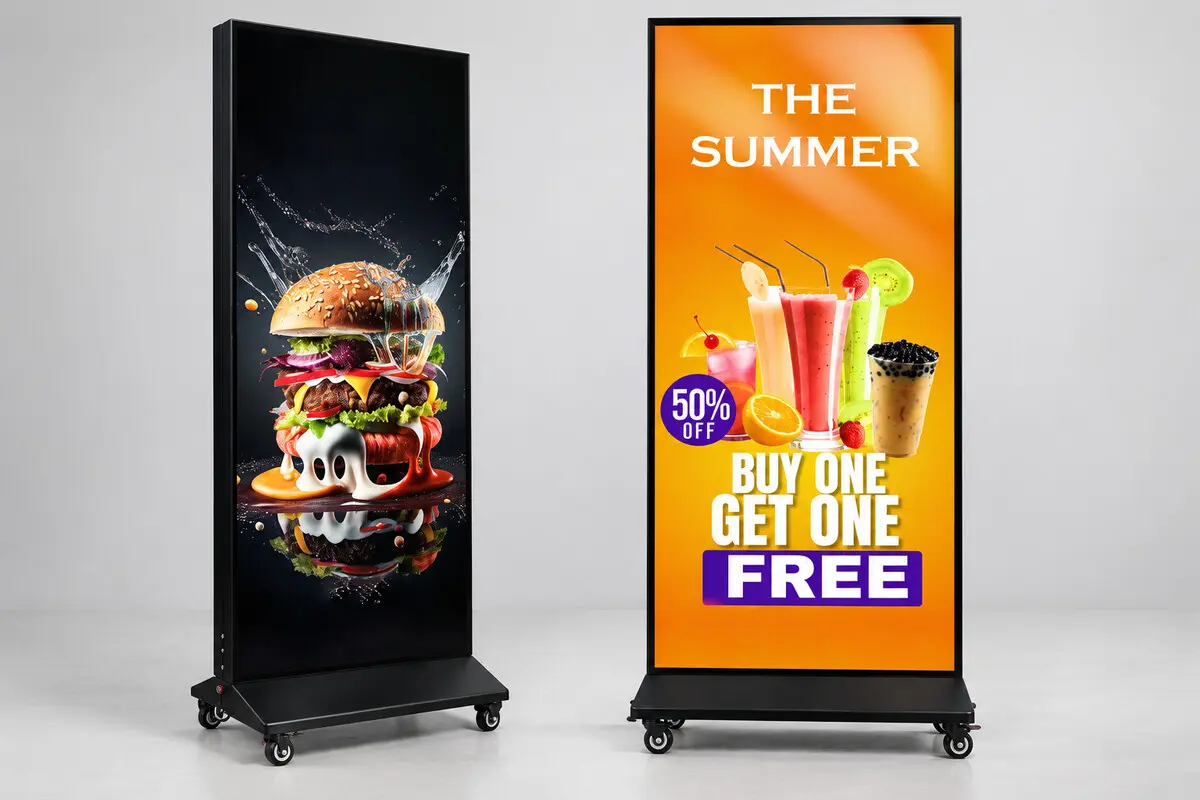
LED standees use UV-printed backlit film – a print film made for backlighting, thin and with controlled translucency, keeping fine details and thin text. This matters because LED standees usually stand indoors and are viewed at 1–3m, much closer than pavement light boxes.
What anodized aluminium frames are
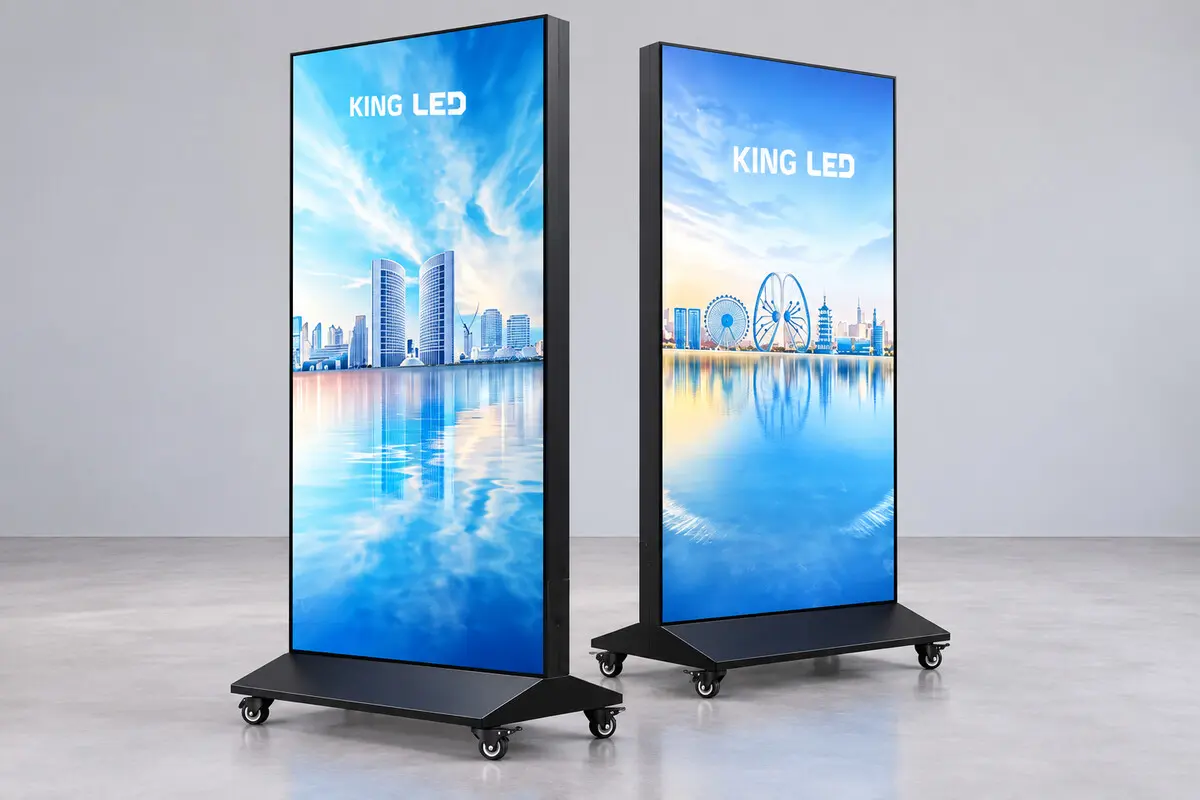
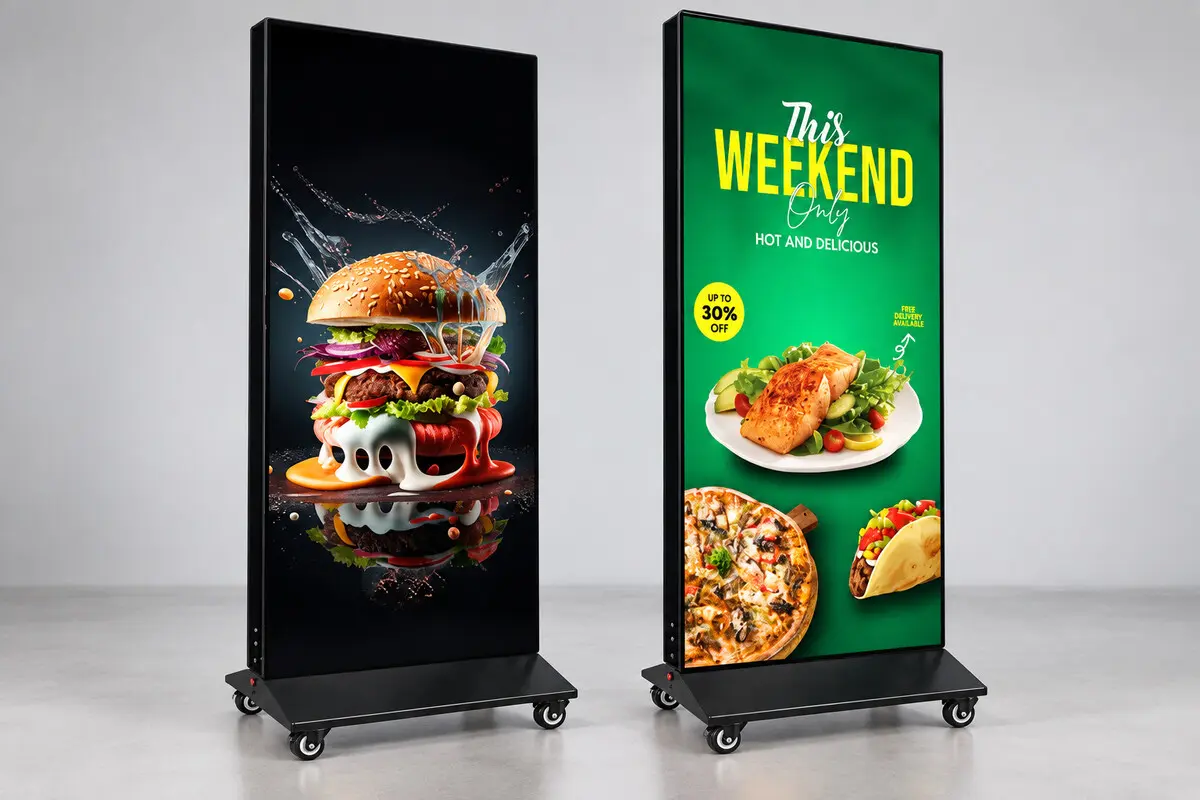
Anodizing is a method of treating aluminium surfaces by electrolysis, creating a hard oxide layer bonded to the metal. Unlike paint, this layer does not peel, does not scratch into white streaks and does not oxidise and dull over time.
For a product that stands permanently in a showroom or hotel lobby for years, this is a clearly visible difference after a few seasons – painted frames start to dull and peel at the edges, while anodized frames still look new.
Two independently printed sides
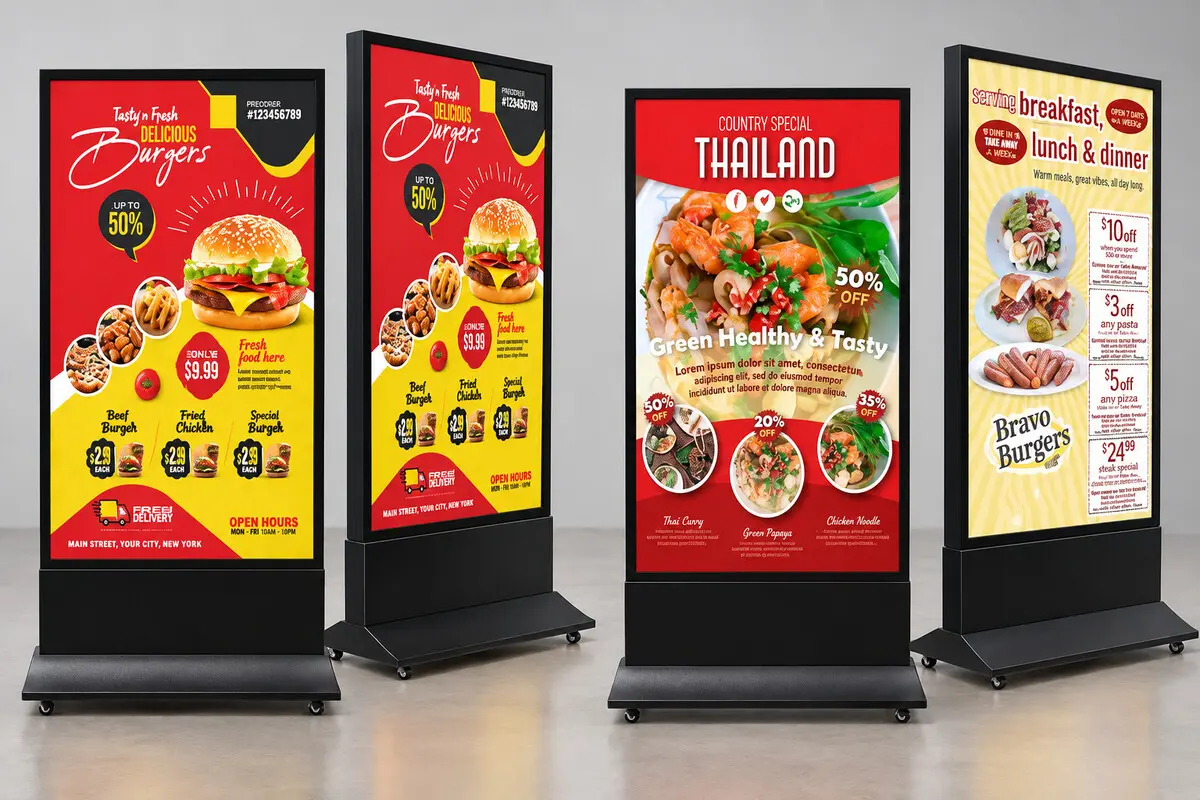
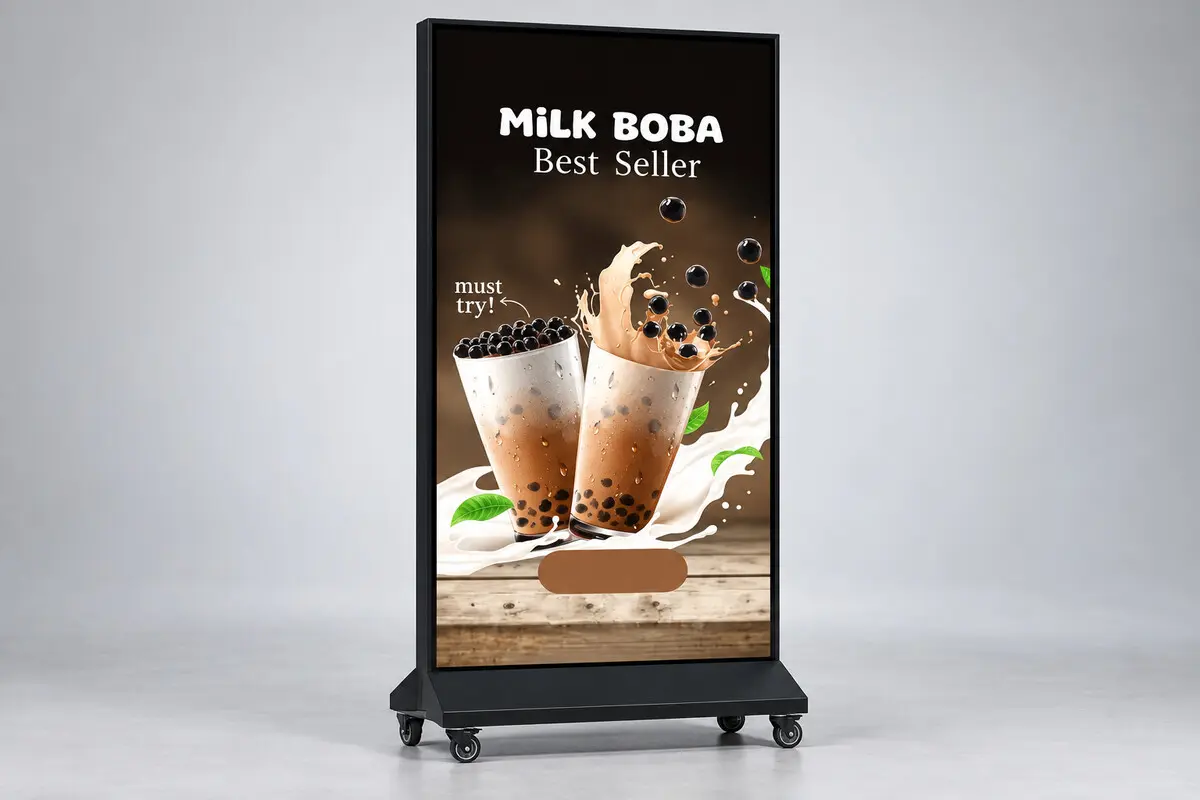
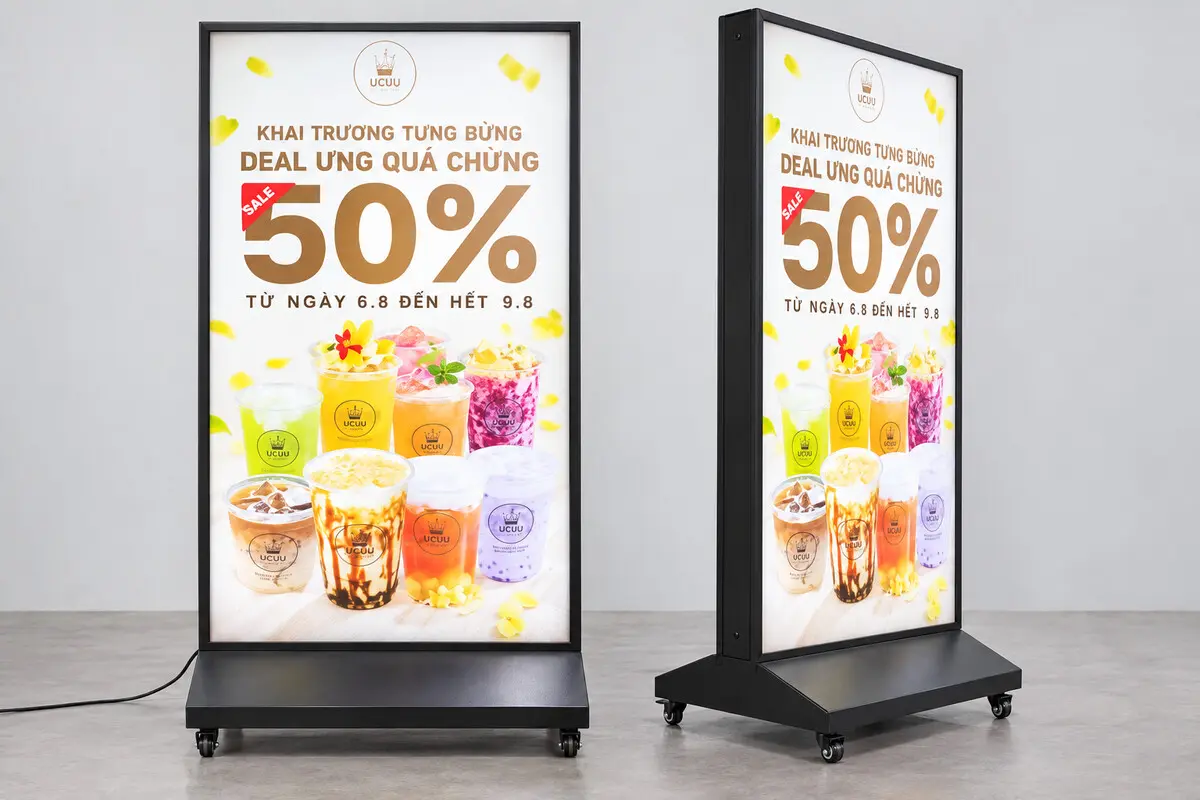
Both sides have their own lights and print sheets, so two completely different contents can be printed. A common use: the side facing the entrance shows attention-grabbing content – promotions, flagship products; the side facing inwards shows content for those who have come in – menus, price lists, instructions.
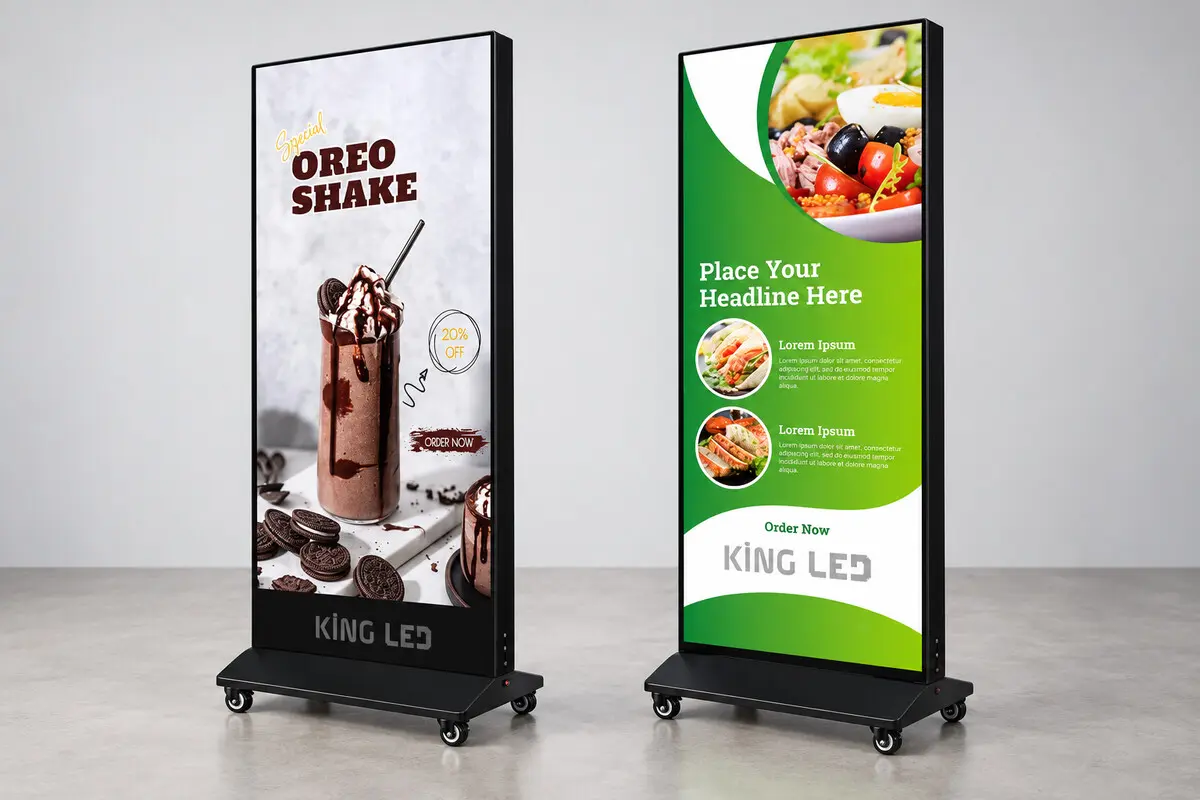
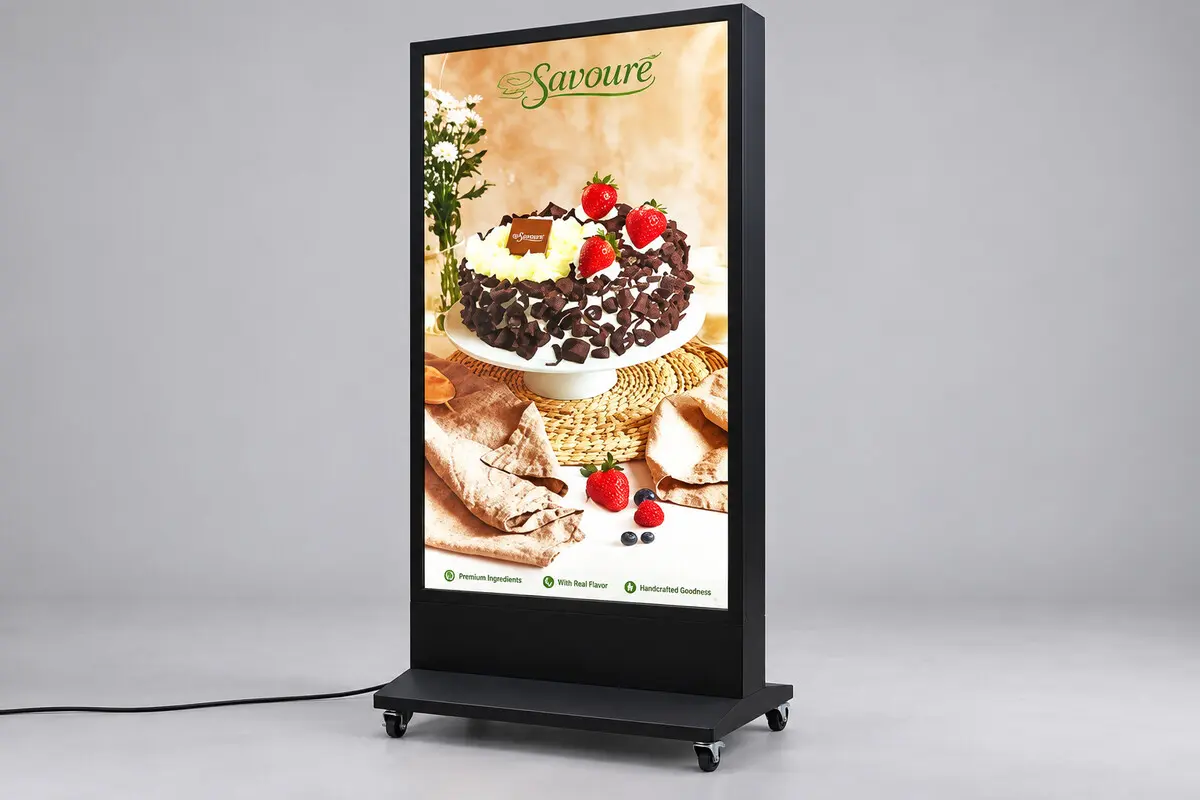
Placed in the middle of a lobby or a wide walkway, printing the same content on both sides makes more sense – whichever way people walk, they read the same message.
Choosing the size by distance and space
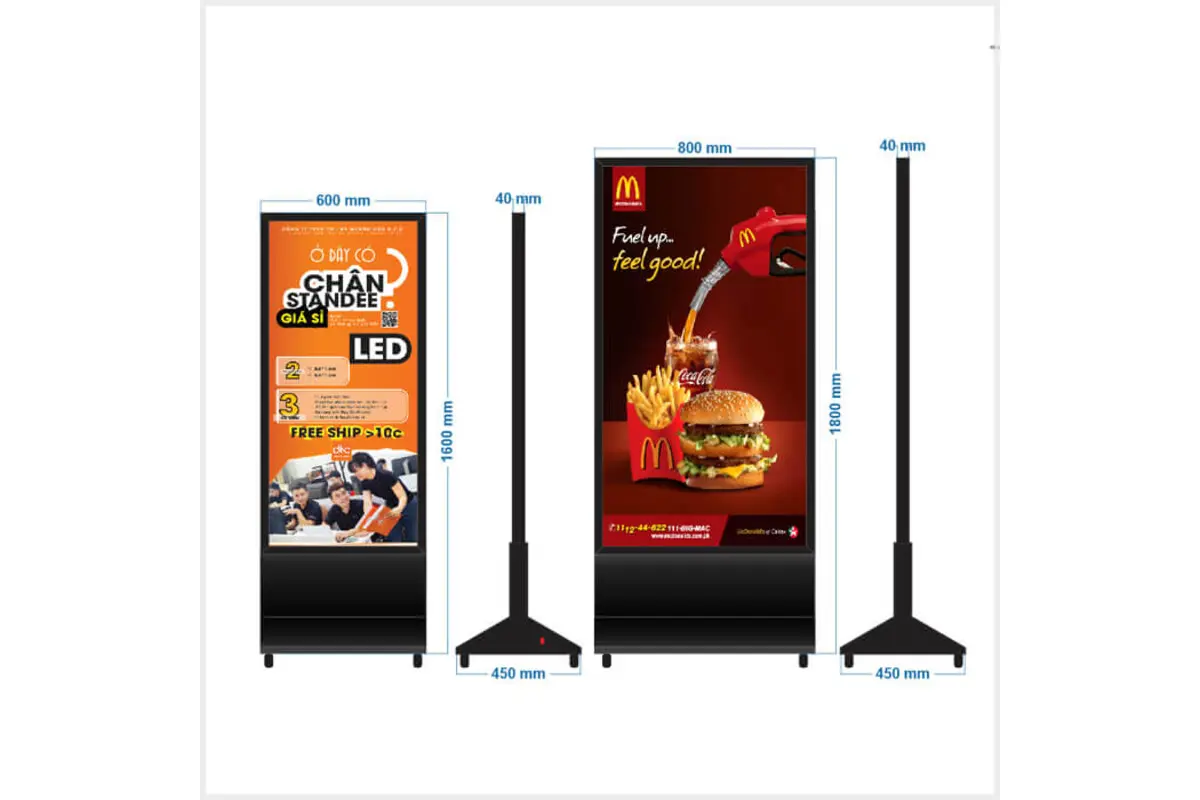
Width 60cm is compact, suited to narrow walkways, next to reception desks or in front of small booths. The 80cm is a third wider, holding larger images or more information – suited to wide lobbies and showroom fronts. A height of 120cm when the standee is placed close, 150cm when it needs to be seen from afar or over people's heads.
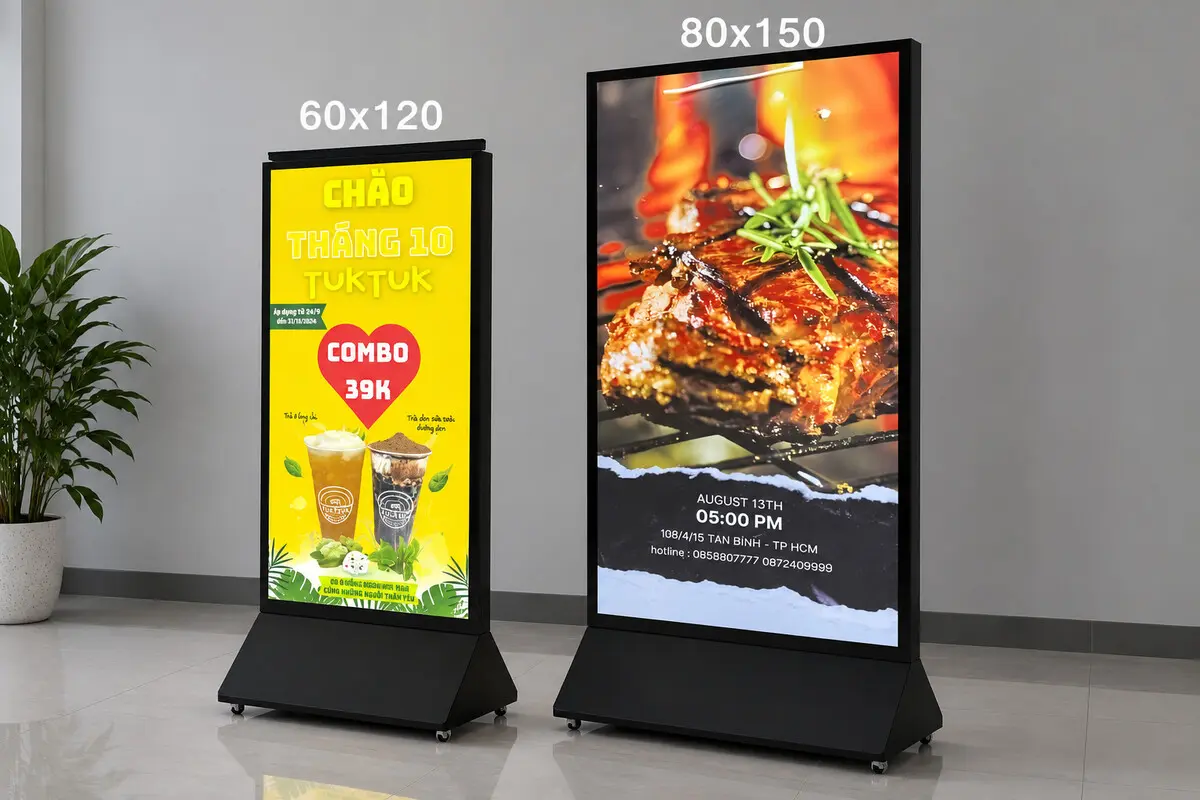
Note how the specification is written: the first figure is the size of the lit face, and the “30cm base” part is the frame below the lit face. “60x150cm + 30cm base” gives a total height of about 180cm. When designing, make the file to the lit face size, not including the base.
Which one should you choose?
Placed on the pavement, in front of a restaurant, where strong light is needed among street lights with a moderate budget – a backlit banner light box is the sensible choice. Placed indoors, in showrooms, hotel lobbies and shopping malls, where customers look up close and the space is already invested in – an aluminium-frame LED standee is worth the difference.
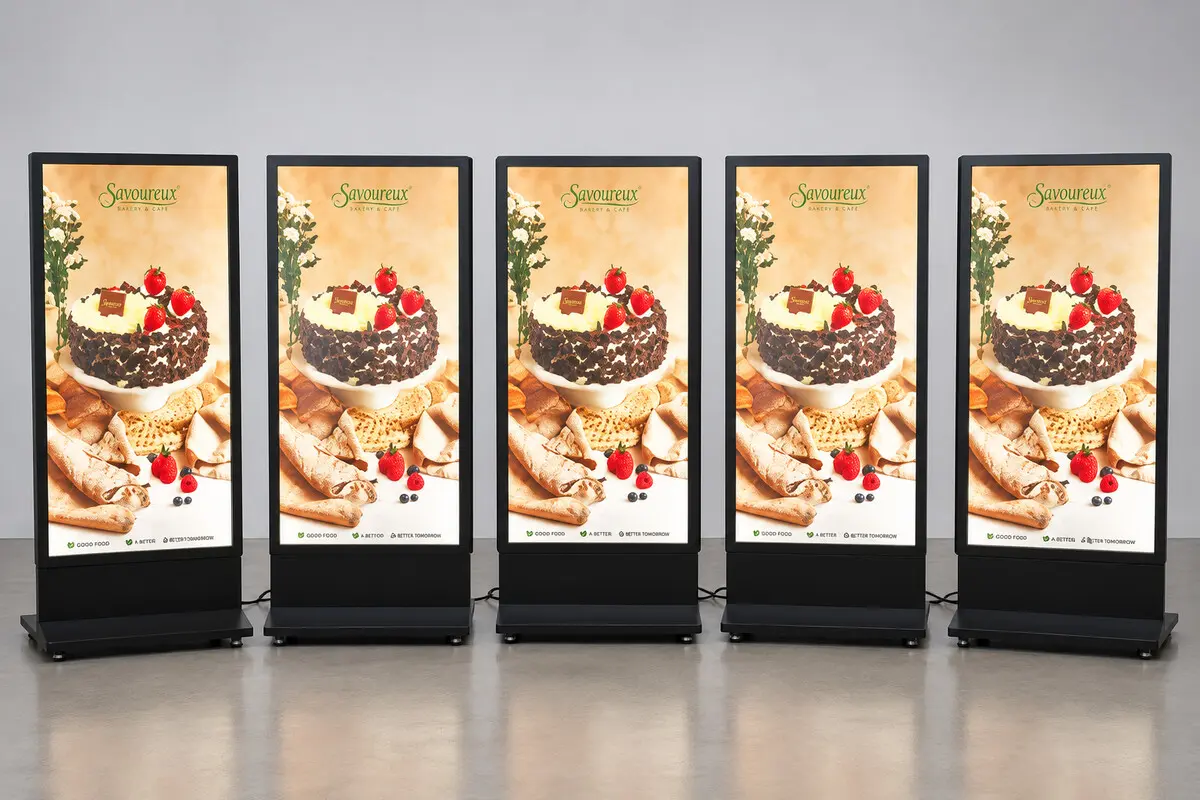
Need a quote or want to order a double-sided LED standee?
See the four size specifications and prices on the Double-Sided LED Standee product page. Or message on Zalo / call 0866.511.099 — we will quote within 30 minutes during working hours. In Quảng Cáo Q7, 49 Mai Van Vinh, Tan Hung Ward, Ho Chi Minh City.
Full comparison table of edge LED and lights inside the box
The sections above described each method. The table below gathers all the criteria so you can compare them at once, without rereading the whole article.
| Criterion | edge-lit LEDs | Lights inside the box |
|---|---|---|
| Sign thickness | 2 to 5 cm | 10 cm or more |
| Light evenness | Even across the face | May show streaks from each lamp |
| Initial cost | Higher | Lower |
| Power consumption | Lower | Higher |
| Printed sides | Light-guide acrylic, backlit film | Backlit banner |
| Large format | Limited by the light-guide sheet | Can be made very large |
| Repair | Open the side cover, replace the LED strip | Open the front face, replace the lamp |
| Suitable for | Indoors, viewed up close | Outdoors, viewed from afar |
The deciding point is usually viewing distance. Customers standing one to two metres away will immediately notice the uneven light streaks of lights inside the box, so edge LED is worth the money in lobbies and reception desks.
Conversely, signs hung high outdoors are not looked at closely by anyone. Lights inside the box are bright enough and much cheaper, especially for large sizes that edge LED struggles with.
Related products

Standee

Standee

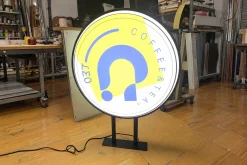
Light boxes

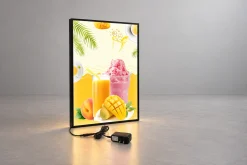
Restaurants & Shops
Cost over time of the two methods
In terms of upfront price, lights inside the box are always cheaper. But counting electricity and maintenance labour over a few years, the gap narrows considerably.
| Cost item | edge-lit LEDs | Lights inside the box |
|---|---|---|
| Upfront price | About a third higher | Lower |
| Monthly electricity | Low | Higher, most noticeably at large sizes |
| LED strip lifespan | Long | Shorter, individual lamps often burn out |
| Lamp replacement labour | Rarely needed | Once every few years |
| Replacing the print face | Pull the sheet through the side cover | Remove the front face, re-stretch the banner |
| Space taken up | Thin, almost flush with the wall | Deep, clearly protruding |
For signs on all day in a shopping mall, the electricity savings of edge LED make up for the upfront difference after about two to three years. For signs only on for a few hours in the evening, the payback period is much longer.
Besides money, there is another factor hard to put into numbers: the brand impression. A thin, evenly lit sign looks much more polished, which matters more for showrooms and hotels than for pavement eateries.
Choosing for each specific space
Below are common situations and how to choose between edge LED and lights inside the box for each place.
| Space | Recommended | Reason |
|---|---|---|
| Hotel lobby, reception | edge-lit LEDs | Customers stand close, need a smooth lit face |
| Furniture and car showrooms | edge-lit LEDs | Displaying premium goods, the sign must look polished |
| Shopping mall corridors | edge-lit LEDs | Narrow space, a thin sign is less in the way |
| Restaurant and beer bar fronts | Lights inside the box | Seen from the street, needs strong light |
| Signs hung high on outside walls | Lights inside the box | Large size, nobody looks up close |
| Cashier counters, small menu boards | edge-lit LEDs | Customers read at close range |
| Free-standing box signs on the pavement | Lights inside the box | Withstands knocks, easy to repair |
A quick way to choose: if customers will stand closer than two metres, choose edge LED; further away, lights inside the box are enough. This rule holds for most cases without any further calculation.
For cases that are both near and far — such as a sign at the entrance that passers-by can also see — prioritise the more important customer group. Usually that is people who have already stepped in, which means choosing edge LED.
What to ask before ordering
The few questions below help us quote accurately the first time, avoiding extras after work has started.
- Wall-mounted, floor-standing or ceiling-hung? Each type needs different accessories and wiring.
- How far is the nearest socket? Over two metres means extra wiring must be included.
- Single- or double-sided sign? Double-sided almost doubles the lights and print faces.
- How many hours a day will it be on? This affects the choice of power supply and electricity calculation.
- Will the content change often? If so, prioritise a type with quick print face replacement.
- Indoors or outdoors? Outdoors needs waterproofing for the power supply and moisture drainage holes.
Answering these questions early keeps the drawing and quote close to reality. Most cases of rework are due to discovering electrical problems after the sign has been made.
See also the finished product at Double-Sided LED Standee and Backlit Banner Standee, or the article on print face materials at Backlit Film.
Power supply and installation safety
Whether you choose edge LED or lights inside the box, the electrics are still the part that fails most often. The principles below apply to both types.
- Choose a power supply with spare capacity of about twenty percent over the total wattage of the LED strips; running close to the maximum makes the supply hot and fail sooner.
- Place the power supply somewhere ventilated and easy to reach; do not hide it inside a wall cavity.
- Use a socket with a cover if the sign is outdoors or near a doorway exposed to driving rain.
- Do not run cables across walkways; it is both dangerous and wears the cable out over time.
- Fit a separate switch for the sign; do not share it with the shop's lighting system.
- Switch off when closed to extend the life of the LED strips and power supply.
If the sign is outdoors, drill a few moisture drainage holes in the bottom of the box. The temperature difference between day and night makes water vapour condense inside, which over time clouds the print face and causes short circuits.
When the sign does not light up, check in this order: socket, power cable, power supply, and only then the LED strips. Most faults lie in the first three, not in the lights.
Replacing the print face when changing content
The print face is the only consumable part of both sign types. Understanding how to replace it helps you calculate the long-term cost correctly when the shop changes content by season.
| Sign type | How to replace the print face | Replacement time | Who can do it |
|---|---|---|---|
| Edge LED with aluminium frame | Open the side cover, pull out the old sheet, slide in the new one | Under 5 minutes | Shop staff |
| Lights inside the box with stretched banner | Remove the tension strip, replace the banner, re-stretch | 15 to 30 minutes | Needs someone experienced |
| Vacuum-formed light box | The whole face must be removed | 1 hour or more | Workshop technician |
| Signs with decal stuck on acrylic (Mica) | Peel off the old layer, stick on the new one | 30 minutes | Technician or experienced staff |
Shops that change content monthly should prioritise the quick-replacement type, because repeated replacement labour will exceed the upfront price difference. Shops keeping the same content for years need not worry about this factor.
Order one spare print face from the first batch. A face damaged midway can be replaced right away without waiting for a reprint, especially for signs in important positions.
Quick Q&A
This section gathers the questions we receive most when customers are torn between the two types of illuminated sign.
- Is edge LED as bright as lights inside the box? Overall brightness is slightly lower but more even, so it actually looks clearer up close.
- Can lights-inside-the-box signs be made thin? The thinner the box, the more the streaks from each lamp show, so it usually has to be 10 cm deep or more.
- Which sign can stay on 24 hours? Both can stay on continuously, but edge LED uses less electricity.
- Which is easier to repair? Lights inside the box are easier, because opening the front gives access to all the LED strips.
- Can they be double-sided? Both can be made double-sided, with different content on each side.
- Which type for outdoors? Lights inside the box, because the deep frame withstands knocks and is more waterproof.
- What about very large signs? Lights inside the box, because the edge LED light-guide sheet has size limits.
If you are still unsure, the quickest way is to message us on Zalo with a photo of where it will go and tell us how far away customers will stand. Those two pieces of information are enough for us to advise on the right sign type.
Lead time and how to order
Lead time depends on the sign type and size. The table below shows typical times, counted from when the customer approves the drawing.
| Item | Typical time |
|---|---|
| Small edge LED sign under 1 metre | 3 to 5 working days |
| Large edge LED sign | 5 to 7 days |
| Medium steel-frame light box | 3 to 5 days |
| Large light box needing an on-site frame | 7 days or more |
| Only replacing the print face for an existing sign | 1 to 2 days |
| With installation | Scheduled according to the installation team |
Former District 7, Nha Be, District 4 and District 8 get door-to-door delivery and installation. Other districts of Ho Chi Minh City are served according to the installation team's weekly schedule.
When ordering, send a photo of the installation spot, the width and height, plus the design file if you have one. We survey the site, then send a drawing and quote; production starts only after approval.
Need printing or signage in Ho Chi Minh City?
In Quảng Cáo Q7 runs its own print workshop in Tân Hưng Ward (former District 7), Ho Chi Minh City, producing and installing signage, banners, window graphics, exhibition booths and event displays. Send us the size, material, quantity and a photo on WhatsApp and we will get back to you.

Phone: +84 866 511 099 · Also on WeChat
Workshop: 49 Mai Văn Vĩnh, Tân Hưng Ward, Ho Chi Minh City