




































































Backlit banner and how to design for light boxes
Sep
Backlit Banner and How to Design for Light Boxes
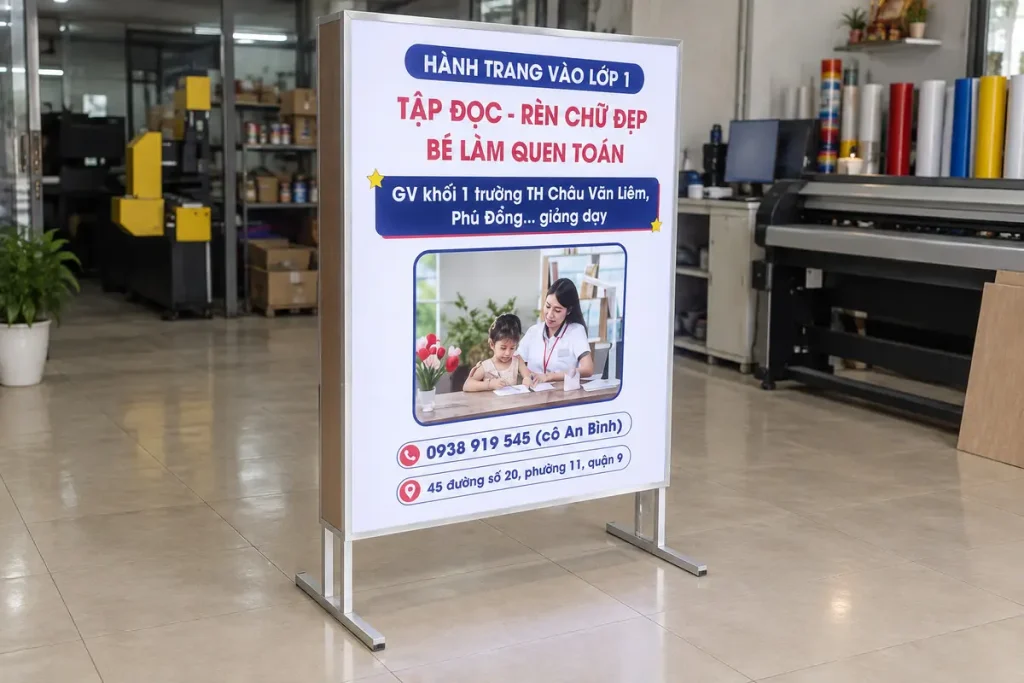
Many shops order a light box standee and then find it “not as nice as the picture” – the text blooms, light colours wash out, or the lamp streaks inside are clearly visible. Almost all of this comes from two things: choosing the wrong banner type, or designing it like a regular printed poster. This article covers both.
How backlit banner differs from regular Hiflex banner
Regular Hiflex banner has a light-blocking liner on the back so light from behind does not pass through and wash out the printed image – necessary for banners hung outdoors. Backlit banner is the opposite: it has no light-blocking layer and is made thinner and more translucent in a controlled way, so light passes evenly across the whole banner face.
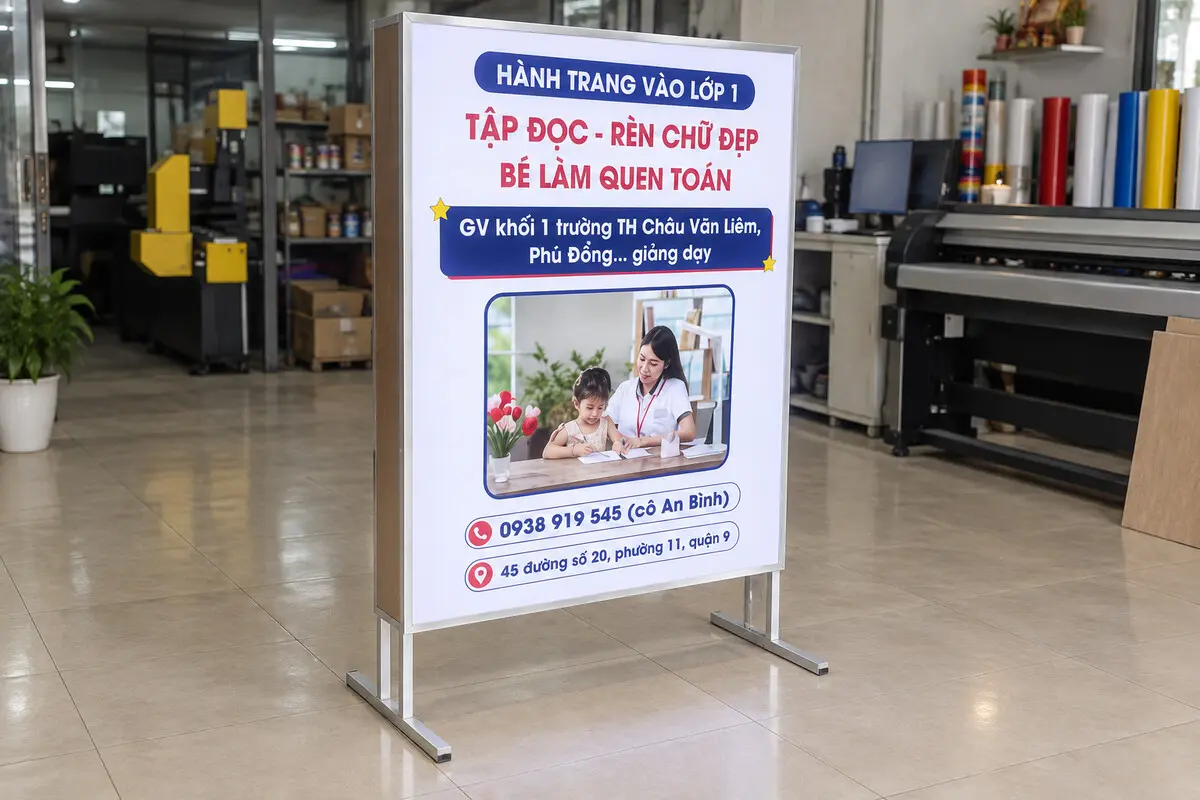
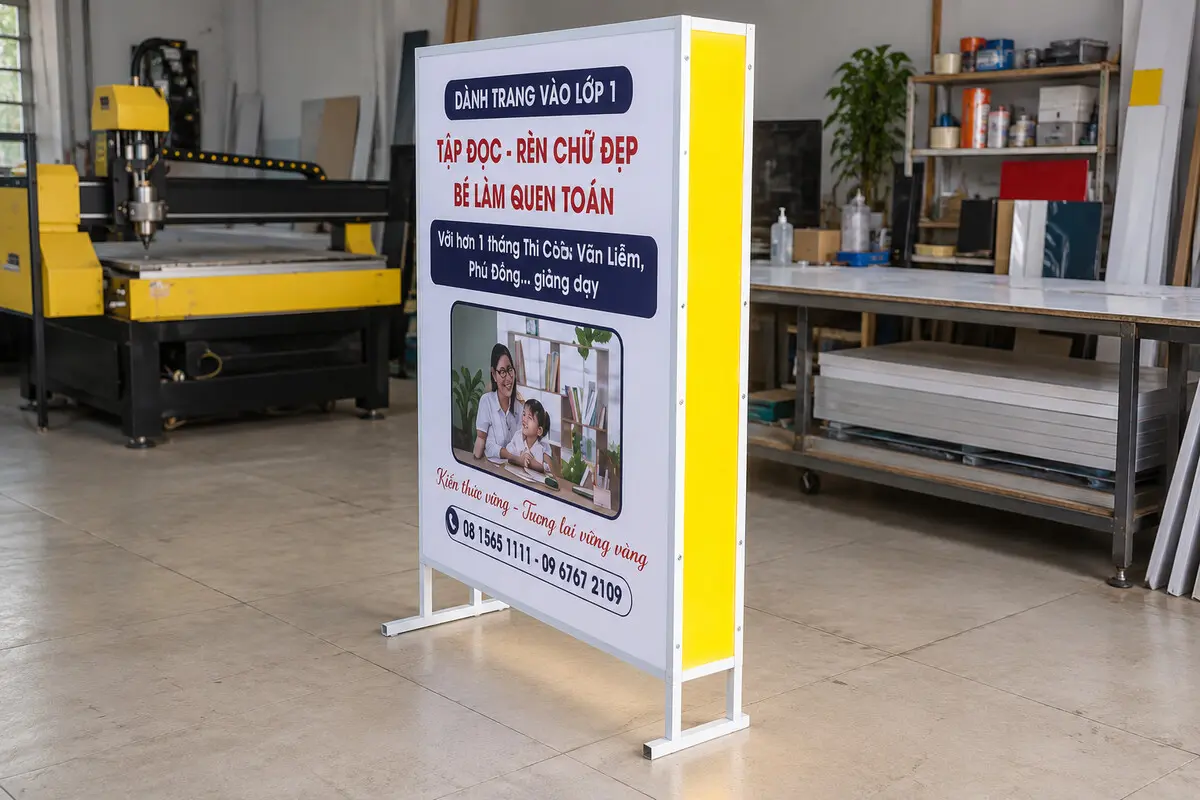
The word “controlled” matters here. Banner that is too translucent shows each LED inside as streaks of light; banner that is too thick lets no light through, and the printed face stays dark even with the lights on. Proper backlit banner diffuses the light into one even area.
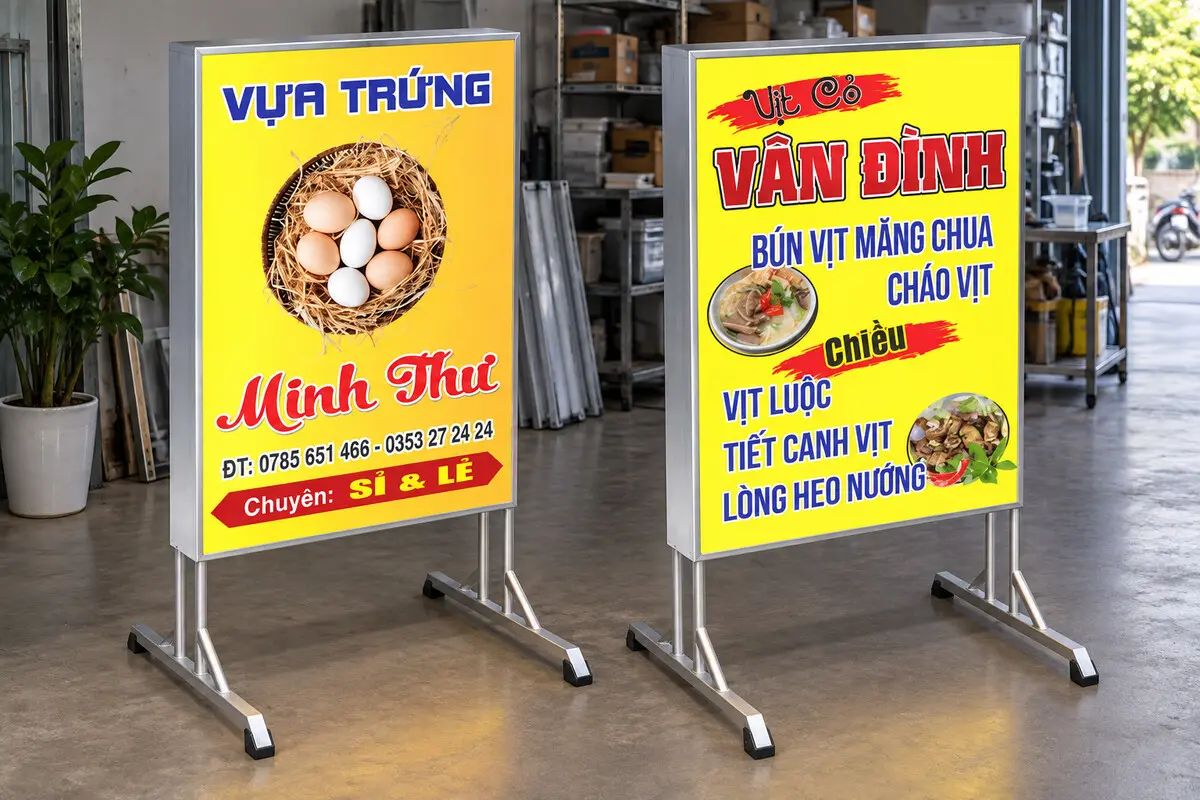
Construction of a light box set
A hollow steel frame forms the box body, with LED lights fitted inside, the printed backlit banner stretched across the face of the frame, and a 220V power cable about 2m long that plugs into an ordinary socket.
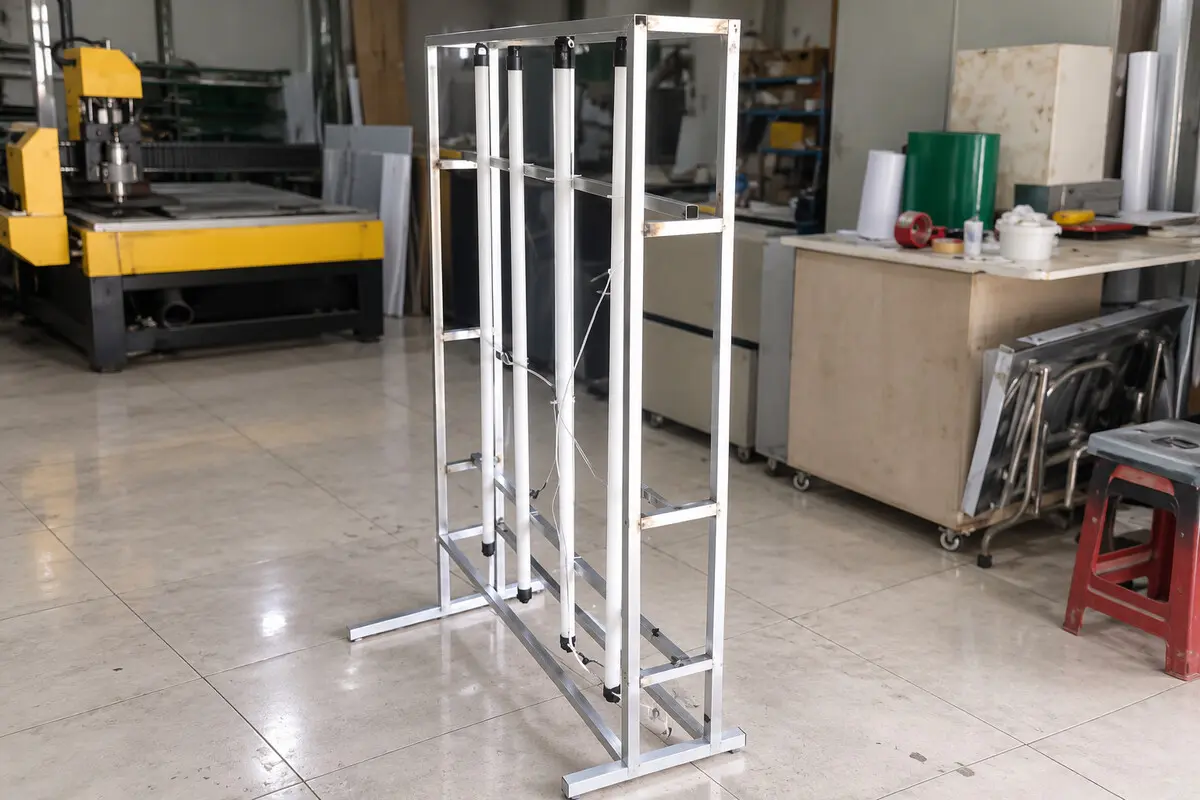
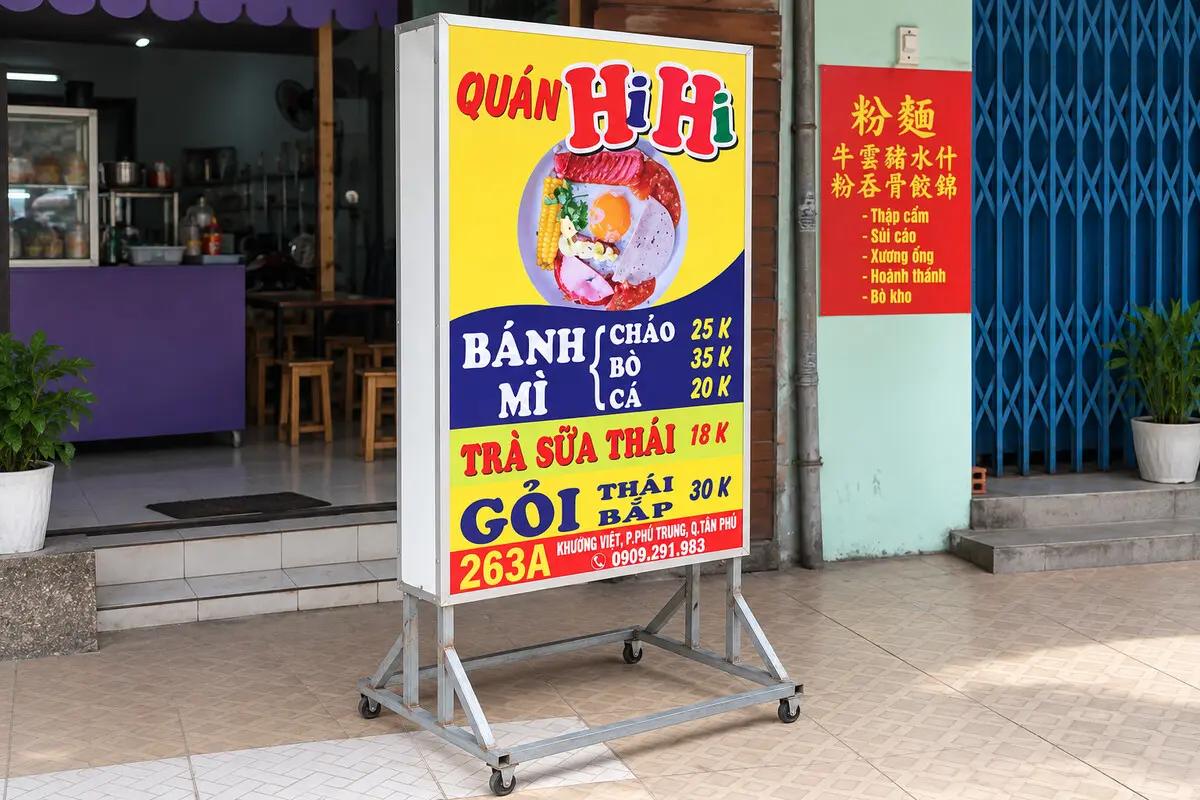
The biggest difference from every other type of standee: it needs electricity. It must be placed near a socket or the cable route must be planned in advance. The 2m cable is enough to place it at the doorway with a socket inside; further away needs an extension cable, and an outdoor-rated extension should be used if the standee stands on the pavement.
Design: three things that differ from regular printed standees
Choose a dark background with light text
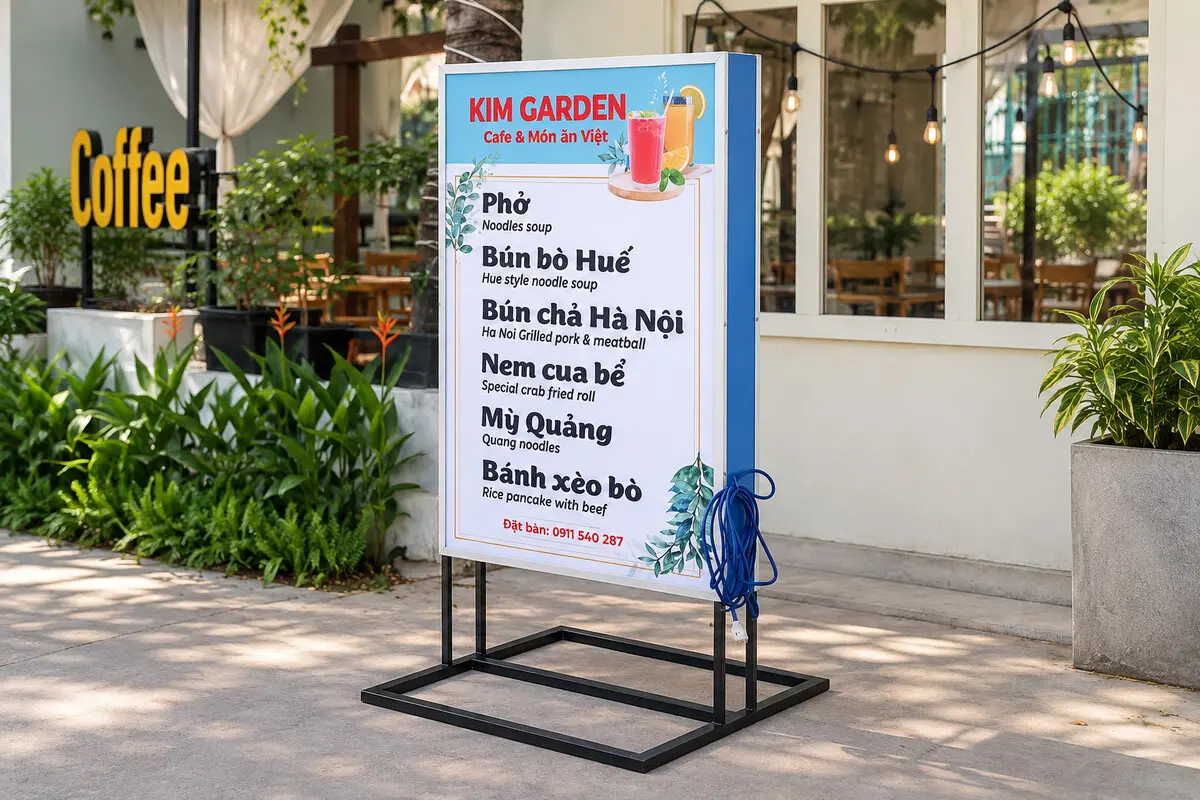
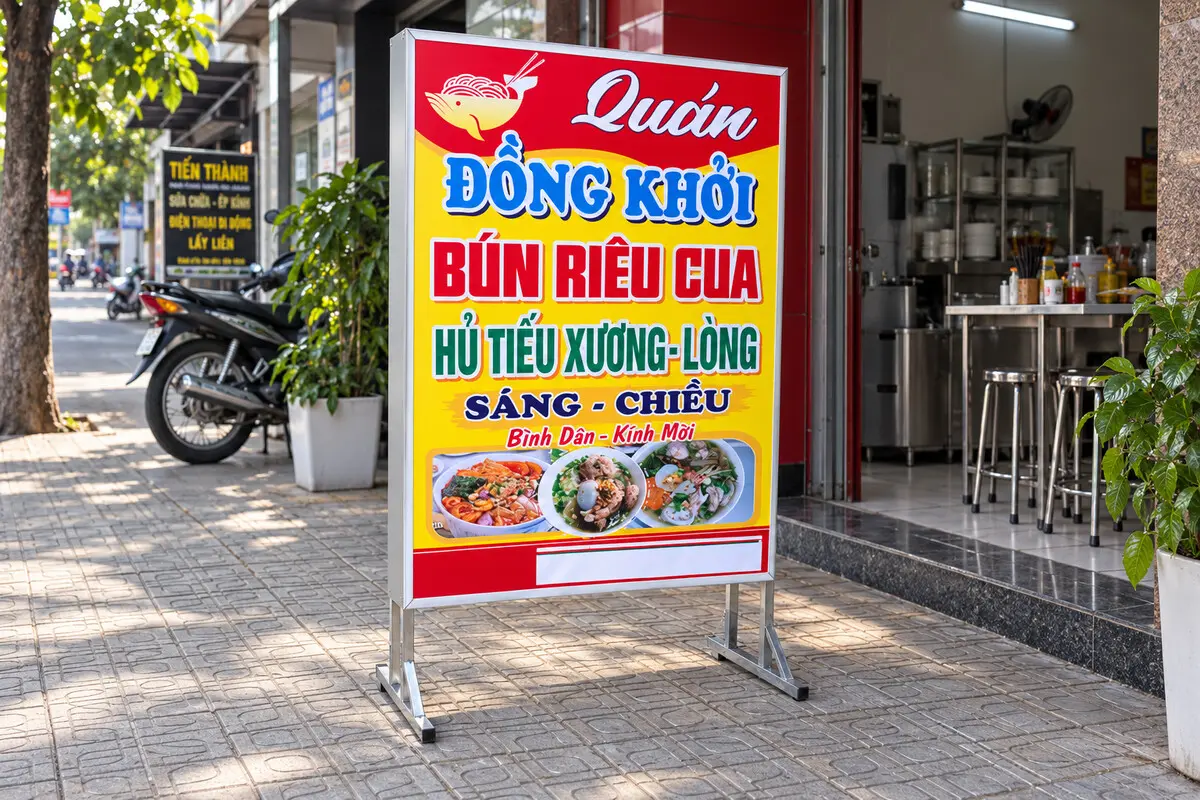
With light from behind, colours look brighter and more vivid than on screen. Light colours easily “wash out” to white, while dark colours look great. Choose a dark background – red, navy, brown – with light-coloured text and images, instead of black text on white like a regular poster.
Bold text, thick strokes
Light passing through the banner makes text strokes bloom slightly. Thin text under 2cm and fine-stroke fonts lose their sharpness. Bold text with thick strokes and strong contrast is the safe way.
Limit subtle gradients
Light gradient areas and transparency effects are already hard to control in print; with backlighting the result is even harder to predict. Flat colour areas with clear boundaries come out closer to what you intend.
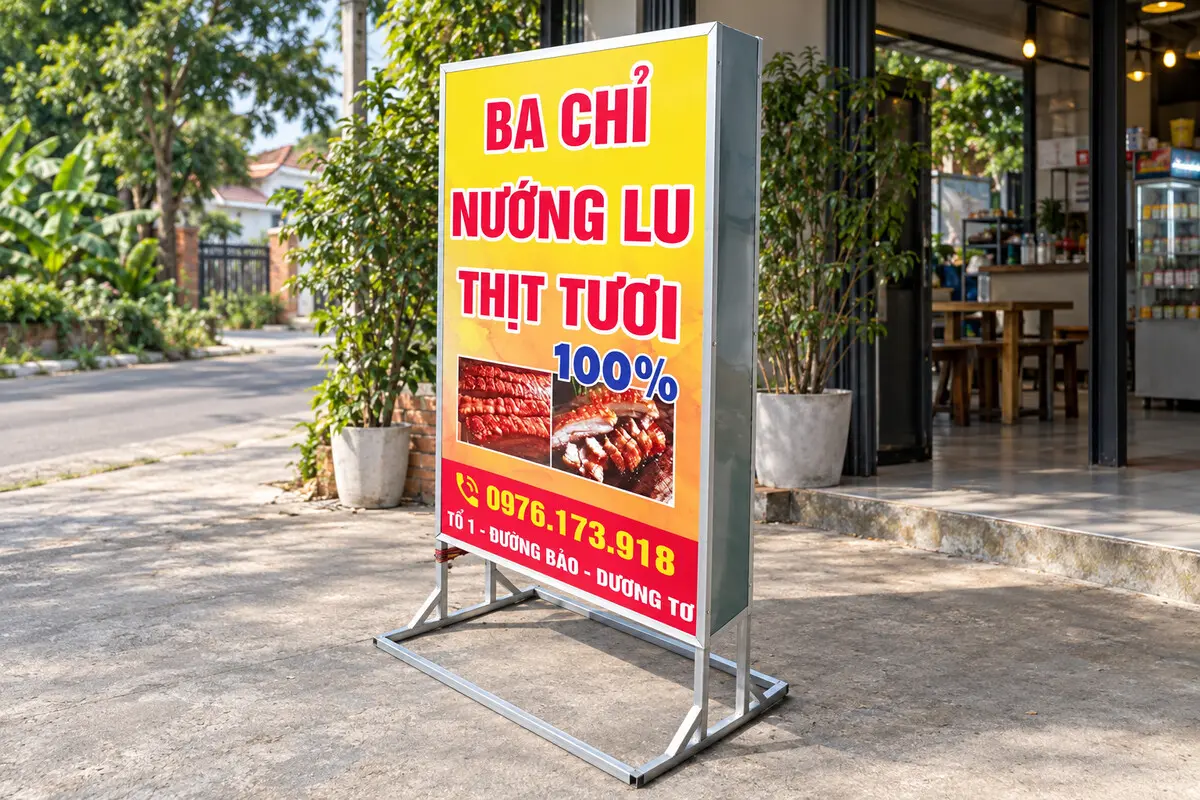
Reading the specification “60x120cm + 25cm base”
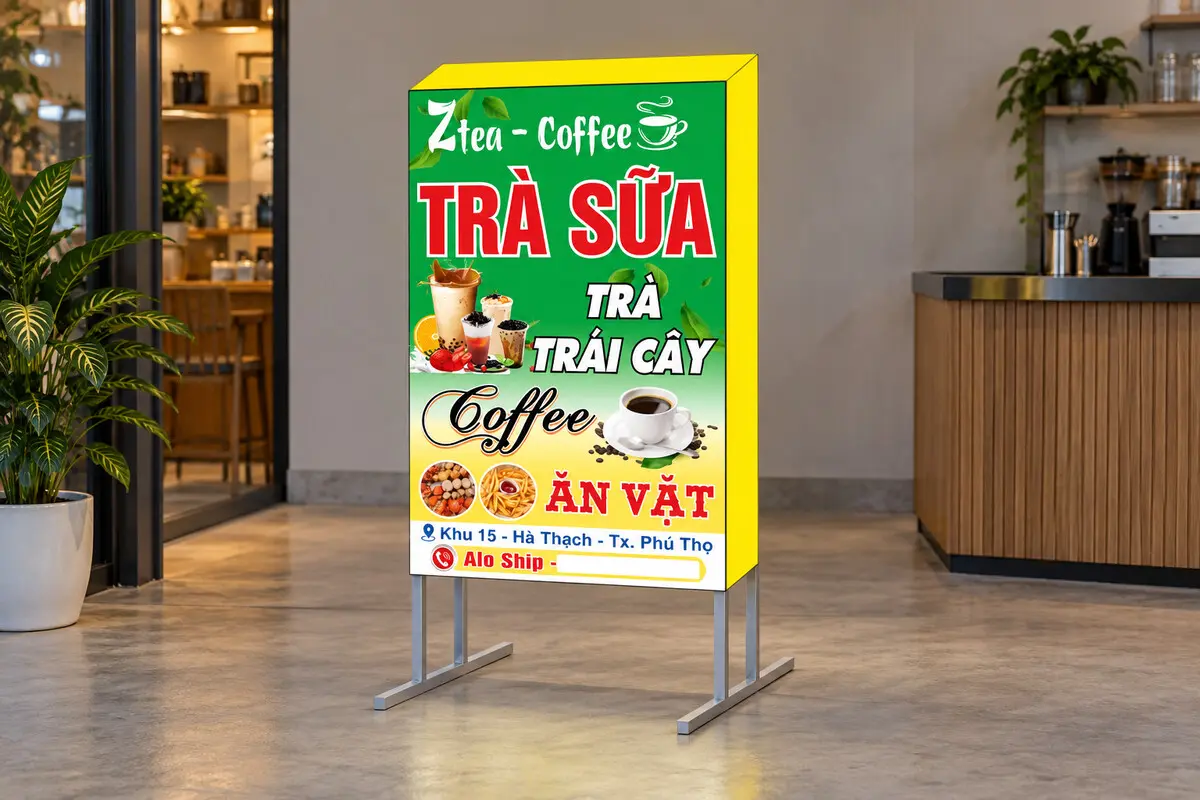
The first figure is the lit face size; the “25cm base” is the part of the frame below the lit face. “60x120cm + 25cm base” means the lit face is 60cm wide and 120cm high, with another 25cm of frame below – a total height of about 145cm. When designing, make the file to the lit face size, not including the base.
Small sizes (60×80, 70×90) suit placement right by the door, indoors, where viewers stand close. Large sizes (60×120, 80×120, 80×150) are placed on the pavement or shopfront so people on motorbikes can see them from afar.
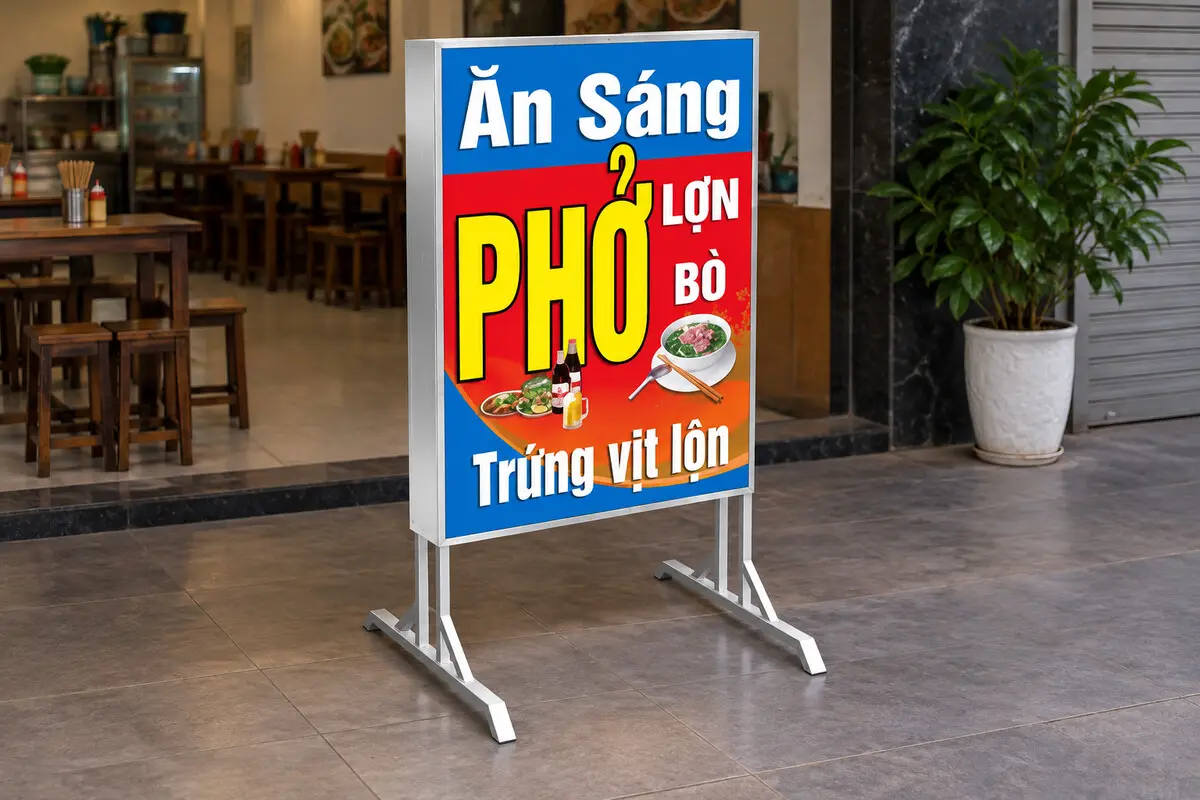
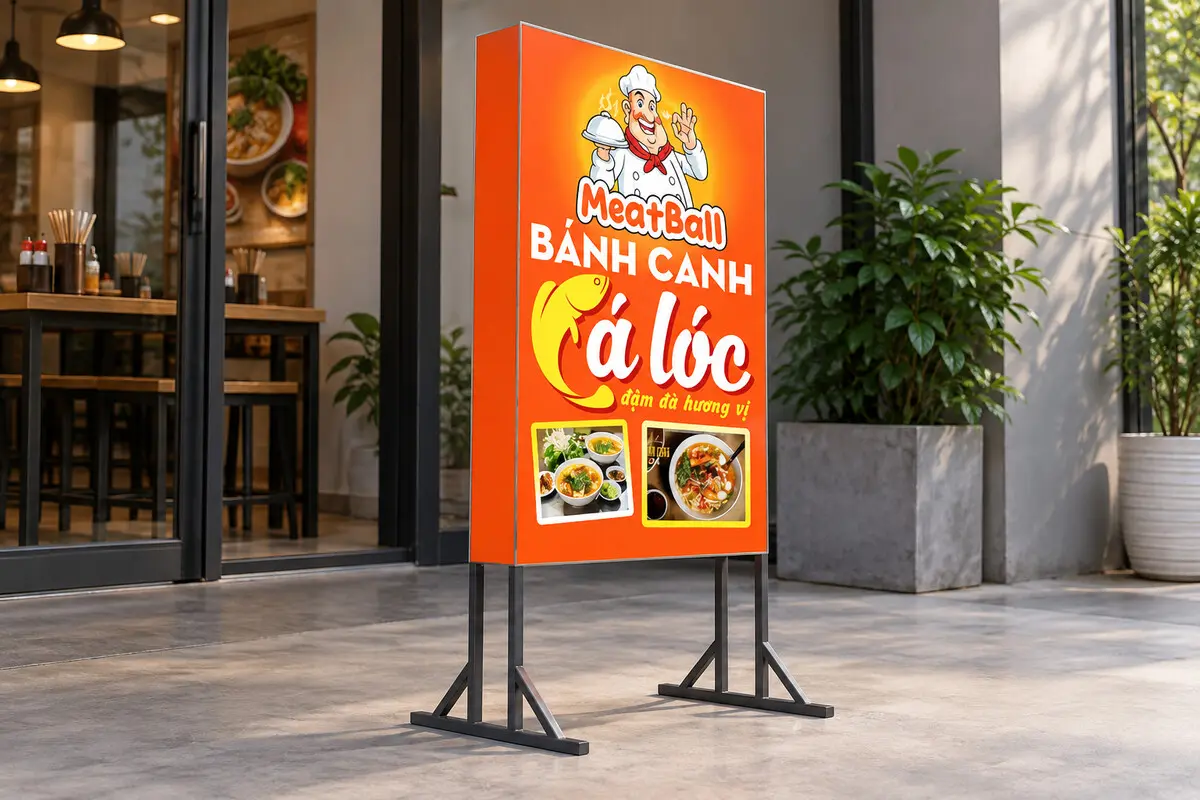
Why shops and eateries favour light boxes in the evening
Around 6–10 pm is the busiest time for restaurants, cafés and street-front shops – and also when every regular printed standee becomes hard to read: yellow street lights, weak light, and people riding past have no time to notice anything.
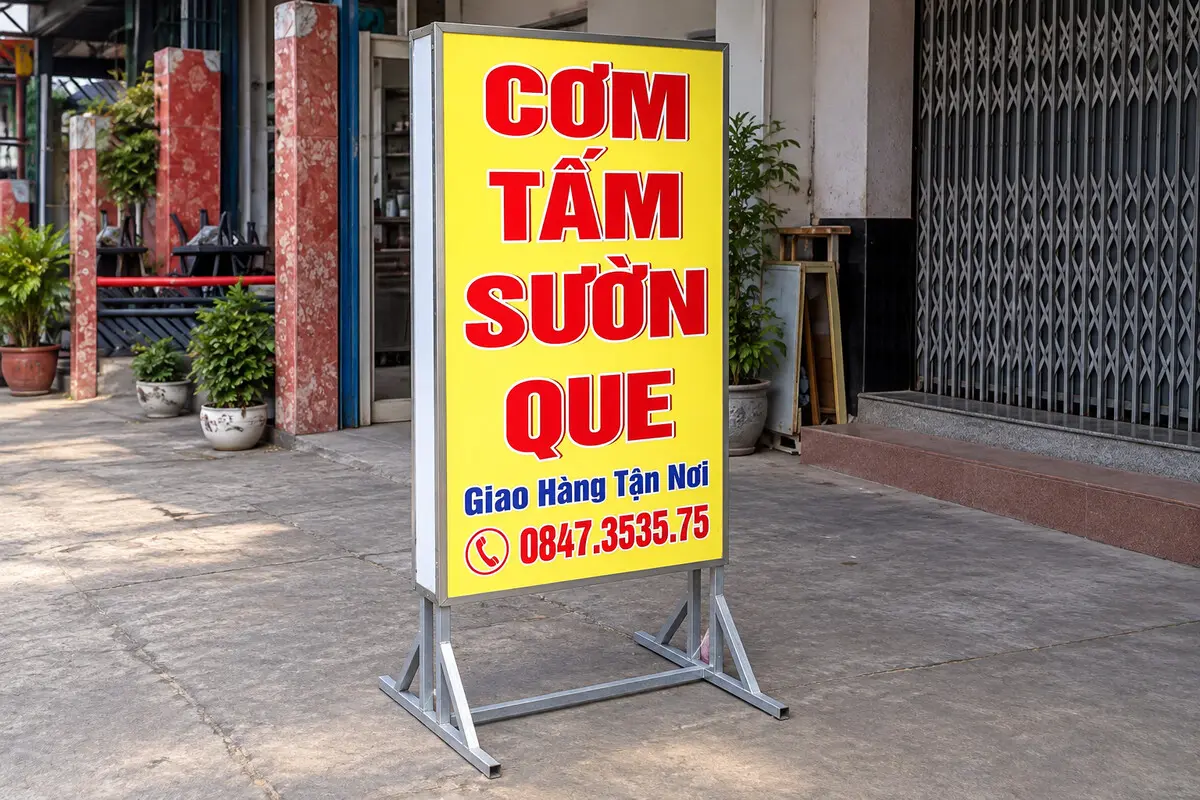
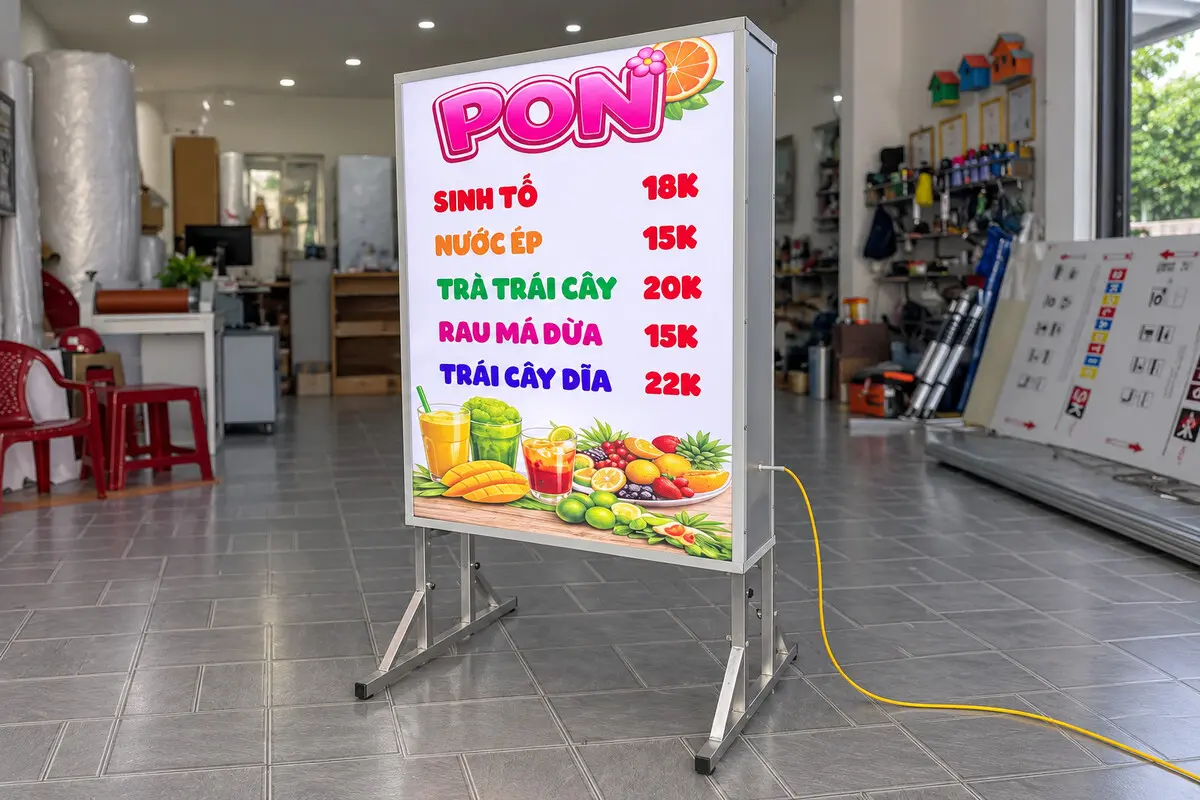
Light boxes solve exactly that time slot. The printed face lights up by itself so it stands out clearly against the dark street and can be read from afar. For eateries there is one more advantage: food photos lit from behind look very appetising – something regular printed standees cannot do.
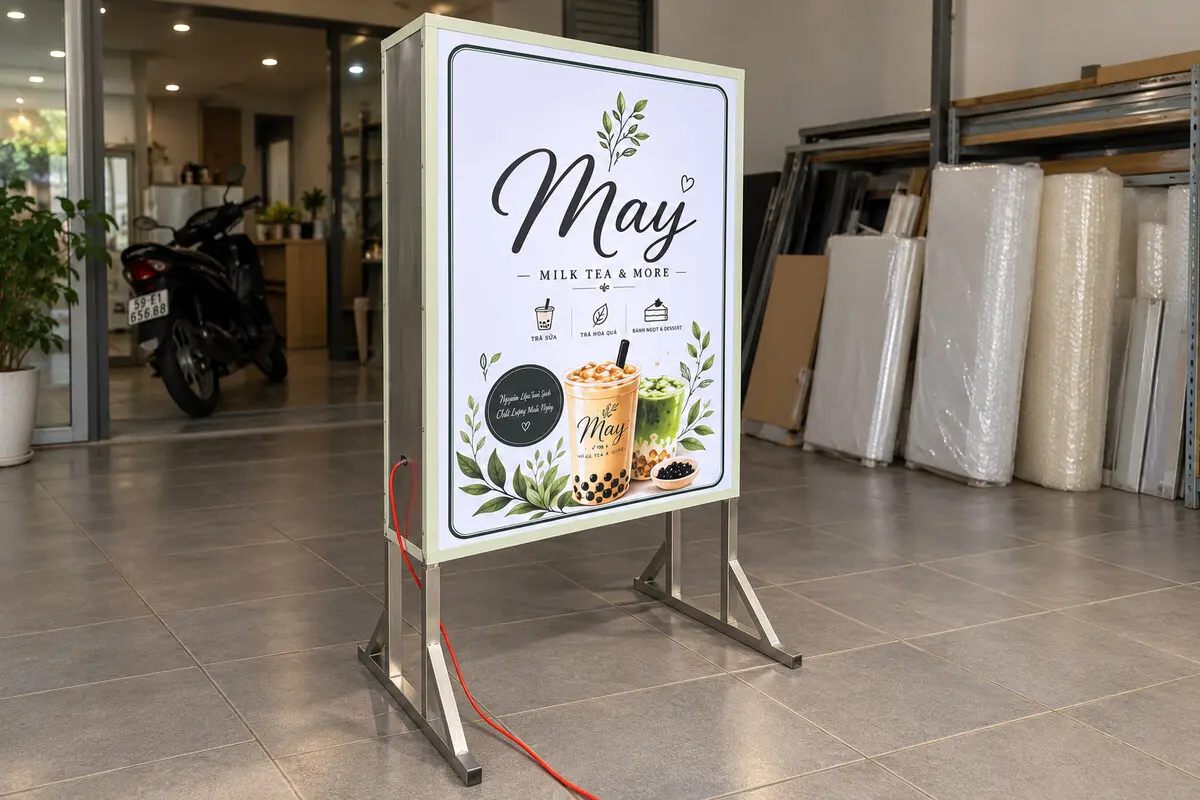
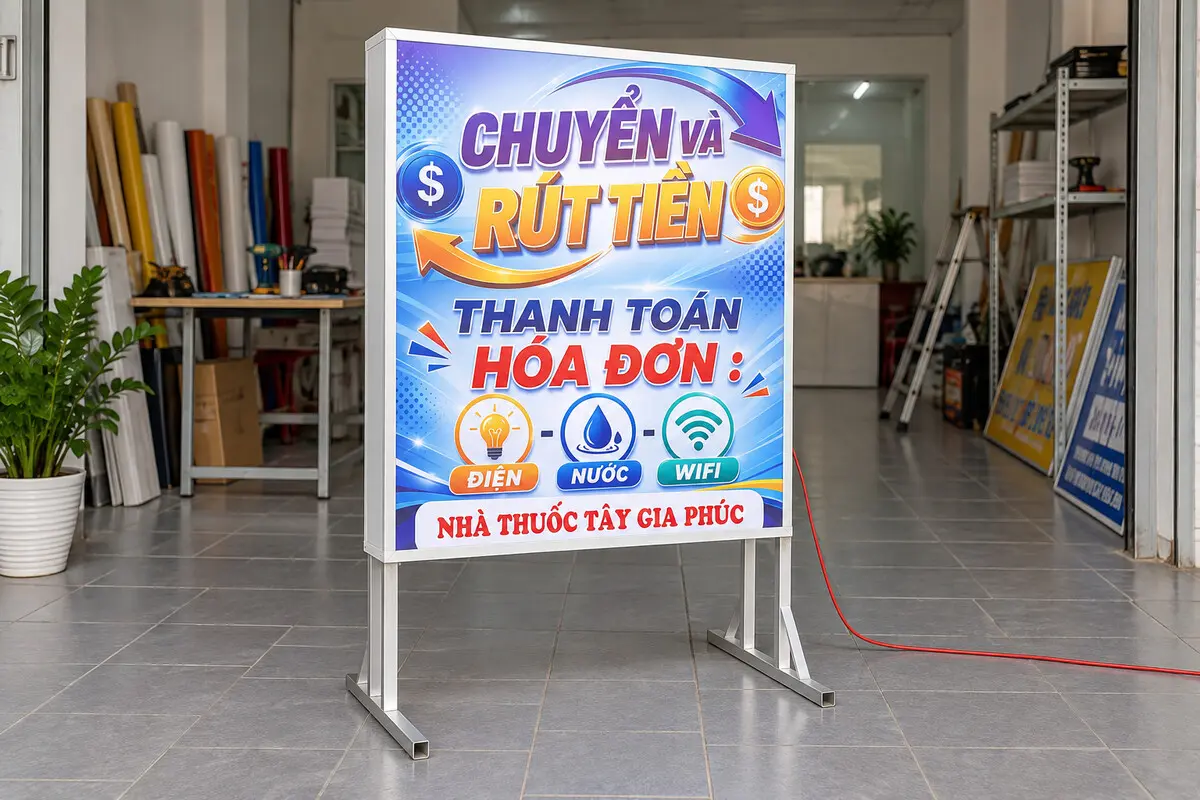
Besides shops and eateries, who else uses them
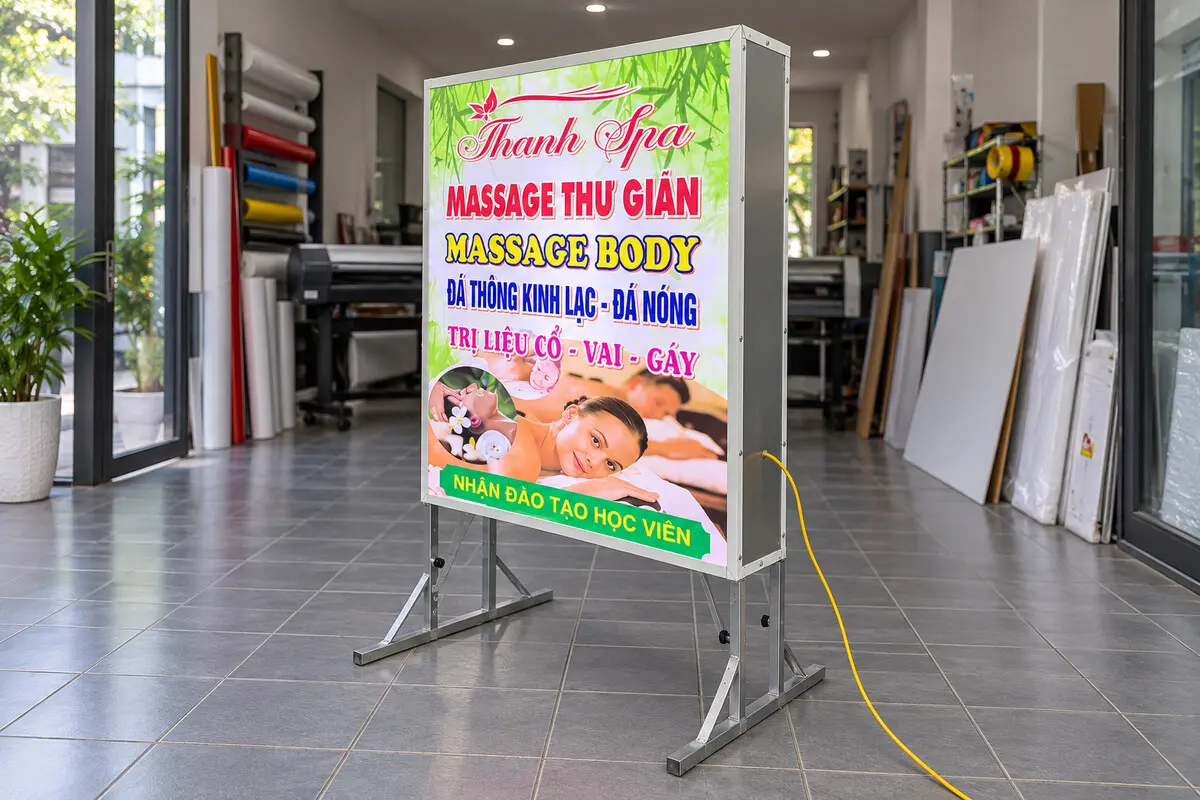
Spas, salons, hair and nail shops – open until late and often located in alleys or rows of townhouses. A light box standee both advertises the services and acts as a guiding light helping customers find the right door.
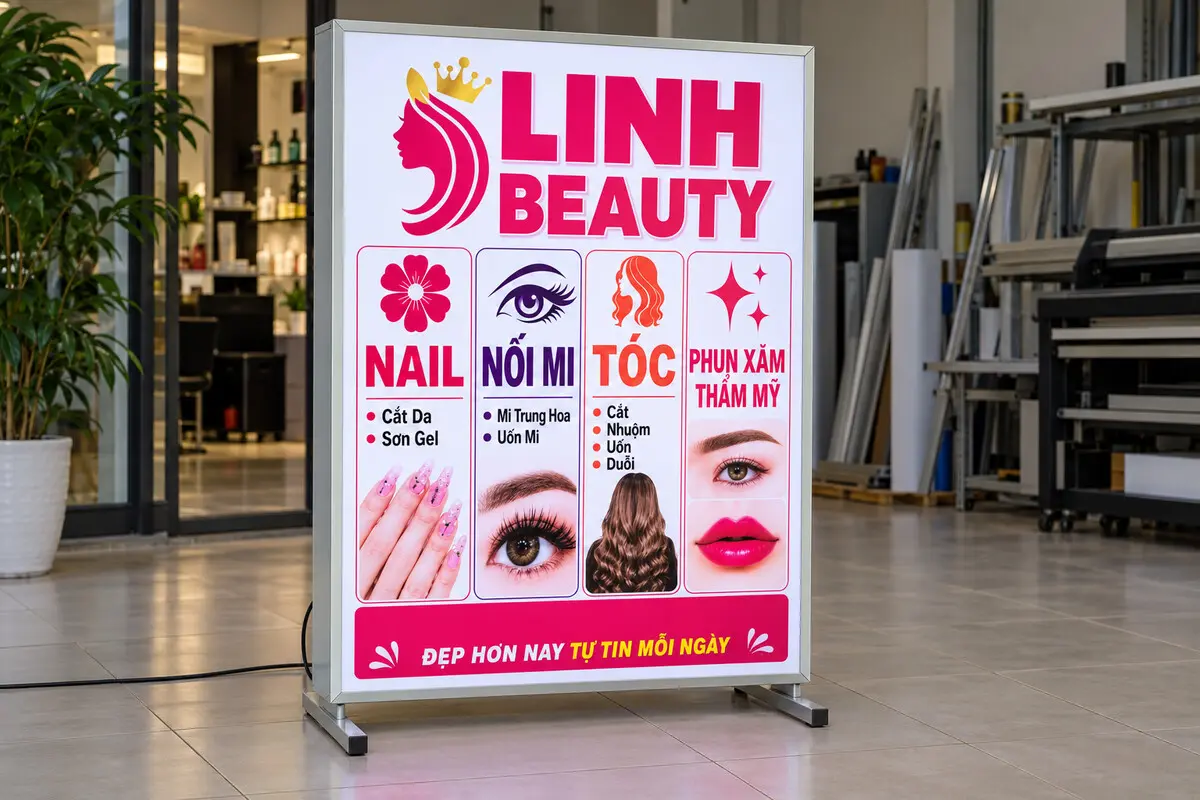
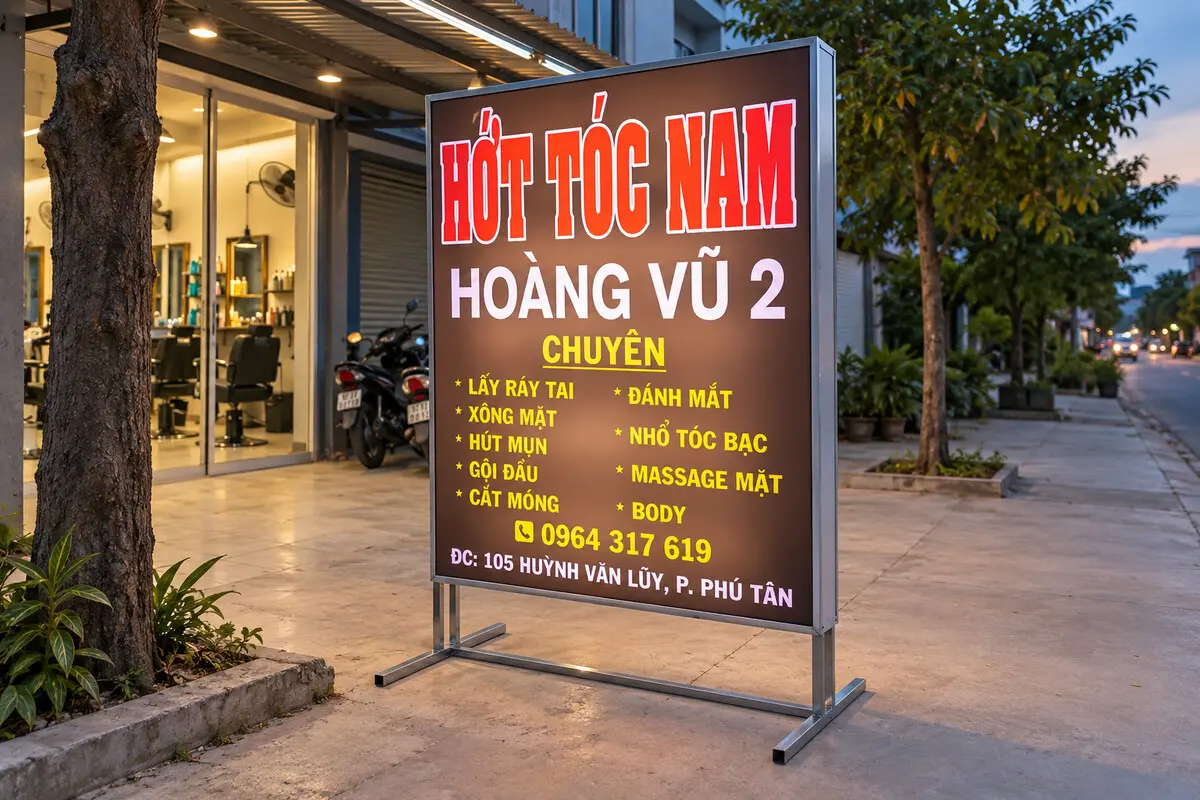
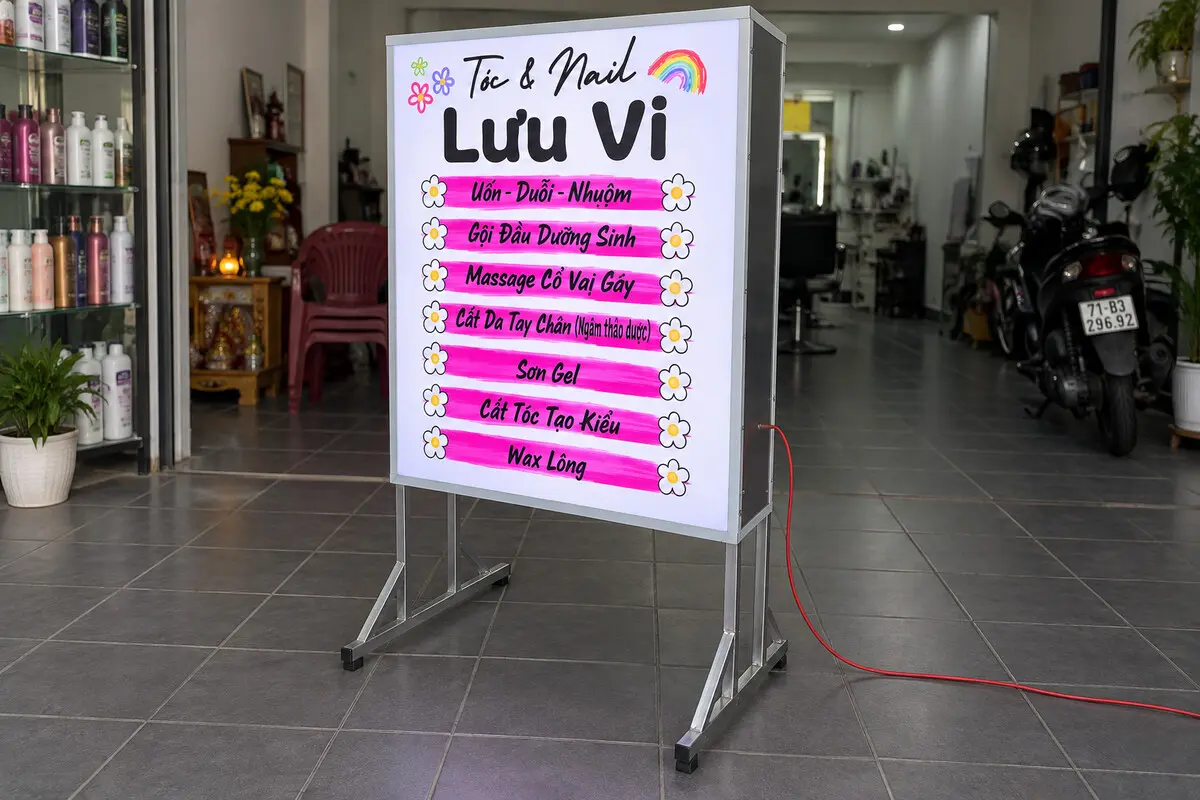
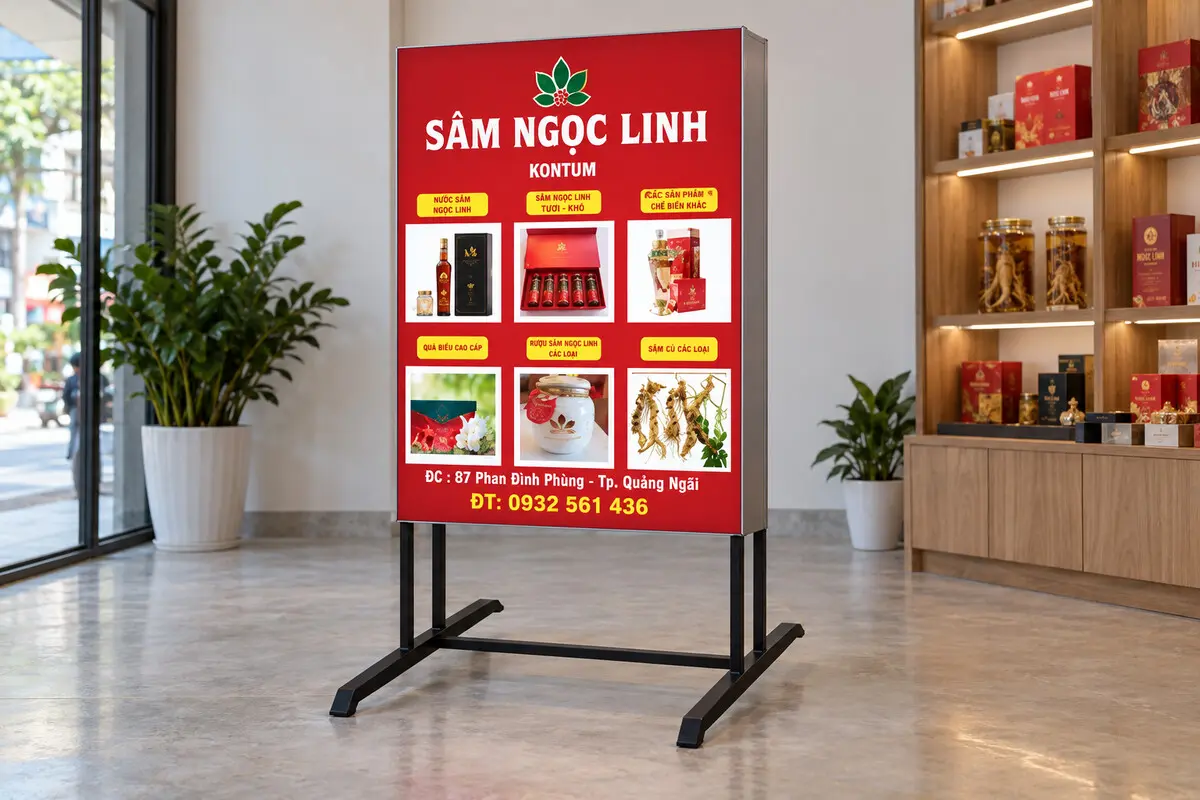
Retail shops – dietary supplements, cosmetics, local specialities: standees placed inside or in front of the shop, printed with flagship products. In brightly lit retail spaces, a light box still stands out more than regular display shelves.
Use and care
The LED wattage is low, so it does not noticeably affect the electricity bill. A few practical tips: run the cable along the wall or through trunking so customers do not trip; outdoors, cover the socket from driving rain and unplug when closing; and switch the lights off during the day – saving power and extending the life of the lights.
Need a quote or want to order a light box standee?
See the five size specifications and prices on the Backlit Banner Standee product page. Or message on Zalo / call 0866.511.099 — we will quote within 30 minutes during working hours. In Quảng Cáo Q7, 49 Mai Van Vinh, Tan Hung Ward, Ho Chi Minh City.
Related products

Standee

Backlit film

Light boxes

Hiflex
Choosing the background colour for backlit banner
This is the biggest difference when designing for backlit banner compared with regular prints. Light comes from behind and passes through, so the colours look completely different from what you see on screen.
| Base color | With the lights off | With the lights on | Recommended? |
|---|---|---|---|
| White | Clean, easy to look at | Glaring, text hard to read | Limit it, use only in small areas |
| Light yellow | Gentle | Vivid and harsh | Not recommended for large areas |
| Burgundy, deep brown | Slightly dark | Warm, clear, pleasant | Very suitable |
| Charcoal blue, moss green | Subdued | Deep, white text stands out | Very suitable |
| Jet black | Completely dark | Barely lights up | Use only as a border |
| Multi-colour gradients | Looks good on screen | Blotchy, loses detail | No |
An easy rule: a medium-dark background with light text is the safest for backlit banner. The lighter the background, the more glaring it is when lit, and text on top gets its strokes swallowed by the light.
A test before sending the file: open the file on your phone, turn the brightness up to maximum and look at it from two metres away. Whatever is still clearly readable in that state will be readable on backlit banner when lit.
Common mistakes when making light boxes
| Mistake | Consequence | How to avoid it |
|---|---|---|
| Using regular Hiflex banner instead of backlit banner | The banner face stays dark when the lights are on | Use only the type without a light-blocking layer |
| Designing large white background areas | Glaring, text hard to read | Switch to a medium-dark background |
| Thin-stroke text | The light swallows the strokes when lit | Use thick-stroke text |
| Measuring by the outer frame | Banner lacks margin, cannot be stretched | Measure the inner opening and add the margin |
| Stretching the banner too tight | Tears at the tension strip after a few months | Stretch moderately, leaving slight slack |
| Sealed box without moisture holes | Condensation inside clouds the banner face | Drill moisture drainage holes in the bottom |
| Power supply running close to capacity | Power supply gets hot and fails quickly | Choose a power supply with about 20% spare capacity |
As for choosing the wrong material, this is the costliest mistake because the whole face must be reprinted. When ordering, state clearly that the print will be fitted into a box with lights behind it, so we choose the right type from the start.
If you already have a frame from a previous batch, just send the inner opening size and we can print a new sheet. There is no need to bring the whole frame to the workshop.
Content layout on a backlit banner face
A lit sign in front of the door only has a few seconds to catch passers-by. The layout should follow a clear order of priority instead of spreading information evenly across the backlit banner face.
- One single message: the dish name, the offer or the shop name — choose one, do not cram in all three.
- The main line takes up one third of the height, readable from five metres away.
- Food photos should be real photos, taking up about half the area.
- Clearly stated prices: signs without prices are often ignored by passers-by.
- Leave a 30 mm safety margin around the edges because the tension strip covers part of the border.
- Avoid small details: patterns and secondary text fade when light passes through.
Shops that change content monthly should build a template file that keeps the same layout and background colour, changing only the text and dish photos each time. Regular customers used to that layout will recognise the shop from afar.
If the shop has several branches, print for all locations in one batch. The colours between backlit banner sheets will be consistent, and the price per sheet is also lower than ordering separately.
Lifespan and maintenance
The banner face is the consumable part; the frame and lights last for many years. Knowing the replacement cycle in advance helps you calculate the long-term cost correctly.
| Part | Typical lifespan | Signs that it needs replacing |
|---|---|---|
| Backlit banner face | 1 to 2 years outdoors | Faded, frayed edges, torn at the tension strip |
| LED strips | 3 years or more | A section goes dark or flickers |
| Power supply | 2 to 4 years | The sign flickers or does not light up |
| Powder-coated steel frame | Many years | Rust at the welds and frame feet |
| Tension strips | Many years | Broken joints, no longer holds the banner |
The simplest way to extend its life is to bring the sign in when closing and wipe the banner face weekly with a damp cloth. Street dust left for a long time dulls the face and weakens the light passing through.
When replacing the face, take a photo of the frame with a tape measure and save the measurements on your phone. Next time just send the old measurements and we will print the right size straight away.
See the finished product at Backlit Banner Standee, or compare with edge LED and lights inside the box. For other print face materials, see Backlit Film.
Choosing the size by location
Which size suits depends on the location and the distance of passers-by. The table below lists the most ordered specifications with usage situations.
| Specification | Suitable location | Recommended content |
|---|---|---|
| 60x80cm + base | Narrow pavement, next to the entrance | One dish with price |
| 60x120cm + base | Medium pavement, shop entrance | A combo or two dishes |
| 60x150cm + base | Wide shopfront, seen from afar | Shop name with flagship dish |
| 80x120cm + base | Busy food area, needs to stand out | Condensed menu |
| 80x150cm + base | Large shopfront, busy road | Large shop name |
| Custom size to fit an existing frame | Replacement face for an old light box | According to the new content |
A base height of about 25 cm keeps the bottom edge of the sign from being hidden by parked motorbikes. On pavements crowded with bikes, a slightly taller base is much more effective.
If people approach the shop from two directions, the best way is to place two signs at both ends instead of one sign in the middle. Each sign only needs one short message.
Quick Q&A when ordering
This section gathers the questions we receive most about lit signs using backlit banner.
- Do you accept an order for one set? Yes, from one set, with no minimum quantity.
- Can it be used outdoors? Yes, but it needs a canopy and a waterproof socket for the power supply.
- How long does replacing the banner face take? About fifteen to thirty minutes, removing the tension strip and stretching the new sheet.
- Can it be printed on both sides? Yes, and the two sides can have different content.
- How much electricity do the lights use? LED strips use little power; leaving them on all evening is negligible.
- Can an old frame still be used? Yes, just send the inner opening size to print a new sheet.
- How soon is it ready? 3 to 5 working days depending on size.
Former District 7, Nha Be, District 4 and District 8 get door-to-door delivery. Other districts of Ho Chi Minh City are delivered according to the day's vehicle schedule.
If you do not have a file yet, send your logo, dish photos and content via Zalo. The design team will lay it out at the exact size and send a preview; printing and installation start only after approval.
Who else uses them besides shops and eateries
Besides shops and eateries, lit signs using backlit banner are ordered for many other places. Below are the common customer groups.
| Where used | Purpose | Placement notes |
|---|---|---|
| Clinics, dentists | Service boards, working hours | In the lobby, away from the sun |
| Spas, hair salons | Price lists, service packages | Next to the glass door |
| Convenience stores | Weekly promotions | In front of the entrance |
| Pharmacies | Secondary signs, duty hours | On all night if open 24 hours |
| Language centres | Course start dates, offers | Placed in the ground floor lobby |
| Small showrooms | New models, installment programs | Place at the head of the main aisle |
What these groups have in common is needing a standing sign that stands out but without drilling walls or making a permanent signboard. A sign with a base meets both needs, and can be taken along when moving premises.
For rented premises, this is almost the only option that does not need the landlord's permission. When the lease ends, take it with you and lose nothing.
What the cost of a set includes
The cost of a set has four main parts. Understanding each item helps you compare quotes between suppliers properly.
- Powder-coated steel frame: the largest share, priced by size.
- LED lighting system and power supply: priced by the length of LED strip needed.
- Printed sides: priced per square metre; it is the only consumable part.
- Tension strips and accessories: priced per linear metre.
- Base stand: usually included in the set; tell us in advance if you need a different height.
- Delivery and installation: inner city by area, other provinces according to the bus company's price list.
Because the frame and lights make up most of the cost, later batches that only replace the print face are much cheaper than the initial set price. That is why it pays to invest in a good frame from the start.
If you order several sets at once for a chain of shops, the price per set drops noticeably because frame fabrication is done in batches. Combine them into one batch instead of ordering each location separately.
Summary of the points to remember
A summary of the points to remember about backlit banner, so you do not have to reread the whole article when reordering.
- Backlit banner has no light-blocking layer on the back, so light passes evenly across the face.
- Regular Hiflex banner has a light-blocking layer; fitted into a light box, it stays dark when lit.
- A medium-dark background with light text looks best on backlit banner.
- Only thick-stroke text keeps its sharpness when light passes through.
- Measure the inner opening of the frame and add the margin to get the right size of backlit banner sheet to print.
- The backlit banner face is the only consumable part; the frame and lights last for many years.
- Order one spare sheet from the first batch to replace it immediately when needed.
If you are not sure which type suits, message us on Zalo with a photo of where you plan to place it and tell us whether the sign has lights behind it. We will confirm whether backlit banner should be used before quoting.
Need printing or signage in Ho Chi Minh City?
In Quảng Cáo Q7 runs its own print workshop in Tân Hưng Ward (former District 7), Ho Chi Minh City, producing and installing signage, banners, window graphics, exhibition booths and event displays. Send us the size, material, quantity and a photo on WhatsApp and we will get back to you.

Phone: +84 866 511 099 · Also on WeChat
Workshop: 49 Mai Văn Vĩnh, Tân Hưng Ward, Ho Chi Minh City